Is that truth (‘every idea we have about truth and reality, is subjective to us.’) also subjective to us?
I think we use philosophy, with all its methods of reasoning, to get beyond our personal perspective into something which applies beyond ourselves.
But indeed philosophers tend to change their position before they
arrive at something solid.
But who said this? Did ‘the truth itself’ say it, or just some person whose personal truth this was?
Can we possibly know if there is a ‘the truth’ independently of perspective?
Or is perhaps ‘the’ truth something to do with that the truth is always perspectival?
I don’t know, I can’t know. I cant know if there is a non-perspectival truth.
Do you think there is? If so what would be its standard, its meaning?
Nietzsche calls nihilism: the highest values devaluing themselves.
Truth is one of those values.
Thus you get truth behaving like this: “nothing is absolutely true, not even that nothing is absolutely true.”
I agree with that, yes.
For something to be entirely unrelated to truth, it has to be perfectly meaningless, and does not carry the power of a lie.
But nihilism goes a bit deeper/stranger than ‘nothing is true’, as it says ‘nothing is true, not even that nothing is true’. What do you make of that? Where does that leave us?
Sure is. Even if its an objective statement, it was my subjective self that came up with it, and since we are not a hive mind, my truth and my ideas are my own.
Surely. Stretching, tearing, expanding our idea of the world is a key part of philosophy.
When a tree falls in the forest and nobody is around to hear it fall, does it make a sound?
But to put it simply: We do know that things can exist regardless of perspective.
If that were not the case, then we would not be able to discover new things since they could not exist.
Take outer space as an example. Seems like all those planets and stars out there didnt much care about whether or not they are observed or named.
So sure. We know a reality exists independent of us.
We also know that it does not care for our expectations or observations.
Science is playing catch up with it since it’s inception. Trying to figure out how it works.
But if you want to go all out: Who knows?
Could all of existence be a dream or simluation?
What if everything in existence including you and me came to be 12 seconds ago with all memories intact? Would we have any means of verifying that? Not really.
So technically if you want to push the boundaries, then you can be sure of nothing.
Precisely. We dont know what we dont know.
Thats why our idea of reality is subjective.
Whats the nature of existence as a whole and it’s meaning?
Now you see THAT is a question probably only a god could answer for you.
That question is on a scale that cant even be compared to things like “whats the meaning of life”.
All seeks equilibrium. In physics as well as in psychology.
Correct. We are not omniscient. Our truths will always only be guesswork.
Correct
The answer to that might be as simple as what i stated. That our truths are subjective, thus “technically” not true, or not “true true”.
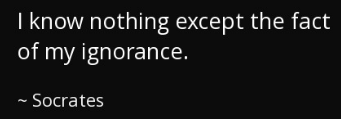
Or as Socrates said it:
The totality of our understanding peaks with the recognition that we will never know the full picture, because its an impossibility.
Knowing “The truth” would be omniscience.
It is to know all there is to know. Everything that exists, existed, will exist. Back in time, forward in time and outside of it as well.
Not only have we no means to know all, we are but meager sacks of flesh, with eyes that only see through the reflection of light and hear through the vibration of air. Our brains have an estimated 2.5 million gigabyte capacity for storing, converting and reforming information.
The idea that a human being could know “the truth” is an absurdity on not just a metaphysical level, but on a scientific and biological one as well.
There a few true nihilists, many find purpose in destruction of ideas/belief or seeking base pleasures…and the majority find purpose in claiming the futility of things.
A true nihilistic would understand that is futile to see the futility in things…there are few real nihilistics. The majority of nihilists are people who want an identity from a label.
No, there are true nihilists out there and they are the most dangerous kind of human being as they care about nothing beyond power or pleasure. They make constant sport out of the lives of others and see all others as purely a means to an end.
They find meaning in power and pleasure…that is not nihilism. Psychopathy, sociopathy, high degree narcissism…the list can go on, but it is not nihilism.
A true nihilist would see power and pleasure as futile.
There are true nihilists, but they are not as common as one thinks.
One reason fot the proliferation of nihilism is that much of modern philosophizing is based on Barroque rationalism. But Barroque philosophy operated taking Catholicism, or at least Christianity, for granted. So modern people only get half the soup, and it’s barren of profound meaning. Even Descartes, people too often forget that he held not only the self, but God, as the absolute certainties.
Subtract religion from Barroque rationalism, and you get a circular word game that amounts to nothing.
For those philosophers, what matters was very much the first question, and the answer was God. Subtract God, it appears as if they were asking what is true. But that is barren as a first question
There is a dissonance between understanding and practicing it.
You might as well say that true nihilists wouldnt mind their life ended, so why not just go ahead with it?
Because despite knowing and understanding that there is neither purpose nor any meaningful consequence of your actions, you still do not want to be frightened, you still do not want to suffer, feel pain, you still care about those who are close to you and dont want to go out of your way to hurt them.
So you can full well understand that your entire existence is completely free of consequence in the larger scheme of things and nothing you do will last or survive.
That does not mean that you gonna set yourself on fire upon the realization.
You are not describing a nihilist.
You are describing a calculating, high functioning sociopath which absolutely does not believe that everything is futile. They have goals, they want to achieve things, they use people as tools for their own benefit.
Power? Pleasure? Making sport out of other peoples lives?
A nihilist’s response to that would be: “What for?” “Whats the point of that?”
My own nihilism came to be and is the polar opposite of what you describe.
I became a nihilist once i realized that people can only save and absolve themselves and solve their own problems. Not eachother’s. I cant save anyone. I cant fix anything. I cant solve anything for anyone.
To truly solve a problem everyone needs to reach that point, conclusion and fix themselves, and there is no way around that. Every outside force even when its intended to be beneficial, will only shield from the consequences of not having yet solved the issue, and thus contribute to the exact opposite: To not solving the issue.
I am a nihilist because i wanted to help people. And then i realized that reality is not structured in a way that i ever could. My actions. My intent. My help. Do not matter and are in fact just counter productive.
Even though its all without a meaning and nothing will last, i saw value in bettering everything around myself. The happiness of all is my own benefit too in the end afterall. But sadly, thats not how any of this works.
Correct.
But with a purpose and goal.
Which runs contrary to what nihilism is.
You cant say “nothing matters” and then use that idea as leverage to motivate yourself into doing things. The f is that logic even
Your nihilism lasted only while you believed that nothing matters.
The moment you stepped out of that and said “so i can do whatever i want” you removed yourself from nihilism as quick as you stepped into it.
In any basic philosophical form of nihilism relativism is everywhere. Everything becomes relative to the point of being trivial, absurd, irrelevant, and meaningless.
Whether you agree with me or not on any of this is of little relevance to me.
Former and recovering existential nihilist over here. Beware of existential traps, pitfalls, and dead ends.
Travel that road of existential despair long enough before it consumes you whole and you’ll eventually know what I am talking about.
Stare into the abyss and void of nothingness long enough before it winks right back at you.
I work in absolutes.
I have designed myself a view of the world where i can hold any amount of truths even if they contradict each other, simply by putting each truth into it’s own framing.
My nihilism does not come from relativism.
Its coming from the factual reality of how life and the universe works.
Today you live, a hundred years from today even those who remembered you will be dead.
Today we build and tomorrow all of it might be snuffed out by a stray asteroid.
And on the off-chance that we somehow, for some reason last long enough: Not even the universe will last infinitely.
There is no relativism in the statement that “nothing ever lasts”.
I embrace all of them so i can see the patterns they work off of.
I know. Does it matter? It really doesnt.
If i want to do something with my life, i can at any given moment.
If my will for life comes through being delusional or denying the things i know and learned, then all i am doing is spitting myself in the face and living a lie. I am simply not going to do that.
My reason for existence is to see and to understand.
Pretending for the sake of bettering my life and expectations runs counter to that.
And this is not to say that you are doing anything wrong.
Everyone decides for themselves what they want to do with their life.
I picked my reasons a very long time ago.
Fair enough, but under the same mental realization on a long enough timeline of events there becomes no reason to do much of anything. If annihilation is the end result of everything then everything becomes a wasted effort. Everything becomes pointless and just an exchange of constant futility.
There is no life affirmation, only death and annihilation. You can see where this line of thinking plays havoc with human civilization.
I do have an interesting question though: Does it matter that everything is a wasted effort?
Forget about the end of the universe. An eternity before the universe or our sun would die, you know for a fact that you are going to die very soon.
In fact, your entire life is hardly anything more than the blink of an eye.
Technically, nearly everything you do is a wasted effort. Even things like passing off your genes to the next generation are just just attempts at consoling one’s self, suggesting “some” kind of continuity of your own remaining in the world even once you are goan.
And?
Do you stop breathing?
Do you stop going to the toilet?
Drinking and eating?
Going to work?
Talking to your loved ones?
I think that the futility of our existence is just part and parcel of life.
We face it, we take note of it, we nod and we move on.
Its entirely a personal choice to stop and give up. Would that change anything, about anything?
If you want to be technical about it, even giving up is meaningless.
The fact that its all wasted effort, that too means nothing.
So why would i go through the extra effort to make myself and those around me suffer a bit harder than i need to? Why would i try to end myself when my end is on it’s way anyway, and why would that matter?
Imo the totality of nihilism is when you realize that even futility is futile. So you might as well make the best of it. At the end of the day, the only value you can add to your life will be weighted in either tears or swears after it’s passing. And that too does not matter
Not all nihilists are the same, for every high functioning nihilist you have the nihilists that simply want to burn all of civilization down to the ground just to feel its warmth.
Although in my now older and wiser years I like to believe there is more to this existence than simply nothingness.
I dont really attribute that to nihilism. How should i put it… its more like every individual’s own reaction to it’s inevitable demise.
Kinda like how governments never talk to their population about global or wide spread catastrophes cause it would lead to panic, looting an destruction due to those specific type of individuals.
Dont know about that, but the saying goes that we are all a story being written. You might as well make it a good one even if nobody’s gonna read it.
“Anything. Anything but what you know. I don’t believe it if you already know it.”
(a grunge guy some dank night)
Thats a blessing.
What about logic, and mathematics, do you believe it is purely subjective? Like could you come up with something else that works just as efficiently not just for yourself but other people?
Do we?
we know “sound” is tied to “tree falling in forest” kind of definitionally.
Because sound is defined as airwaves.
But knowing this is perspectival.
Uh, I m trying not to get bogged down in meaninglessness.
It seems to me exist, you need to be a perspective, a selectiveness. I think we agree on this?
Ah, our own perspective, yes I see. Things can exist outside of that. Not maybe outside of perspective as such.
Of course die hard astralists will insist they only came into existence when people encountered them, which is nonsense but disprove it. Disprove it by physics, math of orbits, gravity.
Do you think this math is on some level subjective?
We can at best suspect that.
And changing parts of it in the process.
Only of “there is a questioning of existence (a questioning which what what “I” call “I” happens to call “I”), therefore something exists”.
Still I keep pusding for it. Do you think something like action = -reaction is subjective?
Yes, that seems fair.
Well no, I wouldn’t go as far as that. We can verify a lot of things so that they become at least relative certainties off of which we can base actions which get us to things which matter to us. Thats more than merely arbitrary random guessing.
That there is probably no absolute knowledge of absolute truth, doesn’t mean all is completely up for grabs by any given pirate-state-of-mind.
He did not quite put it that way though… I don’t remember the exact phrase exactly. But this is a paraphrase. And he really professed to know a very great deal. He’s not always totally honest.
What I know is absolutely true is that I have always loved frying steaks. For example. I know a lot of things are absolutely true, about myself. About my preferences, my loves, etcetera. Those are the areas where you want to be hunting for truth, as it’s seething with game.
But we can’t even now that, for certain.
Can we?
Can we make a solid argument for that?
Is ‘we are part of the whole and the part cant know the whole’ a full logical argument? I don’t think it is. Why cant the part know the whole? It seems completely inevitable but prove it.
And are we really only the part? Are we not the whole reflecting itself, as some people think?
I give it to you to disprove any of that.
This is what I find tricky - what ‘truth’ even means. People differ on that.
Does it mean all information? Or does it mean the most crucial part of all information that ties everything together?
If the latter, a person might just stumble on it.