

Film: A Few Good Men (1992), Columbia Pictures

Lt. Kaffee (Tom Cruise): I want the truth!

Col. Jessup (Jack Nicholson): YOU CAN’T HANDLE THE TRUTH!!!

As he sat among the ashes, his wife said to him,
“Still holding to your loyalty? Curse God, though you die for it!”
But he told her, “You are talking like an impious fool. Are we to take
good from God’s hand…and not evil too?”
In all this Job sinned not with his lips.
(Job 2: 9,10 James Moffatt Translation)
The reader is [b]invited to share a deductive logic leading to acceptance of the evidence provided by the natural world, which seems to reveal the TRUE nature of the Judeo-Christian God (if he exists).
An appeal to adult, mature, and courageous honesty follows the startling revelation in the previous article: Are We Ruled By An Evil God? that, in the absence of Type-3 Omnibenevolence, the Judeo-Christian God is necessarily an evil God (that is, if indeed God is free of malevolence, he is nevertheless “evil” in the sense that he is directly or indirectly harmful in what he decrees, allows—or uncontrollably produces. If evil exists because of what God decrees or allows, then God is evil (harmful) by reason of his failure or refusal to prevent the existence of evil from the start.
Facing up to the true nature of God entails requires knowledge (or at least knowledge of the possibility) of whether or not God possessed knowledge of the hypothetical subjective experience of created beings, in terms of their feelings toward their being forced to experience evil, pain, and death—and if God’s goodness claimed by the Bible stands, despite (seeming) failure of sufficient empathy and conscience to forebear the creation (or allowance) of evil.
Given the existence of natural and deliberate evil, it is obvious, in terms of human logic, that despite any “goodness” God possesses there (seems to) exists sufficient absence of empathy and conscience that negates or displaces the resolve to create a perfect, painless, and happy world.
One can argue that humans have every right to charge God with a moral flaw, as it is we who are “in the trenches”—held down under the machine gun fire of suffering, pain, and the trials and tribulations of the human condition:[/b]
Film: Lethal Weapon (1982), Warner Bros. Studios


McCleary the Suicidal Jumper: The only one hurt is ME…..ME!

`
Sgt. Martin Riggs (Mel Gibson): I know. I get it. You’re hurting.
[b]Once it is accepted (if it is true) that God lacks sufficient conscience to prevent the existence of evil from the beginning, one can move forward to deduce the psychological condition of a being that wants start off with an evil world in the creation of an all-good world.
-
If God’s (not complete) lack of sufficient empathy and conscience nevertheless co-exists with God’s intention to not allow evil to exist forever and:
-
If God’s (not complete) lack of empathy and conscience nevertheless co-exists with an absence of malice for malice’s sake toward his creations.
—It can be argued that God possesses a degree of moral obligation and empathy (if God is not omni-malevolent and “kidding around” with omnipotence) that motivates God to create an all-good world—and (for some reason) to choose to create this all-good world from one of two types of “the best of all possible evil worlds”:[/b]
1. World X: An evil world possessing the least amount of pain, in which conscious subjects only experience emotional but not physical pain (there are a small number of conscious beings in this world, outnumbered by billions of philosopher’s zombies or “bots”. Any physical “pain” seems to be “experienced” only by zombies, who inwardly possess no conscious experience (and thus do not experience pain or anything else).



(Figure 1: Inhabitants of World X experience only emotional pain. The third (airbrushed) individual above, if World X exists, is a philosopher’s zombie or “bot”—a functioning body and brain wholly bereft of consciousness (yet exhibiting behaviors indistinguishable from those of conscious beings, deceiving conscious beings into the belief that zombies have experiences)
The conscious inhabitants of World X do not know that they are surrounded by zombies, thus the minority of conscious beings erroneously believe that physical pain exists (although it mysteriously fails to affect them), with some forming nihilistic or cynical philosophies about the world that (unbeknownst to them) have no objective support, given that the pain spawning the philosophy does not exist.



2.World Y: An evil world supporting physical pain (as opposed to World X ), with pain maintained at minimal levels for non-sociopathic inhabitants (physical pain is brief and transitory; subjects do not suffer amputation or broken limbs; injuries do not exceed muscular injury; pain does not reach unbearable levels; all pain is non-fatal). Many non-sociopathic beings are partial zombies: they are transformed into zombies before suffering violent death (if violent death is a requirement of their predetermined fate). Sociopathic subjects of World Y do not enjoy mitigation of pain, and are thus vulnerable to unbearable pain and fatal injury. All other beings (i.e. aborted fetuses and animals) are zombies.


Every conscious subject (sociopathic and non-sociopathic) suffer psychosocial, environmental, and financial stress, but for non-sociopaths the conflicts are consistently resolved to one’s favor.
There hath no temptation taken you but such as is common to man: but God is faithful, who will not suffer you to be tempted above that ye are able; but will with the temptation also make a way to escape, that ye may be able to bear it.
(1 Corinthians 10:13 KJV)
World X and World Y are metaphysically and logically possible worlds, but there remains the possibility that Occam’s Razor holds sway: World X and World Y does not exist and the world that exists is, and has always been, World Z: an Evil world without zombies and the entire spectrum of physical and emotional pain (fatal/non-fatal;bearable/unbearable) is felt by sociopaths and non-sociopaths alike (good moral character in World Z does not protect one from suffering and death).





If World Z exists, then one of the following propositions are true:
1. God is omni-malevolent (the good, love, or happiness that exists in the world is only a deceptive “means to an end” toward neverending horror)
2. God is indifferent (unaware or aloof of human existence and suffering)
3. God does not exist
b World Z may imply that only natural laws and processes exist, giving rise to human existence, the human condition, and the future extinction of consciousness. Bertrand Russell describes the nature of our world in the absence of God:[/b]
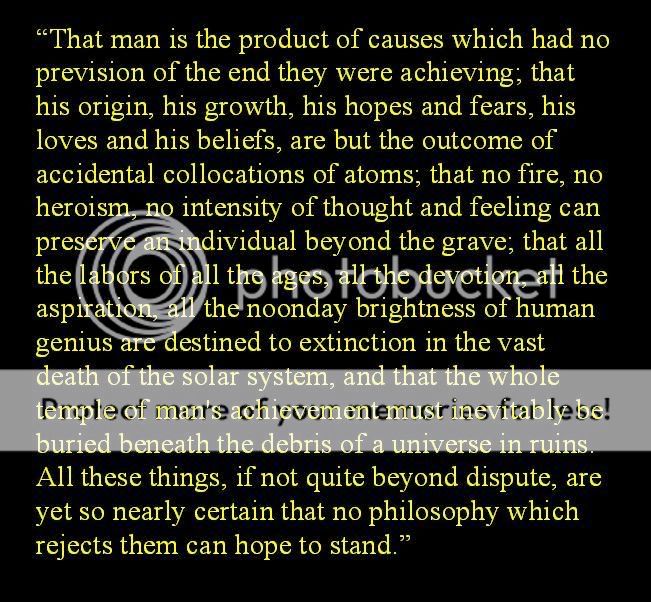
(Bertrand Russell: A Free Man’s Worship, published in Independent Review, 1903 (also included: Mysticism, Logic, and Other Essays, W. W. Norton and Company, - New York, 1929).

(Moore, Alan and Gibbons, Dave: The Watchmen, DC Comics 1986)
b World Z may be the product of beings who do not share God’s power(s) and/or God’s intention to create an all-good world. Such beings may be gods----or technologically advanced humans creating World Z for education, philosophy, or entertainment (Bostrom):[/b]
[b]The existence of unnecessary evil is one of the most powerful arguments against the belief that the world was created by an all-powerful, all-knowing, and perfectly good God. Theologians have spent centuries trying to answer it, and with very questionable success. But the problem of evil is only a problem if one assumes that the world was created by an omnipotent and perfectly good being. If one assumes instead that the creator was not perfectly good, and perhaps not even omnipotent, then it would be much easier to reconcile the view that our world was created with its seemingly obvious ethical shortcomings.
What about you? You’re not all-powerful, all-knowing, and perfectly good. But what if you had the ability to create this kind of Matrix, would you do it? Even if you would not have chosen to create a world like this, there are many other people who do not share your scruples. If these people had the ability to create Matrices, some of their works might well look like the world in which we find ourselves.[/b]
(Bostrom, Nick: Why Make a Matrix? And Why You Might Be In One, simulation-argument.com/matrix2.html)
4. World Z is created by a deus ex machina, a blindly operant universe-creating mechanism (either the quantum mechanism believed to currently be at work or an unknown process) that operates independent of God’s will and power (with God in existence) to automously produce humanity, consciousness, and the existence of evil.
[Important Note!: In an upcoming article, I hope to demonstrate that there is a “way out” for God in the form of a deus ex machina creating humanity and evil arising from processes in the mind of God—independent of God’s deliberate intention. The remainder of this article (written before the new idea), will ignore the notion of this “absolving” mechanism.]
[b]5. World Z is created by a God intending to create an all-good world from World Z, but is unwilling to spare his subjects even the worst pain. The failure of sufficient moral conscience to spare others evil, pain, and death indicates that a God that would go so far as to create World Z (as the starting point for an all-good world):
(5a.) Possesses such an alien perception of right and wrong that (following the conclusion of David Hume) the goodness and benevolence of God does not resemble goodness and benevolence as understood by human beings.
(5b.) There is no future all-good world, and World Z is a product of the cruel nature of an omni-malevolent God.[/b]
Choice Of Possible Worlds
Of the three worlds presented above, the existence of physical pain indicates that World X does not exist. The choice of possible worlds, then, narrows to World Y or World Z.
The True Moral Nature Of God Is A Big Deal If God Controls Human Will
The issue of God’s lack of empathy (if God indeed lacks empathy) has logical significance only if God is responsible for the existence of evil and rules through theonomous or theological determinism:
Theological determinism is the thesis that there is a God who determines all that humans will do, either by knowing their actions in advance, via some form of omniscience, or by decreeing their actions in advance. The problem of free will, in this context, is the problem of how our actions can be free, if there is a being who has determined them for us ahead of time.
(Wikipedia: Determinism, en.wikipedia.org/wiki/Determinism)
[b]God is omniscient, i.e. God knows everything (that is true) about the past, the present, and the future. In addition (it has been claimed), God has given human beings free will so that human beings can choose between good and evil.
But if God knows beforehand what you are going to choose, then you must choose what God knows you are going to choose. If you must choose what God knows you are going to choose, then you are not truly choosing; you may deliberate, but eventually you are going to choose exactly as God knew you would. There is only one possible upshot of your deliberating.
Thus if God has foreknowledge, then you do not have free will; or, equivalently, if you have free will, then God does not have foreknowledge.[/b]
(Norman Swartz: Lecture Notes On Free Will And Determinism sfu.ca/philosophy/swartz/fre … resumption)
If theological (theonomous) determinism is true, humans are but mechanical contraptions built from either quantum physicality or quantum mentality—with God (analogous to a novelist or comic book writer) possessing total control over the thoughts, feelings, choices and behaviors of his “quantum puppets”—even going so far as to contrive the very outrage of created beings over their existence in an evil world.
The Bible, believe it or not, implies theological determinism:
For none of us lives to himself alone and none of us dies to himself alone. If we live, we live to the Lord; and if we die, we die to the Lord. So, whether we live or die, we belong to the Lord.
(Romans 14: 6, 7 NIV)
A man’s steps are directed by the Lord. How then can anyone understand his own way?
(Proverbs 20:24 NIV)
The lot is cast into the lap, but it’s every decision is from the Lord.
(Proverbs 16:33 NIV)
[b]However, one can argue that human subjectivity is ultimately a thing-unto-itself (in the sense that human subjective experience is a separate entity from the subjectivity of God himself). Despite this, theonomous determinism holds that the evolving structure of subjective experience depends upon quantum assimilation by God (Acts 17:28). Humans, then, are mechanized God-ideas given external subjective manifestation.
(If God does not exist, a form of “theological determinism” remains, in the sense that human will and destiny is governed by the microscopic “gods” in the Standard Model of Physics: we are controlled by the ongoing dynamics of collocations of atoms (Russell).)
For the purposes of this article, the existence of God and theological determinism is a given .[/b]
In order to demonstrate the TRUE(?) moral nature of God in God’s decision to create an all-good world from an evil world, one can hypothetically roleplay—pretending that one is God speaking from God’s conceivable point of view during an imaginary therapy session with an imaginary psychiatrist. In this way, one can apply human logic to God’s motivations in the form of imaginary theraputic catharsis—with God on the psychiatric couch explaining his plans, goals, and possible culpability in the existence of evil. The hypothetical “breakthrough” comes in God’s acknowledgement or realization of the effect of his actions upon helpless and “existentially thrown” conscious beings.
Existential “Thrownness”
“How did I get into the world? Why was I not asked about it and why was I not informed of the rules and regulations but just thrust into the ranks as if I had been bought by a peddling shanghaier of human beings? How did I get involved in this big enterprise called actuality? Why should I be involved? Isn’t it a matter of choice? And if I am compelled to be involved, where is the manager? I have something to say about this. Is there no manager? To whom shall I make my complaint?”
Kierkegaard, Soren: Repetition in Kierkegaard’s Writings, vol. 6, Princeton University Press, 1983
"“Heidegger coined the term “thrownness” (also used by Sartre) to describe this idea that human beings are “thrown” into existence without having chosen it. Existentialists consider being thrown into existence as prior to, and the horizon or context of, any other thoughts or ideas that humans have or definitions of themselves that they create.”
(Wikipedia,: Existentialism, en.wikipedia.org/wiki/Existentialism)

The psychiatrist begins, inviting God to lay out his intentions toward the world, to state requirements for the success of his intentions, and to admit the consequences of his success for those forced to participate in the unfolding of this type of world:

Psychiatrist: You’re free to begin if you wish.
God: 1. I want to create an all-good world
-
But I wish to create an all-good world from an evil world.
-
I want to change the evil world appearing without consent in my mind into an all-good world.
-
I knew that I could, if I wished changed the evil world symbolically—creating only zombies that portray the imaginary beings indigenous to the evil world in my mind. As zombies are physically functioning bodies and brains without conscious experience, there would have been no true pain and suffering in the world beyond my mind. Pain and suffering would have been only conceptual entities.
-
I realized that a literal transformation of an evil world into a good world requires beings that subjectively experience pain, stress, fear, and death.
-
I realized that a literal transformation of an evil world into a good world requires deliberate imposition of pain, stress, fear, and death.
-
But why do I want to create an all-good world?
-
And why would I wish to create this all-good world from an evil world?
-
Why would I want other beings to experience pain and suffering, in order to create a literal evolution of evil into good?
-
Why should they suffer pain, fear, and death, or participate in a literal evolution of evil into good?
The psychiatrist invites God to indicate the accuracy of the psychiatrist’s rationale of God’s motivation behind the creation of an evil world.
Psychiatrist: Do you want others to subjectively experience pain for it’s own sake?
God: No.
Psychiatrist: Do you like inflicting pain on others?
God: No.
Psychiatrist : Then the existence of pain makes little sense. Is there something else going on? For example, do you inflict pain as the opposite and “before” state that sets up the experience of eventual relief of pain?
God : (after quiet deliberation) In a sense.
Psychiatrist: Do you do it to harvest philosophical and emotional intelligence in your subjects, arising from knowledge gained during a lifetime of painful experience? For the philosophical and emotional intelligence arising from comparison of a life of pain with experience of a world without pain?
God: That’s very good. You’re close, do you know that? (God suddenly grows silent, staring thoughtfully—but not angrily—at the psychiatrist. The psychiatrist shifts uneasily in his seat)
He nevertheless resolves to push the issue, laying out moral facts behind God’s decision to create an evil world regardless of mitigation of pain and zombification (if World Y exists). He skillfully edges toward prognosis of God’s true moral and psychological nature based upon the evidence:
Psychiatrist: As I see it, the very decision to create a subjectively experienced adaptation (despite remedy and future resolution) of the negative aspect of your mind is in itself “evil” (in the sense that this decision, despite the future good intended for your subjects, is harmful to and spelled ill for those forced from the very start to act in your omniscient “movie”).
Such harmfulness would exist even if you did nothing and allowed free will, your creations would still suffer harm in your decision to not prevent the existence of evil. Free will, presumably, does not necessarily exist with evil (i.e a universe containing a different paradigm of possible choices, independent of choices resulting in harm to oneself and others, could possibly have existed in lieu of the current world).
Psychiatrist: Further, any excuse that suffering somehow yields positive psychological and moral growth runs into the quicksand of your omniscience.. Being omniscient, you would know if there were ways an individual could gain wisdom and other psycho-emotional benefits without suffering.
Given this, and the bizarre nature of the very wish to start with a painful world in the derivation of a painless world, the emergent facts concerning (at least) your moral nature are:
-
Human beings are perceived as things upon which you can impose pain with little or no negative emotional consequence (at least there exists sufficient absence of conscience failing to move you to forego the existence of pain in the first place).
-
You did not forbear the imposition of pain out of respect for the Golden Rule.
Thus it is logical to conclude that you intend the following toward your subjects:
(a) “I want them to feel pain.” (if not, pain would not exist)
(b) “I want them to feel fear.” (if not, fear would not exist)
(c) “I want them to die.” (If not, death would not exist)
(d) “I want them to feel pain, fear, and I want them to die.”
God: Do I?
Psychiatrist: I don’t know. Perhaps not forever. But one may logically infer that such is the case, and I wouldn’t disagree. Thus it is quite easy to write the world off as a product of pure malevolence. But I find myself arrested by the notion of your desire and intention to create an “all-good world”. Does this indicate a degree of benevolence and moral obligation, or are you only “kidding around” with your creations? Could it be a case of robotic and pointless exercise of will, as if you decided to create an all-good world in the same way that one would say: “Suddenly, for absolutely no reason at all, I wish to run to my left”, before suddenly jaunting off to the left?
God: (Amused by the statement, smiles) You tell me. It seems as if you’re on to something.
Psychiatrist: To be fair, considering your conceivable point of view and your perspective while in the process of creating everyone and everything, I wonder: if humans are only compositions of physical and/or psychical Lego-blocks or jigsaw-puzzle-pieces, does a moral responsibility to these Lego-creations or jigsaw-puzzle portraits even exist? Is “moral obligation” itself merely an assumed or self-imposed construct at this level?
When you think about it, are these jigsaw-puzzle portraits or Lego-creations something to which the Golden Rule should apply? Aren’t they just “things” in the end? Given your collocational perception of others (a natural consequence of your responsibility for their existence), I empathize with your seeming emotional distance. But then again, there is the problem of omniscience—which demands the existence of knowledge of what things are like on the inside for the ‘little people’. Given this, it is not so easy to dismiss them out of hand as merely quantum jigsaw-puzzle pieces arranged in distinct, circumscribed forms.
It is just this knowledge, I contend, that generates or should generate a conscience and a sense of moral responsibility and obligation to one’s subjects, if one possesses a mind that experiences empathy and conscience.
God: Therein lies the rub, I suppose.
Psychiatrist: On a very positive note, the fact that you wish to create a good world indicates that, despite your lack of sufficient conscience to forgo evil altogether:
i. You desire a happy end for your subjects no matter what.
ii. You have no wish for evil to forever exist.
iii. You devised a way to, through shared positive and negative experience, reinterpret the intrinsic meaning of evil through Christ.
I suppose my question is: Why?
If we assume that you did not create an evil world out of malice, and that an all-good world is not simply a deception (it is not truly forthcoming) or, if it is created, only created for the purpose of maliciously pulling the rug out from under your subjects (in the creation of world worse than the first)—then the sticking point, I think, seems to lie in the question of what psychological condition or moral state generates absence of conscience that motivates one to force created beings to experience both a “bad” existence and a “good” existence, regardless of their hypothetical feelings on the matter if they had known beforehand…
To these you said (in a sense): “You’re going to go through this whether you like it or not!”
Psychiatrist: My prognosis:
You are a God suffering from Maleficent-Utilitarian Personality Disorder[b]. The hallmark of the disorder is a callous resolve to bring about what you perceive to be a “greater good” than the creation of a world without trouble from the very start. You sustain the belief that every aspect of your mind should have external manifestation and expression for the purpose of using “everything” in your mind as spare parts for an altered restoration of pre-evil existential conditions. You wish to bring about this restoration–with an audience to appreciate it (humans)—through a “rewrite” or “redefinition” of the evil in your pre-universe vision of possible worlds. This “changing the story to one that you can live with”, unfortunately, requires subjectively experiencing “hostages” forced to act out your “from-bad-to-good” Shakesperean tragicomedy.
Optimistically, the plan ultimately results (provided there exists no malicious ulterior motive or deception) in the end of pain, suffering, and death–in the form of a new universe programmed to maintain this “audience participation” version of previous pre-evil existence.[/b]

Dragonball Z (Episode 222): Final Atonement, 2003 Funimation Studios

Vegeta (to Piccolo): There’s one thing I’d like to know….tell me….will I meet that clown Kakarrot in the Otherworld?


Piccolo [Gravely responds]: I’m not going to lie to you Vegeta, although the answer may be difficult for you to hear…

Vegeta: [Squints. Tenses in anticipation (and dread) of Piccolo’s pronouncement of afterlife fate.]

Piccolo: This is the truth…

The TRUE moral nature of God (if God deliberately created a replica of the evil in his foreknowledge) entails Maleficent-Utilitarianism
util·i·tar·i·an·ism -ē-ə-ˌni-zəm\ n 1: a doctrine that the useful is the good
and that the determining consideration of right conduct should be the usefulness of its consequences;
specifically : a theory that the aim of action should be the largest possible balance of pleasure over
pain or the greatest happiness of the greatest number
The utilitarianism is a “goodness in the usefulness” of God’s creations “working” or “earning” an all-good world—rather than having it granted to them with a silver spoon from the start. Thus an evil, world, even a false evil world, is more “useful” or “practical” in God’s perception as if affords a rite of passage for his subjects that is deemed more meaningful and satisfying than simply granting them happiness from the start.
If God is indeed evolving into a Type-3 Omnibenevolent God, the utilitarianism is a fading aspect of Type-2 Omnibenevolence (see the ILP thread: Are We Ruled By An Evil God?). The severity of God’s utilitarian attitude is determined by whether or not the world in which we live is World Y or World Z. Beyond the utilitarian aspect of transforming a world “from bad to good”, it is proposed that God is “editing” the evil of pre-universe foreknowledge–“changing the story” so that it has a happy ending. The problem, however, lies in the use of his creations to play the parts of the “drug addict”, the “cancer patient”, or “the prostitute” to bring about cosmic moral evolution.



One could defend God, however, in the observation that there exists a natural callousness that the Creator should feel toward the created—due to the Creator’s remembrance of the material cause (Aristole) of one’s subjects: conscious beings are, in the end, created from material that just happened to be lying around for the Creator’s use. The Creator remembers that one’s creations were, not so long ago, merely “nuts, bolts, and scrap metal” lying about the cosmic workshop:
For he knoweth our frame; he remembereth that we are dust.
(Psalm 103:14 KJV)
If God created humans (and the world) from quantum physicality (if the physical exists) or quantum mentality (if the physical does not exist), then in the same way that a computer-generating cartoon technician remembers that his or her characters are “nothing but” pixels, (pixelated computer compositions behaving as conscious beings), God remembers, so to speak, every “pixel” making up the entire simulation of human existence (…“he remembeth that we are dust”).




The maleficent callousness of God, then, is analogous to the maleficent callousness of fiction writers in their creation of characters that the writer wishes to “experience” pain, suffering, and even death during the course of a novel or film. The character’s misfortune is called for as a feature of the storyline or plot.


The death of McCloud’s mentor and friend Ramirez (Sean Connery) at the hands of the Kurgan (Clancy Brown) in the film: Highlander (1986)
But God differs from human writers: God’s omniscience grants him intuition that the physical or psychical pixels arranged into seemingly conscious shapes do not form philosopher’s zombies, but beings possessing very real, personal, and meaningful experience (regardless of pixelation). As stated before, it is this realization, and how the creator behaves toward the created in light of this realization, that reveals the Creator’s moral nature.
He humbled you, causing you to hunger and then feeding you with manna, which neither you nor your fathers had known, to teach you that man does not live on bread alone but on every word that comes from the mouth of the LORD.
(Deuteronomy 8:3 New International Version)
[b]Regardless of whether or not humans would hypothetically wish for such a fate before the fact, humans are nevertheless forced to have wisdom concerning their role in God’s mind, through their forced portrayal of the goings-on within that mind. At the end of the day, the Judeo-Christian God is the conduit of Existence: an anthropomorphic psychic universe in which the typical collocations generally believed to take place in a godless universe are mentally realized before their physical fact (if the physical exists).
The negative aspect of the mind of God (manifest in humans, who are the primary source and recipients of evil), however, is infused with and redefined by the mind of Christ. This infusion redefines the nature of evil and “calls things that are not as though they were”—turning the entire gambling table of sin, guilt, wrath, and blame on its head—as one interlocking his actions and life with Christ Jesus (or having his actions and life interlocked with Christ) “dies” in the sense that the individual is no longer a person-in-itself.[/b]
I have been crucified with Christ and I no longer live, but Christ lives in me. The life I live in the body, I live by faith in the Son of God (faith that my actions are and my mind is ultimately the actions and secondary mentality of Christ (wearing my form) in his mind while dying on the cross), who loved me and gave himself for me.
(Galatians 2:20 NIV)
When you were dead in your sins and in the uncircumcision of your sinful nature, God made you alive with Christ.
(Colossians 2:13 NIV)
Christ redeemed us from the curse of the law by becoming a curse for us…
(Galatians 3:13 NIV)
It is only in respect to Christ that the maleficent utilitarianism of God is rendered moot, as the merger between non-Christ creations and Christ himself is the ultimate goal of God’s utilitarianism. While one is “in Christ”, God becomes predictable and reliable, such that human beings possessing God-imposed experiential union with Christ enjoy predictabile and reliable favor from God (interspersed with negative World Y experience).
CONCLUSION
The Will Of God: An Aspect Of The Absurdity Of Existence
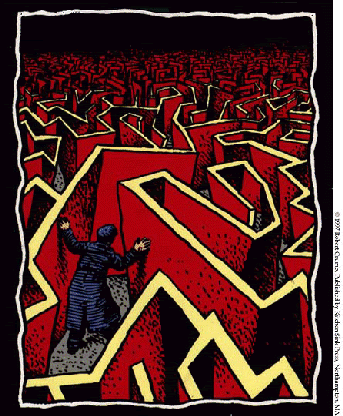
[b]Ultimately, the nature of the world in theonomy, and the human condition itself, reduces to goal-directed will and the inherent absurdism in the goal-directed wills of God and man. The creation of any world, fictional or actual, is the product of absurd goal-directionl. At the end of the day, a fiction writer wishes to produce a fictional work simply because he or she wishes to do so. Perhaps there are secondary motivations such as entertainment or education, but at bottom the creation of a fictional world is an absurd exercise of will.
In a theonomous world, God’s reasons for the creation of the world reduces to absurd goal-directed will:[/b]
WILLING
The capacity to will is as central a feature of existential views as are freedom and responsibility. Yet, despite its centrality, will is difficult to define unambiguously. Will is used psychologically in at least two senses. First, there is will as in willpower: the will of gritted teeth, clenched jaw, and tensed muscle. This is exhortative will. It can be useful at times, as when we force ourselves to work when we would rather play.
A second and more significant kind of will is associated with future goals. It is called goal-directed will. Much as memory is the organ of the past, goal-directed will has been called “the organ of the future” (Arendt, 1978). It is quite different from exhortative will, for it develops out of hope, expectation, and competence. Unlike exhortative will, it is not urged upon us but is rather a freely chosen arousal in the service of a future that is willingly embraced. This kind of will cannot be created: it can only be unleashed or disinhibited.
(Seligman, Martin E.P. and Rosenhan, David L: Abnormal Psychology (pg.91), Second Edition, W.W. Norton & Company New York London 1989, 1984)]
Absurdism
ab·surd·ism \əb-ˈsər-ˌdi-zəm, -ˈzər-\ noun
(1946)
:a philosophy based on the belief that the uni-
verse is irrational and meaningless and that the
search for order brings the individual into con-
flict with the universe
(Merriam-Webster’s Dictionary, Tenth Collegiate Edition Reader’s Digest Association, Inc.
New York 1998)
The Absurd
The notion of the Absurd contains the idea that there is no meaning to be found in the world beyond what meaning we give to it. This meaninglessness also encompasses the amorality or “unfairness” of the world. This contrasts with “karmic” ways of thinking in which “bad things don’t happen to good people”; to the world, metaphorically speaking, there is no such thing as a good person or a bad thing; what happens happens, and it may just as well happen to a good person as to a bad person.
This contrasts our daily experience where most things appear to us as meaningful, and where good people do indeed, on occasion, receive some sort of “reward” for their goodness. Most existentialist thinkers, however, will maintain that this is not a necessary feature of the world, and that it definitely isn’t a property of the world in-itself. Because of the world’s absurdity, at any point in time, anything can happen to anyone, and a tragic event could plummet someone into direct confrontation with the Absurd.

Lieutenant Dan (Gary Sinise), facing an uncertain future as a Vietnam War veteran and amputee, comes face to face with Absurdism at the stroke of midnight during a New Years Eve party in the film: Forrest Gump (1994)
The notion of the absurd has been prominent in literature throughout history. Franz Kafka, Fyodor Dostoevsky and many of the literary works of Jean-Paul Sartre contain descriptions of people who encounter the absurdity of the world. Arguably, the most extensive existentialist study of “the absurd” was done by Albert Camus in his classic essay The Myth of Sisyphus.
(Wikipedia: Existentialism, en.wikipedia.org/wiki/Existentialism)
Existence by it’s very nature is absurd in the sense that there is no reason or meaning behind the existence of something save the fact that it exists. This is the rock bottom of reductive explanation. Emerging from this background meaninglessness is constructed meaning, when a conscious being assigns psychological meaning to the inherently meaningless.
Relationship between Existentialism, Absurdism, and Nihilism In Opinions Concerning The Existence Of Meaning
1. There is inherent meaning in the universe (either intrinsic or from God)
Atheistic existentialism
No
Theistic existentialism
Maybe, but humans must have faith to believe there is
Absurdism
Maybe, but humans can never know it
Nihilism
No
2. Individuals can create meaning in life themselves
Atheistic existentialism
Yes, it is essential that they do
Theistic existentialism
Yes, it is essential that they do
Absurdism
Yes, but it is not essential
Nihilism
No, because there is no such meaning to create
3. The pursuit for intrinsic or extrinsic meaning in the universe is a futile gesture
Atheistic existentialism
Yes, and the pursuit itself is meaningless
Theistic existentialism
No, and the pursuit itself may have meaning
Absurdism
Yes, but the pursuit itself may have meaning
Nihilism
Yes, and the pursuit itself is meaningless
4. The pursuit for constructed meaning is a futile gesture
Atheistic existentialism
No, thus the goal of existentialism
Theistic existentialism
No, thus the goal of existentialism
Absurdism
Maybe
Nihilism
Yes
Theological Absurdism
[b]If God exists and wishes to create an all-good world from an evil world, the desire itself is fundamentally absurd. It is nothing more, in the end, than a product of natural selection of a particular actuality over potentiality. Before the world existed, any rationale for it’s creation is ultimately a product of the Creator providing itself with reasons for creating a world. Perception and reason are themselves products of the Absurd, themselves naturally selected winners of actuality over potentiality. The absurdity of the very wish to create a world lies in the fact that in the end the wish simply happened to exist, for better or for worse. It came to be in lieu of the decision not to create a world.
“Meaning”, in the end, seems to require the existence of consciousness. Would “meaning” exist if consciousness did not? The charge of Absurdism is that meaning is constructed rather than intrinsic; it must be given to a fundamental meaninglessness. For those who believe in God, this implies that there is, at bottom, a fundamental theological absurdism, wherein even the constructed meaning ascribed to existence by God is nothing more than a conscious being’s “meaning” given to a meaninglessness. Whatever meaning God gives to existence, this ‘meaning’ is only another aspect of “that which exists for no other reason than that it happens to exist”, and “that which exists in lieu of that which might have existed in it’s place”. Behind every will and decision of God lies the outer void of the Absurd.
Maleficent-Utilitarian Personality Disorder, then, also emerges from this fundamental absurdity, and despite its indefensible nature is a necessary ingredient in a literal (rather than symbolic or imaginary) transformation of an evil world into an all-good world.[/b]
The Cure For Maleficent-Utilitarian Personality Disorder
“It is YOU who are the Master here, ,
for it is by YOUR will these things occur…”------
In the end, if God is predictable and reliable toward Christ (whose encounter with God’s utilitarianism is deliberately quarantined to thirty-three human years and sacrifice on the cross), this reliability is an indication that the negative aspect of God’s mind is limited (in the sense that through Christ there is a limit to God’s capacity to harm).
Since we have now been justified by his blood, how much more shall we be saved from God’s wrath through him!
(Romans 5:9 NIV)
Thus, evolution of God into Type-3 Omnibenevolence may occur through universal identification (of created beings) with Christ. It may be that the cure for God’s harmful perception that the most good and useful end is through the creation of “positive results from suffering”—and God’s forced “positive spin” of the nihilistic aspect of his foreknowledge—is achieved through identification of the “hostages” with the “Son that he loves”—which weakens the callousness of God to the point of nonexistence. It is identification and union with Christ, then, that precipitates extinction of God’s hostility toward man (and vice versa).
[b]For he himself is our peace, who has made the two one and has destroyed the barrier, the dividing wall of hostility, by abolishing in his flesh the law with its commandments and regulations.
His purpose was to create in himself one new man out of the two, thus making peace, and in this one body to reconcile both of them to God through the cross, by which he put to death their hostility.[/b]
(Ephesians 2: 14-16 NIV)
Summary
[b]The existence of natural and deliberate evil, reveals that either God does not exist, or that God is less than truly omnibenevolent (as true omnibenevolence cannot tolerate the existence of evil). Unless there is a fact of existence in which God is somehow not directly responsible for evil—the obvious conclusion follows that God is necessarily evil.
But, one can propose that God is not evil in the sense of predatory malevolence, but in a maleficence (harmfulness) in which his perception of “the greater good” involves providing closure to the negative aspect of his omniscient mind, which in turn involves “hostages” forced to subjectively experience this closure. This harmful “goodness” is deactivated or rendered moot through union of the “hostages” with Christ.[/b]
END


](https://www.ilovephilosophy.com/uploads/default/original/2X/7/7c349bf1053f368a5729d053e1e91215f22ce66c.gif "Brick wall")


