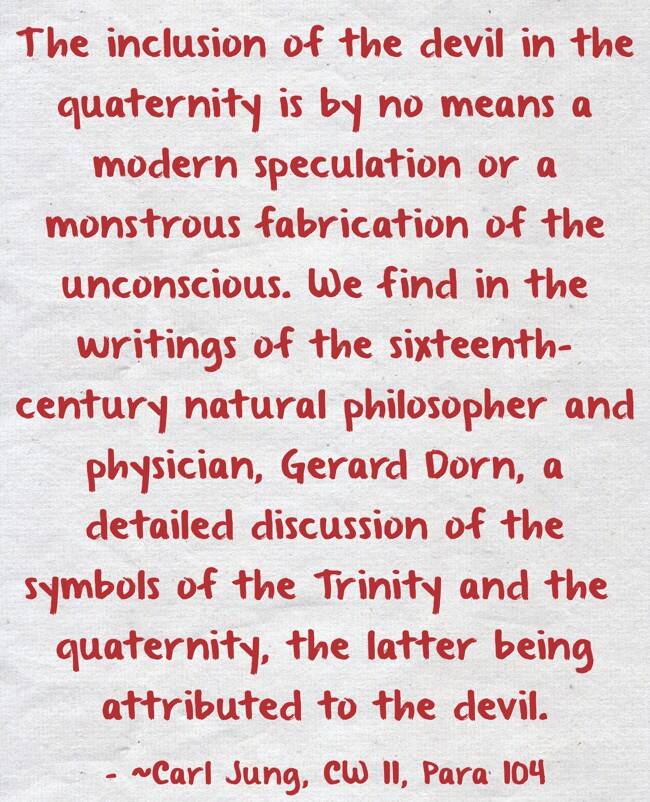
Just FYI… I dunno ANYthing about this:
indicative △ imperative △ subjunctive
Just FYI… I dunno ANYthing about this:
indicative △ imperative △ subjunctive
You’re “sure” about many things…
This is just a different formulation of your earlier one:
As such, it still doesn’t address the issue under discussion:
In other words, what could there possibly be besides everything binary and everything non-binary? Or besides something and everything else—including nothing—? Or besides all that is A and all that is not A?
True the the quadernity has deeper implications than standard notions of Jungian consciousness theories.
You don’t include privation in the triads.
Development is towards something (becoming).
Privation is away from something (divergence).
The created triad starts out with capacity, not absolute emptiness—an impossibility (there are three impossibilities… are you asking for those?).
The uncreated is always full and draws out our capacity (as we draw from their fullness) in mutual consent/recognition.
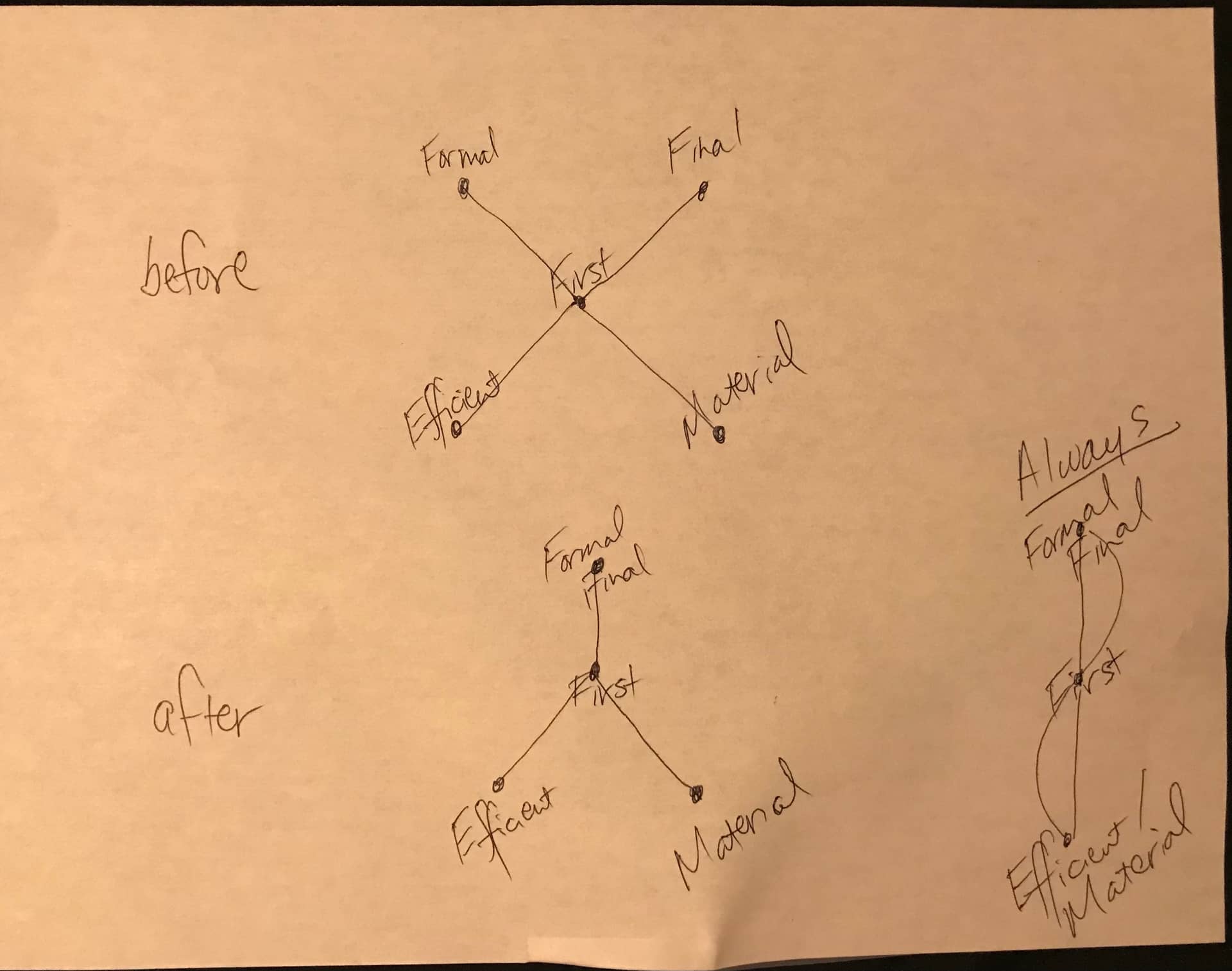
I see your four and I “raise” you one (it isn’t a raise) from September 2022 or thereabouts:
It says “efficient” but the way Aristotle put it is “moving” apparently.
This spoiler alert is thousands of years old. It’s like it’s timeless, really.
So you’ll agree there is no answer to this?:
development, towards something (becoming) △ privation, away from something (divergence) △ ________
In that case, it does not require an uncreated triad. So why postulate one?
Sure, you can conflate any two items of any quaternity so as to make it a trinity… But why stop there, then? Why not conflate the other two as well and make it a duality?
To be sure, though, identifying the formal and the final cause can make sense. But the same goes for the efficient and the material cause. And what is “first cause” doing in the middle there? That’s not from Aristotle; in Aristotle, the “first cause” is the final cause: the unmoved mover, who moves by attracting…
The modern philosophers, starting with the earliest, then rejected Aristotle’s formal/final cause and founded modern science on the material/efficient cause alone—although, as the late modern or postmodern Nietzsche suggested, it remains to be seen if human psychology can ever do without the formal/final; whether that is not really the root of the material/efficient…
This is actually supported by what you point out: the final cause is the— unmoved—moving cause…
Development towards… is triadic… and impossible without a final end.
…as is privation/divergence away.
The uncreated is the fullness without which capacity makes zero sense & 100% nonsense/absurdity. Those who see capacity without postulating full development have blind spots.
I was thinking earlier how if action was not drawn by final fullness & had zero finality/fullness, it wouldn’t move. If being did not contain formal capacity, it wouldn’t hold together. Nothing moving is nothing being, and vice versa. Formal/final is not a conflation, though — a plan is a plan, man… God’s never needs updating (no plan B) — they’re omnipresent spatiotemporally. We are in the middle, so we perceive the artifact of what is behind and the seed of what is ahead. They see all because they are in all, and all is of them. Conflating the other two does make a duality — a black hole. That’s the wonky line on the right… if you remove first, final, formal. Of course… it can’t “exist” on its own. It is still within triune reality. (pulled this last part outta m’arse, take it with… um, maybe don’t take it). But anyway, the wonky line was supposed to represent uncreated triad that is always full/omnipresent. Prolly better/no way to do that.
First is the whole thing. The unity. Wasn’t sure how to do that without just making the whole thing darker.
I think you mean formal in being/material cause and final in moving/efficient cause, not first (or first in both/all), but I’ve been wrong before. The capacity is formal drawn by (hungering for) final completion/fullness. All that is first/always. Show me what Aristotle said that differs…and why it is more helpful than how I am putting it. Always willing to learn.
And… what about first? hehe snort. Anyway. That’s actually not science’s beginnings. Trying to make it all about stuff that moves without mind has resulted in seriously absurd conclusions that are easier to accept (for some) than recognizing the personhood of others (in the image of original personhood). Folks just trying to make ends meet and never exposed to a single deep thought got excuses — philosophers who would analyze the origins of fire while charring your hamburger … not so much.
I must admit I didn’t really look at that doodle in the corner; I thought you’d scratched it out, but apparently that’s some kind of sine wave? And yeah, that’s precisely what I meant, identifying formal with final and material with efficient causes. I first seem to have made those identifications on March 1, 2018; when did you?
I thought “before” meant what Aristotle taught and “after” meant what you made of his teaching. And I don’t care what you actually meant.
If we ignore your addition of a “first cause” and that sine wave, the “before” and “always” pictures may be ascribed to Aristotle. The “after” picture, however, may not in any case.
That’s a mere or mad assertion. “…as is privation/divergence away.”
If you say so…
You were thinking that? Then it must be true.
And “matter” is energy… So formal/final is a conflation if you arbitrarily stop there and don’t do the same for material/efficient.
No, look. In Aristotle, unlike in Christianity and the like, there is no first cause in the sense of an eternal Creator before the beginning of the temporal (the “Creation”); there is the eternal movement of everything except the unmoved mover, which latter moves the former by attracting it by its thought-thinking-itself.
The final and formal causes coincide because the final cause is the Platonic Form (eidos) or Idea (idea). And the material and efficient causes coincide because an efficient cause, a sculptor for example, is a physical being… The forms or ideas really only exist in the minds of living beings (compare Buddhism’s namarupa).
The existence of a hunger does not guarantee the existence of the object of the hunger, though…
…you can go ahead and take full credit for that one.  Sometimes being the origin of something isn’t the awesomest thing ever.
Well I don’t care that it meant before you see formal=final, versus after you see it.
Well, I guess we’ll just have to take your word for it, then.
I abducted (back to) the best explanation. I’m not comfortable with absurdity. Gosh, I wonder why that might be?
Descartes says, “Even though I burn this mother down, I burn, therefore I am.”
You:
Oh, now you’re validating the sine wave? Make up your mind!
The forms or ideas are the shape of the perfect mind(s). Spoiler alert? It’s just like the golden rule (correctly represented) describes (represents) the perfect. We can either align with it or diverge from it—reconciliation is part of the shape of the forms.
Not familiar… feel free to discuss as briefly and relevantly as possible.
It is a wonder we aren’t all dead… and how we even got off the ground (seeing as we’re all hungry rockets consuming rocket fuel).
So what does the “always” mean?
No, I’m not validating that. I don’t even know why you drew it. What I’m validating is the “always” picture without the “first” and the sine wave.
Yes, that pretty much what Picht says:
“‘In order that there might be any degree of consciousness in the world, an unreal world of error had to—emerge: beings with the belief in persisting things, in individuals etc.’ (V 2, 11 [162]). What is called the unreal world of error here? Nietzsche’s answer reads: ‘beings with the belief in persisting things, in individuals etc.’ On a cursory reading, one might think that what is unreal about this world of error be only the belief of the beings that populate it. But the beings are actually themselves that in which they believe, namely individuals, more precisely put: that which they call their Being organizes itself through their will to be individuals. Life means self-assertion; life rests on the delusion that there were a self-identical self, which can persevere through time, which can hold its own. Greek ontology calls that which perseveres as something identical through the changes of an organic being its εἶδος, its form. This form is never purely realized. It never comes into full presence. But all the phases in the development of a living being may be designated as becoming or perishing, that is to say as degrees of approximating or moving away from the realization of the form. Therefore the form has the character of the τέλος—the goal immanent in each living being. Greek ontology designates the self-identical τέλος as the true Being of each thing that moves. The designation of the τέλος as the Being of entities suggests itself strongly when one considers that becoming, that is, the transition into Being, is a process of approximating the immanent τέλος, and that perishing, conversely, is a process of moving away from the immanent τέλος." (Georg Picht, Nietzsche, pp. 250-51, my translation.)
But then he immediately continues as follows:
“But with the decline and eventual fall of metaphysics, the possibility of designating a non-sensual, never given being as the true Being of the temporal vanishes as well. If the τέλος has no Being, then the only remaining alternative is to interpret it as a Non-Being that presents itself as a Being, that is, to interpret it as show [Schein]. Now it remains true, however, that all life is only made possible by the fact that a being organizes itself in the striving after such a unity. One cannot say that the τέλος were a man-made fiction. Every living being is in actual fact oriented towards an organizing unity. Thus the show of the τέλος is a show brought forth by nature itself. Show, or, as Nietzsche also puts it: error, is the condition of the possibility of life. The unreal world of error is thus no man-made fiction but the real world of living beings. All living beings whatsoever exist only through the belief in persisting things, that is to say through their striving after the organizing unity of the τέλος. But that after which they strive never has a Being. Thus they exist only by virtue of error.”
It doesn’t mean it rules out experience. And it doesn’t mean it happens before the beginning.
It means already always or always already. They don’t have to look ahead, and they don’t have to look back.
You have given me chunks of quotes from someone I have never heard of about someone I have zero respect for. I’m sorry, but I have no motivation to read it. Time is precious.
But I’m talking to you, right? Give me your thoughts.
In words I can read, Emoticonman.
Every moment is first, last, and always to the one present in every one of them (already… always). The old/new.
Without temporality, omnitemporality is meaningless, and vice versa.
Nuther clue. 15 characters