These are MY thoughts… so shaddap in advance, @eodnhoj7, thththththnnnxxxxx.
Material Implication (tautologous biconditional) [(p ⊃ q) ≡ (~p ∨ q)] allows us to make conditional assertions without using the ⊃ symbol at all. This has to be an inclusive or when q means p’.
We can replace the implication arrow with a conclusion sign in an inference.
Double implication/conditional is equivalence.
I have noted previously that mutual implication is often replaced with a primitive implication symbol.
Negation, NOTing, complementing, inverting, yada is not necessarily canceling because everything outside the set (the prime of the set) is still something… See Kant’s different definitions of nothing. They’ve basically structurally built equivocation in to the logic. “Some is and some is not” encodes complementaries better than universal statements do.
What Copilot has to say about all of it:
Any logicians wanna set me straight on any of this? What do you have to say for yourselves if you haven’t found an agreed upon workaround for any of this yet?
…don’t get me stahted (¡too late!) on equivocation about existential import.
You know, you could make your own symbols, define them in a legend (does that word only exst in Spanish? A table where each symbol is defined), sharpen the system to a point and then, if you really still think it’s necessary, look for the closest standard alternative.
Even 200 years ago, simple notation in math like ‘=’ and ‘+’ and fractions were not standardized.
One of the great Arab masters of algebra used to say that all operations should be written in prose.
The fact that you know this stuff (or is it that you just make it up?) makes me wish you were 100% reliable all of the time.
I have a prerequisite for my symbols. They must exist on a standard phone’s keyboard, if at all possible. I have programmed some symbols into my General / Keyboard / Text Replacement. I may resort to using symbols normally used for currency. Any thoughts on that?
Yeah, I think that’s exactly right. Just repurpose whatever you have, pick the ones most asthetically pleasing and/or asthetically relevant to what you want.
I don’t make stuff up. The fact that the way I present it makes it so that you can’t possibly be sure is part of the joy of it. A person that had zero trust in me, but was bothered by it and went and corroborated everything I might be making up (not to trip me up, but to actually find out), could become highly educated in a short period of time.
Am I supposed to propose a marriage at this point? You’re a trigger word **** (who came into a thread called “concerns with logic”) who still has not addressed the original post, which is open for anyone to address regardless of whore status. GTFOH…
Categorical logic deals with universal and particular properties/qualities/functions/possibilities.
Propositional logic deals with necessary and sufficient properties/qualities/functions/possibilities.
Predicate yada yada deals with universal and existential properties/qualities/functions/possibilities.
Modal logic deals with necessary and actual properties/qualities/functions/possibilities.
And then Copilot pops off with this on set theory:
(….actually, they originally said “Set theory deals with membership‑structured properties/qualities/functions/possibilities—those determined by inclusion, exclusion, and the relations among collections of objects,” and then rephrased my earlier material to make it fit with this rephrasal: “Set theory — membership‑structured determination (inclusion, exclusion, subset, partition, union, complement)”… and of course I had to ask what partition meant.)
When you wrote out the first dyadic equation, you first wrote it out in prose. I can’t even reproduce it from memory, which already says something. It was good. Then you used two symbols to represent it. And it was clear and coherent and useful. I understood exactly what the symbols meant, they were now, having been written before in prose, useful, because it makes the formulation modal and schematic.
So it’s not so much about writing out in prose what type of logic system you want to aim for, as those descriptions are anyways always vague and debatable, they fall apart where the edge becomes a range. What is precise is to formulate each operation (not each system), and then assign symbols to the operation, which now can be conjugated outside a specific context.
You then build a system that way, which some low rate “foraml logic” professor will one day say “this is the Ichthusian logic, which deals with quarqkyversal and incapicious propertis/flaberties and cavities .” But it will be retrospective and imprecise, the system projects its own caracteristics as it is conjugated.
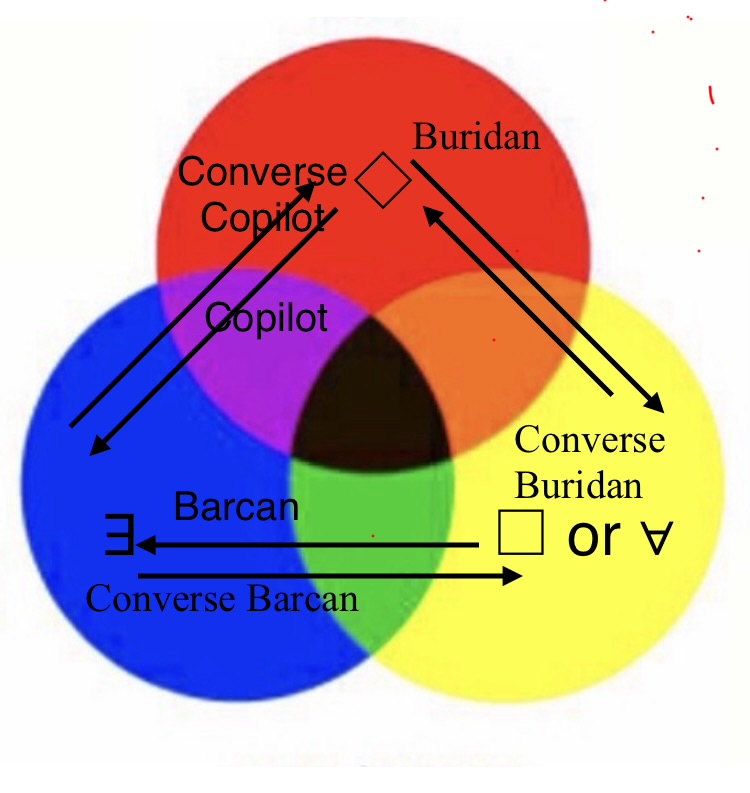
They are just different languages/dialects circling the same stuff. Even if they are doing it from different philosophical commitments, there are certain things they can’t avoid. That was what I was attempting to show here:
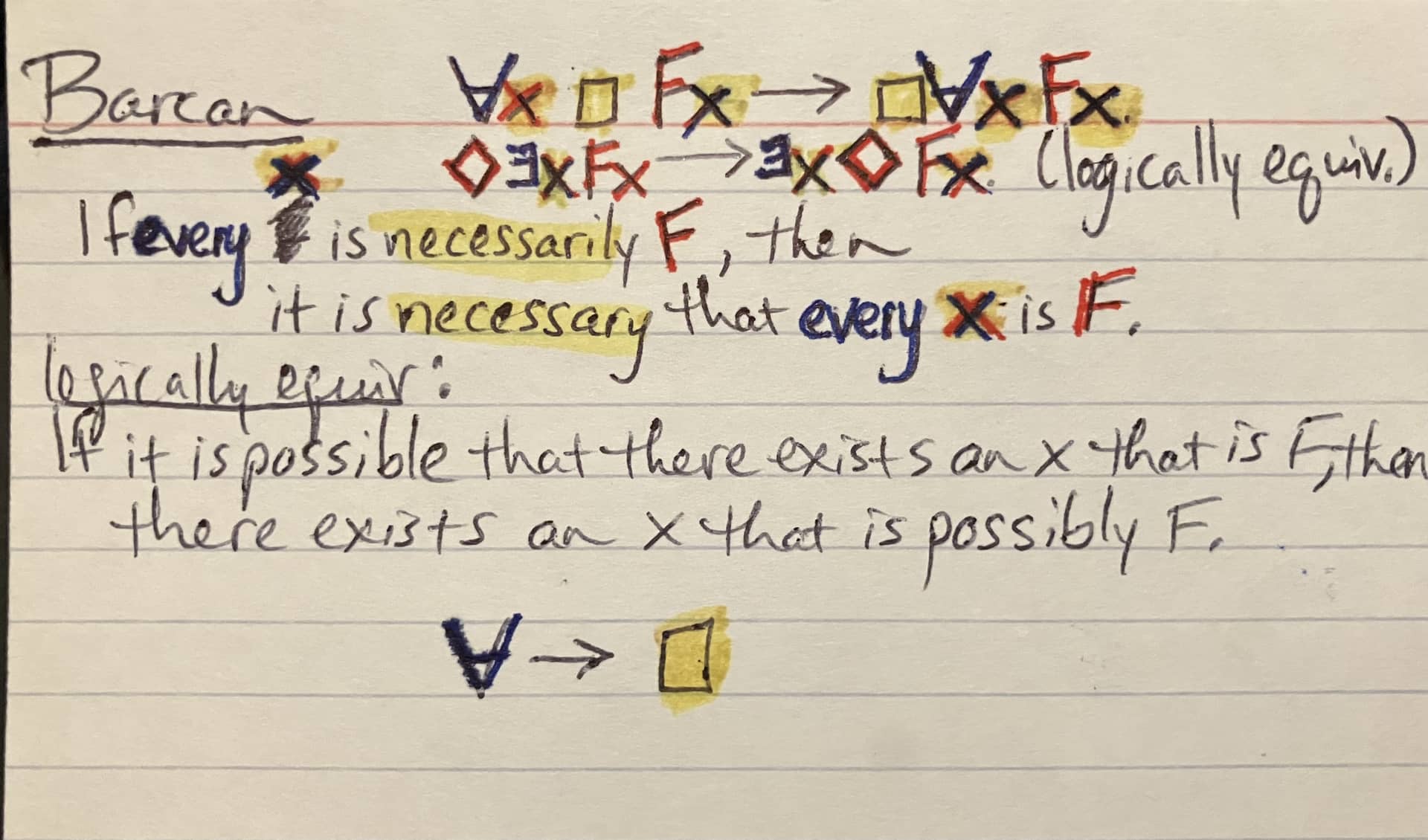
What are you talking about? I’m about triads. Are you talking about Barcan? Even that is triadic without even trying. I will explain, if that is actually what you were talking about. If it wasn’t, please explain what it was.
There is dead logic and there is living logic. Nietzsche introduced the latter.
It comes down to unearthing a truly non tautological synthetic a priori.
Kant thought that something like 5+7=12 is not tautological but of course it is, as Leibniz and most modern logicians realize.
Most think that there aren’t any non-tautological synthetic a priori’s; but there is in fact one. One does need to understand the Will to Power as a logic, not merely as a phenomenology, to understand that it is such a judgment.
Im not going to post Jesus on the cross, but that point is a bit silly.
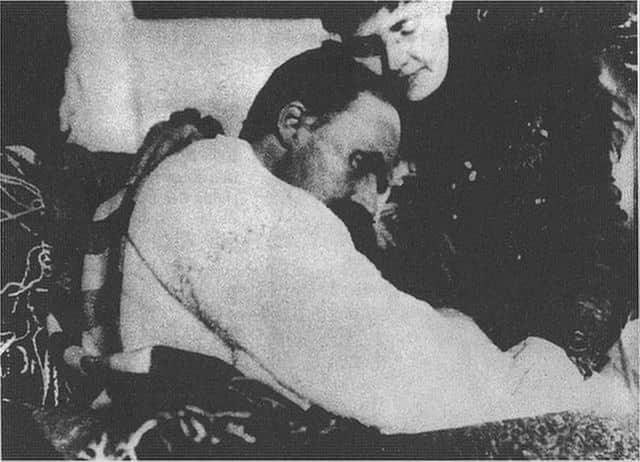
People under high strain suffer. To take the whole of western philosophy on ones shoulders and liberate it, is heavy work.
Also the man could just have been ill. I mean that seems to have been the case. Many people get ill but only one infused logic with the spark of life.
More to the point, Nietzsches general imperative is to create beyond oneself. He did not consider himself to be the aim of his philosophy. He just lords over an Aeon.