script.js
const canvas = document.getElementById('canvas');
const ctx = canvas.getContext('2d');

const particleCount = 1000;
const particles = [];
const stableAttractors = [];
const decayRate = 'rgba(2, 2, 2, 0.1)';
function updateStablePositions() {
  stableAttractors.length = 0;

  stableAttractors.push({
    x: canvas.width * 0.82,
    y: canvas.height * 0.45,
    radius: 9,
    color: '#0088ff',
    glow: '#0044ff',
    fieldOfInfluence: 480,
    gravity: 0.1,
    spin: 1.5
  });

    stableAttractors.push({
    x: canvas.width * 0.22,
    y: canvas.height * 0.45,
    radius: 9,
    color: '#0088ff',
    glow: '#0044ff',
    fieldOfInfluence: 480,
    gravity: 0.1,
    spin: 1.5
  });
}

function resize() {
  canvas.width = window.innerWidth;
  canvas.height = window.innerHeight;
  updateStablePositions();
}
window.addEventListener('resize', resize);
resize();

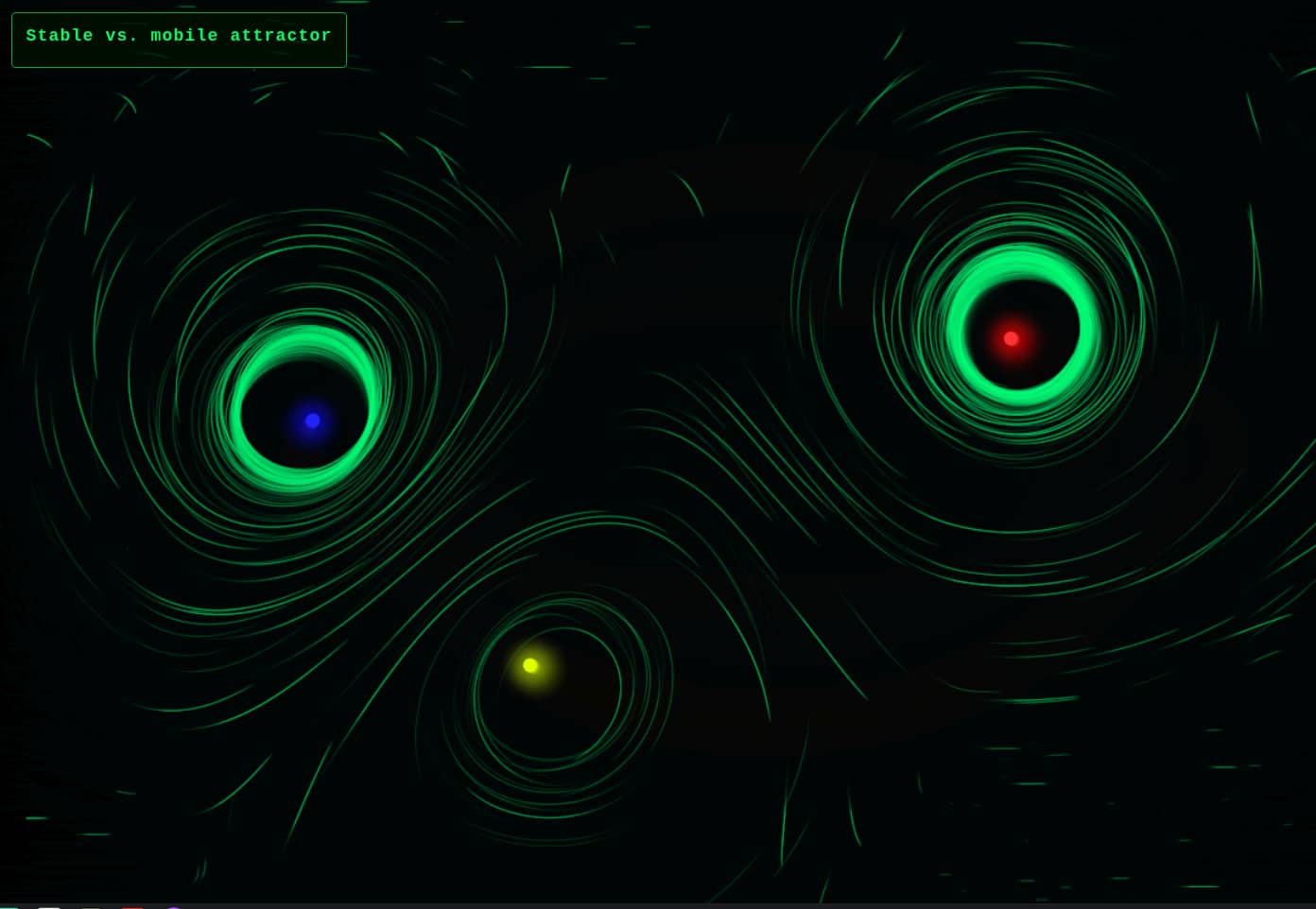
// moving attractor
let movingAttractor = {
  x: canvas.width / 2,
  y: canvas.height / 2,
  color: '#ff3333',
  glow: '#ff0000',
  radius: 6,
  fieldOfInfluence: 380,
  gravity: 0.1,
  spin: 2
};

class Particle {
  constructor() {
    this.reset();
  }

  reset() {
    this.x = Math.random() * (canvas.width * 0.18);
    this.y = Math.random() * canvas.height;
    this.speed = Math.random() * 1;
    this.history = [];
    this.maxHistory = 40;
  }

  update(cx, cy) {
    this.history.push({x: this.x, y: this.y});
    if (this.history.length > this.maxHistory) this.history.shift();

    let rdx = cx - this.x;
    let rdy = cy - this.y;
    let rdist = Math.sqrt(rdx * rdx + rdy * rdy) + 1;

    if (rdist < movingAttractor.fieldOfInfluence) {
      let rInfluence = (1 - (rdist / movingAttractor.fieldOfInfluence));

      let rPullX = (rdx / rdist) * movingAttractor.gravity;
      let rPullY = (rdy / rdist) * movingAttractor.gravity;

      let rOrbitX = (-rdy / rdist) * movingAttractor.spin;
      let rOrbitY = (rdx / rdist) * movingAttractor.spin;

      this.x += (rPullX + rOrbitX) * rInfluence * 3.5;
      this.y += (rPullY + rOrbitY) * rInfluence * 3.5;
    }

    this.x += this.speed;

    stableAttractors.forEach(sat => {
      let sdx = sat.x - this.x;
      let sdy = sat.y - this.y;
      let sdist = Math.sqrt(sdx * sdx + sdy * sdy) + 1;

      if (sdist < sat.fieldOfInfluence) {
        let sInfluence = (1 - (sdist / sat.fieldOfInfluence));

        let sPullX = (sdx / sdist) * sat.gravity;
        let sPullY = (sdy / sdist) * sat.gravity;

        let sOrbitX = (-sdy / sdist) * sat.spin;
        let sOrbitY = (sdx / sdist) * sat.spin;

        this.x += (sPullX + sOrbitX) * sInfluence * 4.5;
        this.y += (sPullY + sOrbitY) * sInfluence * 4.5;
      }
    });

    if (this.x > canvas.width || this.x < -100 || this.y < -100 || this.y > canvas.height + 100) {
      this.reset();
    }
  }

  draw() {
    if (!this.history || this.history.length < 2) return;

    ctx.beginPath();
    ctx.moveTo(this.history[0].x, this.history[0].y);

    for(let i = 1; i < this.history.length; i++) {
      let p = this.history[i];
      if (p) ctx.lineTo(p.x, p.y);
    }

    ctx.strokeStyle = `rgba(0, 255, 120, ${this.speed / 4.5})`;
    ctx.lineWidth = 1;
    ctx.lineCap = 'round';
    ctx.stroke();
  }
}

for(let i=0; i<particleCount; i++) {
  particles.push(new Particle());
}

function animate() {
  ctx.fillStyle = decayRate;
  ctx.fillRect(0, 0, canvas.width, canvas.height);

  if (canvas.width > 0 && canvas.height > 0) {
    const time = Date.now() * 0.0002;
    movingAttractor.x = (canvas.width / 2) + (Math.sin(time * 0.8) * (canvas.width * 0.2));
    movingAttractor.y = (canvas.height / 2) + (Math.cos(time * 1.3) * (canvas.height * 0.2));
  }

  ctx.shadowBlur = 20;

  stableAttractors.forEach(sat => {
    ctx.beginPath();
    ctx.arc(sat.x, sat.y, sat.radius, 0, Math.PI * 2);
    ctx.fillStyle = sat.color;
    ctx.shadowColor = sat.glow; // Apply blue glow
    ctx.fill();
  });

  ctx.beginPath();
  ctx.arc(movingAttractor.x, movingAttractor.y, movingAttractor.radius, 0, Math.PI * 2);
  ctx.fillStyle = movingAttractor.color;
  ctx.shadowColor = movingAttractor.glow;
  ctx.fill();
  ctx.shadowBlur = 0;
  ctx.shadowColor = 'transparent';

  particles.forEach(p => {
    p.update(movingAttractor.x, movingAttractor.y);
    p.draw();
  });

  requestAnimationFrame(animate);
}

animate();
index.html
<!DOCTYPE html>
<html lang="en">

  <head>
    <meta charset="UTF-8">
    <title>Attractors Test 3</title>
    <link rel="stylesheet" href="./style.css">

  </head>

  <body>
  <div id="ui">
  <h3>Stable vs. unstable attractors</h3>
</div>

<canvas id="canvas"></canvas>
    <script  src="./script.js"></script>

  </body>

</html>
style.css
body {
  margin: 0;
  background: #020202; /* Deep black void background */
  overflow: hidden; /* Prevent scrollbars from popping up */
  color: #00ff66; /* Bright terminal green for UI text */
  font-family: 'Courier New', Courier, monospace; /* Monospaced terminal font */
  user-select: none; /* Prevent accidental text highlighting */
}

#canvas {
  position: absolute;
  top: 0;
  left: 0;
  z-index: 1; /* Place the canvas layer behind the UI */
}

#ui {
  position: absolute;
  top: 15px;
  left: 15px;
  z-index: 10; /* Keep the info panel on top */
  background: rgba(0, 15, 0, 0.85); /* Semi-transparent dark green box */
  padding: 12px;
  border: 1px solid #00aa44; /* Subtle green border */
  border-radius: 4px;
  pointer-events: none; /* Allows clicks to pass through the box */
}

#ui h3 {
  margin: 0 0 6px 0;
  font-size: 15px;
  letter-spacing: 1px;
}

#ui p {
  margin: 2px 0;
  font-size: 12px;
  line-height: 1.4;
  color: #aaffaa; /* Lighter shade of green for description text */
}
Set zoom 0.5
Full screen (1k particles):
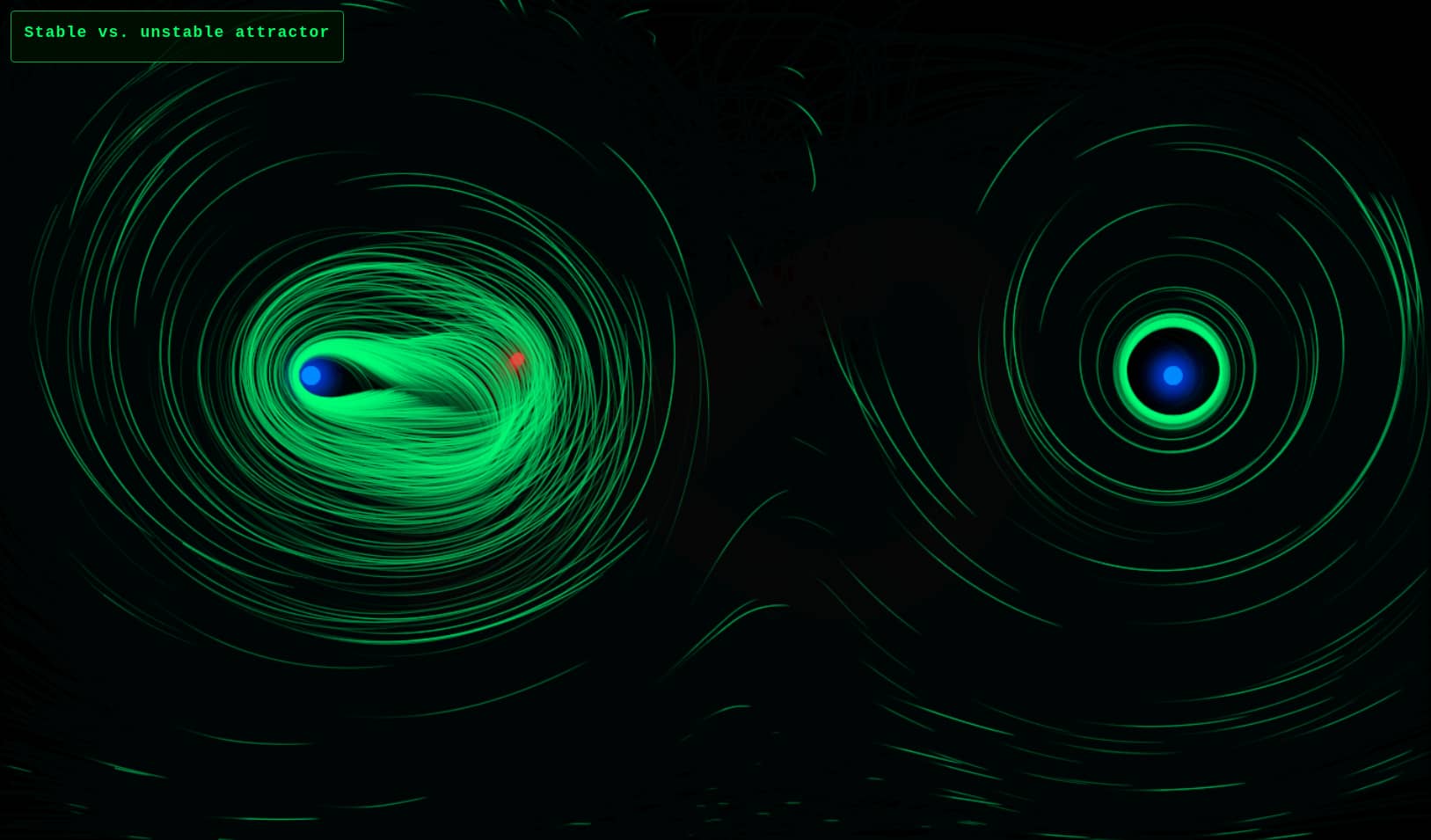
Full screen: https://niall.gt.tc/ (some phones probably can’t handle it)