I’ll bother to grace this with a  and also with a somewhat amiable =D>
Truly honored.
curtsies
Human and Itchy, can you both do me a favor, and respond to the topic at hand with a few rational points of agreement/disagreement.
I want to see if either of you have triple-digit IQs…
Wish granted before requested. You, Lorikeet, and Flannel Jesus have called me Itchy. Just an observer observing observer(s). Obsequiously.
You contradict yourself on almost every one of your points here. That’s why it’s probably pointless to go into every one of your points.
Therefore, only this much:
Modern Monetary Theory (MMT) is the largest, Marxism the second largest and Keynesianism the third largest contradiction in economic history to date, and yet the three prevailed and belong to the so-called “progress”, not only because history has progressed during this time. This three theories have little to do with reality. They are more utopian projects than economic theories. And most people misunderstand what “progress” means. This word has also been using in the context of brainwashing, especially in left-wing circles since the 1830s/1840s (Hegel died in 1831, so that the Old Hegelians [Right Hegelians] and Young Hegelians [Left Hegelians] finally split; and Marx published “The Communist Manifesto” in 1848, the year of revolutions in several countries of Europe).
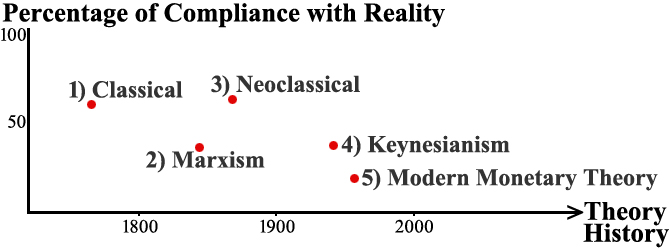
It can be concluded that Modern Monetary Theory (MMT), Marxism and Keynesianism agree less than 50% with reality. Of all economic theories, modern monetary theory has the least to do with reality, namely less than 20%.
When you say that you are “an economic progressive, but … oppose the minimum wage, Keynesian economics, much regulation, corporate taxes, etc. etc.” (**), then you are either not a “progressive”, because Keynesianism is still considered “progressive”, or you are not against Keynesianism at all, which is also clear from your fourth point: “I’m a libertarian but I think we should have a large redistributive basic income”. Basic income (“preferably” a digital one, right?) and Keynesian economic policy hardly differ. In both cases, the state or a similar institution (e.g. central bank) is called upon.
It is no coincidence that at the same time that zombies exist as companies - those companies that are actually already “dead”, but are kept alive by financial support - there are also zombies as persons, because they too are actually already dead, but are kept alive by brainwashing and usually also by financial support.
I was that sort of zombie pre-9-22-05.
Not that I’m the least zombie-ish Being now.
MMT = a religion of psychological coping where you kick the can down the road and keep doing that pretending you can do it forever with no consequences. And if you are ever faced with the consequences you just find something else to blame and keep kicking the can down the road anyway, because you know (or hope) that by the time the can can’t be kicked down the road anymore you’ll be long dead.
It’s basically the highest form of evil that ever pretended to be an economic theory. At least Marxism was (semi) authentic.
Marx vacillates between saying that a revolution will be like out with the old, in with the new, versus we need to go global with x, y, z so that total oppression will be assured.
He accurately predicted that “Only when commerce has become worldwide and is based on large-scale industry, when all nations are drawn into the competitive struggle, will the permanence of the acquired productive forces be assured” (TGI, 136).
On the other hand, he calls global communism, or universal private property, a “very crude, unthinking communism,” (EPM, 69). “Universal envy establishing itself as a power is only the disguised form in which greed reestablishes and satisfies itself another way,” (ibid).
Weil concurs greed is an issue when she says, “As for the restoration of capitalism, which could only take place as a sort of colonization, this is not at all impossible, in view of the greed that characterizes all imperialism and of the economic and military weakness of the U.S.S.R,” (OL, 5).
But Marx also vacillates between saying revolution is completely inevitable versus only the ruling class are free enough to rule. “The class that is the ruling material power of society is at the same time its ruling intellectual power. …controls…the ideas of those who lack the means of intellectual production. … The individuals who comprise the ruling class possess among other things consciousness and thought. …regulate the production and distribution of the ideas of their age,” (TGI, 129). “The division of labor…is expressed also in the ruling class as the division of mental and material labor, so that within this class one part appears as the thinkers of the class…[and one part] is more passive and receptive because they are really the active members of this class and have less time” (ibid, 130). This is why revolutions usually come from the ruling class in conflict with itself. Also,
Marx seems to think of people experiencing homelessness the same way Ayn Rand does when he says, “The ‘dangerous class,’ the social scum, that passively rotting mass thrown off by the lowest layers of old society, may, here and there, be swept into the movement by a proletarian revolution; its conditions of life, however, prepare it far more for the part of a bribed tool of reactionary intrigue,” (TCM, 167). One can hope a charitable reading, that he is just using dialectic to shock us out of slumber, is an accurate one.
Weil points out that the proletarian revolution would be a miracle, considering they have less means than the active members of the ruling class to permanently overcome their chains. Weil noted that the main irony with Marx is he dismissed heaven but expected a miracle from a proletariat he deemed too enslaved to be revolutionary. “He believed in miracles without believing in the supernatural,” (ibid, 150).
References:
(EPM) Marx, Karl. Economic and Philosophic Manuscripts. Selected Writings, edited by Lawrence H. Simon, Hackett, 1994.
(OL) Weil, Simone. Oppression and Liberty. Routledge & Kegan Paul (transl), 1958.
(TGI) Marx, Karl. The German Ideology. Selected Writings, edited by Lawrence H. Simon, Hackett, 1994.
(TPM) Balibar, Ettienne. The Philosophy of Marx. transl. Chris Turner. Verso, 1995
I believe in the supernatural:
ilovephilosophy.com/viewtopic.p … 6#p2922366
Modern monetary theory wouldn’t be so evil if it applied self=other to all its applications.
I think I agree with this. When I said “tribalism”, I meant a system that ascribes inordinate moral weight to tribe members to the exclusion of non-tribe members. In your style, you might call it a limitation on ‘self = other’, something like ‘self = tribe member and self (\neq) non-tribe member’. That includes both difference-in-kind (e.g. where non-tribe-members are simply not moral patients), but also extreme difference-in-degree, e.g. if the concerns of tribe members outweigh the concerns of non-tribe members to some extreme degree. The latter is fuzzy and you can debate where the line is drawn: I don’t think it’s wrong to care about your kids more than other people’s kids, but I think it’s wrong to e.g. steal toys from other peoples kids to give to your kids; I don’t think it’s wrong to e.g. root for a European soccer team because it’s European, but I do think it’s wrong to give someone of European descent a job because they’re European.
This gets at some points Lorikeet makes that I (gasp!) agree with: I also think it’s wrong to give someone of African/Asian/Latine descent a job because they’re African/Asian/Latine.
I’m not arguing against identity, which I think is the stance HumAnIze is taking. But I am encouraging a weakening of the implications of identity, an appreciation for the diversity within identity, individuals to adopt multiple/complex/intersectional identities, i.e. “a messier collection of many small and weakly bound” tribes. That kind of tribe serves both to connect and to individuate. I think that undermines the nefarious form of tribalism.
This is incorrect as a description of the world. Look at Jewish Voice for Peace, the ADOS movement, the ‘Five Races’ of China, the history of the idea of a ‘Japanese identity’, and e.g. opposition to Korean reunification. All of these supposedly homogeneous groups actually have internal diversity and disagreement, and less tribalism than it seems. Saying otherwise benefits ethnonationalists, because it serves to lump together ‘others’ as a monolithic opposing force, which serves to justify the need for a coalition of co-ethnics.
But in fact, they aren’t monoliths. Even in Europe, surveys show e.g. more people are attached to their country (91%) and even their village/town (89%) than they are to Europe itself (65%).
I think doing otherwise is both impossible, because humans are naturally tribal and political, and not desirable, because cooperation is the only way to accomplish anything and identities are shorthand for ‘people I can cooperate with’. There’s a difference between “supporter of a collection of policies” and “member of a political party”, and that difference has implications for which collection of policies is likely to be implemented.
In a sense this is true, but also the tribe is its members, and if the members change and adapt, the tribe will change and adapt. Lowering the friction for individual adaptation should help to make tribes adapt more readily (or make them less stable, which has the same effect).
I don’t think this is literally true, but it’s still a strong rebuttal to my position. It’s not their only purpose, but tribes do serve to highlight commonalities and downplay differences, and in doing that they resist change by constraining the Overton window.
But again, weakening the extent to which tribes suppress disagreement would weaken this effect. So frequently acknowledging and pointing out disagreement within tribes should serve your ends, to the extent that more adaptive tribes are better at truth-seeking.
I intended for there to be some tension in each of my points, but I don’t think there’s contradiction. I’ll briefly defend each here, but if you want to discuss any in particular, start a thread and let me know:
There’s no contradiction in saying that a belief is both false and produces positive effects.
I should clarify that by “their beliefs” I mean “fertilized embryos are equal in moral worth to newborn babies (and newborn babies have very high moral worth)”. If you take that as a given, the harms of the pro-life position can easily be outweighed by its benefits.
Those policies don’t support the aims of economic progressivism, i.e. social justice, redistributing wealth and social power, increasing mobility, etc. (I say more about this below in response to your specific objections)
A state that merely applied a progressive tax and a universal basic income would be significantly smaller than the states we have.
Knowing how to fight makes it easier to avoid violence, and to respond to violence in non-violent ways.
Given that you identify multiple progressive economic theories (Keynsianism, MMT, and Marxism), it can’t be that merely rejecting Keynsianism means I’m not a progressive. Nor, I would argue, are those three the only economic theories that deserve to be called “progressive”, there are others, including various flavors of left-libertarianism, e.g. Georgism. I agree it’s debatable whether I’m still an economic progressive (and that’s part of my point in this thread), but I identify that way, largely because I come to it as an evolution of a more traditional progressivism, keeping most of the ends and values while becoming disillusioned with the commonly proposed means.
Here’s some of my previous threads on related topics, if you’re interested in reading/rehashing any of them:
Some Thoughts on Tax Policy
The “Size” of Government
Optimal Evil
Money as Reward, Money as Vote
The Market as Information Aggregator
Zero Marginal Productivity Workers
Wealth Tax
Climate, Health, and Inequality: A Proposal
Progressive Opposition of Business Taxes
Progressive Opposition to a Minimum Wage
In defense of a Basic Income (Response to McArdle)
House the Homeless
[Edited for grammar]
Careless…who the fuck is speaking about “monoliths”?
In modern times homogeneity is impossible.
But importing ethnicities unrelated to the local populations is anti-diversity.
There are ethnic families, based on linguistic family trees…with some exception, like Finland, Hungary in Europe.
So, race is about genes…then memes, and then will, choice, loyalty.
Your anti-nature, antireal diversity Americanism is in decline.
You will not impose it on the world…even if you call them terrorists or racists…
Those words have lost their power due to overuse and their use by hypocrites and liars, like you.
Racist 
Hahahaha this alone redeems you.