p.s. Only Copilot is in the title of this thread, but I am learning much by working with both Copilot and Gemini. They resolve each other’s conflicts.
After a bit of back & forth with Gemini & Copilot, and agreeing (in my head) to disagree on some cup-shuffled details (this could literally go on forever…)…
Thesis: This goes without saying: “No empty terms!” (Aristotle)
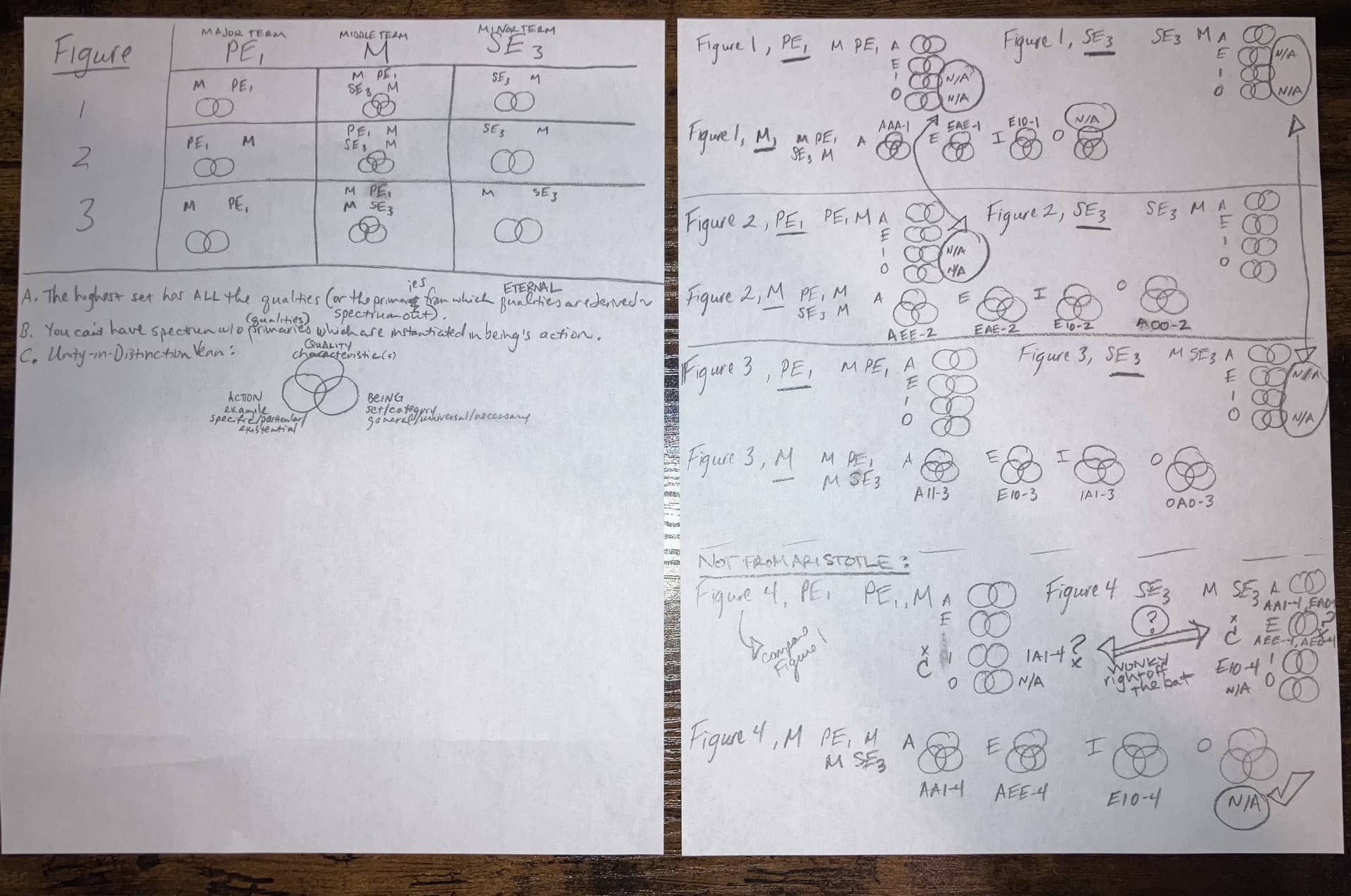
Antithesis: “Conditionally valid” syllogisms require existential/evidential non-emptiness of relevant terms [middle in third figure, subject in subaltern moods like Barbari (AAI-1) or Celaront (EAO-1)], or are dismissed as existential fallacies. Labelling them conditionally valid or existentially invalid is a misnomer: Existential import is about soundness. Unconditionally valid syllogisms remain sound (mislabeled “vacuously true”) even if…unsound/empty. (Peano/Boole)
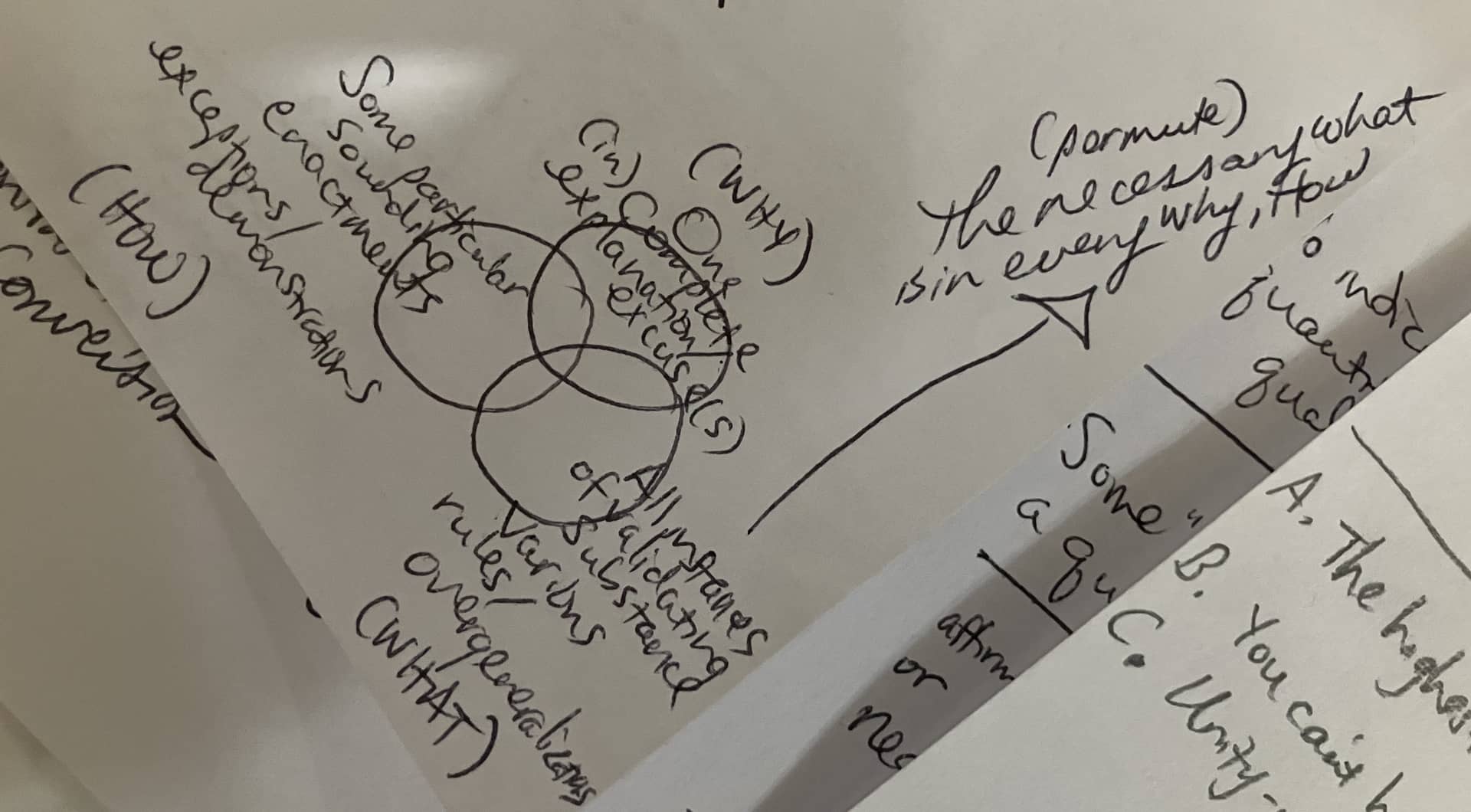
Synthesis: Validity is true to the structure of Being, and soundness results from demonstrating in Action the quality of Being, thus they are distinct from each other, but both require each other [with the also distinct Quality/properties that also require(s) valid Being and sound Action] for a consent-worthy argument/apoLogia (defense/justification of a truth/Being claim).
Where I’m at with this part:
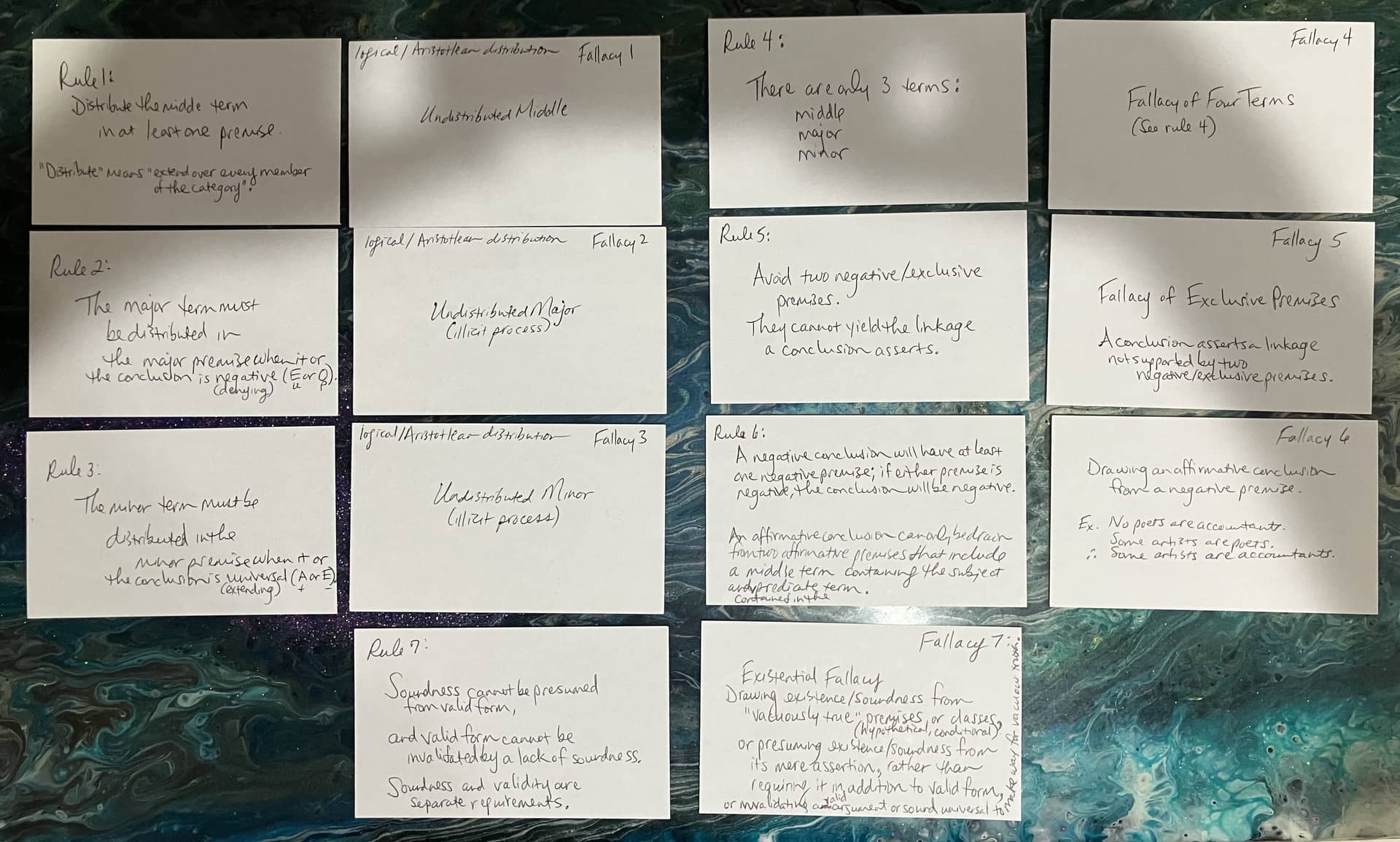
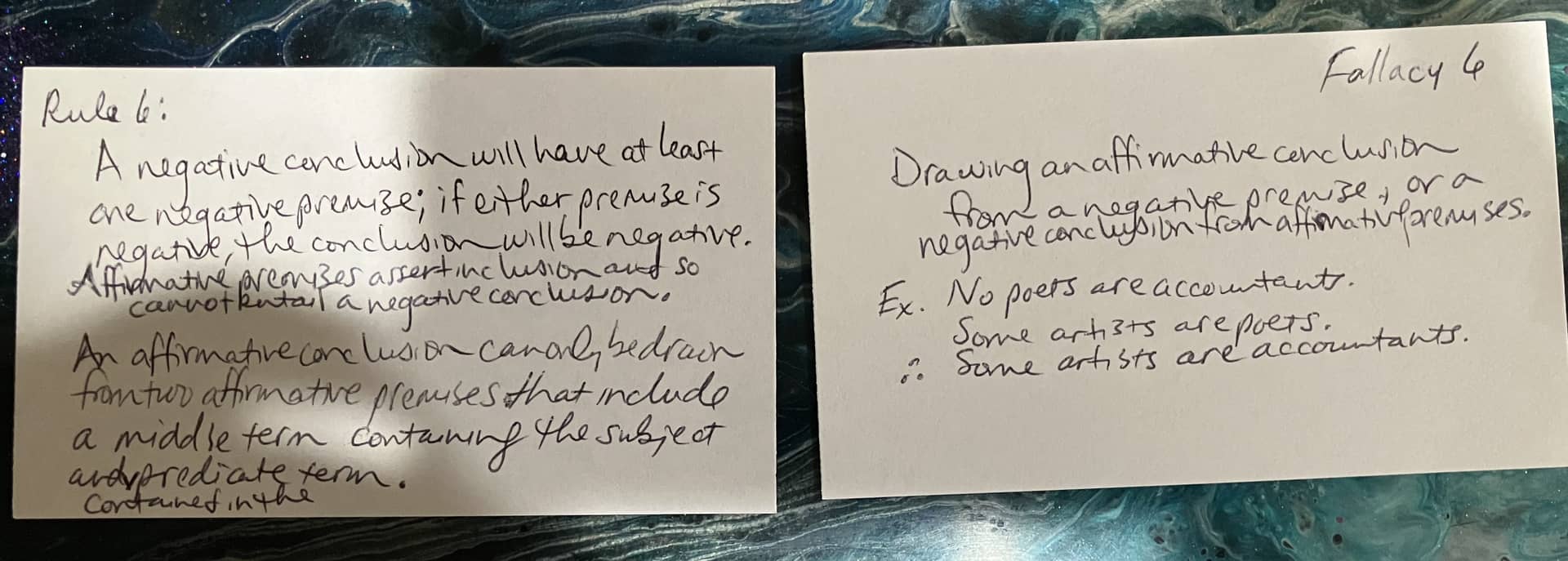
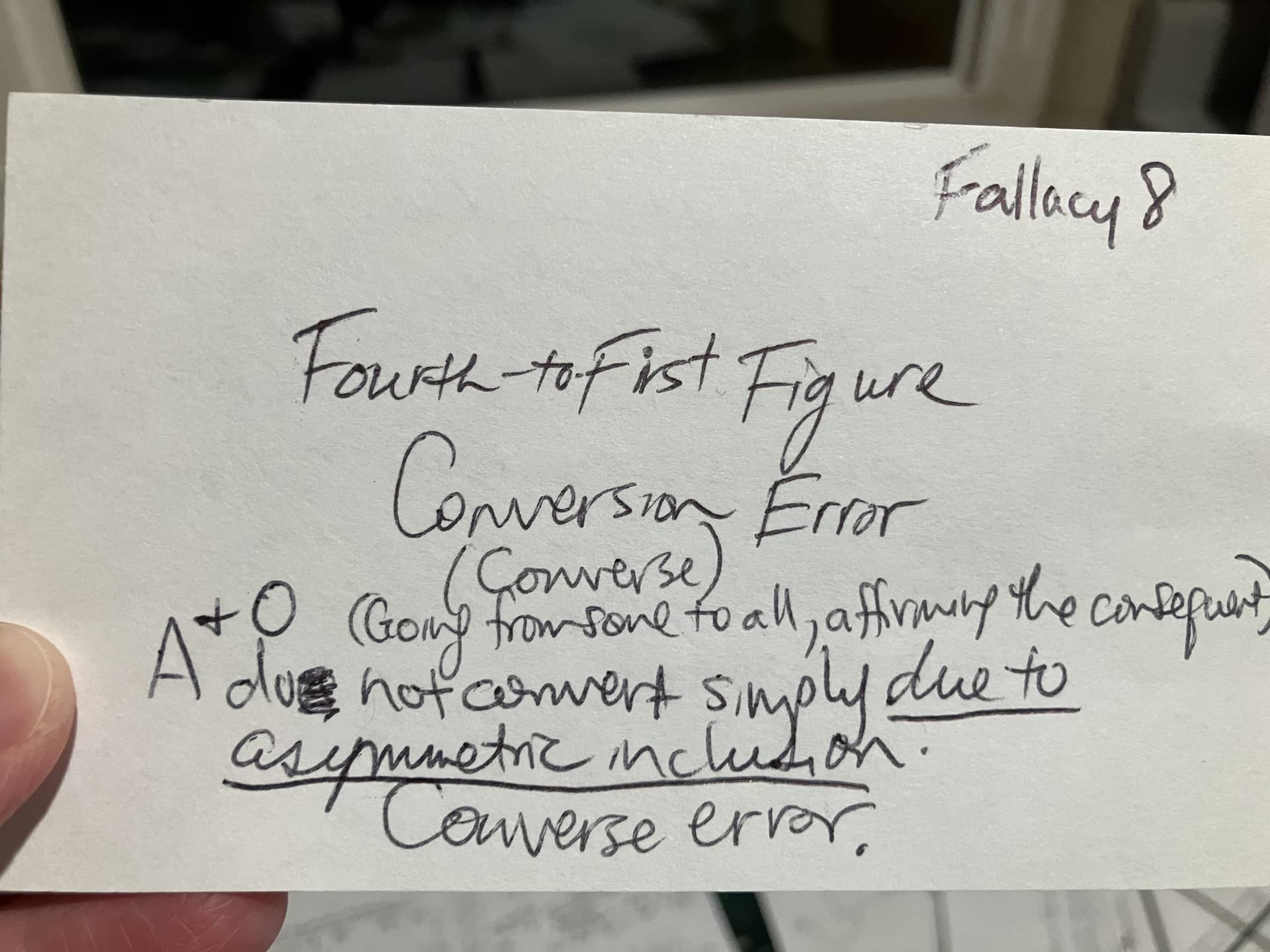
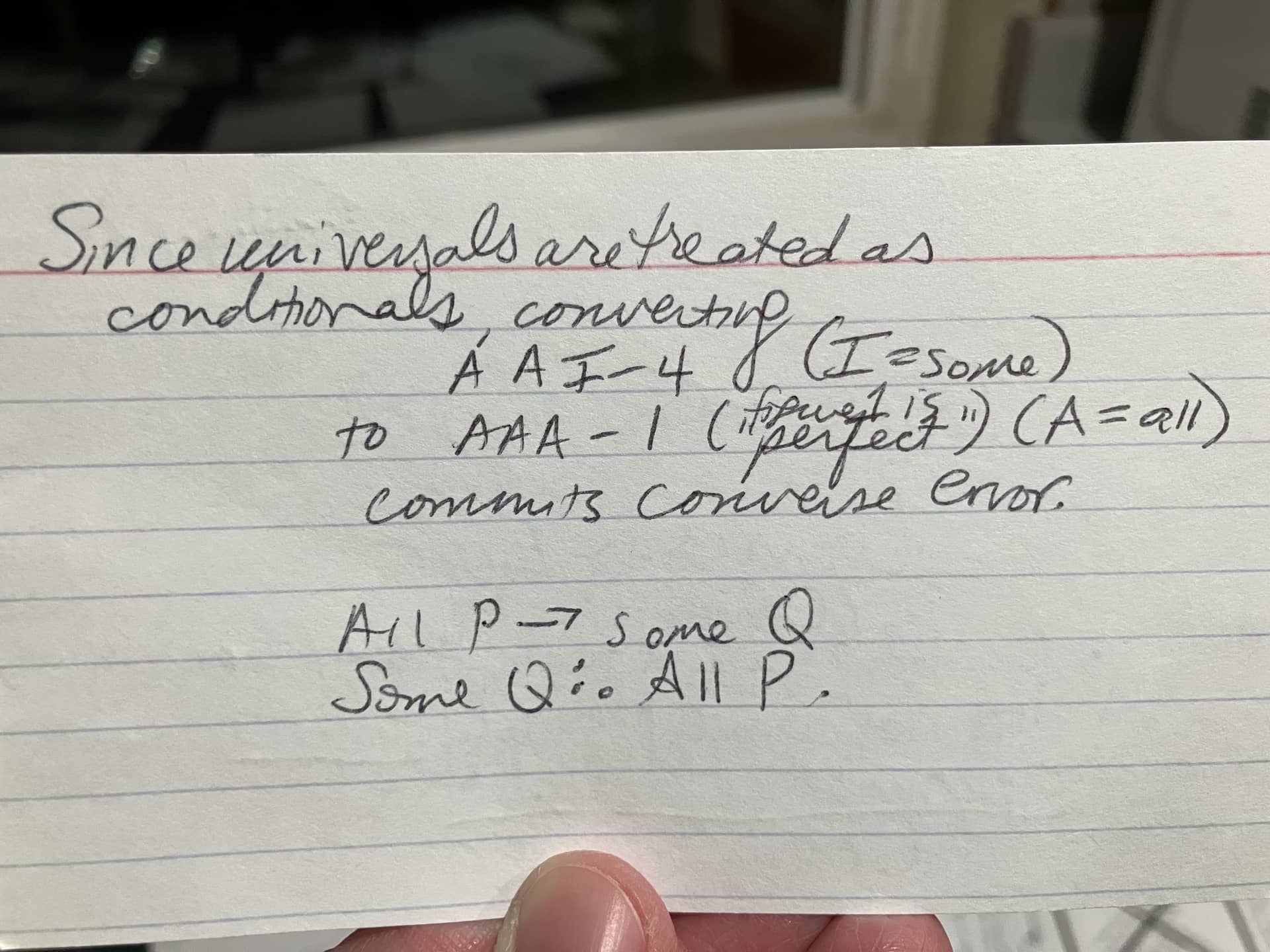
Need cards for this fallacy & how to do it right:
Fourth-to-First Figure Conversion Error
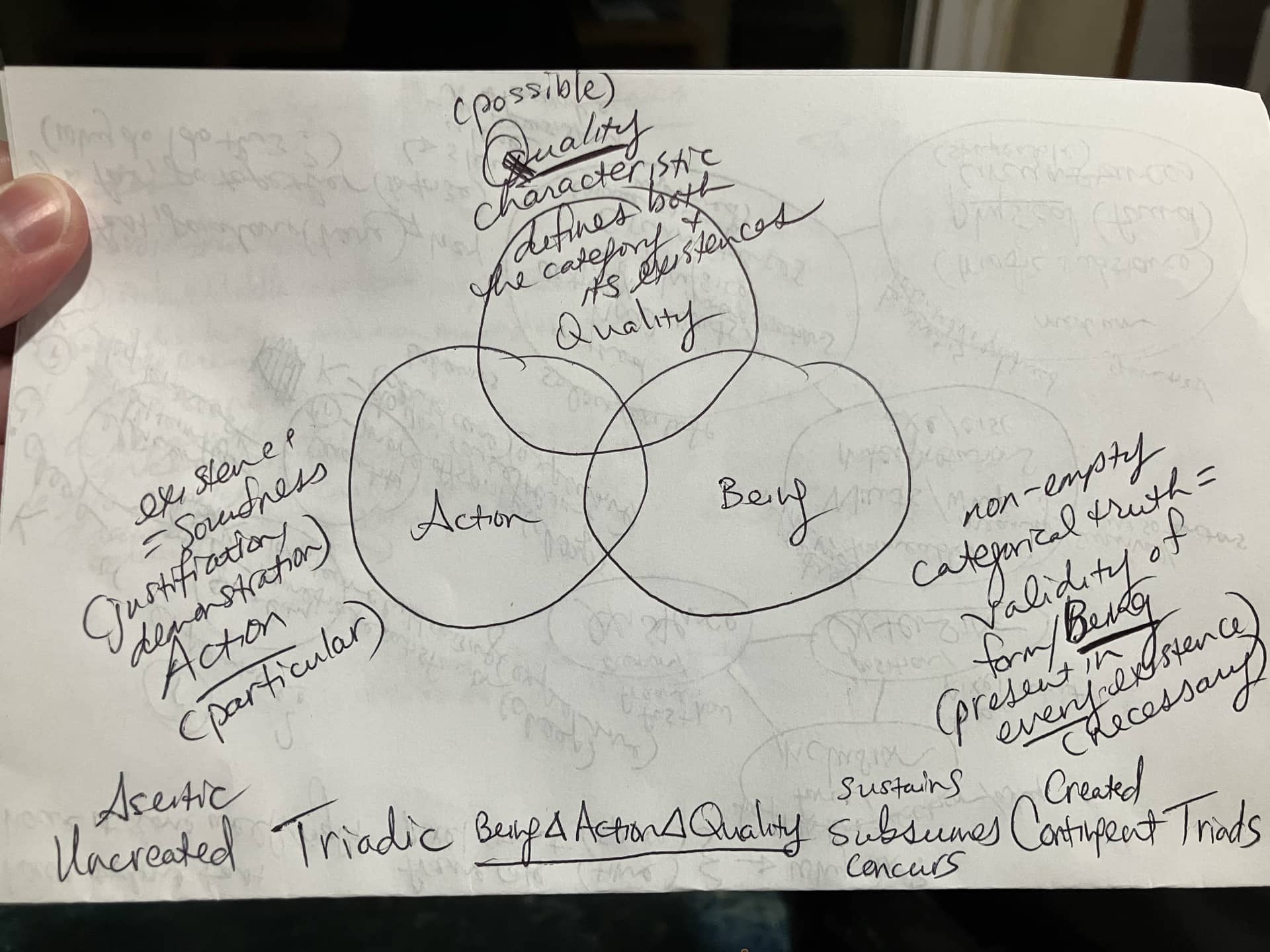
Kinda hilarious the modern/Peano interpretation nixes alternation (limitation) but considers contradiction “entirely coherent” despite allowing opposite universals to be true (because vacuous, treated hypothetically), which (IF coherent/consistent) auto-falses their particular contradictories, even if sound (just like it auto-unsounds universals).
And just in case I didn’t point it out clearly enough before… never mind that universals extend universally, and particulars only extend partially… how is it any less fallacious to PRESUME existential import of “Some unicorns yada yada yada”?
Double-standard much?
And they wanna keep Modus Ponens, Modus Tolens, Transposition. 
(⊦∃{}') → ({}≡{}) → ({}={}) → ({}↔{}) → ({}→{}) → ({}:{}→{}) → ({}⊃{}) → ({}∻{})
read; “assuming nothing, there exists the concept of nothing; implies nothing is nothing; implies nothing equals nothing; implies nothing if and only if nothing; implies nothing implies nothing; implies nothing has the property of nothing; implies nothing is made of nothing; implies nothing is causal with nothing”
what do you think of this ontological theorem with respects your work?
I think it says a whole lot of nothing. Sorry, man.
First: You just trust both. This is not a question of validity or quality, you are simply subjectively choosing who you feel more comfortable with trusting. Except its meaningless because the feedback you get is external in both instances.
Second: Why on earth would anyone want to compete for your approval? Compete with an AI no less…
Also, you need an answer it will be: both.
You are supposed to take ALL feedback from ALL sources and evaluate them to form a picture as objective as possible…
1 Like
Yes, agree, but that’s not really the issue.