Well, Marx and Engels had their rendition and I have mine. Mine starts with the assumption that out in the real world, national economies don’t revolve around the fictional or theoretical interactions embraced by those like the “free market” Objectivists or the Libertarians…but around crony capitalism or state capitalism. That, in other words, wealth almost invariably translates into political power. The “deep state”. Mine here…
No, I’m suggesting that in some contexts, the law becomes a factor. And what you choose to do can involve “the state” intervening and punishing you legally. Whereas, in other contexts, it doesn’t become a factor. Take the movie Witness, for example. There are the parts in the film where the state/the law was a factor and parts where it was not. Like when Rachel was threatened with “shunning” because some deemed that she was breaking the moral code of the community.
Eli: What is it with you? Is this the Ordnung?
Rachel: I have done nothing against the rule of the Ordnung.
Eli: Nothing? You bring this man to our house with the gun of the hand. You bring fear to this house.
Rachel: I’ve commited no sin.
Eli: Maybe. Maybe not yet. But, Rachel, it does not look good. You know there has been talk. Talk about going to the Bishop and having you shunned.
Rachel: That is idle talk.
Eli: Do not take it lightly. Rachel, they can do it. They can do it just like that…You know what it means, shunning. I cannot sit at table with you. I cannot take anything from your hand. I cannot go to worship with you. Child, do not go so far.
Rachel: I’m not a child.
Eli: But you are acting like one.
Rachel: I’ll be the judge of that.
Eli: No, they will be the judge of that. And so will I. If you shame me…
Rachel: You shame yourself.
Also, with communities like the Amish and Pagans, there’s a “spiritual” element. Morality comes to revolve around it. How, for example, Maia has come to construe Nature and the Goddess as her own rendition of MagsJ’s “intrinsic self”. Something that is not applicable to those like me.
Again [as always] it depends on the context. The fact is, there are any number of situations where it is precisely because sighted people see something that they become bothered in the first place. Had they not seen it they would not be bothered. But, again, it depends on what it is they did not see. If what they failed to observe might have upset them had they seen it, but it is a relatively trivial thing, that’s one thing. But if it involved something, say, life-threatening, that’s another thing altogether.
When you are blind, not being able to see something might actually be to your advantage. Why? Because seeing some things might have bothered you even though they were trivial. Yes, but not being able to see other things can become catastrophic.
Then the part where dasein factors in. Blind or sighted, different people become bothered by different things.
+++The least bad option. Better that than someone who gets to decide for the whole group. Or an authoritarian “might makes right”/“right makes might” dogmatic approach.
And there was the law to take into consideration. Making it more clear cut in regard to the consequences.
But the sort of situations that most intrigue me are those that revolve around contexts in which there are greater moral and/or practical consequences…like a member choosing an abortion when other members view that as out of sync with nature. Or behaviors that revolve around guns or sexual preferences or the role of government or social justice issues.
I’m still Googling here in order to explore that sort of thing.+++
The only thing I can think of like that was the time when the leader of a Wiccan group I used to be a member of found out that one of the other, newer members had had an abortion before joining. She booted that person out immediately and severed all contact with her. While moots tend to be consensus oriented, groups almost never are.
+++Of course, for me as a sighted person, the first thing that pops into my head is that in being blind, I wouldn’t be able to see how people are reacting to me. I’d just always feel that there might be many things that others are doing around me that I am simply not privy to.
On the other hand, what you can’t see, can’t bother you.+++
There are many clues as to what a person is thinking, such as tone of voice. I don’t feel in any way disadvantaged for being blind.
What are some of the consensuses reached in moots that you are familiar with? It’s the part where one member can feel spiritually connected to nature and be on one end of the moral spectrum while another member is no less spiritually connected to nature and be on the other end.
How is nature both the same and different for them?
I’ve found an article from a magazine that I subscribe to – The Atlantic – that focuses specifically on Pagan morals. But it is from 1914! I’ll get around to it on my morality thread here eventually.
Yes, if this is how you react to being blind…being comfortable overall with your life and the circumstances in it…then, of course, that’s the bottom line. I would never argue that you should feel disadvantaged. After all, what can I know about it?
I can only note that from my own frame of mind, I can imagine any number of new situations that you might find yourself in where in fact you would be disadvantaged in not being able to see what others are doing around you.
There is no way that I can imagine myself not feeling vulnerable in any number of contexts if I were to go blind. But that also takes us back to those who were born blind and know of no other world and those who were once sighted and lose their vision.
Even in the world of the blind, communication between those who experience these two, at times, very different realities, must only go so far.
That’s why it would be fascinating [to me] to find a link where this sort of communication is attempted. A discussion among those born blind, those who lost their sight and those who are sighted…
So is it fair to say you are only interested in contexts in which the state is involved? I thought dasein was all that mattered? I thought that as long as a person’s moral convictions can be challenged by your arguments on dasein, that’s what interests you. No?
No, I think it is fair to say that, given the example Maia noted above…
…she broached the reality of “the law”. Of the state, of the government.
And, sure, there are any number of contexts in which one’s moral and political and spiritual convictions [rooted existentially in dasein] have to take that into account.
Here’s the thing though: the law itself changes down through the ages historically and across the global culturally. And it is pertinent to any particular individual out in any particular world in a particular way. And there does still not seem to be a way to determine [philosophically or otherwise] what the law ought to be in regard to conflicting goods.
In regard to things like sex and booze and cigarettes and other behaviors “underage” – legally – varies from jurisdiction to jurisdiction.
Ah, so it’s not that Maia’s story didn’t involve a moral dimension, it’s that the final decision at the end of the night was based primarily on the legal ramifications, not the moral ramification–the law trumped morality–but the contexts you are most interested in are one’s in which morality takes center stage, context in which people can rage and debate and protest without necessarily incurring any legal ramifications. Of course, these situations often boil over and one or both parts push things too far–into areas where the law is compelled to intervene and shut things down–favoring one side or the other, or both or neither–but it typically starts with, and is usually because of, a lack of legal considerations and only moral considerations.
You’d have to ask Maia about the complexities revolving around that. I was only noting that she was noting how, given that particular context, there was a legal factor to be taken into consideration.
Also, the fact that laws themselves are generally predicated on moral considerations. After all, why, in any given community, would certain behaviors be either prescribed or proscribed legally if it was not because some behaviors are deemed to be right and others wrong?
Then it comes down in each particular community to whether this revolves more around might makes right, right makes might, or moderation, negotiation and compromise. Or a more or less complex combination of all three.
My point to Maia is that the moral and political prejudices of those individuals in the moot are, in my view, still no less the existential embodiment of dasein. And that her own moral convictions, while apparently in sync with my understanding of dasein, still revolve in turn around a moral objectivism all her own: her “I just know” “spiritual Self” in sync with the Goddess in sync with Nature.
And isn’t that, in one crucial respect, the perfect moral framework? If your “spiritual Self” revolves largely – entirely? – around your own uniquely individual interaction with Nature, then of course no one else can possibly grasp that. Right?
Maia makes this six or seven year commitment to the Goddess/Nature to refrain from all things sexual. But if I or others try to suggest that this does not seem all that rational…and even at odds with how other Pagans seem to revel in human sexuality…she just comes back to her own “spiritual Self” explanation. End of discussion.
Thus my argument that, in regard to all of the many, many, many God and No God objectivisms out there – historically and culturally and pertaining to personal experiences – the point isn’t what you believe but that in believing what you do it allows you to feel “at one” with an essential Reality that comforts and consoles you. All the way to the grave for many.
Like your own “emotional Self” that is still beyond my grasping insofar as it allows you to avoid being “fractured and fragmented” as “I” am in regard to the trucker protest.
Can you at least explain to me how you’re conceptualizing my “emotional self”? I mean, I may end up agreeing with you! But as it stands, whenever I hear you utter my “emotional self” in your attempts to describe me, I think you’re just making it up (and then getting confused by it). As I said countless times before, I never expressed a concept like my “emotional self”, and I can only surmise that based on a handful of things I’ve said, you built this concept of my “emotional self” and attributed it to my basis for keeping myself in tact. But in truth, I have no idea what your talking about.
I mean, I do know how this concept first arose in this thread–you started uttering it after our discussion about how I’m driven primarily by my emotional reaction to the trucker protest–as opposed to some abstract intellectual series of cogitations about the trucker protest the culmination of which determined my stance on the moral status of the protest and therefore what I should do about it–and then you seemed to tie that into my sense of “self” and how I keep myself “intact” (because that’s what you seem most desperate to understand–you need to breathe). I tried on numerous occasions to explain to you that my self remains intact because I anchor my sense of self mostly on my either/or world characteristics (which you should be the first to admit tend to be stable). But you keep ignoring that and come back to this “emotional self”–as though I said I anchor my sense of self on my emotions. So please tell, how do you conceptualize my “emotional self”–who knows, maybe it turns out it ties directly into my either/or world characteristics after all?
+++What are some of the consensuses reached in moots that you are familiar with? It’s the part where one member can feel spiritually connected to nature and be on one end of the moral spectrum while another member is no less spiritually connected to nature and be on the other end.
How is nature both the same and different for them?
I’ve found an article from a magazine that I subscribe to – The Atlantic – that focuses specifically on Pagan morals. But it is from 1914! I’ll get around to it on my morality thread here eventually.+++
I don’t know of any discussions about that. Pagans tend to be pretty accepting of other people’s spiritual beliefs. Most discussions are about practical matters, such as organising trips to events, hiring minibuses, paying for such things, and so on.
+++Yes, if this is how you react to being blind…being comfortable overall with your life and the circumstances in it…then, of course, that’s the bottom line. I would never argue that you should feel disadvantaged. After all, what can I know about it?
I can only note that from my own frame of mind, I can imagine any number of new situations that you might find yourself in where in fact you would be disadvantaged in not being able to see what others are doing around you.
There is no way that I can imagine myself not feeling vulnerable in any number of contexts if I were to go blind. But that also takes us back to those who were born blind and know of no other world and those who were once sighted and lose their vision.
Even in the world of the blind, communication between those who experience these two, at times, very different realities, must only go so far.
That’s why it would be fascinating [to me] to find a link where this sort of communication is attempted. A discussion among those born blind, those who lost their sight and those who are sighted…+++
I’m very happy with my life, and that includes being blind.
Note where I noted that her story didn’t interest me. I merely made the crucial distinction between contexts in which there are legal ramifications involved in the behaviors we choose and where there are not. Between the state actually arresting you and charging you with a crime…locking you up in jail…and contexts as in Witness where the group may shun you but no state/government is there to take it beyond that.
Thus…
Again, that is something you’d have to run by Maia. She is considerably more familiar with the details of the incident. I only suggested that, when each member had access to the drinking horn, their own personal opinion regarding such matters is, in my view, no less a manifestation of dasein. Whether in regard to the law or in regard to their moral convictions.
From my frame of mind though, debates within a moot are “settled” only insofar as something in the way of a consensus is reached among men and women who, if they think as I imagine Maia thinks, come to conclude what they “just know” is the right thing to do given their “spiritual self” derived individually from nature.
There’s Maia’s “spiritual self”, your “emotional/intuitive self” and my “fractured and fragmented self”. Then issues like the worker protest and the context Maia described. The communication breakdowns we continue to have here because we are unable to fully grasp others frames of mind.
It depends on how “technical” you want to get? As I noted to “dimebag” over at PN:
Pick an issue. There’s me reacting to it, you reacting to it, Maia reacting to it. So: Re dasein more or less than spiritually or emotionally?
Well, this is a philosophy forum. So: given the tools that philosophers have at their disposal, how close can they get to either 1] the “best of all possible worlds” optimal resolution or 2] the one and the only manner in which [re Kant and other] all rational [virtuous] men and women are in fact obligated to think about it. Where for philosophers do our emotions and intuitions and spirituality fit in?
Thus…
Note to Maia and MagsJ:
By all means, weigh in here on how your own rendition of an “intrinsic self”, enables you to avoid becoming “fractured and fragmented” in regard to the moral conflagrations that pop up in forums like this over and again. Maia…you in particular. Why? Because as with gib you share part of my own assessment of dasein, but there is still a part of your “spiritual self” that “somehow” enables you to feel wholly connected with the “Right Thing To Do”.
And, to me, this is, “for all practical purposes”, just another existential manifestation of moral objectivism. A way for you psychologically to have something in the way of a Real Me that allows you to sustain the comfort and the consolation of being grounded in a font. Something that transcends dasein but not as most do…re God and denominational religion. Or, for others, deontologically. Or, for others, re ideology and political dogmas. Or, for others still, Nature in the manner in which Satyr and his KT clique/claque envelop it.
Yeah. How can they if they are not you? Ironically, it isn’t all that far removed from the manner in which “I” construe dasein. If our moral and political value judgments are rooted largely in the individual lives that we live and, in many crucial respects, the lives that I and you and Maia lived/live were/are almost certainly very different then of course our value judgments will often collide.
Okay, Mr. Philosopher, Mr. Ethicist, Mr. Political Scientist…what then?
Or…
Perfect understanding? That’s precisely what I suggest is beyond the reach of mere mortals in a No God world. But there seem to be those like you and Maia who are able to convince themselves that they can still come close enough…emotionally, intuitively, spiritually.
The trucker protest. Abortion. Guns. Feminism. The role of government. And all the rest of them. Emotionally and spiritually we can sort of emulate a world with God. All we need to do is to find those who feel like we do…who have the same spiritual connection to nature as we do.
Yeah, there’s the dasien arguments that Biggy notes here…
And, sure, if you are able to sustain a Self that is not fractured and fragmented, good for you. But “I” myself don’t possess a “post existential” emotional and spiritual font to fall back on.
Well, does she? Only she is willing to acknowledge that had her life been different she might possibly not even understand it as she thinks she does here and now herself! So, thank the Goddess for a spiritual connection to nature. Even though nature itself has countless ways in which to turn her life into a living hell. Natural disasters we call them. Pandemics we call them. Ghastly medical and mental afflictions we call them.
Then you with your emotional and intuitive Self that in turn is construed by you to transcend a fractured and fragmented reaction to the trucker protest.
Yeah, if you can convince yourself that intuition is not in turn an existential component of dasein, and that works for you, take it no further. On the other hand, how many folks out there are falling back on intuition themselves to explain why they protested the trucker protest?
Same with Maia. Each member of the moot has their own uniquely personal spiritual connection to nature. And, like the rest of us in regard to conflicting goods, they might find themselves all up and down the moral and political spectrum.
Only many liberals and conservatives here don’t fall back on intuition and spirituality in condemning those on the other side as “morons”. Instead, they fall back on God and ideology and deontology.
But the result is the same: a Self that allows them to sustain the comfort and the consolation of being – of feeling – “at one” with something greater than themselves.
Yeah, if I was 30 years younger and my circumstances were difference, I’d certainly consider pursuing a relationship with her that went beyond a “world of words”. After all, I have a great deal of respect for her intelligence, her capacity to articulate it, her wit, her curiosity, her commitment to living a life that revolved around inflicting as little pain on others as possible.
Maia is very attractive, voluptuous. Look at her avatar. The other photos she has posted. Of course there are going to men here [even women] who might wish to take things beyond a world of words with her. Same with MagsJ. She too is an attractive woman with brains. Same with phoneutria back when. Or take Astro Cat over at PN: forum.philosophynow.org/search. … 2&sr=posts
The men there lining up to impress her. Crushed that she is a lesbian!!
What…this all changes with philosophers?
But that’s all la la land for me “here and now”. Instead, I was hoping to sustain a “virtual friendship” with Maia. But I don’t have much confidence that this will unfold either. Why? Because when push comes to shove, I’m still convinced that Maia is intelligent enough to recognize that if she goes down that path with me, there is a greater likelihood of her stumbling down into “the hole” with me than the other way around.
The thing with Maia though is that, in having been blind since birth, what does she [can she] know about all the emphasis the sighted world still places on “looks”?
From her? I’m sure she would be aghast at imagining a “romantic” relationship with me. And for too many reasons to count. From her end. The reality is simply what it is.
Isn’t that how it works for the overwhelming preponderance of moral and political and spiritual objectivists among us? They simply put more emphasis on what they think…derived from one or another Scripture, or one or another political dogma/Ism, or one or another idealistic/deontological school of philosophy.
I have. What you deem to be an emotional/intuitive reaction to things like the trucker protest, I suggest is still no less derived existentially from dasein. What I keep waiting for is you explaining it to me in such a way that I can grasp how it is actually more than that. You support the truckers emotionally and intuitively. Then you come upon someone who rejects the truckers emotionally/ intuitively. Then what? Why your emotions/intuition and not theirs? And where do these emotions/intuitions come from if not largely from the life you lived? Yeah, the bit about dasein might change your thinking about the truckers, but, somehow, deeper down inside you, your intuitive self is immune to dasein. And maybe it is.
Somehow. But it’s not something that I am able to grasp.
But I’m considerably less interested in the part where it revolves around our concept of things. I’m more intrigued instead with how, existentially, we acquire the concepts we use to justify/rationalize the actual behaviors that we choose.
Not how others remain “intact” conceptually, but existentially.
You go out among the truckers and pitch your conceptual assessment of the government confronting a covid pandemic with a health policy…with a set of legal prescriptions and proscriptions. A pandemic that has resulted in over 4 million cases and nearly 46,000 deaths.
Unless, of course, as some will insist here, that’s all just a “globalist” “libtard” hoax.
Well, in that case, if, down the road, you come upon a conflict revolving around a moral or political conflagration of the sort that splinters many of us here, please bring it to my intention. It’s not the practical matters that interest me nearly as much as the conflicts in which those who embrace Paganism sustain a “spiritual self” relationship with nature…but are on opposite ends of the political spectrum. The part I root in dasein. And the part you do as well. But the part in which, unlike me, you possess this spiritual connection to nature that “somehow” enables you to connect the dots between the Real Me and the Right Thing To Do.
So, either one day a new set of circumstances will unfold in your life confronting you with the fact of being blind in a whole different [and challenging] way or it won’t. If that does happen and you find your thinking shifting, please relate that to me.
Right, which is why it struck me as odd that you would say “But the sort of situations that most intrigue me…” as though Maia’s story didn’t intrigue you–it had all the key ingredients: a moral dilemma, legal ramifications, the effects of dasein weighing in on the final decision–your perfect candy store–so why brush it aside for what “really” intrigues you? Could it be–perhaps, maybe–that, as always, you don’t actually want a satisfactory answer to your queries?
I can never tell if you’re addressing me with phrases like this or just some hypothetical/imaginary “Mr. Philosopher”, “Mr. Ethicist”, “Mr. Political Scientist”, etc. It’s part of what fosters contention between us.
Now it’s a “post existential emotional font”, huh?–keep coming up with those fancy words, Biggy–it’s all I need just to be more confused.
Again, we’ll have to hear it from her. My conversations with her (which are here in this very thread) indicate that she doesn’t think of it in the way you want to paint it–namely, rising above the biasing powers of dasein through a connection to the Goddess–it seemed to me it wasn’t all that different from an ordinary case of faith held high but not to the point of certainty.
Yeah, the nerve of someone like me, transcending my own fracturing and fragmenting–all I can say is it’s gotta be more than a construal if I am, in fact, not fractured or fragmented.
You seem wholy convinced that intuition can only ever be used as an excuse for one to say “I just know” and be done with it. Absolutely it can, but all I want to say is that sometimes intuition speaks the truth.
What does this have to do with the trucker protest?
I don’t think you need to be sighted to know the world puts great emphasis on looks. I think having sight simply confirms why we place such emphasis on looks–so Maia may struggle to understand why, but I’m sure she understands that the world places great emphasis on looks. Besides, if you’re talking about physical attraction, that’s a very male perspective. Not that women put no emphasis on how a sexy attractive guy (or girl) looks but attraction is a lot more “mental” for women than it is for men (God, I’d kill to know what that’s like). Most women I’ve talked with (most “real” women) tell me the same thing–the “mental” connection is a must, the physical attraction is just a welcome bonus–so I guess your statement is true–the world does place great emphasis on looks–but I think it’s more accurate to say men–only half the world–place great emphasis on looks.
And what a harsh reality it is.
Sure (I guess) but this could apply to pretty much anything one believes–indeed, anything one experiences–including taking a shit–if I take a shit, I feel the shit, I smell the shit, I believe in the shit–I am, for all intents and purposes, “in sync” with the shit–I feel that my “I” is aware of and experiences the shit, my “I” is connected to it–so why not define my “I” based on the shit I took? ← Too anchored in the either/or world? Maybe. But this is what I don’t understand. Why, for you, must it be something from the is/ought world? Why must one anchor one’s self onto a morality rather than, say, a career? And why not something just as abstract as morality but something morally neutral–say mathematics, for example. There are a lot of math nuts in the world who find mathematics just fascinating. Yet I wouldn’t say mathematics is either morally good or morally bad. Would you conjure up a concept like one’s “mathematical self” to explain why these people aren’t fractured and fragmented?
I can only guess this is what you mean by my “emotional self”–you seem to think I’m connected to a certain morality through my emotions and that connection makes me feel like my “I” is in sync with that morality. IOW, it has to go through morality in order to work for you; my “emotional self” can’t just be based on the fact that I’m in sync with my emotions–I have to be in sync with some morality, and if my emotions are the means by which I connect with that morality, so be it. I imagine you saying something similar for the math enthusiast–it’s not that he anchors his self on his understanding of mathematics, it’s that his understanding of mathematics allows him to see a morality–the morality, objectively real as it were–and it’s that which he anchors his self to. Is that about right?
^ Well, you said it, not me.
What, the 4 million cases and nearly 46,000 deaths? Well, I don’t know about the actual figures, but I certainly believe the numbers are high and very, very real.
In any case, I have no idea where you’re going with this. This was a response to a guess I made about what you mean by my “emotional self”. I don’t know what that has to do with me confronting a crowd of truckers with my conceptual assessments or whether the pandemic is a “globalist” “libtard” hoax. But hey, feel free to run with that as far as you can go.
Easy for you perhaps. I’m not telling her that I have no interest in her story. I’m noting the distinction between legal consequences and moral consequences and pointing out what I have made abundantly clear to everyone here for years: those particular contexts which intrigue me most. Which is why I then asked her if she could recall any such contexts in the moots. And, above, she did not go there. She noted instead that the conflicts she was familiar with all tended to revolve more around practical matters.
Sure, if that’s how [subjectively] you wish to interpret it. But it would make more sense [to me] had I responded to her like this:
“No, you don’t understand. Your story doesn’t interest me at all. And why should it? The only really interesting stories are the ones that revolve around my own assumptions here”.
Run that by her. And then, given her “spiritual self”, your “emotional/intuitive self” and my “fractured and fragmented self”, we can remind ourselves yet again why a “failure to communicate” just keeps dogging us. Only “I” expect that to be the case given the subjects we discuss on this thread.
Of course: from memes to genes. Again, we don’t even know for certain if this exchange itself reflects but the only possible reality in the only possible world.
This part:
What difference does it make? Either philosophers, ethicists and political scientists, using the tools at their disposal, can resolve such conflicting assessments as those that come up at Maia’s moot or on this thread or they can’t.
I’m certainly not arguing that they can’t. I’m only noting that if they have accomplished this it hasn’t been brought to my own attention “here and now”.
Any links from anyone?
Well, in that case, your own understanding of omniscience and omnipotence must be different. Though, sure, while God may have a perfect understanding of these things, we mere mortals will only know what He tells us. Even “up there”, right?
Come on, my point here is always to differentiate 1] the moral and political objectivists [fulminating fanatic pinheads or not] from 2] those like you and Maia who come “close enough” by way of your [to me] mysterious “intrinsic self” from 3] those like me, fractured and fragmented.
Again, if, “for all practical purposes” this actually works for you such that, intuitively, you don’t feel “drawn and quartered” in regard to the Canadian government and the truckers, well, what can I say but “good for you”.
But don’t forget this part: All the while admitting to yourself that had your life been different you might be here castigating the truckers as virulently as those who embrace them.
Only “somehow” that really doesn’t matter at all. Why? Because “somehow” Maia’s spiritual Self and your intuitive Self would have steered you both in the right direction anyway.
As though those on the other side can’t be making exactly the same points that you do here. Only they have come to “a close enough understanding of each other’s points of view to nod their heads and say ‘I agree’ and then work towards their own completely oppposite common goal.”
Please. One is either in possession of an essential spiritual/emotional/intuitive font – God or No God – that allows them to “just know” that the truckers are the good guys, or, as with our thinking about them, our emotions and intuitions are in turn rooted existentially, subjectively in dasein.
From my frame of mind here, those like you and Maia create a deep-down-inside me Self that allows you to anchor your own value judgments to a comforting and consoling sense of righteousness. The “I just know deep down inside me that the truckers really are the good guys and that the Canadian government officials really are the bad guys” sense of Reality.
Again, you’d have to run that by her, right? Compare and contrast your intuitive Self and her spiritual Self. In regard to the truckers, abortion, guns etc.
Indeed, though my own understanding of that remains rather far removed from how I still don’t fully understand your own understanding Or Maia’s.
Note to Maia:
You tell me what you think he means here. I’m no more able to grasp his intuitive Self reaction to the truckers than I am your own spiritual Self reaction to sex. All I know is that had your life been different you yourself would agree that you could be here embracing the Wicker Man approach to all things sexual; but that “somehow” your own deep down inside spiritual Self went the way of the Godess. At least for now.
You’re the one here who seems to be suggesting that I am mocking you for going down the emotional/intuitive Self path. Instead, It’s more in the way of my being unable to grasp how you go about it…given how you admit that, had your own life been different, you could be here condemning them as loudly as Peter Kropotkin and the liberals here do.
Genes more or less than memes, you seem convinced [to me] that there is this Real Me gib that “somehow” does largely transcend the points I make in my signature threads regarding dasein.
Thus…
The either/or facts are true for all of us. My point is that you’ll argue that intuitively/emotionally you embrace the truckers as the good guys, while intutitively/emotionally others will reject the truckers as the bad guys.
Same for those who think about them from both sides. So [to me] there doesn’t appear to be a set of human intuitions and emotions which lead us to the most rational or virtuous frame of mind.
Instead, from my frame of mind, our intuitions and emotions are no less subjective concoctions rooted existentially in the very different lives we lived/live.
Over and over and over again:
Those on both sides of the trucker protest can claim that their intution tells them the truckers are either right or wrong. That they think or they feel the truckers are right or wrong.
Then what? Then back to what the philosophers and the ethicists and the political scientists – and the physical scientists and the theologians? – can tell us “objectively” about it?
Sure, make it personal.
And your snide comments above won’t change any of that. But even here my own personal reaction to her sexually, romantically and otherwise is no less ambivalent. And the either/or circumstances don’t change.
You’re the one who made it personal above in regard to my noting Maia’s commitment to the Goddess. I just reminded you that I’m not in possession of an emotional/intuitive/spiritual Self that allows me to “somehow” “just know” how I ought to react to Maia romantically beyond our “world of words” here. How any rational and virtuous person ought to?
Yes, if I was younger and my circumstances were different, I would have attempted to contact her…to see if we could pursue a more personal, romantic relationship. But that is completely unrealistic. And all I can do is to accept that.
True, but my point doesn’t change. She has in fact been blind since birth. So when the sighted speak of having a beautiful face, of having a desirable body, of having great sex appeal, there’s no way she can grasp that in the same way. Also, the fact that men here are attracted to her “looks”, to her body, to her sexually can motivate them to approach her in terms of that in and of itself as much as in exchanging philosophy.
Right, like there aren’t a zillion different individual perspectives on all of this. Then back to the part where it’s rooted more existentially in history and culture and personal experiences than in any so-called objective assessment that all rational men and women can agree on.
Two words: sexual fetish. It’s not for nothing there are dozens and dozens of them. It wouldn’t surprise me if there was one in which people are turned on by blind people.
Yes, from my end, it is. On the other hand, how Maia feels about me doesn’t make how I feel about her go away.
Like that classic scene from Adaptation:
Maia’s thoughts and feelings about me are her business. My thoughts and feelings about her, mine. As long as I respect and abide by her thoughts and feelings about me.
Sure, if you want to compare taking a shit with supporting or not supporting the trucker protest. Or committing yourself to or not commiting yourself to literally years of sexual abstinence.
On the other hand, suppose you believed that taking a shit was natural. And if you happened to be out in a neighbor’s yard when you needed to, you squatted down and took a shit there. That’s when we shift from the either/or world to the is/ought world. Is nature’s calling here in sync with doing it anywhere and anytime you need to? No. Once the things we choose to do like taking a shit or protesting a government impacts others, that changes everything.
Again: huh?!
It is in the is/ought world that conflicting goods are far, far more likely to pop up. A choice of careers becomes a problem only when what you do on the job rubs others the wrong way. Or if what you do…like being a narcotics cop…pisses off those who believe that drugs ought to be legal.
Same thing. And how many mathematicians are fractured and fragmented regarding this or that time-tested equation? Only way out on the end of limb regarding theorethical mathematics might someone be pulled and tugged amabivalently in different directions.
Again: Huh?
You tell me you think the truckers were right but that had your life been different you might well be here telling us you think the truckers were wrong. So, is there or is there not an emotional and intuitive gib who feels in his gut that they are right? And does this gib transcend the thinking gib in the end?
And what mathematicians do you know that are taking stands on morality in the same manner that they take stands on mathematics?
I can only assume [once again] that I am not understanding your point here regarding how your emotions/intuitions allow you to avoid being fractured and fragmented. That it is “somehow” a part of you that is not a part of me. But then as you note, “there I can’t help you”.
Sure, you can do that. But this doesn’t make my point go away. You’re both falling back on what you feel and intuit. But you’re both feeling and intuiting exactly the opposite. And while the differences in your thinking can be attributed to dasein, “somehow” that does not include your emotions and intuitions?
But my answer in regard to my thinking is also largely the same as my answer in regard to my emotions and intuitions: dasein.
Thus…
No, I said maybe it is. Or maybe it’s not. Maybe I’m closer to explaining it but you are just not able or willing to go there yourself because in your own way you too are a moral and political objectivist. It’s not what you feel or intuit is true about the truckers but the fact in feeling and intuiting what you do, it comforts and consoles you…anchors you to a more overarching Reality.
Again, concepts that revolve around such things as freedom and liberty and justice. Okay, as they pertain to protests in general and government policies in general, or how each of us as individuals come to think and feel about them given particular instances like the trucker protest and the Canadian governments’s healthcare policies in regard to the covid pandemic. From my frame of mind the concepts are no less derived from dasein than the behaviors themselves. Here the liberal’s concepts and the liberal’s behavior. The conservative’s concepts and the conservative’s behavior.
My turn: Huh?
The government healthcare policy, the trucker protest, the 4 million cases, the nearly 46,000 deaths…thought experiments? Let’s discuss the relationship between them…conceptually?
On the contrary, this [from my end] is still me grappling to understand what you mean by an emotional/intuitive Self here. Trying to imagine you explaning it to the truckers. You tell them them that what you think about their protest could well be just the opposite had your life been different. In fact, you tell them that what they themselves think about it could have been just the opposite had their lives been different.
But you assure them that as long as you both share the same feelings and intuitions about it, then what any of you might think about it morally and politically here and now doesn’t really matter anyway.
You score big points on the technical front–technically you did say “most”–but I can read between the lines. It was pretty dismissive. And I know why. You don’t want anyone rising to your challenges.
Precisely!
Nice segue.
Not to split hairs, but a lack of determinism doesn’t necessarily entail volition.
Like you actually believe it’s even possible.
Even then, it’s hubris to suppose we can know the mind of God.
You go right on making that differentiation. And I’ll go on making the points I want to make. And we’ll both go on talking right past each other.
All the same, that doesn’t make the fact that ordinary conversations usually work for nearly all people everyday… go away.
There’s no middle ground?
Ooo, someone hold me back!
Concoctions? As in, we just make up our emotions and intuition? I don’t know how you experience your emotions/intuitions (or if you even have them), but they feel pretty real to me. That’s at least true of my emotion. As for my intuitions, they feel real too in the sense that I definitely have them, but I’m not always sure they’re real in the sense that they tell me the truth.
No, you just either believe what someone tells you on intuition or you don’t. I don’t care either way. This is a you problem, not a me problem.
You didn’t answer my question: is she voluptuous in her pics?
Oh sure, it’s ok for you to be off topic but not me! Yeah, I made it personal (kinda, sorta, not really) but how many times have you started a tangent only to accuse me of being off topic when you had no better response? For shame, Biggy, for shame!
Well, I’ll be a dead monkey’s left testicle, it exists! Is this what you have?
Good philosophy. Now if only you could apply that to those you engage with when discussing dasein.
This is more goal post shifting. Stick to the point I was making. The way you rationalize your approach to identifying one’s “I” could apply to pretty much anything they experience, including taking a shit.
Yeah, that’s my point. Most people aren’t fractured and fragmented because they anchor their “self” onto things that aren’t problematic or ambivalent. Things they and everyone around them can be certain about. Only you seem to think that’s impossible unless it’s some kind of objectivist morality that they believe in dogmatically and prejudiciously. Why?
Yeah, I don’t think anybody can help you here. I don’t think you can be helped… period. Despite how simple it is: I just accept my emotions/intuitions.
Whether or not it includes my emotions and intuitions doesn’t matter–for neither of us–myself nor the anti-trucker–we don’t care whether our emotional/intuitive reaction to the truckers rises above dasein or not–it’s the last thing on our minds–we are far more interested in satisfying our emotions, following our intuition–it just feels better that way, and we get on with our lives.
Then either…
a) That’s my answer too.
or…
b) That’s not an answer to the question. “dasein” applies to both your emotions/intuitions and those with the opposite emotions/intuitions. So again, why your emotions/intuitions and not theirs?
I’ll gladly concede that! Going with my emotions certainly does comfort and console me, and it in fact does anchor me to an overarching reality (emotions, like any other mental state, project as reality). I’m ok with this because I don’t see why any other alternate state of mind should count as the “real” reality from which I’m using my emotions to hide. All mental states project as reality–yours, mine, Maia’s, the objectivists, the subjectivists, the truckers, the anti-truckers, everyone’s–there is no one more priveleged than the others–so we might as well embrace the one that speaks to us the most–i.e. the one we feel most comfortable with, the most enduring and resilient, and the one that promises to be the most psychologically healthy. ← We have nothing else.
You mean, how we acquire these concepts, as opposed to the concepts themselves?
I don’t think that’s where you were taking this, but okay, let’s not drop it. The Canadian government healthcare policy was to ensure Canadian truckers returning to Canada after delivering a shipment to the US (or bringing a shipment into Canada) had to be vaccinated before entering or quarantine for 14 days without pay. The relationship between this and the trucker protest was that the former sparked the latter. Many truckers felt it was their fundamental right to refuse vaccine (my body, my choice) without having to undergo such draconian consequences. The 4 million cases and nearly 46,000 deaths? Well, I gues that sparked the government policy (although I don’t necessarily grant you those exact figures).
^ Is that what you wanted to discuss?
I guess something like that (depends what you mean by “doesn’t matter”). I’m impressed you didn’t use the word “right”, at least in the sense of believing we know what’s right, but I would more or less agree that it doesn’t make a difference to what we might think about our position and our states of mind here and now vis-a-vis the morality and politics of the situation. We don’t need to escape dasein, we don’t need to convince ourselves that we’ve risen above our biases and prejudices (at least I don’t)–we’re ok with them just as they are–products of dasein through and through–because (at least for me) it isn’t about reaching beyond dasein but accepting dasein and going with its flow.
But there is a crucial difference between how I think of dasein and how you think of it. While you seem to think dasein furnishes us with illusions and dreams–prejudices and biases that trick us into thinking we have some special insight into the absolute objective moral facts of the situation–I believe dasein furnishes us with truths–personal and conflicting truths–truths that contradict other truths but coexist with them anyway because of the relativistic nature of truth–and this allows me to accept the truth my personal path through dasein has given me, to embrace it and run with it–and I know it’s not special, it doesn’t have a special seat above other people’s truth, and it doesn’t apply to other people–it’s my truth and mine alone–but it is a truth, not an illusion, and this helps me to accept it, to stay intact, rather than become fractured and fragmented because I feel I can’t get at the truth through all the illusions dasein inundates me with. The way I think of dasein is such that the truth–these kinds of personal relativistic truths–are within dasein, given by dasein–so I need dasein in order to behold such truths, to believe in something, anything–and I don’t want to rise above dasein to apprehend some absolute truth–I’m a relativist and a subjectivist, so I accept–and embrace–dasein for giving me the kinds of truth I most believe in.
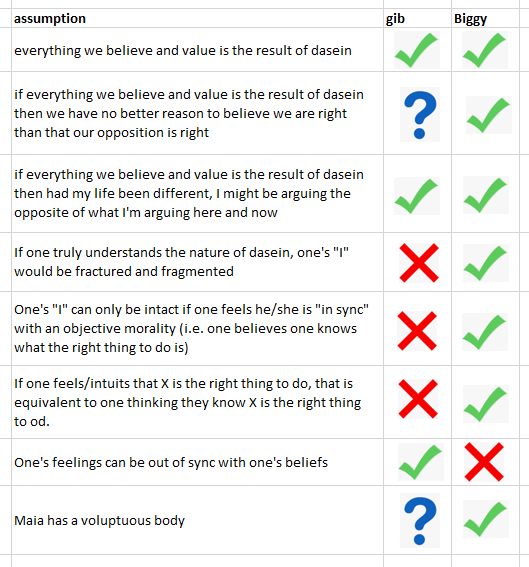
If arguments written in text are too obscure for you, and you can’t make heads or tails of my cloudy paragraph-sized explanations, maybe charts will help. Charts, tables, graphs, etc., are great for making clear in a precise, crisp, and succinct way potentially hard-to-understand textually or verbally expressed concepts. So I created the chart above for our reference. It consists of a small list of statements that we either agree with, disagree with, or are unsure about. If you or I agree with it, we find a check mark beside it under our name. If we disagree, then it’s a red X. I also allow for uncertainty with a blue question mark.
So first things first… looking at the graph, do you agree with my assessment on where you stand with respect to each statement?
Second… are there any other statements you’d like to add, and if so, where do you stand with respect to them?
This chart is a living breathing document. It is intended to grow as this discussion unfolds and can (and will) be brought into other discussions between you and I in other threads. This is gonna solve all our problems, Biggy, I can feel it!
Perhaps someone should finally explain what the term “dasein” means. It’s used hell of a lot but no explanations of what it means are ever provided beyond the simplistic, and rather unhelpful, “being-there”. For someone who’s obsessed with being down to earth, Biggy’s love of Heidegger’s horrific neologisms is mind-blowing. No respect for those of us who aren’t Nazis.
Maybe you should do it, Gib? You use it a lot. And given that you’re not averse to explanations, like Biggy is, chances are you will. I have my fingers crossed. After al, Gib is the opposite of Big. Maybe I should call you Gibby. The eternal battle between Gibby and Biggy. Like God vs Devil. Batman vs Joker. Tom vs Jerry.
I take it that “dasein” simply means “the sum of one’s experiences”. So when he speaks of things being subjectively rooted in dasein, he’s talking about beliefs being determined by one’s prior experiences.
Hardly a revelation. Pretty banal, in fact. Bit somehow, we are told, such a knowledge is supposed to make us “fractured and fragmented” a.k.a. confused.
You don’t want to get rid of the influence of your prior experiences on your decision making process. That would be silly as hell. Though you must make sure the influence is of the proper – i.e. logical – kind. What you want is to correct your mistakes by checking that you’re correctly reasoning and by acquiring new experiences while not forgetting prior. And to that end, it helps to listen to and talk with other people.
We haven’t defined dasein because we (Biggy and I) have been through it a few times before–pinning down what exactly he means by dasein–and though he took it initially from Heidegger, he’s since run with it in his own direction. I even remember the first time I asked him this question:
This is why I put a question mark in the chart above beside the statement “if everything we believe and value is the result of dasein then we have no better reason to believe we are right than that our opposition is right.” I’m not certain I agree with this. I mean, I get the point Biggy is making. We all feel certain about our strongest convictions, the one’s we’re willing to stand up for, to protest for; we all feel that the reasons backing up our convictions are logical and rock solid. This is no less true of our opposition than it is of our peers. So the feeling that our convictions must be true, rational, obvious, etc., is not a good indication that we are right. On the other hand, I don’t believe that all such convictions are equally (un)grounded. Obviously, some convictions are backed up with more justifications than others, with more evidence than others; some people have more and better sources for their convictions, based on more solid statistics and research than others, etc… In that sense, some convictions are more likely to be right than others.
+++Two words: sexual fetish. It’s not for nothing there are dozens and dozens of them. It wouldn’t surprise me if there was one in which people are turned on by blind people.
Disability fetishists and obsessives are not really news to those of us who spend time online.
If they weren’t so obvious and pathetic, my attitude might be a bit more positive. After all, I don’t regard my blindness as in any way unnatural or something to be ashamed of, so why should I object if someone finds it attractive? But, as I say, that’s the theory. In practice, they are very sad individuals.
“One’s-being-in-the-world” is a strange expression. It seems unnecessarily wordy. Where else can one’s being be but in the world? Nowhere, right? So it can be shortened to “one’s-being”. But then, “one’s-being” itself can be shortened to “oneself” because that’s what one’s being is – oneself. So “dasein” obviously means “Me, myself and Irene”. This is one of the reasons I can’t convince myself that Heidegger is worth reading. He’s one of those guys who likes to use excessively complicated language. And it surprise me that Biggy, who regularly complains about people on this forum and elsewhere being “up in the sky”, would endorse one of his terms.
Yeah, I’ve heard that explanation before. It’s not particularly good but it reinforces my idea that what he’s talking about is the sum of one’s experiences. These things do, in fact, determine our beliefs, but not completely, since our beliefs are also determined by the kind of “mapping” that is being employed (which can either be logical or illogical.) An illogical mapping would be someone whose experience consists of nothing but observations of white swans concluding that all swans are black. That’s an instance of illogical mapping. A logical one would be the same person concluding that all swans are white. Doesn’t matter whether that person is right or wrong, we’re merely talking about the correctness of their reasoning process, and not the veracity of its output. Biggy seems to think that the fact that our beliefs are grounded in personal experiences necessarily implies indoctrination. I beg to differ. Indoctrination refers to a type of influence over one’s belief system that has no regard for the effect it has on the level of intelligence of that person. It’s a negative type of influence because it stupefies; and it stupefies because it employs means such as teaching the person to reason incorrectly (the reasoning ability thus becomes weakened) and excessively limiting the flow of information (the person thus becomes insufficiently informed.) The goal of indoctrination is to spread beliefs no matter what (even if it decreases intelligence.) The goal of education is to increase the intelligence of people.
If John and Mary disagree, it is due to one or all of the following:
one or both of them reasons incorrectly
they have different experiences
You can resolve the disagreement by addressing the above. Ask them to expose their reasoning. This way, everyone can check whether they are reasoning correctly, but also, everyone can become aware of the differences in their experiences. That gives you something to work with.
Perhaps they are both wrong. Perhaps only one of them is. If they truly disagree, it’s logically impossible for them to be both right. By employing reasoning and taking advantage of your prior beliefs, you can form your very own belief as to which one is the case. Your belief will have a degree of certainty proportional to how much effort you have put into forming it. It may or may not be rational for you to act upon on such a belief.