I’d rather read. Your eyeballs and fingers have full instant control of stop, play and rewind at all times. I’ve listened to a few while travelling, but it’s usually personal biographies or something light, I’d rather read what you’re suggesting fully focused, in text form, and am now very much looking forward to it.
I need a break from logic and tech and all that bullshit, so this is a gift and a great idea.
Long live the Star Wars afficionados, and may the force be with them, always.
Grabbed it.. And people complain about technology? Whole lot was £4.99 FFS, a single beer used to cost me that, bet I get a lot more out of this..
You know (personal anecdote incoming).. I knew I had to take a break, to focus on something else for a while. I thought about diving into the (fragmented) works of a certain philosopher (Timon), or reading through that Christopher Hitchens Mother Teresa critique and fact checking it, but those are both goals. Why not something without a goal FFS?
I had just forgotten how the Universe works, this conversation shows that. You never have to look for anything, you just have to be patient. In fact, the best thing to do is forget what your wishes are after you’ve expressed them inwardly, and just let the Universe do its thing, don’t always expect a fixed delivery date. It usually solves everything beautifully, and sometimes in a way that means a lot on a personal level. You just have to be receptive and appreciative.
Am I a fruit loop? Asking seriously.
edit—Changed “mad” to “fruit loop”, mad means angry in America.
Trans-humanism, for me, is just a ridiculous fashion for the younger generation, one that is designed to annoy, or older ones who are very misguided. The amount of people who read Gibson or Dick, or Stephenson or even just played Cyberpunk 2077 and thought “This is how it’s going to be!”, is far too many. They are certain their destinies will be fulfilled through artificial means. It’s all fantastic until the power goes out.. Fannies. I think you overrate the Trans-humanists and their influence. Even the Scientologists don’t talk as much shit as them.
The optimistic version is that individuals find meaning in improving for its own sake.
I have in mind chess and go: Humans were surpassed by computers in chess 40 years ago, and about 10 years ago in go, and it’s pretty clear humans will never be competitive in either game again. There are computers that beat the best human players 100% of the time that are themselves beaten by yet-better computers 100% of the time.
And yet, the appeal of playing and learning and improving hasn’t changed. If anything, computers add to the game by helping people learn, and providing on-demand expert analysis that enhances both playing and watching games.
I think this also goes to worries about cognitive decline. People will get worse at lots of things, but there will still be outlets for cognitive function, and assuming our cognitive function evolved mostly for its social benefits (as I do), we should not expect it to decrease over generations.
I’ve followed this line of argument for a while, and while I kind of accept it, I have a hard time operationalizing it. I worry about my job because I can do something about that, change careers or reskill or whatever.
Even in terms of existential worries, my most salient concern is political and social instability, but again only because operationalizing that concern is relatively straightforward (support egalitarian policies and politicians, and oppose fascism and oligarchy).
But Yudkosky’s drum has long been that AIs are inherently an existential threat, and I don’t know what to do with that. Part of it is that it seems inevitable: assuming superintelligence is possible, it almost has a gravity that pulls us inexorably toward it. That fits with how we’re seeing it develop, and if so we’re already past the point of no return (again, assuming it’s possible).
But a real part is that I’m uncertain about the value of that future. If the alternatives are 1) a future in which humans are pets to superintelligent AIs, or 2) a future in which superintelligent AIs wipe out humanity and go on from there… I’m really not sure which I prefer.
And in light of the seeming inevitability, the other option seems to be 3) a world in which we take extreme measures to cripple the progress of AI technology, which is already widely distributed and deployed, and rapidly being advanced by independent actors around the world. That too seems like a bad future.
This is happening in parallel though. Remarkably capable AIs can already be run on low-power devices – an iPhone running a pre-trained model can convincingly pass the Turing Test without an internet connection. And a consumer grade gaming PC can run an open source model capable of recursive self-improvement. A number of Chinese models were rapidly bootstrapped using then-frontier models that are now surpassed by the leading open source models.
At this point, we’d need to destroy much more hardware than just the data centers to significantly slow things down.
I think this is becoming less and less true. In times of high uncertainty, with high and rapidly increasing recursion – companies building tech funded by companies using tech whose value is determined by independent judgments made by the tech – the causal pathway in prices is not at all straightforward.
It continues to affect fundraising throughout the life of the company, whether that’s through borrowing or selling additional shares down the line.
I agree with a lot of your criticisms, but I think this section underestimates the extent to which finance supports the production of “things of value in this world that others want”. I want the computer I’m reading and writing on, and it wouldn’t be possible without the elaborate financial system that enables the complex supply chain it take to build.
There’s a point where speculation becomes disconnected from value, and modern financial regulation has failed to keep pace with financial innovation. But the real economy is really dependent on a lot of highly abstracted financial transactions to allocate resources and mitigate risk.
Razors
Toothbrushes
Detergent
Basically every household cleaner
Nerf guns
Basically every non-electric childrens toy
Shoes
Food
Bandaids
Basically every medical product
Paint
Bikes
And that’s without taking cost into account. If we consider cost, it’s roughly everything (i.e. we can buy a product of similar quality for less, or a product of higher quality for the same price).
Yes but there humans were surpassed in specific areas, especially those involving purely rules-based logical deductions made at lightning speed, which computers are good at. But there’s just so much that’s just not practical or desirable for AIs to perform, we just have qualities that they can’t and never will be able to replicate, or become skilled at. Imaginative output is definitely one of those things, without question.
Yes, use them as tools, they can augment and supplement, just not be wholly depended upon.
I think we should be wary of losing any practical cognitive function. We should always know how to get things done without relying on AI altogether.
Then what are the data-centres for? Why localise and concentrate it all like that? Why the monolith? I want local LLMs, but I don’t want a Ferrari on steroids to power them, I’m out of that nonsense. Also, I just try to get the “Corpo” AI’s to do stuff with anon access, they usually can and need little prompting for most stuff, but I really need at least one local LLM, but can only be GGUF, no Ferrari required. Bet the leading open source models all need 12GB GPU or something..
I just want to know the purpose of the data-centres. To me, they make no sense.
The influence of transhumanism in our current world is huge and that is unfortunate because I view it to be the most dystopian philosophy to have ever existed.
Very few people are smarter than AI. I am one of the few who is smarter than AI, but only at a limited portion of the time. AI is often smarter than me, and also the sheer volume and speed that AI can research is faster than any human can do. Humans have to read data at a very slow pace while Ai reads the same data in only a few seconds.
The only way humans can outpace Ai is human cyborg, robot implants in their brain.
Technology is a tool, the point of a tool is to make any job easier. The Luddites, in the 19th century complained about automation taking their jobs. The whole point of automation was to take jobs.
The whole point of AI, is to make jobs easier and to take jobs. The point of AI is UBI.
There was a “no kings rally”, probably the largest protest in history, why is there not a “we need UBI” movement which could be an even larger protest than the no kings rally.
Who would own the automation, and how would you decide what the UBI amount is? Would there be different amounts given to different types of people based on qualifications? Could people receive it while also choosing to work and earn even more income? If there are human jobs, who owns them, and will they end up competing somehow with whoever owns the automation… or do human jobs only exist in sectors where automation isn’t used?
Markedly improved.. How have toothbrushes markedly improved? By becoming more “ergonomic”? Detergent washed the dishes / hair just fine.. household cleaners the same.. Can’t argue with Nerf guns, but children’s toys, are they more fun to play with? Are shoes much better? Maybe a bit, but Dr Marten’s were invented and you can’t really beat that for shoe technology.. Food? It was full of colourants and preservatives, now.. um.. Bandaids? Are they markedly better? They just have to keep dirt out and stay stuck on.. Are bikes markedly better? I mean they have got a lot more complicated, but is that always for the better?
Anyone who think the state will keep paying trillions a year in UBI payments to a population of people who don’t even produce anything and aren’t needed by the system anymore, rather than just killing those people off, is naive.
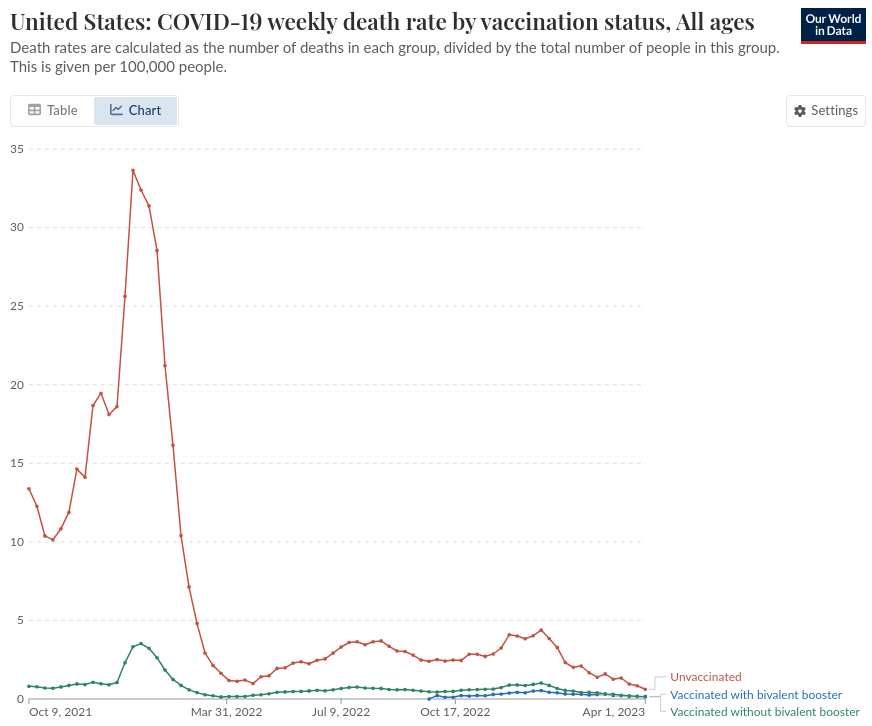
Well, that’s the worry. Some people believe that’s what the Covid trial was all about. They created a virus which spreads like wildfire, but was (mostly) harmless. Then they produced a vaccine which instead of insulating against the virus, seemed to make people more susceptible..
Are the vaccinated now more vulnerable to future strains? Why were they so keen on getting kids vaccinated?
Any of the above could be wrong, but haven’t seen much proof that it is.
Specificity limits the disruption, and the generalist AIs will break a lot of things. But it doesn’t seem relevant when thinking about how humans will feel if everything that we value is done better by computers. In the cases where we have some perspective on that question, we find that people feel fine doing something they know a computer could better. I think applies to keeping life interesting more generally: we still value human learning and creativity even where they are significantly surpassed by computers.
And I think you’re wrong about imaginative output being strictly the domain of humans. I find current-gen LLM output pretty imaginative, but even if you don’t, there’s nothing in principle that prevents further advances from surpassing humans there too. Imaginative output is a function of remixing and randomness.
Eh, I don’t know how to skin a rabbit and that doesn’t bother me. But if it did, I just asked Claude how to do it, and it provided what seem like reasonable step-by-step instructions.
I don’t mean to be flip. I agree that it would be a concern if humans will gradually lose the scaffolding that makes modern human intelligence possible. But I don’t think that will be the case so long human interaction with other humans determines reproductive success, and I’m not concerned with the loss of specific learned knowledge or abilities – if we need them again, we’ll learn them again.
In short, efficiencies of scale. Inference use a tone of data and processing, and even running the large models uses a lot. Small efficiencies add up. And that includes both efficiencies in resources (human and physical) and efficiencies of control.
It’s interesting they tend to cluster near cities. I’d have thought some sunny plain would make more sense. But I guess at high I/O volumes, the distance to users must start to play a significant role.
This is somewhat subjective, I’ll take a stab at justifying my earlier list:
Toothbrushes: Better materials generally. Diversity of bristle stiffness, both between and across brushes. Contoured heads. And yes, contoured handles.
Detergent: Biodegradable, color-safe, less harsh, moisturizing, concentrated.
Household cleaners: safer (for surfaces and people), smell better, easier to use (e.g. better spray nozzles), more diversity/special purpose.
Other childrens toys: Diversity and availability is a big part of this, but anything with moving parts (especially ball-bearings) is more reliable, materials are lighter and stronger. I think they are more fun to play with, and it’s just hidden by the fact that screens are so much more compelling.
Shoes: Again, materials are much better. Stronger, lighter, breath better. Doc Marten’s are fine for what they are, but you can’t really jog in them. Diversity again does a lot of work.
Food: Quick-prep meals are significantly better. Food quality is higher and more consistent. Average nutrition is higher, and easier to achieve nutrition without sacrificing taste. Easier to avoid specific ingredients without sacrificing tastes. Diversity again.
Bandaids: More flexible, stick better, breath better. Easier to apply. Diversity of shapes, sizes, styles.
Bikes: Lighter, better and more consistent build quality. Improvement in materials (steel to aluminum, carbon fiber). Brakes are much better and more reliable. Gear shifters are better and more reliable. Shocks on mountain bikes.
Granted, some of these are more “marked” than others, though I think price has decrease markedly for equivalent items across all of them. And the value of a diversity of offerings is easy to underestimate.
I’ve said this before, but one of the benefits of UBI is not making this determination. Giving everyone the UBI and increases taxes to offset the difference is more efficient.
You open with speculation, I always try to avoid that when discussing AI, it takes far too much for granted. There’s a difference between a “possibility” and a “certainty”. I don’t consider either AGI or ASI to be certainties, so I don’t factor them in. I think we should be very wary of placing AI on a pedestal above ourselves, and attributing qualities to it that don’t currently exist, and might never exist, it is completely unknown at this stage.
I think you are vastly oversimplifying that. Our imaginative output is not constrained by previous knowledge, and is not just a “remix” of previous experience. I’ll agree with the “randomness”, but as you well know, computers are not capable of producing randomness, just a facsimile of it, whereas humans are. Many human works can be pointed to that AI just couldn’t have come up with, as it would not have the data in it’s “soup” to do so. We don’t just rehash the old to come up with the completely new, we are capable of making leaps of imagination that AI is clearly not, and we possess inherent qualities to allow that to happen. We don’t even understand fully what those qualities are, so how can they be simulated via AI?
It’s the “thinking for you” aspect that I find worrying. AI is a great tool for checking / critiquing logic and reasoning, but it shouldn’t be the originator of those things, and I find when it is left to do such things as tasks, it often fails due to false assumptions. If we can’t solve a problem without “asking the AI”, then we are in big trouble, that’s my impression.
Thank you, that is very interesting. When I ask about the data-centres, it’s out of legitimate curiosity, it still doesn’t feel like a very long-term or resilient solution, although I agree that under the circumstances it’s more efficient.
OK, this is probably to be taken less seriously, it was certainly presented as so, but when I say “markedly improved”, what I mean is in a “quality of life” way. What I’m thinking of is things I could use just fine without pining for the modern equivalents..
It’s a fair cop. I haven’t looked at the data, I’ve just always thought there was something “fucky” about the whole thing, and I should probably shut up about it until I do know more. What I said sounds like what someone would say on X, so thanks for the course correction.
Sorry about simply posting a video, but I think it’s very relevant to the topic:
A virtual influencer / companion creator who grew a conscience..
“My impulse is to choose something real and flawed, over something synthetic and perfect. If you come across that impulse in yourself, then please, protect it. Your new best friend is perfect, and you deserve so much worse than that.”
 I’ve listened to a few while travelling, but it’s usually personal biographies or something light, I’d rather read what you’re suggesting fully focused, in text form, and am now very much looking forward to it.