if we do move forward with stem cell research and get to the point where we can cure all illnesses, what will happen to people? i mean will people die? Couldn’t the stem cell be used as an “Elixir of Life” and be used to “cure” old age. What will happen to the population of the planet, i mean so many births and so few deaths. Can we get to the point of overpopulation?
There will always be some new disease out killing everyone.
actually the government currently stigmatizes such research and goes beyond blackballing any grant money, they blackball any donated money.
we here in the states like to turn the other cheek to promising technology if it threatens the sanctity of the “soul”.
meanwhile, other countries will develop the cures and all the brightest and best will move to that country while this one rots away to become a service nation. ^-^
While that is related, I think it’s not unjustified to give people the highest quality of life possible.
not to sound “overbearing”, but perhaps those of you standing against said research, would feel differently if it held the promise of a better life for you?
Why did Hwang Woo Suk have his paper recalled? Faked data. He said that he had created 8 personalized stem cell lines via nuclear transfer . . . He hadn’t. Totally fabricated, a complete and utter lie. Pretty crazy, eh?
Yes, I didn’t realise it was that bad.
I suppose it would end up just being organs cloned. People being cloned are fine, a sentient being is a sentient being it does not matter how you got here.
I hate to think of scientists bowing before what some think of as immoral research when, it is desperately needed, so that man may move forward.
Purse strings are hard on pure research and development also. It is a shame that science could not be socialized Pangovernment.
Yeah, just cloning organs is the way to go. Most likely through transgenic pigs. Can’t commodify a commodity.
As for scientists bowing out of what some consider immoral research, this really doesn’t happen by choice . . . ever. Nazi scientists were really at the top of their field, and they wanted some questions answered, so they went ahead and did it. While that was an extreme case, it replays itself in many small ways everyday. Scientists don’t think of science as an ethical persuit, so they will research what interests them, concequences-be-damned. Granted, it takes that kind of drive to work through the hours at the bench, but I do think SOME ethical understanding is a good thing.
The only time a scientist won’t pursue their interest is if the purse strings get cut. Pure-and-simple. I can’t think of a single scientist who stopped his research because he thought it might lead to negative concequences. It is simply not in our nature.
is letting people die when you have the technology to save them moral?
same question.
i was wondering, do the stem cells have the ability to alter people’s DNA, well basically wat i mean is that, if we use stem cells to rid of all these horrible diseases, then will our bodies become weaker since the white blood cells and our bodies natural fighters won’t have a job to do, so we might stop producing them. Which in later generations could make us very week as we become dependent on these excess stem cells and our bodies have evolved to be reliant on excess stem cells to cure us?
Yes, it is.
See, that’s taking it a bit too far. Nobody is suggesting using stem cells as replacements for antibiotics . . . and even if they were, bacteria are to quick-evolving for us to ever surpass them. Stem cells are more about diseases our bodies can’t cure on their own. . . period. Alzheimers, diabetes, parkinsons. These are death sentences. Plus, with the exception of diabetes (the most begin of the bunch), they all manifest themselves post-breeding anyway . . . so it’s not like we’ll become anymore dependent than we already are. We’ll just live longer.
I feel retro so lets bump this old and forgotten thread. Have opinions changed? For me not so much. I do think since it will be done it needs to have more than one group or govt doing it.
It is outdated, Kris–which shows how much science has advanced in the last 6 yrs.! But it still seems to be a misunderstood topic for a lot of people. Should a new thread be started based on today’s science? 
I’d be more than happy to answer any questions people have about it.
Okay, can stem cells only be extracted from aborted fetuses or can they not also be extracted from the umbilical cord material left after a live birth? Is the mother free to donate the umbilical cord as an organ donation?
We’ll start with that. 
Good questions!
First off, it isn’t a fetus that gets aborted, it is an embryo. There are critical differences between the two.
This is a fetus:
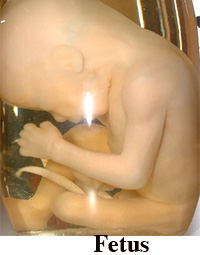
I wouldn’t call that thing a human but that case can certainly be made in a very effective manner.
This is an embryo:
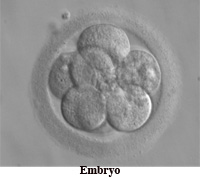
That is a clump of cells and in no way shape or form human in any meaningful sense. Any case of that being human is going to hing pretty heavily on either the potentiality argument or the ensoulment argument. It is a mass of cells, no more worthy of moral consideration than a mole growing on my skin.
And most embryonic stem cell lines aren’t created from “aborted” cells, in the normal sense of the term abortion. They aren’t in women at the time. To increase the chances of success during in vitro fertilization, many eggs are fertilized and allowed to develop to the embryonic state before transplantation into the mother. But, only the best looking ones are transplanted to increase the chance of success. The other embryos are thrown away. Or turned into embryonic stem cell lines.
Does that make sense?
Now, you are correct that the umbilical cord is a good source of stem cells, but they aren’t embryonic stem cells they are hematopoietic (blood producing) stem cells. An embryonic stem cell can give rise to every cell type in the body and can develop into an entire organism (this is theoretical with human embryonic stem cells since attempting it would have rather obvious ethical complications). Adult stem cells, on the other hand, have more restricted lineages. For example, a neuronal stem cell can give rise to any cell type found in the brain; a hematopoietic stem cell can give rise to any type of blood cell and so on. It is strange to think of hematopoietic stem cells from the umbilical cord as “adult” stem cells but that is how they are classified. Hematopoietic stem cells found in the umbilical cord have been shown to be helpful with a variety of conditions like leukemia and blood disorders like fanconi anemia. But if someone had a neurological disorder like Parkinson’s disease where the substantia nigra in the brain has atrophied, hematopoietic stem cells would be useless. That is why totipotent stem cells like embryonic stem cells are so important: because they can be used to create any other type of stem cell and thus, any other type of tissue.
Interestingly, there is now something called an induced pluripotent stem cell (iPS). Stromal cells or adult stem cells can be reprogrammed by using viruses to modulate the expression of certain genes and be turned into something that resembles an embryonic stem cell. This field is still on going but in order to understand what is going on in this situation, it is important for us to understand the cell type we are trying to recreate: the embryonic stem cell. Umbilical cords can be donated but umbilical cord banking is big business, so most of them are either stored on a for-profit basis or for the family’s own future use. Though umbilical cords are donated all the time for research purposes.
Is that helpful?
It’s exactly what I asked for Xunz. Most abortions occur during the embryonic stage of development–i.e., the first trimester. if I recall the hysteria of six or seven years ago it had to do with first trimester abortions simply to reap the stem cells. I think there was also some fear that women would become impregnated in order to abort in order to provide stem cells–and get paid for it.
BTW, title of the thread is “Is Stem Cell Research Morally Justified,”–It makes no distinction about where those cell come from. If a doctor aborts an embryo, puts that small mass of tissue into a kidney pan for disposal, is s/he more morally at fault that the doctor who freezes the embryo for research purposes?
I’ve answered this question to myself, but never told anyone. So I’ve made a bunch of points based on prior posts in this topic to express it.
Xun made a good distinction about potentionality and how if we had the potential to make a fetus from a type of cell, if potentionality == actuality, every time we didn’t let that type of cell actualize, it would be murder and therefore, every living being is a mass murderer. This doesn’t seem rational, therefore, I don’t relate to it.
Eugenics was mentioned. I don’t eugenics is wrong, it’s a just a tool that can be used to help life, or hurt life. A hammer is not evil, even though it can be used to bash someone’s head in. Again, potentionality != actuality. If we are wise, we can embrace technology without hurting ourselves.
The book ‘Time Machine’ was referenced. It describes the future of our species being in a state of numbness. BMW-Guy, the poster, described this as a recession of the species as opposed to advancement. To this I would say, in the current time, we don’t have the technology they did in the fictional future, and they did what they did as a reaction to the present. I find it difficult to see a reaction as being regression. I would say it’s not. Therefore, numbness is not regression.
When will technology end? BMW asks. - Either, with man, or with the end of life. Depending on how you want to define technology.
Kris made a good post about the neutrality of science. Science is neutral, scientists aren’t.
Tab: “It will happen somewhere, then it will happen everywhere. Few care about morality in the face of death.” - Is morality not defined by what causes death/suffering?
Mastriani says technology is bad because that was it’s only intent. Musical intruments are type of technology. Spectacles. Vitamins. Chairs. Paper. Lamps. Blinds. Heating. Houses. Clothes. Cars. Umbrellas. To dismiss technology based on certain applications is unfair. Technology is an extension of our ability. We desire something that we might not be so well adapted for, so we bridge that gap with technology. If anything, technology bridges the difference between the self, and the ideal self. If you desire war, technology can enable. But, it is not technology, that is the source of the problem.
Overpopulation was mentioned. There is no definition of what the planet can support. If there were, then we’d have a way to gauge what and when overpopulation occurs. If people don’t die, and keep reproducing, the planet is finite, and therefore will eventually disallow us to continue this practice. Again, we must be wise, and learn how to live in synergy with the planet, if we don’t, that’s our problem, not the problem of technology.
‘Nobody’ says: there’s always a disease killing someone. Yes, and if there’s always a disease killing someone, there’s always a someone fighting said disease.
Xunzian says Science needs ethics and that Science isn’t immoral. Scientists need ethics, scientist aren’t immoral. There’s a distinction.
cba1067950 asks: “Is letting people die when you have the technology to save them moral?” Depends on what they want, and the effects of the choice.
FtheNaysayers answers: “Yes, it is.” - Again, depends on the circumstances.
If you haven’t gathered my position from the above statements. My answer is yes, Stem Cell research CAN be morally justified, and I think it is.
Good posts! With education the answers change. So the purpose of keeping people ignorant of facts is control.
The subject of ethics and morals on using embryonic stem cells depends upon fact vs. religion/ education. How about its fine to use them for certain well defined medical issues. Cloning? Depends. Extending life well beyond norm., depends.