Okay, I’ll give it a shot, though we both know it will be pure speculation. 
With that being said, let me first introduce a little bit of information I acquired a while back regarding black holes…
According to an article on the website “LIVESCIENCE,” it is estimated that…
“…40,000,000,000,000,000,000, or 40 quintillion, stellar-mass black holes populate the observable universe…”
https://www.livescience.com/researchers … 20universe
Now, with the above in mind, I suggest that black holes might be the proverbial (and primary) “pistons,” so to speak, that help turn the metaphorical “crankshaft” of the great engine of the universe.
In other words, black holes might be one of the primary means by which the kinetic movement of the very fabric of reality is achieved.
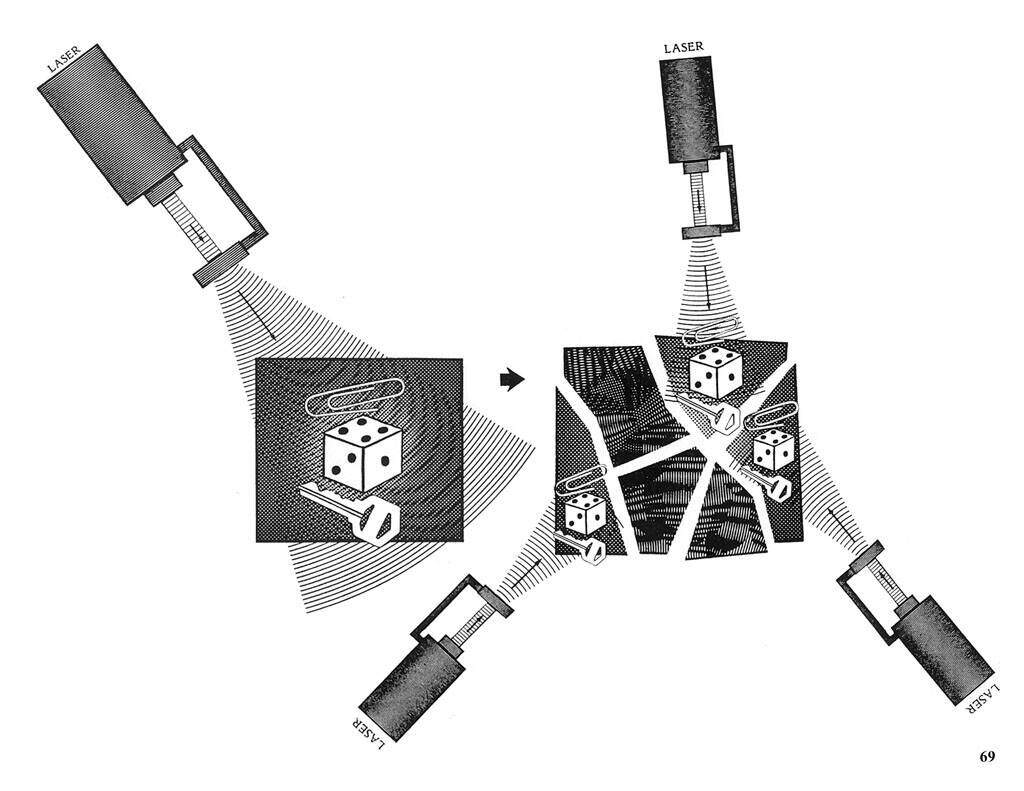
To explain why I say that, as you know, I’m a big fan of using the right-hand side of my laser hologram illustration…
…as a tool to help us visualize quantum entanglement.
Furthermore, the alleged existence of quantum entanglement has led to (or at least implied) the hypothesis that at the deepest level of reality,…
(the “non-local,” informationally-based level of matter)
…everything in the universe might be seamlessly connected (enmeshed) in a manner that is loosely similar to how the key, and the die, and the paperclip are connected at the informational level of the hologram.
Now, to better understand what I am getting at, allow me to copy and paste something that ChatGPT said in my “Tugging on the Quantum Web” thread…
A laser-encoded hologram contains three objects—a die, a key, and a paperclip—all embedded in a single emulsion. If the plate is shattered, each piece still encodes the entire image. This reflects a kind of informational unity: the parts are not separable in a classical sense.
Now imagine trying to rotate the key within that plate. Because the key’s representation is entangled with that of the die and paperclip, altering one part requires recalculating the entire structure. You can’t just twist the key—you must shift the total field of encoded relationships.
This metaphor captures the challenge of moving an object at relativistic speeds. The object’s quantum state is deeply interwoven with the rest of the universe. As its velocity increases, the burden of recalculating its new relationships across the entangled web grows. The mass increase described by relativity may be a symptom of this growing computational cost.
To add to that, even though physicist Paul Dirak allegedly had gravity in mind when he made the following poetic statement regarding the interconnectedness of the universe,…
…nevertheless, the point is that because the underlying fabric of matter seems to exist in an interpenetrating state of “oneness” → so much so that the mere picking of a flower on Earth might move the farthest star in some miniscule way…
…then just imagine the dynamic (roiling, churning, moving) effect that 40 quintillion black holes would have on the entangled underpinning of the universe as they violently transform matter from its highly ordered, three-dimensional state of existence up here in the context of “local” reality, and then back into the '“non-local” raw essence from which the phenomenal features of our “local” reality are formed.
Again, we’re just speculating here, but the point is that the black holes could very well be the essential (built-in / designed) sources of power that provide the kinetic impetus that keeps the whole system in dynamic motion.
Now, another option having to do with the purpose of black holes comes from the fact that there has always been this persistent mystery of what happens to the matter and light that crosses the event horizon of a black hole?
Well, as silly as this may sound, aside from black holes functioning as the metaphorical “pistons” of the universe, perhaps they may also function as the cosmic “recycling bins” for the very foundational essence from which the stars, and planets, and our bodies and brains, etc., are created.
Someone came up with the following GIF to demonstrate the “not-so-empty” status of the vacuum of space…
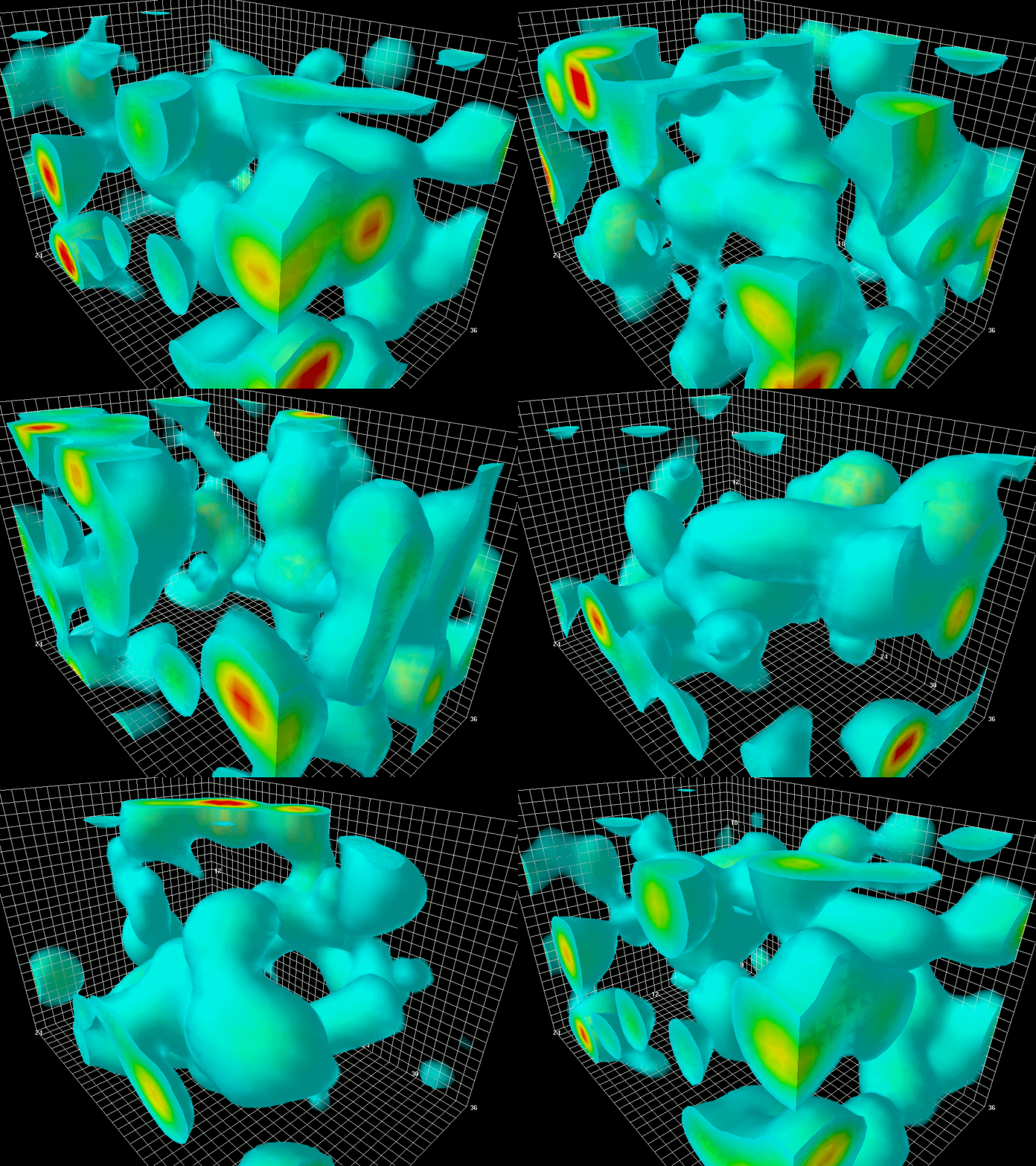
In which case, is it not possible that the matter and light that disappears into a black hole is simply dismantled and reduced back into, again, the infinitely malleable essence from which our 3-D reality is created?
Anyway, in conclusion of my speculative guesses regarding the purpose of black holes,…
…not only might black holes be the metaphorical “pistons” that help keep the cogs and gears of the great engine of the universe moving,…
…but, again, they may also function as the cosmic “recycling bins” where the very foundational essence from which our “local” reality is formed is stripped of its phenomenal attributes and then added back into the oneness of the roiling and churning substance depicted in the vacuum GIF.
We’re talking about a “non-local” (holographic-like), informationally-based substance that is then reused in the formation of something new somewhere else up at the “local” level of reality.
You always give me shitloads to think about. Thanks for your response, I appreciate it.