nothing is omnipresent

nothing is omnipresent

omnipresence itself is a given, all things are present. that something is or has omnipresence contradicts this…

can we have something that is omnipresence other than omnipresence itself? in order to do so we must extrapolate ‘x’ presence from omnipresence ~ let us imagine a circle within which are all presences, to make a given thing have the quality of omnipresence we must take it outside of that circle, which is an impossible conclusion to draw.

the same applies to omnipotence; to have anything of any description that has potency over anything within our circle, we have to first take from within that. considering that all potencies are within the circle this to is impossible.
if were were to do so then we have two instances of ‘x’ being ‘x’, of presence or potency being itself when it already is itself.

fig 1
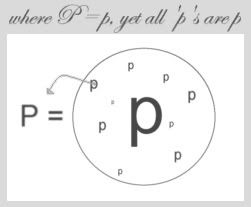
p = property

omniscience
to have all knowledge we must first be in a position where all knowledge is present. to arrive there time must have ended and no more events may ever occur, as each new event would represent a new item of knowledge.

the only exception to the rule is where all possible items of knowledge are understood in a predetermined fashion. for example we may understand something we don’t know by adding together other items of knowledge that we do know. this is only an estimation of the unknown knowledgeable item and can never be absolute knowledge of that even if the information provided by the deduction is correct.

an unknown item of knowledge must always have a ‘strange’ aspect, no two instances can be exactly the same, all things hold their own positions relative to one another and cannot occupy the same space.

infinite historical accuracy; the above would not be true if we were beyond time looking back upon the history of knowledgeable items. or if we were looking down - so to say, upon all-time and all events and hence all knowledge.

as we have discussed before; there is no exact knowledge, so there is never absolute knowledge of all things even if we could view existence from an extraneous/infinite perspective.
secondly there are hidden knowledgeable items, in our primary formula (fig 1) we note that P cannot = p, hence there cannot be a position of the onlooker which is outside of the omni-perspectile view. infinity would not be outside of the circle and no observation from point x may observe itself nor other obscured entities.

note. nothing is also within the circle, there can be nothing outside of it. then that there is nothing between all things within the circle and hence all ‘p’s are connected as there is nothing to separate them except self imposed definitions and limits.

the end of all things has already happened, time is not linear, nor is knowledge. Nothing encapsulates all things. Nothing is all.

as in all-time exists yes. personally i can’t except that little bubble of existence, or the notion of ‘all-time’ ~ another debate perhaps. you still can’t have anything outside of the circle looking in as there is no outside, hence nothing to know all knowledge, then if an item of knowledge can be truly known.

how can nothing be ‘all’ i could say something is all and be nearer the truth, and any given something is not a nothing.

i would agree though that in essence we only have a nothing being acted upon by law and principles thence becoming energy and other descriptive entities. i just don’t think nothing nor something describes ‘it’.

This is the same argument we had on the religious forum in a different form I belive. Something can be omnipresent as it does not have to be taken out of omnipresence it simply must be by definition omnipresence itself. Much the same as in our previous argument that God could not be outside of reality. He does not have to be, just has to be reality itself.

There was an argument I heard once that explains how nothing and everything are infact one in the same or at least could be in theory. It works on the principle that everything is in ballence so for every positive there is a negative of equal preportions to eqaulise the ballence. With this in mind, if one were to view all properties of the universe at the same time. (in other words, to see it as a whole) they would infact see nothing as everything cancels everything out.

1-1+1-1+1-1=0

rhinoboy

yes i agree, i read that somewhere too, and a similar one for energy = zero overall [perhaps the same theory].

i must of missed that, this idea comes off the back of a debate about karma at another forum. never the less i disagree; the only thing that can be omnipresent surely is omnipresence itself. it is not a thing or an entity, only a description of a state of presence which all things possess, albeit where the term ‘presence’ itself is a rather loose definition. i feel the idea carries to the indefinitive ‘x’ of an entity. as to reality, again if we attribute something else to it, then it is not ‘reality’ it is that something else. if we call it god then that definition has to be exactly the same as what we mean by the term ‘reality’, or we are making a false description of ‘it’.

The enlightened man agrees that nothing is omnipresent, omnipotent or omniscient. But not for the reasons you’ve given.

Not so. For they can be one in the same. If we are to use God as an example, we can say that he is all things as a collective. There is no need to describe him as anything else outside of this

the enlightened man explains exactly why this is so. :smiley:

i would say that all of these qualities are true, but only as themselves rather than something possessing them ~ which is the main thrust of my argument.


see above and…
i see the point, yet are we not imagining a vague entity and labelling it god so as to say it may possess certain qualities. to me its a bit like saying god = E=MC2, he does not the formula only means what it means, refferring only to its own constitute parts.

why look at is as a bubble? or any shape for that matter. all is all until there is nothing, then nothing is still apart of all, it all goes way past what we grasp or could ever hope to grasp and if that is so then why is not all the ultimate sentience? I No bubble no end nor barrier anywhere or time just 1 or 0 or whole or empty. knowledge of any kind is just a piece of something else and something else is a piece of something else etc. One part of a whole or nothing and it is with out a doubt sentient. How could it all not be?

Right, like any absolute concept, its meaning dissolves into tautology. It simply is whatever it is, which makes speaking of it either misleadingly reductive or totally redundant. There is no philosophy in a world of absolutes.

Can a philosopher argue for or against the Case for “God” without actually believing in the Spirit of “God”? :-s

i’d venture that probably depends on what you mean by Spirit, no?

I don’t see why not, I do it all the time :smiley:

Of course, but people always assume that they know what they’re talking about (even when they don’t).

i agree [i dont think of the line of the circle as in any way existent, as like the universe is not a bubble nor contained], this idea is in the title ‘nothing’ is omnipresent in its second meaning. i would say that the whole is nothing, just as energy overall equates as 0, and as you say time too.

a cube is a cube even to god - so to say. so a principle is a principle, it doesn’t matter if there is a load of stuff we don’t know as that stuff either falls into the definition or it does not. i would like to know what exactly we cannot understand? the problem with this argument is that it makes a vague presumption that other things will interfere with the known, i would state that occult factors may be added on top of what we have yet cannot contradict it ~ where it is true.

i am torn between this idea and one whereby it appears to be sentient because it is all so well engineered. i wonder if it is even aware as much as conscious and perceiving.

well i would hate for the latter to be true, i am nothing if totally against dogma. as i see it though, this idea stops dogma and is no different to 2 + 2 = 4 except not as definative.

as i said before the idea comes off the back of a few ideas e.g. karma, or a matrix god etc, where we have controlling factors rather than a natural flow of self determined entities bound together by universal principles that stop existence being a dictatorship!!!

yes, one may have the idea of it. just as one may have the idea of flying pink elephants. apart from which who said i didn’t believe in god? i just think that if there is a god it is not a taker of freedoms ~ quite the opposite.

‘the greatest wisdom of god is that all things add up to the greatest wisdom of god’

so what is the wisest kind of god. for me it is all in the title ‘nothing’ is omnipresent in its 3rd notion; god may be everywhere but not in any specific instance i.e. of presence. so you can have a kind of g?d that is nothing just as nirvana is nothing yet at the same time the highest kind of awareness. nirvana though does not interfere with us or existence as the god of the bible does.

jus evolving ideas people.

edit; i have made a slight amendment to the op i had forgot, doh.

thought i would also add this…
in a spiritual context the inferred meaning that ‘nothing’ is omnipresent would suggest to me only a philosophical space may occupy all areas without being doubly present in all properties. the spirit may be thought of as that space, then that it may make utility of all properties within the eternal circle [as fig 1].

the above formula then does not deny eternity nor spirit, just provides us with a more elegant explanation - if i may.

Ideas are always good even if they appear to be bad ones, there are no bad questions if someone learns.

One body working as one with many seperate parts. Although it may appear to us that there is conflict, it is quite possible that conflict is needed.

The religious differences may be needed.What if there is only truly one true sentience existing, then our sentience is not ours but, part of a whole.

In your figure one, the circle, Note that what is outside is still part of the circle. There is a meeting.

firstly we would need to break down the meaning of the term sentience, in my mind we would end up with the philosophical space as described above. we would end with an empiness that is the original spirit, rather than us belonging to it or sentience not being ours it would not be anyones not even gods.

i love anarchism :smiley: .

there is no outside of the circle by any definition whatsoever, otherwise this would donate a primary dualism where ‘duality does not exist’ [i state].

Then you must define God.

But leaving God alone for a sec. Your innitial argument is that nothing can be truely omnipresent. What about we just group eveerything together into one whole and label it as such. Does this not have omnipresence?