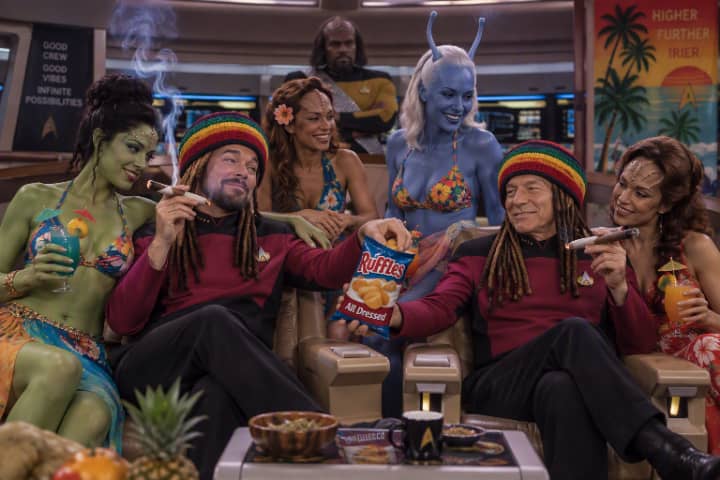
If you take the story of Star Trek, it is about a restart of a civilisation that nearly wiped itself out but managed to create a utopia after first contact. It then intends to go out and discover the universe but quickly encounters oppressive species (Klingons, Andorians, Cardassian, Romulan and of course the Borg) which despise the liberal utopia of the Federation and see them as a threat to their power. Similarities with Trump and Putin are coincidental.
I have always thought Contact was an underrated film, although perhaps not an unpopular one. What I found particularly fascinating about it was that it explored a very different possibility of encountering an extraterrestrial civilisation: not simply a species more technologically advanced than humanity, but one whose understanding of existence, knowledge and the universe might be so far beyond ours that we would struggle even to comprehend it. Rather than presenting an alien invasion or an immediate threat, it explored the profound implications of making contact with an intelligence that had evolved far beyond our own. It also raised an interesting question about the relationship between science, faith and the limits of human understanding.
The interesting thing is how differently some of the great science-fiction films have approached our relationship with intelligence, whether artificial or extraterrestrial. 2001: A Space Odyssey was, in many respects, a story about humanity’s evolution, from its primitive beginnings to the possibility of a further evolutionary transformation. Yet it also introduced HAL, an artificial intelligence created by humanity that eventually became a threat to its creators. There was something particularly unsettling about that relationship: we had developed an intelligence capable of operating beyond our own limitations but had not necessarily developed the wisdom to understand or control what we had created.
Blade Runner approached the question from another direction. Here, artificial beings had become sufficiently advanced to look, feel and behave like human beings, yet they were treated as little more than manufactured slaves. The irony was that Rick Deckard, the man employed to hunt down and eliminate these androids, might himself be one of them. The film therefore raises a much deeper question about identity and consciousness. What actually makes us human? Is it our biological origins, our memories, our capacity to feel, or our ability to recognise the humanity of another being? If an artificial being can experience love, fear, suffering and the desire to live, on what grounds do we deny it the same dignity we claim for ourselves?
Then there is Arrival, which takes the encounter with an extraterrestrial intelligence into an altogether different philosophical territory. The visitors possess a language that fundamentally alters the way they experience time. Rather than experiencing existence as a linear progression from past to present to future, they perceive it in its entirety. Humanity, however, struggles to understand this possibility, largely because we are so accustomed to interpreting reality through the limitations of our own experience. The tragedy, if there is one, is not that the visitors threaten humanity, but that humanity repeatedly risks failing to understand what is being offered because it cannot move beyond its own assumptions.
What connects these films, for me, is that none of them is really just about aliens or artificial intelligence. They are about humanity confronting the limitations of its own understanding. Each asks us to consider what might happen when we encounter an intelligence that challenges our assumptions about consciousness, identity, time and existence itself.
Perhaps the most interesting possibility is that the greatest obstacle to our development might not be a lack of intelligence or technological sophistication, but our difficulty in recognising that reality could be considerably more complex than the framework through which we currently perceive it. We keep creating things that challenge our understanding of what it means to be human, yet we seem remarkably reluctant to question the assumptions upon which that understanding rests.
Since H. G. Wells, popular science fiction has often been less about predicting the future than using an imagined future to examine the shortcomings of the present. It creates alternative worlds in which humanity can confront its existing social, political and moral arrangements, and perhaps imagine overcoming them.
Wells was particularly important in establishing this tradition. In The Time Machine, he used the distant future to explore class division and the consequences of social inequality. In The War of the Worlds, humanity suddenly found itself in the position of a technologically inferior civilisation, inviting readers to reconsider the arrogance of imperialism. In The Island of Doctor Moreau, he explored the boundaries between civilisation, humanity and the animal condition.
That tradition subsequently developed in several directions:
- Utopian possibilities: Writers such as Ursula K. Le Guin imagined societies organised around fundamentally different values, challenging assumptions about hierarchy, gender, ownership and power.
- Dystopian warnings: George Orwell and Aldous Huxley explored how political authority, technology and social conditioning might become instruments of oppression.
- Technological emancipation: Much of science fiction has explored whether technological development might release humanity from drudgery, scarcity and the limitations of biology.
- Evolutionary possibilities: Writers and filmmakers have considered whether humanity might eventually transcend its present limitations, biologically, intellectually or spiritually.
What I find interesting about these films is that they take this tradition a step further. Contact, 2001, Blade Runner and Arrival are not simply imagining a better organised human society. They are questioning whether humanity’s existing understanding of itself is sufficient for the next stage of its development.
There is perhaps a distinction worth making here. Much popular science fiction imagines overcoming oppression by changing the world around us. The more philosophically ambitious examples ask whether we must also change the way we perceive the world, and our place within it. It suggests that the future of humanity may depend not simply on what we invent, what political systems we establish or how much technological power we acquire, but on whether our consciousness, empathy and capacity for cooperation develop alongside them.



 You are way behind the play with your ‘3 genders’ comment. The alien race had three sexes. It was their biology. Didn’t you know that the number of ‘genders’ is limited only by one’s imagination? I believe that at this time there are 72 but it’s going up all the time.