# Stopped Clock Paradox - Analysis
**URL:** https://www.ilovephilosophy.com/t/stopped-clock-paradox-analysis/37079
**Category:** Science, Technology, and Math
**Created:** [October 13, 2013, 7:57pm UTC](https://www.ilovephilosophy.com/t/stopped-clock-paradox-analysis/37079 "2013-10-13T19:57:04Z")
**Posts on this page:** 20
**Page:** 2
### Author:  [@James\_S\_Saint](https://www.ilovephilosophy.com/u/James_S_Saint)
#### Post date: [October 14, 2013, 2:53pm UTC](https://www.ilovephilosophy.com/t/stopped-clock-paradox-analysis/37079/21 "2013-10-14T14:53:16Z")
> [@phyllo](#):
>
> > [@](#):
> >
> > It is one event SEEN differently by different observers.
> >
> > If I show you a picture of what a clear sighted person sees as an object and in the same picture frame include what a visually impaired person sees as that same object, are there two objects? Or merely one object seen differently by different people?
> >
> > The triggering is a single event, but it appears to occur at different locations by each observer.
>
> Read this and read about relativity of simultaneity. Notice how similar the concepts are. Phrases like ‘SEEN differently by different observers’ and ‘appears to occur at different locations’ are leading to certain logical conclusions.
The difference is that SR proposes that whatever is perceived IS what reality is, regardless of any logic.
> [@James S Saint](#):
>
> Wiki is often presumptuous and erroneous. Read Einstein’s words;
>
> > [@](#):
> >
> > IX. The Relativity of Simultaneity
> >
> > UP to now our considerations have been referred to a particular body of reference, which we have styled a “railway embankment.” We suppose a very long train travelling along the rails with the constant velocity v and in the direction indicated in Fig. 1. People travelling in this train will with advantage use the train as a rigid reference-body (co-ordinate system); they regard all events in reference to the train. Then every event which takes place along the line also takes place at a particular point of the train. Also the definition of simultaneity can be given relative to the train in exactly the same way as with respect to the embankment. As a natural consequence, however, the following question arises: 1
> > Are two events (e.g. the two strokes of lightning A and B) which are simultaneous with reference to the railway embankment also simultaneous relatively to the train? We shall show directly that the answer must be in the negative.
> >
> > 
> > FIG. 1.
> >
> > ```
> > 2
> >
> > ```
> >
> > When we say that the lightning strokes A and B are simultaneous with respect to the embankment, we mean: the rays of light emitted at the places A and B, where the lightning occurs, meet each other at the mid-point M of the length A —\> B of the embankment. But the events A and B also correspond to positions A and B on the train. Let M’ be the mid-point of the distance A —\> B on the travelling train. Just when the flashes 1 of lightning occur, this point M’ naturally coincides with the point M, but it moves towards the right in the diagram with the velocity v of the train. If an observer sitting in the position M’ in the train did not possess this velocity, then he would remain permanently at M, and the light rays emitted by the flashes of lightning A and B would reach him simultaneously, i.e. they would meet just where he is situated. Now in reality (considered with reference to the railway embankment) he is hastening towards the beam of light coming from B, whilst he is riding on ahead of the beam of light coming from A. Hence the observer will see the beam of light emitted from B earlier than he will see that emitted from A. Observers who take the railway train as their reference-body must therefore come to the conclusion that the lightning flash B took place earlier than the lightning flash A. We thus arrive at the important result: 3
> > Events which are simultaneous with reference to the embankment are not simultaneous with respect to the train, and vice versa (relativity of simultaneity). Every reference-body (co-ordinate system) has its own particular time; unless we are told the reference-body to which the statement of time refers, there is no meaning in a statement of the time of an event. 4
> > Now before the advent of the theory of relativity it had always tacitly been assumed in physics that the statement of time had an absolute significance, i.e. that it is independent of the state of motion of the body of reference. But we have just seen that this assumption is incompatible with the most natural definition of simultaneity; if we discard this assumption, then the conflict between the law of the propagation of light in vacuo and the principle of relativity (developed in Section VII) disappears. 5
> > We were led to that conflict by the considerations of Section VI, which are now no longer tenable. In that section we concluded that the man in the carriage, who traverses the distance w per second relative to the carriage, traverses the same distance also with respect to the embankment in each second of time. But, according to the foregoing considerations, the time required by a particular occurrence with respect to the carriage must not be considered equal to the duration of the same occurrence as judged from the embankment (as reference-body). Hence it cannot be contended that the man in walking travels the distance w relative to the railway line in a time which is equal to one second as judged from the embankment. 6
> > Moreover, the considerations of Section VI are based on yet a second assumption, which, in the light of a strict consideration, appears to be arbitrary, although it was always tacitly made even before the introduction of the theory of relativity. 7
> >
> > Note 1. As judged from the embankment.
>
> He is REDEFINING the word “simultaneous” to mean “perceived by an observer to be simultaneous”.
>
> He admits that the moving observer will move out from what he already defined as the center between the actual simultaneous strikes. So he defines the scenario in the same way that I define mine, with a couple of important differences.
>
> 1) I do not redefine what a word means.
> 2) I make it physically impossible for the “lightening strikes” to occur separately in time from anyone’s perspective (the trigger arms, although there are other methods).
> 3) I arrange for a record to serve as testimony of what actually took place (the stopped clocks).
>
> Thus unlike Einstein’s version wherein no one has any way to know for sure what really took place due to the light travel time involved and having no remaining evidence of simultaneity, thus forced to make subjective guesses, my scenario arranges that there can be no doubt as to whether the flashes (lightening strikes) actually did occur together.
>
> In effect, he was redefining what it means to say, “simultaneous”, and other words throughout the paper so that each was to mean ONLY “relative to my subjective perspective”, thus seemingly removing the need for knowing any actuality, any absolute frame. But as reality would have it, words do not dictate the truth. Truth dictates the situation and if you want to hide the situation with your words, then you simply don’t know the truth (The Matrix). But the real situation cannot be hidden from ALL perspectives.
>
> “You can fool some of the people some of the time and all of the people some of the time. But you can’t fool all of the people all of the time.”
>
> The Stopped Clock Paradox reveals the truth that the redefined words attempt to hide.
>
> And I bet that you thought Science was above such mind games of manipulation.
>
> And in case you haven’t caught on, this all relates to;
> Clarify, VERIFY, Remember/Instill/Record/Document…
---
### Author:  [@James\_S\_Saint](https://www.ilovephilosophy.com/u/James_S_Saint)
#### Post date: [October 14, 2013, 3:01pm UTC](https://www.ilovephilosophy.com/t/stopped-clock-paradox-analysis/37079/22 "2013-10-14T15:01:35Z")
Phyllo, explain this one…
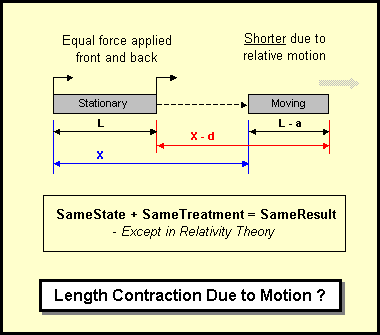
---
### Author:  [@phyllo](https://www.ilovephilosophy.com/u/phyllo)
#### Post date: [October 14, 2013, 3:06pm UTC](https://www.ilovephilosophy.com/t/stopped-clock-paradox-analysis/37079/23 "2013-10-14T15:06:07Z")
> [@](#):
>
> The difference is that SR proposes that whatever is perceived IS what reality is, regardless of any logic.
And what you are saying is that there is an absolute reality which is not perceived.
---
### Author:  [@phyllo](https://www.ilovephilosophy.com/u/phyllo)
#### Post date: [October 14, 2013, 3:08pm UTC](https://www.ilovephilosophy.com/t/stopped-clock-paradox-analysis/37079/24 "2013-10-14T15:08:19Z")
I don’t know what that picture is trying to show. What force? What are you suggesting with all the lengths?
---
### Author:  [@James\_S\_Saint](https://www.ilovephilosophy.com/u/James_S_Saint)
#### Post date: [October 14, 2013, 3:20pm UTC](https://www.ilovephilosophy.com/t/stopped-clock-paradox-analysis/37079/25 "2013-10-14T15:20:45Z")
> [@phyllo](#):
>
> I don’t know what that picture is trying to show. What force? What are you suggesting with all the lengths?
???
F = ma is the force on the front and back of an object.
Same force at both points.
But somehow because the whole thing started moving, the front and rear didn’t accelerate equally.
SameState + SameTreatment = SameResult
That is a fundamental philosophical principle to ALL Science and all [rational] thought.
So why doesn’t it apply to Relativity Theory?
---
### Author:  [@phyllo](https://www.ilovephilosophy.com/u/phyllo)
#### Post date: [October 14, 2013, 4:03pm UTC](https://www.ilovephilosophy.com/t/stopped-clock-paradox-analysis/37079/26 "2013-10-14T16:03:37Z")
That’s a stationary object with has two forces on it, one front and one rear, and then it becomes the moving object on the right?
Still not sure what to make of it. The situation is complex for the stationary observer. I guess the observer is at the midpoint of the object but as soon as it moves, then he sees the rear approaching faster than the front is receding.
He interprets that as a greater force on the rear?
But how does Newtonian F=ma apply when the mass of the object is increasing and acceleration is dependent on time which is distorting?
---
### Author:  [@James\_S\_Saint](https://www.ilovephilosophy.com/u/James_S_Saint)
#### Post date: [October 14, 2013, 4:11pm UTC](https://www.ilovephilosophy.com/t/stopped-clock-paradox-analysis/37079/27 "2013-10-14T16:11:07Z")
> [@phyllo](#):
>
> That’s a stationary object with has two forces on it, one front and one rear, and then it becomes the moving object on the right?
>
> Still not sure what to make of it. The situation is complex for the stationary observer. I guess the observer is at the midpoint of the object but as soon as it moves, then he sees the rear approaching faster than the front is receding.
> He interprets that as a greater force on the rear?
> But how does Newtonian F=ma apply when the mass of the object is increasing and acceleration is dependent on time which is distorting?
The point is that the observer knows that equal treatment (beginning from a standstill) is being given to two objects (the front and the rear), yet according to relativity, they don’t behave the same.
Relativity REQUIRES that identical things behave differently even though treated identically.
…which violates the ontological definition of “identical”, being “behaving the same when treated the same” (among other things being the same).
---
### Author:  [@PhysBang](https://www.ilovephilosophy.com/u/PhysBang)
#### Post date: [October 14, 2013, 10:19pm UTC](https://www.ilovephilosophy.com/t/stopped-clock-paradox-analysis/37079/28 "2013-10-14T22:19:32Z")
The problem is that James does not want to ever, ever look at a physics scenario in enough detail to look at what is actually happening. James will not describe his picture in any more detail because he knows that as soon as he does, he will either cease to be able to do the required physics or the problem will disappear.
James seems to be angry that in SR, there is length contraction.
---
### Author:  [@phyllo](https://www.ilovephilosophy.com/u/phyllo)
#### Post date: [October 14, 2013, 10:24pm UTC](https://www.ilovephilosophy.com/t/stopped-clock-paradox-analysis/37079/29 "2013-10-14T22:24:19Z")
PhysBang, are you going to tackle the ‘Stopped Clock Paradox’ ?
---
### Author:  [@James\_S\_Saint](https://www.ilovephilosophy.com/u/James_S_Saint)
#### Post date: [October 16, 2013, 6:49am UTC](https://www.ilovephilosophy.com/t/stopped-clock-paradox-analysis/37079/30 "2013-10-16T06:49:40Z")
So given up yet… or?
---
### Author:  [@PhysBang](https://www.ilovephilosophy.com/u/PhysBang)
#### Post date: [October 16, 2013, 3:04pm UTC](https://www.ilovephilosophy.com/t/stopped-clock-paradox-analysis/37079/31 "2013-10-16T15:04:17Z")
> [@phyllo](#):
>
> PhysBang, are you going to tackle the ‘Stopped Clock Paradox’ ?
Sure: look at the stupid gifs in the first post, notice how in those posts, the flashes are simultaneous in both reference frames, notice that that is impossible.
It’s pretty easy. This kind of scenario is exactly what Einstein lays out in his Relativity book that James often quotes from but does not read. Einstein explains why the two flashes aren’t simultaneous in pretty straightforward language.
Notice that James did not assign actual coordinates to anything presentation of this scenario. This is because he has probably done that somewhere else in the past, noticed that he can never get his numbers to work out, and then moved on to try to snow somebody else.
If James assigns coordinates to the scenario, then I will go into great detail showing the problem in the coordinates.
---
### Author:  [@James\_S\_Saint](https://www.ilovephilosophy.com/u/James_S_Saint)
#### Post date: [October 16, 2013, 3:11pm UTC](https://www.ilovephilosophy.com/t/stopped-clock-paradox-analysis/37079/32 "2013-10-16T15:11:40Z")
Yes, it’s ALL about that stupid James, James, James.
What Einstein said and did was to redefine the word “simultaneous” to mean, “perceived as simultaneous to the observer”. Thus declaring that truth is only what an observer perceives. And that is true for those who cannot think beyond the obvious. But for some odd reason, they keep running into paradoxes (such as length contraction). But then it helps to be even so blind as to not see those either.
---
### Author:  [@Fixed\_Cross](https://www.ilovephilosophy.com/u/Fixed_Cross)
#### Post date: [October 16, 2013, 3:20pm UTC](https://www.ilovephilosophy.com/t/stopped-clock-paradox-analysis/37079/33 "2013-10-16T15:20:17Z")
> [@James S Saint](#):
>
> > [@Fixed Cross](#):
> >
> > The issue is also that the time in seconds required for the photon to bridge the distance is unequal in both frames.
> > This makes it seem difficult to decide on a simultaneous event.
>
> That is the whole paradox issue itself. The physical construction guarantees that the flashers are simultaneous, yet if they really are, it is obvious that the time of flight for the photons won’t yield a coherent end result… ASSUMING the theory to be correct.
Note that the theory of relativity does not guarantee that the flashers can be said to flash simultaneously in each frame. In fact, by definition of “relativity”, whether this definition is valuable or not, it is impossible to establish such simultaneity. That would require a non relative meta-perspective.
Note also that it’s a theory, which is a representation of reality. Within this particular representation, such assumptions are made as to make it logically impossible to have a synchronicity between reference frames in motion relative to each other.
IF the speed of light is constant from all frames, and if these reference frames differ from each other, then by definition everything that is constant besides c within these frames, is asymmetrical with whatever is constant besides c in another frame.
So I think we can resolve this discussion by observing that by any logic following from a constant c, it is impossible to establish a logical notion of synchronicity.
That is why I am curious how in your representation, c does differ, as this would indeed allow for synchronicity.
> [@](#):
>
> > [@Fixed Cross](#):
> >
> > If the crucial point is simultaneity then we have to be thinking about progression of time, what it means for a moment in one frame to be a moment in another. A moment compared to which other points in time?
>
> Well that makes sense to me. So let’s do that;
>
> I take it that you agree that time is forward sequential void of reversals or random jumping around. So it seems to me that we could begin a sequential examination of each relevant instant of time passage… IN ORDER of their occurrence.
>
> So the action starts with the triggering of the flashers, so let’s start there at “t0”;
To establish an objective t0 independent of any reference frame is already a logical violation of relativity. Whenever you start with such a premise, you have to use another means than relativity to calculate. I assume you have such a means.
It is of no use to try to show how relativity isn’t correct by expanding the argument beyond “there is a t0 that applies to both reference frames”. The premise itself is a negation of relativity. Clearly from there on out, the laws of relativity won’t be coherent.
> [@](#):
>
> Do you agree that picture represents (separately) each of the reference frame’s view at the instant of trigger?
> The upper station’s frame has the train reduced in length and touching the darker orange, “inner” fingers. The lower train’s perspective has the station reduced in length (shown as a longer train for my drawing convenience) and touching the outer lighter orange fingers.
>
> At that point in time, “t0”, both frames experience the fingers touching the flashers. The train would argue that the outer fingers touched and the station would argue that the inner fingers touched. We don’t really care as long as they both agree that both flashers are being triggered at that very instant of clock alignment.
Still, because the relations of the inert mass to c that apply in both frames are incompatible with each other, t0 on the train is fundamentally different than t0 in the station.
> [@](#):
>
> > [@Fixed Cross](#):
> >
> > By length contraction and time dilation, the smallest moment of PtA change in frame A would have to appear different from the smallest moment of PtA change in B, no matter that this moment has an effect in each frame. If this is true, how can absolute time be established in either frame? How can it apply to a real situation?
> >
> > Do we divide the energy of each reference frame by infinite, or do we divide an objective scale by infinite so as to build each reference frame from the ground up?
> >
> > I need to see how an objective standard for infinitesimal PtA can be successfully applied to two different reference frames.
>
> Let’s resolve the issue of whether Relativity theory can answer this before we get into RM:AO’s answer.
I think it is resolved: relativity can not answer this question positively.
---
### Author:  [@James\_S\_Saint](https://www.ilovephilosophy.com/u/James_S_Saint)
#### Post date: [October 16, 2013, 3:42pm UTC](https://www.ilovephilosophy.com/t/stopped-clock-paradox-analysis/37079/34 "2013-10-16T15:42:18Z")
> [@Fixed Cross](#):
>
> That is why I am curious how in your representation, c does differ, as this would indeed allow for synchronicity.
Each time you have said that, I am puzzled as to what you are seeing that makes you think that the pic has “c” differing…?
> [@Fixed Cross](#):
>
> To establish an objective t0 independent of any reference frame is already a logical violation of relativity.
Well, okay, let’s start at a place where we won’t have that possibility. Let’s start with only one frame and let the train gradually become another frame.
> [@James S Saint](#):
>
> 
>
> F = ma is the force on the front and back of an object.
> Same force at both points.
> But somehow because the whole thing started moving, the front and rear didn’t accelerate equally.
>
> SameState + SameTreatment = SameResult
> That is a fundamental philosophical principle to ALL Science and all [rational] thought.
> So why doesn’t it apply to Relativity Theory?
1. We start with the train not moving at t0.
2. we apply exactly equal forces to both the front and rear of the train.
3. by definition of “equal force”, we obtain equal acceleration.
4. thus the front and rear of the train accelerate equally.
5. having equal acceleration, they remain a same distance from each other.
6. Thus from the station perspective, having provided those forces, it can be assured that there has been no length contraction.
Agreed? 🕶
[size=85]… not damn likely…[/size]
---
### Author:  [@Fixed\_Cross](https://www.ilovephilosophy.com/u/Fixed_Cross)
#### Post date: [October 16, 2013, 3:51pm UTC](https://www.ilovephilosophy.com/t/stopped-clock-paradox-analysis/37079/35 "2013-10-16T15:51:06Z")
> [@James S Saint](#):
>
> > [@Fixed Cross](#):
> >
> > That is why I am curious how in your representation, c does differ, as this would indeed allow for synchronicity.
>
> Each time you have said that, I am puzzled as to what you are seeing that makes you think that the pic has “c” differing…?
I don’t. The comment does not apply to the pic.
You said that in RM, c is seen to slightly vary.
That makes sense to me for the reasons explained - it’s the only way to circumvent relativity “weirdness”.
> [@](#):
>
> > [@Fixed Cross](#):
> >
> > To establish an objective t0 independent of any reference frame is already a logical violation of relativity.
>
> Well, okay, let’s start at a place where we won’t have that possibility. Let’s start with only one frame and let the train gradually become another frame.
>
> > [@James S Saint](#):
> >
> > 
> >
> > F = ma is the force on the front and back of an object.
> > Same force at both points.
> > But somehow because the whole thing started moving, the front and rear didn’t accelerate equally.
> >
> > SameState + SameTreatment = SameResult
> > That is a fundamental philosophical principle to ALL Science and all [rational] thought.
> > So why doesn’t it apply to Relativity Theory?
Because relativity holds that there is no SameState unless it is truly identical in all respects.
And the front of the train does accelerate equally to the front of the train. (“A” proper = “A” proper)
I am curious what you think of my statements about a constant c disabling all other symmetry between different frames. For me, that observation alone is enough to resolve the clock paradox. If c is constant in all frames, then by definition these frames only compute in terms of c, and provide ‘syntax errors’ in all other comparisons.
---
### Author:  [@PhysBang](https://www.ilovephilosophy.com/u/PhysBang)
#### Post date: [October 16, 2013, 3:53pm UTC](https://www.ilovephilosophy.com/t/stopped-clock-paradox-analysis/37079/36 "2013-10-16T15:53:28Z")
> [@James S Saint](#):
>
> Yes, it’s ALL about that stupid James, James, James.
Again, yes. You are producing a fantasy physics, calling it relativity theory, and then making claims about why relativity theory is wrong. Your fantasy version of relativity theory is wrong, I’ll grant you that.
> [@](#):
>
> What Einstein said and did was to redefine the word “simultaneous” to mean, “perceived as simultaneous to the observer”.
Despite your claim to have read “On the Electrodynamics of Moving Bodies,” you consistently say this thing above that is not true. I don’t think that you are a liar in this regard, just really incompetent because you want the above to be true.
The real answer is in section one of [fourmilab.ch/etexts/einstein/specrel/www/](http://www.fourmilab.ch/etexts/einstein/specrel/www/)
Simultaneity of distant events is determined by what a synchronized clock would read at the events. The synchronization of two clocks is determined by what they would read at different times delineated by a beam of light passing from one to the other and another beam coming back. That is, if you fire a beam from one to the other, the clocks read what you expect them to read. This process imagines that the clocks are not moving relative to one another so it imagines that there is some system of spatial coordinates that pick out the location of the clocks.
> [@](#):
>
> Thus declaring that truth is only what an observer perceives.
This is the opposite of Einstein’s relativity theory. His theories allow any observer to figure out what any other observer will see, regardless of their relative motion, because there is an underlying invariant structure to cause and effect in spacetime.
> [@](#):
>
> And that is true for those who cannot think beyond the obvious. But for some odd reason, they keep running into paradoxes (such as length contraction).
There is a handy way to identify those who do not yet understand special relativity: they claim that the so-called paradoxes are unresolved. The paradoxes put forward in the textbooks are only apparent, they are only trouble for those who do not want to work through them. Indeed, every presentation of these paradoxes in textbooks comes with their resolution. So we can also identify those who do not read well.
---
### Author:  [@James\_S\_Saint](https://www.ilovephilosophy.com/u/James_S_Saint)
#### Post date: [October 16, 2013, 4:05pm UTC](https://www.ilovephilosophy.com/t/stopped-clock-paradox-analysis/37079/37 "2013-10-16T16:05:57Z")
> [@Fixed Cross](#):
>
> I don’t. The comment does not apply to the pic.
> You said that in RM, c is seen to slightly vary.
> That makes sense to me for the reasons explained - it’s the only way to circumvent relativity “weirdness”.
OH!! Okay, I thought you were referring to the pic. I am not speaking from the RM:AO perspective, which hopefully later you will see is VERY different.
> [@Fixed Cross](#):
>
> Because relativity holds that there is no SameState unless it is truly identical in all respects.
> And the front of the train does accelerate equally to the front of the train. (“A” proper = “A” proper)
Wait. What is “not identical in all respects” when the train is not yet moving??
They are in the same frame. There is only one frame at that point.
> [@Fixed Cross](#):
>
> I am curious what you think of my statements about a constant c disabling all other symmetry between different frames.
When I first read that, I misread it a “simultaneity” rather than “symmetry”. So now I am curious what you actually meant by it.
What symmetry are you talking about?
> [@Fixed Cross](#):
>
> For me, that observation alone is enough to resolve the clock paradox. If c is constant in all frames, then by definition these frames only compute in terms of c, and provide ‘syntax errors’ in all other comparisons.
Yes. And what we are addressing right now is whether we can arbitrarily choose such an ontological priority and remain coherent. Length contraction becomes an issue right away.
---
### Author:  [@Fixed\_Cross](https://www.ilovephilosophy.com/u/Fixed_Cross)
#### Post date: [October 16, 2013, 4:58pm UTC](https://www.ilovephilosophy.com/t/stopped-clock-paradox-analysis/37079/38 "2013-10-16T16:58:06Z")
> [@James S Saint](#):
>
> > [@Fixed Cross](#):
> >
> > I don’t. The comment does not apply to the pic.
> > You said that in RM, c is seen to slightly vary.
> > That makes sense to me for the reasons explained - it’s the only way to circumvent relativity “weirdness”.
>
> OH!! Okay, I thought you were referring to the pic. I am not speaking from the RM perspective, which hopefully later you will see is VERY different.
Yes, I imagine it is.
> [@](#):
>
> > [@Fixed Cross](#):
> >
> > Because relativity holds that there is no SameState unless it is truly identical in all respects.
> > And the front of the train does accelerate equally to the front of the train. (“A” proper = “A” proper)
>
> Wait. What is “not identical in all respects” when the train is not yet moving??
> They are in the same frame. There is only one frame at that point.
Okay, I have to look at that in more depth. What is the problem exactly? So far we’ve been talking only about non accelerating bodies, SR which I can understand, GR is new to me. I figure that a body accelerating with a constant rate (such as 9.8m/s^2) is two reference frames overlapping in one body (such as the Earth and an object moving toward it).
> [@](#):
>
> > [@Fixed Cross](#):
> >
> > I am curious what you think of my statements about a constant c disabling all other symmetry between different frames.
>
> When I first read that, I misread it a “simultaneity” rather than “symmetry”. So now I am curious what you actually meant by it.
> What symmetry are you talking about?
I mean that “A=B and B=C thus A=C” in frame 1 does not equal “A=B and B=C thus A=C” in frame 2 except if A=c.
> [@](#):
>
> > [@Fixed Cross](#):
> >
> > For me, that observation alone is enough to resolve the clock paradox. If c is constant in all frames, then by definition these frames only compute in terms of c, and provide ‘syntax errors’ in all other comparisons.
>
> Yes. And what we are addressing right now is whether we can arbitrarily choose such an ontological priority and remain coherent.
As far as I’ve read only, relativity does not discuss coherency between reference frames other than giving a means to translate them to each other.
What we would be looking for is the ontological meaning of the Lorenz transformation. I agree that this is more than just interesting if we are philosophically and not scientifically speaking. I don’t know how much of this coherence is explicated in General Relativity. The mathematics of GR would seem to become rather complex as soon as there are more than two reference frames.
> [@](#):
>
> Length contraction becomes an issue right away.
Again, I am not familiar with the relativity of accelerating objects, but it appears to me that the light would be bending, in the sense that it crosses a different than linear path, thus, measured linea-recta would appear to slow down.
---
### Author:  [@James\_S\_Saint](https://www.ilovephilosophy.com/u/James_S_Saint)
#### Post date: [October 16, 2013, 5:20pm UTC](https://www.ilovephilosophy.com/t/stopped-clock-paradox-analysis/37079/39 "2013-10-16T17:20:12Z")
Acceleration and gravity are related, but they are not the same thing. Acceleration merely refers to an increasing velocity. Nothing special about it. But what is very relevant to all physics is that “force” is defined as that which brings acceleration (hence the “force of gravity”).
What I am proposing so as to see the rationale of the original anime, is that we start from a known and agreed point in the sequence of events. Since the simultaneity is not something that we can agree upon, let’s begin before that simultaneity becomes an issue.
A place where we can start is the state wherein the train has not yet begun to move, so that we have only one frame of reference and there is no simultaneity or relativity issue to be had.
But as we have been discussing this, I have seen perhaps a better way of making that anime (knew I would have to remake it eventually).
1. Imagine two identical train engines with a big rubber boxcar between them (rubber so that it can stretch or shrink as might be needed).
2. Centered in that car is our stop-clock.
3. Before the trains begin to move at all, we synchronize all clocks, station and traincar.
4. We then apply exactly equal trust to both engines in sync such that (in order to remain ontologically consistent) they necessarily accelerate the same amount and achieve the same speed.
At that point in the scenario, we have a distance between those trains that has not changed, even from the station perspective.
I don’t think that Relativity can disagree with any of that. Acceleration cannot be dependent upon distance from an observer even if the speed of light is perceived constant. Thus both trains must accelerate identically which means that the distance between them (from the perspective of the station) has not changed, else obviously they didn’t really accelerate equally, which would mean that equal force wasn’t really applied.
The reason that I want to frame it this way, is that the later question concerning the distance from front to rear of the train car becomes both known and irrelevant, as the train clock remains centered and the front and rear engines have the flashers and are the same distance apart, “2Xs” as they began.
Can you agree with that much? Does it violate relativity ontology in any way?
---
### Author:  [@PhysBang](https://www.ilovephilosophy.com/u/PhysBang)
#### Post date: [October 16, 2013, 7:47pm UTC](https://www.ilovephilosophy.com/t/stopped-clock-paradox-analysis/37079/40 "2013-10-16T19:47:16Z")
> [@James S Saint](#):
>
> 1. Imagine two identical train engines with a big rubber boxcar between them (rubber so that it can stretch or shrink as might be needed).
> 2. Centered in that car is our stop-clock.
> 3. Before the trains begin to move at all, we synchronize all clocks, station and traincar.
> 4. We then apply exactly equal trust to both engines in sync such that (in order to remain ontologically consistent) they necessarily accelerate the same amount and achieve the same speed.
>
> At that point in the scenario, we have a distance between those trains that has not changed, even from the station perspective.
In SR, if the engines do equal work in the reference frame associated with the station and the front of the train remains, in the reference frame associated with the station, always the same distance from the rear of the train, then in the reference frame associated with the train as a later point, the train will get longer and longer. Looked at from the reference frame associated with the train as a later point, the front engine started prior to the rear engine. In the reference frame associated with the station, the movement of the train introduced electromagnetic stress on the train. One has to assume in this scenario that the strain introduced to pull the train along would normally not overcome the length of train, otherwise what need for a trailing locomotive? In a standard train, we imagine that the engine pulls the entire train, some of the energy going in to generating stress that shortens the train. In this case, it seems that we require a trailing locomotive, or some of the train would not move at all. I suppose that makes some sense for a train with rubber cars.
> [@](#):
>
> I don’t think that Relativity can disagree with any of that. Acceleration cannot be dependent upon distance from an observer even if the speed of light is perceived constant.
What events happen when (e.g., when an acceleration is applied) differs from system of coordinates to system of coordinates. And this is distance dependent sometimes.
[Previous page](https://www.ilovephilosophy.com/t/stopped-clock-paradox-analysis/37079.md?page=1)
[Next page](https://www.ilovephilosophy.com/t/stopped-clock-paradox-analysis/37079.md?page=3)