PB, your attempt to stage a strawman, affirm the consequent, divert with ad homs, sematics, and pedantics, and feign an intelligence person all reveal the very, very conspicuous ego insecurity that you suffer. Such a state leaves you categorically mindless and pretty much isolated due to the futility in anyone’s attempt to communicate with you concerning the extraordinary number of things you know so very little about and yet lust to impress that you already do.
The only reason that the women scored lower than you is that they didn’t show up.
Unfortunately, phyllo, you have scored the highest.
But just as stated on a different thread;
No coherent explanations can be given to anyone who denies “A is A”.
And such leaves everyone else having to merely persuade with deceptions and distractions.
I do not deny that “A=A”, I deny that Randians actually accomplish anything when they bring that up. They like to think that they are doing some intellectual work, but they are adding nothing.
Similarly, providing a description of a system in only one frame of reference says absolutely nothing about translations between frames of reference.
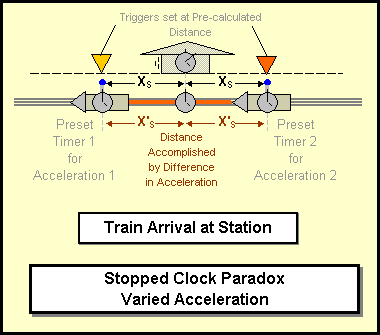
And Hell, it just occurred to me that even if the distance Xs contracted, one could simply pre-calculate what acceleration to give each engine, front and rear, while keeping the stop-clock centered by a stretchable material.
The acceleration of each engine can be set to whatever you want. So, assuming the distance Xs is going to be contracted due to the speed, simply set the acceleration of the engines to compensate, keeping the distance constant as seen by the station. The timers, if used rather than the triggers, could also be pre-calculated to go off at the exact distance “Xs” as would be seen by the station and with trigger arms wouldn’t be necessary, but either way.
The distance X’s (being the distance as seen by the train clock) would be expected to grow due to the varied acceleration, so the clock must be suspended by a rubber attachment between the engines. But even the train perspective would still see both clocks centered.
So now…
Both the station and the train know of the pre-calculations using whatever theory you like, SR, GR, NR, QR… NotR… or whatever. The exact same paradox will occur.
Go ahead and presume length contraction… same paradox occurs.
Indeed, the same “paradox” occurs, the same “paradox” of two things that can’t both be true and only one of which is true.
However, it does seem clear that you tried to read through my equations and found them correct, since you are now trying to co-opt the very scenario I provided.
Your scenario was a strawman. I didn’t bother with it past that point.
Glad to see that you at least know what a paradox implies.
But I seriously doubt that you would be able to search out anyone to coherently answer it for you (more than obvious that you can’t answer it yourself).
Statistics infers a large group of similar, although perhaps not 100% identical, events. If they are truly 100% identical, the statistic, by definition of “identical”, must always yield 100% probability.
Every theory and every thought, regardless of the subject matter, is premised by “A is A”. And a corollary to “A is A” is “SS+ST=SR” (SameState + SameTreatment = SameResult). Thus the SS+ST=SR principle cannot ever be abandoned within any theory concerning any subject, else one is merely saying that given a state and a treatment upon that state, something happened once but the next time it might be different. What would be the point in saying that. Such a statement would not be a theory but merely a statement of ignorance concerning any predictive theory.
Are you really so ignorant? A paradox is a case where there are two or more options, the set of which seemingly exhaust all possibilities, none of which can seemingly be true.
You are presenting a vague case to attack SR where you offer two options, but one is simply denied by SR. You are using your fantasy understanding of physics and your fantasy understanding of “paradox”.
Again the idea that it is a paradox comes from the fact that James thinks Relativity claims for all reference frames to be coherent within a meta-reference frame.
The only interesting question now is whether or not such a meta frame can be construed using us RM logic.
Ah, so there is at least one man (= capable of agreement and courage to say it) in the crowd.
So next question,
Can you give me a coherent argument as to why the speed of light would be independent of its source and yet entirely dependent upon its destination (an observer)?
The paradox gives two options which contradict each other. Thus at most only one can be true.
SR doesn’t deny either option given, only the result of one in favor of the result of the other. The premises of both are accepted in SR. But SR ignores the logic of one so as to accept the logic of the other.
No. James thinks that “one recorded history = one truth” and if two theoretical histories contradict each other, then at least one must be false. Either the clocks stop or they don’t, yet SR demands that one clock stop and the “other” clock must NOT stop.
If the scenario were really played out, looking back, which observer would have been proven wrong even though both had adhered to SR?
The “speed of light is constant for EACH observer.”
That means that the speed of light changes with each observer, which is what leads to the contradiction when only one of them can be right (as a recorded history would reveal - a clock either stopped or or didn’t, yet each must stop according to each observer and the other clock must not).
Train: “According to my ‘constant speed of light’, the station clock must NOT stop.”
Station: “According to my ‘constant speed of light’, the train clock must NOT stop.”
The speed of light is measured to be constant. Err, that’s how the universe works. Are you claiming that the universe does not live up to your ‘logical’ definitions?