Stopped Clock Paradox; Relativity Down for the Count

The basis for the belief in the relativity of simultaneity is the Lorentz transformations. These transformations are established as the proper transformations between inertial reference frames if one accepts that the laws of physics should be the same in all reference frames and one accepts that the speed of light is the same in all reference frames. (The details of this derivation are found in the following link along with every introductory textbook on relativity theory: fourmilab.ch/etexts/einstein/specrel/www/ )

I’d like to see some actual numbers for this. Since it is purely geometry, that shouldn’t be hard to do. Of course, the proper Lorentz transformations should be shown.

Of course, if the distance between the flashers is constant in the frame of the station, then they actually drift away from each other in the frame of the train, so we should see this.

We need to see this mathematically demonstrated, in the reference frame of the train.

Galilean transforms would do it.

x'=x-vt
y'=y
z'=z
t'=t 

Now what? :stuck_out_tongue:

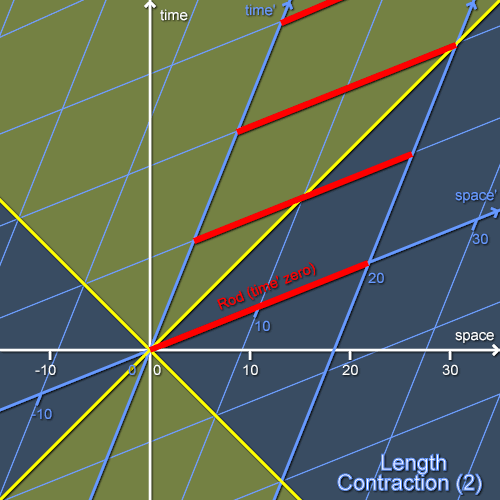
OK, we need a space-time graph. This is taken from a great refresher on time dilation and length contraction:

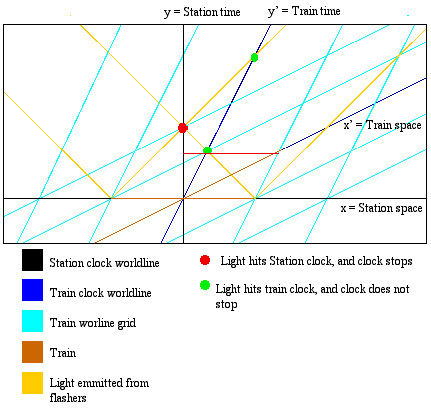
Going off of this graph as an example, I made the following illustration to show your scenario as a spacetime diagram.

I think this makes it easier to see what’s happening. We can see from the diagram, the train functions just like the rod in the first graph, except that we’re measuring from the middle to both ends rather than from the back to the front. The worldline for the train (in dark blue, x’y’) is shifted because it’s moving. Since light is constant in both worldviews, we can ‘squish’ the worldlines for the train clock about the lightline, which in this graph is the line y=x (this designation is arbitrary, but doesn’t affect what the graph shows. It’s just scaling the axes). Also, in this I’ve arbitrarily assigned the speed of the train a value of .5c, because that was easier to draw.

It is clear from this graph that, if the lights are seen to go off simultaneously on the station clock clock ( the red dot), they will be seen to go off at different times by the train clock (the green dots). We can also see that the flashers do not coincide with the alignment of the clocks: in the train worldview, the front flasher goes off before and the read flasher goes off after the clocks pass. In fact, as it works out in this graph, because of the numbers chosen, for an observer at the station, the light from the flash would be arriving at the train clock when for the train clock the two clocks are aligned.

What aspect of this diagram are you challenging, James?

1 Like

First, thank you again for actually addressing the rationale involved. But then to answer your question, I would like to give answer to your answer.

When I first took calculus in high school, I had quite a struggle. My teacher would write out a long calculus problem across the chalkboard and proceed to go through the substitution and algebraic operations to a final resolution. I would write down everything and try to keep up with understanding where all of this was coming from and the why’s behind the methods. But eventually I discovered, several failed tests later, that he was never explaining any of the why’s.

I finally woke up to realize that on each test he always had the exact same problems that he had placed on the chalkboard. So, to save my grades, I shifted from the understanding mode to the mere memorization mode. Instantly I went from not being able to get a single problem right, to getting 100% on every test. Of course, despite my scores, he gave me a low final grade anyway because as he put it, “nobody goes from an F average to an A average” with an insinuation that I was so obviously cheating that he was just going to give me a low grade.

My point is that anyone can “plug and play” if getting to an answer is the only concern. I had been making the mistake of thinking that I was supposed to understand what he was doing, not merely memorize for sake of a predictable test. I found that by in large most of education in the US is handled that way. Understanding is at the bottom of the list of priorities. The chart that you have provided, to me is much like the older calculus tables with all of the answers already listed, all you have to do is use the x and y of the table and pick out your answer.

In engineering, such prepared charts and tables are invaluable. But in the world of understanding what is going on or resolving a paradox, actual understanding is essential.

The chart that you have provided, with a degree of personal labor no doubt (tks again), is basically saying, “because of how we have decided things work, these are the answers you are to use”. Of course, if the logic behind those answers has been truly proven, one seldom needs anything more. I used to accept that such charts had been proven, so until recently, I didn’t even bother (like everyone else) to go verify anything. But then Science and especially metaphysics requires understanding, not merely prepared answers. Prepared answers are for the engineers, not the scientist or metaphysicist. Recently I got into Rational Metaphysics and began discovering the exact why’s behind everything we see in physics. And with such understanding, can predict far in advance of current Science as Science is based, as so many keep saying, “only on observing”, not logical thought.

A paradox presents a situation that seems contrary to logic. Resolving a paradox requires dealing with that logic in detail. Plugging in what is the prescribe answer and merely saying, “See there is no paradox. Things will happen as this table of answers tell me”, is not really solving the paradox, but rushing to an engineering number to use so as to move on. “Moving on”, is not the goal here.

Perhaps that chart really does somehow explain the background logic of its origin, so correct me if I’m wrong, but I don’t think that it does. It merely says, “If you want to know what numbers to use, here is a chart for the time and distance numbers [as per our accepted equations that we have assumed to be perfectly logical and correct].” It doesn’t actually address the logic that led up to the paradox but rather merely jumps over such logic to prepared numbers for use by engineers not questioning the logic behind it all.

So to really use that chart to answer “Answer 1”, I would need to see, not the end result as given by the chart, but a development of reasoning that would indicate exactly why two flashers and a clock, in the same frame, would ever get out of sync or how it is that an already calculated time and distance (using SR) that leads to ensuring that the center of the railcar is positioned at P1 at the designated flash time, somehow got out of whack to the point where despite the calculated SR timing, the railcar is not going to be at P1.

The reasoning involves starting at P0 where equal force is applied to the railcar objects and the clocks are preset, using SR, to ensure that the center of the railcar will be aligned with the station clock. If that chart somehow explains this, could you please show how.

Equal force is applied. The laws of basic physics require that all objects obey the principles and all behave identically in accord with those laws. The force is applied between the station frame to the entire train frame. Everything in each frame must accelerate identically to everything else, thus keeping the distances of every object identically affected. There are no forces involved within the train frame nor within the station frame. Thus nothing can change in either frame from the same frame’s purview. Every object within each frame must behave (accelerate) exactly the same as every other with respect to the other frame’s purview.

This is to say, that the distance between the center and fore and aft walls cannot change from either purview, nor can the synchronicity of the timing of the clocks within each frame. But more significantly, the position of the railcar to the station cannot change as it is what was used to set the timing in the first place. Thus the railcar is most certainly positioned with its center at P1, even if we want to get into length contractions (although unnecessary).

Also, in that chart, although forgive me for not being accustum to using such charts, the chart is saying that the train clock would not stop. But if we made a chart for the train, couldn’t we merely flip the chart, implying the opposite direction of travel, and end up with merely the same conclusion that the train will claim that it is the station clock that didn’t stop?

I have a little trouble trying to see from that chart, where the train would purview the initial flashing.

I don’t see how the chart can be disregarded as just “plugging in,” unless you mean that it is a chart that plots what would be the case is relativity is true, i.e. ‘plugging in’ facts about the situation. But then every graph of anything, whether stipulated or observed, is just empty ‘plugging in’. The chart is made specifically for the problem you devised, and shows how to resolve it in relativistic terms. In relativity, there is no paradox. It doesn’t match the classical prediction, but that doesn’t make it a paradox.

At the very least, this chart shows that skepticism of the constancy of c must logically proceed your paradox in order for it to be a paradox. If relativity, which assumes a constant c, is applied correctly, there is no paradox, and the thought experiment you propose has a definite resolution. Ultimately, though, this chart, and relativity as it was proposed, only made predictions. Einstein asked “what if c were constant in all frames of reference?” That alone doesn’t prove anything, it doesn’t prove that the chart is accurate in real life. It just shows that, if c is constant in all frames, a situation like the one you propose will resolve itself as diagrammed. From there, we have a useful prediction, with measurable results, and suggested experiments. And when the necessary experiments have been run, they’ve vindicated the theory that c is constant.

You now ask, how can the lights become out of sync with an equal force. Consider another situation: Two weights are each attached to one end of a rigid bar, the other ends of which are attached to pivot. One is north of the pivot, one is south of the pivot. An equal force is imparted to each weight at the same time and for the same duration, pushing the weights due east. However, moments later, the weights are moving in different directions: the northern weight is moving south, and the southern weight is moving north. Now, you have equal starting conditions, equal force, and differential outcome.

This is only meant to show that just because the two flashers are attached to the same car, and experience the same force for the same duration, does not necessarily rule out that they will be measured differently. There’s no logical principle, or physical principle, that rules this out.

EDIT: If we flip the chart, putting the train’s frame of reference as x and y at a right angle to each other, the worldline for the station would create an obtuse angle centered around the line y=x. This difference is due to the fact that the station has negative velocity relative to the train.

Also note that we could have the flashers be simultaneous for the train, but then they would not be simultaneous for the station. I can make more graphs if you would like to see different variations on it. They’re time consuming, but I always found them to be the most straightforward way to grasp special relativity, and I’m happy to produce more if it benefits the discussion.

Yes, a chart is supposed to be a plug-in. I’m not complaining of the chart, merely suspecting that it doesn’t show the logic from which the chart is based. It is the result of all values being put into the equations. But my concern is that merely using the equations as simple as they are, the paradox arises.

But if you follow the logic that I provided which included an assumed “tf” time factor dilation, the paradox arises.

I am not seeing how that chart shows any resolution. It appears to merely be saying that the station would think that the train would not stop. But that is the problem, not the solution, because the same dynamics must be apparent to the train viewing the station which would then cause the train to think that the station clock would not stop.

I agree that Einstein merely said, “IF what you have told me concerning the consistency of light is true, THEN…”. I don’t hold that against Einstein. But I do not see the resolution that you are saying the diagram/chart displays.

Sorry, but that is a poor example. The basic physics in your example involves 2 forces being applied, one from the mover and the other from the rigid bar. The force from the ridged bar being in a different direction is what makes the weights turn. The train has no such situation. There are not competing forces involved other than their own inertia which has no direction.

Emm… I have to disagree there. The entirety of physics other than what we are discussing rules that out. Whatever causes one object to move 10 feet, must be able to cause an identical object to move that same 10 feet if everything else is equal or irrelevant to the action. Physics would be totally pointless if that were not true.

If the diagram you have provided displays where the train’s purview of the flashes occur and where they then meet the train clock, we don’t need another diagram (I don’t think). But I don’t see in that diagram where those events occur.

But still, if you point them out, although I will understand the diagram better, it still offers no justification for placing them where they are to be placed. It seems the diagram would merely be saying, “ignore basic physics and logic and use these numbers”.

I need to know how you can accelerate both flashes together and end up with one a different distance from the station clock or the train clock. Equal acceleration MEANS that they will cover the same distance in the same amount of time. Their distances cannot be different or they were not accelerated equally, by definition of “equal acceleration”. How can you justify that one flasher covered more distance than the other when they were accelerated identically? Logic of merely the words involved doesn’t allow that, not to mention the fundamental physics.

Why’d you ignore me when I gave you the answer?

Oh sorry, I thought that you had figured it out. Your proposal denies SR from the start.

The distances to both clocks of each flasher is the same by required setup design and as specifically detailed in “Answer 1”.

You are right that from the clocks purview, the train’s clock would move away from the initial center and thus not stop. But SR specifically states that the exact same rules must apply to either frame used as an inertial frame. So from the train’s purview, the flashers and clock do not move at all. It is the station clock that is moving out from center. But that means that we get different results depending on which frame we choose to see. The problem arises when the train stops later to find out which clock really stopped. SR proclaims that both frames must be right, yet they cannot be because the clocks either stopped or didn’t.

And neither would the train clock. Having them flash at different times, wouldn’t resolve the problem except for either one or the other clock, but the alternate clock would still disagree.

First, the train clock is set in the exact center as specified in Answer 1. But if you were to move it from center, the train clock would not see that the photons got to it together even though the station clock did.

You have to look at BOTH frames, one at a time and get the same end result. The problem, the paradox, is that you can’t if using SR.

I don’t follow your reasoning here.

It dosn’t seem to differ at all…

The frame that observed both flashers go off at the same time would also see the OTHER clock move out from center.
It dosn’t matter which way we look…
If the train clock observes both flashers go off at the same time, than the station clock would be moving toward flasher B and away from flasher F.
OTOH, if the station clock observed both flashers go off at the same time than the train clock would be moving toward flasher F and away from flasher B.

Yes but using SR both frames would have predicted correctly.

If the train was stationary when the flashers were set to go off simultaneously and then LATER was set in motion, than you’d not expect the photons from both flashers to reach the train clock simultaneously, given it’s altered velocity.
But if they were set to be simultaneous while traveling at the trains given velocity, than you would expect to see both flashers go off at the same time.

So the real question is: In which frame were the flashes set to be simultaneous?

Exactly

Exactly

How can they both be correct unless NEITHER clock stopped? But according to SR, if each is positioned in the center, they MUST stop because their speed of light purview requires that each photon take the same time to travel the same distance. the train clock doesn’t see any difference in distance from front to back of the railcar and SR requires that it sees light traveling at the same speed regardless of any speed it might have relative to the station. So the train clock sees 2 photons traveling at what appears to be the exact same speed and coming to it from the exact same distance, fore and aft. According to SR, the station clock must see that same picture. So both frames say that their own clock must stop, but not the other clock.

Emm… nope. The flashers are timed equally (to each other, not to the station clock) and sent down the tracks such that they will be fore and aft the station clock at P1 when they flash.

The flashers have identical clocks and must flash at the same time no matter which frame you are in. Accelerating them from a stopped position does not change them from each other, only from the station clock time.

According to answer 1, they were set while standing “still”, station frame. But they have no means to become asynchronous from each other even after being moved. They will not read the same time as the station clock, but they will certainly read the same as each other.

Well there’s our problem…

But they were set to be simultaneous from WITHIN the frame of the station. So if you were on the train, you’d expect the flashers to flash with a delay so as to be seen simultaneously by the station, given the station’s relative movement.
The prediction would be: the flashers do NOT become asynchronous from WITHIN the frame of the station… the station would observe both flashers go off at the same time, but the train would observe F go off earlier than B

And they were set to be simultaneous from the train as well.

You wouldn’t see the delay “tf” actually, but you would see both flashers go off at point P1. Or did you mean a delay between the flashers? The flashers do not ever get out of sync from either frame purview.

Correct

Correct

Incorrect. The train does not see any difference between the flashers at any time nor does the station. But if the station were reading the flashers clocks (both of them), the station’s clock would not read the same as the flashers. The flasher’s clocks read the same as each other from either frame, just not the same as the station clock. They will always read the same as the train clock.

How do you figure?

You synchronised them and placed them at an equal distence while stationary… when you add velocity in the direction of one flasher and away from the other you alter the space/time between the center of the train and the flashers.
The distence the light from B has to travel to the train clock is longer than the distence the light from F, due to the train now moving toward F and away from B.

If you had syncronised them while moving at the trains given velocity and placed them at an equal distence relative space/time would have remained unchaged… and you’d expect the flashers to be observed to go off at the same time.

Look at it this way… if the train were moving and you synchronised the two at the same location on the train then moved them apart, one of the flashers would have moved at the velocity of the train PLUS, in order to arrive a given distence ahead of the center, and the other flasher would have had to travel a shorter distence. It would have to travel at the velocity of the train MINUS to arrive at the back of the train. That would have “desynchronised” them from the perspective of the station, and made flasher B experience a slightly longer period of time, so as to fire a bit earlier than flasher F, which would have experienced a shorter period of time pass, and thus fired slightly later, allowing both flashes to reach the center of the train at the same time.

If you had placed them apart to begin with but then synchronised them from within the train while moving at the train’s given velocity then whatever means you used to inform them to start the countdown simultaneously, would have reached flasher B slighly earlier than flasher F… and again, they would be desynchronised from the perspective of the station, but appear to flash at the same time from the perspective of the train.

Since B has further to go, it ought to fire first… and indeed it would.

But if they were synchronised and distenced while stationary, and then you ADD velocity in the direction of one or the other, you’d not expect the flashes to reach the center of the train simultaneously.
But you’d expect them to be synchronized from a stationary perspective.

The clocks on the train are synchronised ONLY from the frame of the station… if someone on the station was getting signals from the clocks on the train, adjusting for the varied distences of each, they would all appear to be synchronised.
But if you were standing at the center of the train you’d be seeing the front flasher run faster than it should and the back flasher run slower.

As an aside… will you agree that our current disagreement is about what SR predicts and logically entails and that I am not trying to alter the set up of your thought experiment?
If you do agree… than would you also agree that if my understanding of SR were the proper one, that there would be no paradox?

Read Answer 1. What in that explanation is unclear or seemingly untrue?

Correct. And then apply “equal acceleration” to both of them. “Equal acceleration” MEANS that they both begin to travel the same amount of distance during the same amount of time. Thus by definition, they are still the same distance from each other from the station’s frame. But they also innately have equal acceleration from the train’s frame as well (zero), because the train applies zero additional acceleration, still an equal amount to each = 0.

So from either perspective, both flashers receive equal acceleration and thus from either perspective, both flashers travel the same distance in the same amount of time. This is not a matter of physics. It is a matter of the very definition of the words and concepts. No experimenting need be done because they are defined to still be the same distance apart.

What do you mean away from the other?? Acceleration/velocity was applied to both equally and to both in the same direction. One cannot go further than the other else they would not be equally accelerating.

Well that is easy to say, but now show me how that is possible since the distances were guaranteed to be the same due to both flashers being treated exactly the same (including the directions involved).

Let’s get that point clear before we move on.

Relativity disagrees with that.

My “setup” is that both flashers flash when centered around the station clock at P1. And also that the train clock is centered and at P1, as is the station clock.

But I think you are misunderstanding SR to claim that the flashers will accelerate differently despite accelerating equally.

As another side note; Keep in mind that I have the answer to this paradox and the corrected time dilation equations that are provably logically accurate with no assumptions being made. Einstein stated that he was making certain assumptions that had been given to him. But it does no good at all to try to explain something when no one sees that there is anything to explain ("Why have physics? We already know that God did it all.")

Yes, but the direction from the flashers to the center is not the same… For the front flasher the direction towards the center is OPPOSIT the direction the train is moving, and the direction of the back flasher to the center is the same direction the train is moving.

As you accelerate, everything in front of you seems to move faster proportional to it’s distence from you (simply because you are bumping into the photons and any and all other information coming from that direction at a faster rate) and everything behind you seems to be going slower (simply because of the lower frequency of you bumping into information from that direction)… once you settle at a constant velocity, the frequency will become uniform from both directions again (assuming their velocity is the same as yours), but the displacement from the acceleration will remain.

So If you were at the center of the train you would in effect see the front flasher’s countdown being slightly ahead of schedule and the back flasher slightly behind schedule.
If you were at the front flasher you’d see the center clock being slightly behind schedule and the back flasher twice as far behind schedual.
If you were at the back flasher you’d see the center clock being slightly ahead of schedule and the front flasher twice as far ahead of schedule.

If you were to “stop” or accelerate in the opposite direction… you’d re-synchronise them.

You get the picture.

That’s not what I’m saying… but we seem to have a deisagreement about SR, all the same.
But let’s just say for argument’s sake that my false impression of SR were actually the correct one… would you agree that there is no paradox, then?

James, the chart is using the equations. And the inequality between the flashers is similar to the inequality of the weights. With the weights, as you said, you have a difference of force, and the reason is that if you center the system in a coordinate plane, the length of one of the rigid bars is negative. When you solve the equations for force, one will be negative with respect to the other.

Similarly here, when centering the clocks in a coordinate plane, the flashers are a different distances from the clock: one is x from it, the other is -x. This is relevant when we start solving the equations, and we should expect different results for any equation that relies on distance. As Mad Man said, “the direction from the flashers to the center is not the same.”

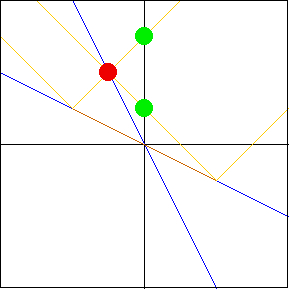
I made another, less cluttered chart that shows the same situation, but this time placing the train’s frame of reference as at a right angle, and the stations frame of reference as an obtuse angle centered about the same light line (y=x).

Untitled.jpg

As you can see, the lights still flash simultaneously in the station’s reference frame. The yellow lines represent the light that is emitted from the flashers, and we can see that the light from the flashers arrives at the train clock at different times (green dots) and arrives at the station clock at the same time, stopping it (red dot).

Note, this diagram doesn’t change the situation at all from the previous example. The difference is in the arbitrary assignment of the trains frame of reference to the vanilla Cartesian plane, and the stations frame of reference to the skewed frame. Both frames are still captured in the diagram, and the same information is conveyed. I think that you are taking the diagram to only show one frame of reference, but it shows both, each represented by a different coordinate system.

The train has no negative applied force. It only applies one force. So no, it doesn’t reflect a similar setup. But let’s not get into two problems at once.

The DIRECTION FROM CENTER of the flashers was never an issue. They never change direction. No force is applied in any but one direction. Direction is irrelevant until the flash, because only at that point is anything moving in any direction other than that of the train.

Well thks, but that isn’t what I was asking about. In that diagram, the flashes occur WHERE from the TRAIN’s perspective? It appears to me that the flashes occur at different times according to the train. If that is what it is showing, by what means do you propose the flashers got out of sync with the train’s clock? The train and the flashers accelerated together. There is no excuse for any of them to be out of sync. “Equal acceleration” MEANS that they traveled the same distance in the same time. But that also means that according to SR, they experience the same time dilation away from the station’s purview. They experience NO time dilation or acceleration between each other. Everything is the same for them, so what physical law caused any one of them to become different, even including SR?

If you are going to make another diagram, make one where the train is the inertial frame and the station is what is seen traveling with both flashers flashing at t=0. But if the issue is that you think the flashers will not flash together by the train’s purview, by what rationale do you believe that? Common sense says they will not be different from each other as well as SR.

You keep saying that they experience the same time dilation. But where is your proof of this? Where is your diagram and the accompanying mathematics that clearly lays out the experience of each flasher in at least one frame.

I explained it in detail in “Answer 1”. The math and logic is so trivial, maybe you missed it.