Now hear (here) for your eyes, the transcript of what the computer and eye, yay yay, came to after an hour of back and forth:
You are packing a great deal into one breath, so let me unpack it carefully and then answer the edging question, which is the real question.
Von Neumann’s roadblock, and what he missed
Von Neumann’s late work—The Computer and the Brain especially—argued that the brain is not a digital machine: it is a parallel, analog, low-precision, high-redundancy system whose “language” is statistics and pulse-rates, not explicit symbols. The roadblock you are naming is what later got called the von Neumann bottleneck (Backus’s term, 1978): the channel between memory and processor is narrow, so information must be shuttled through a serial pipe. Widening the channel—more storage, more throughput—does not dissolve the bottleneck; it relocates it. That is the analytic constraining the synthetic: the more precisely you encode, the less the medium can carry. Von Neumann is dated precisely because he assumed the channel must carry traffic. He did not treat emptiness as a channel property—bandwidth as void rather than as capacity. Sunyata is not a wider pipe; it is the recognition that the pipe was never the obstacle.
The two subtle mistakes, briefly
The Euro-American version: the vessel must be filled, widened, qualified—more information, more explicit encoding, more analytic constraint so the synthetic doesn’t spill. The leak is treated as insufficient specification. The result is a vessel that is full and brittle—your amplifier, overdriven.
The Chinese version (Taoist–Chan): the vessel’s use is its emptiness—the hub, the pot, the room (Laozi 11). The unseen and unseeable can be held precisely because the frame does not insist on filling it. The subtle mistake here is the mirror image: under-specification as virtue, where emptiness becomes an excuse for not distinguishing, and the “unseeable object” becomes a mystification that leaks through the back door as vagueness or spiritual inflation. Emptiness as container is rigorous; emptiness as alibi is a leak.
So the analytic and the synthetic are not enemies. The analytic is the wall; the synthetic is the space. A vessel with no wall spills; a vessel with no space is a brick.
The spilled, timeless future
Your Marx/Engels inversion is sharp. Engels did not merely edit Marx—he systematized him, and the systematization became a container that could not hold the dialectic it claimed to carry. “Even Marx could not withstand Engels’ critiques” is exactly right: the editor became the constraint. The geopolitical pre-ordination you name is the same structure at civilizational scale—a channel so loaded with necessary traffic (security, ideology, historical mandate) that the future arrives already spilled, timeless because it has no vessel to receive it. The Chinese frame can incorporate the unseeable object only if it does not first fill the frame with the geopolitical necessity. That is the test.
Now: edging
Your PS is the best thing in the message, and I will take it seriously rather than winking at it. Edging is the practice of staying at the threshold—maximal charge, no spill, no completion. It is the perfect image of the inordinate and incomplete picture toward satori, because it is the deliberate refusal of the circuit-breaking moment.
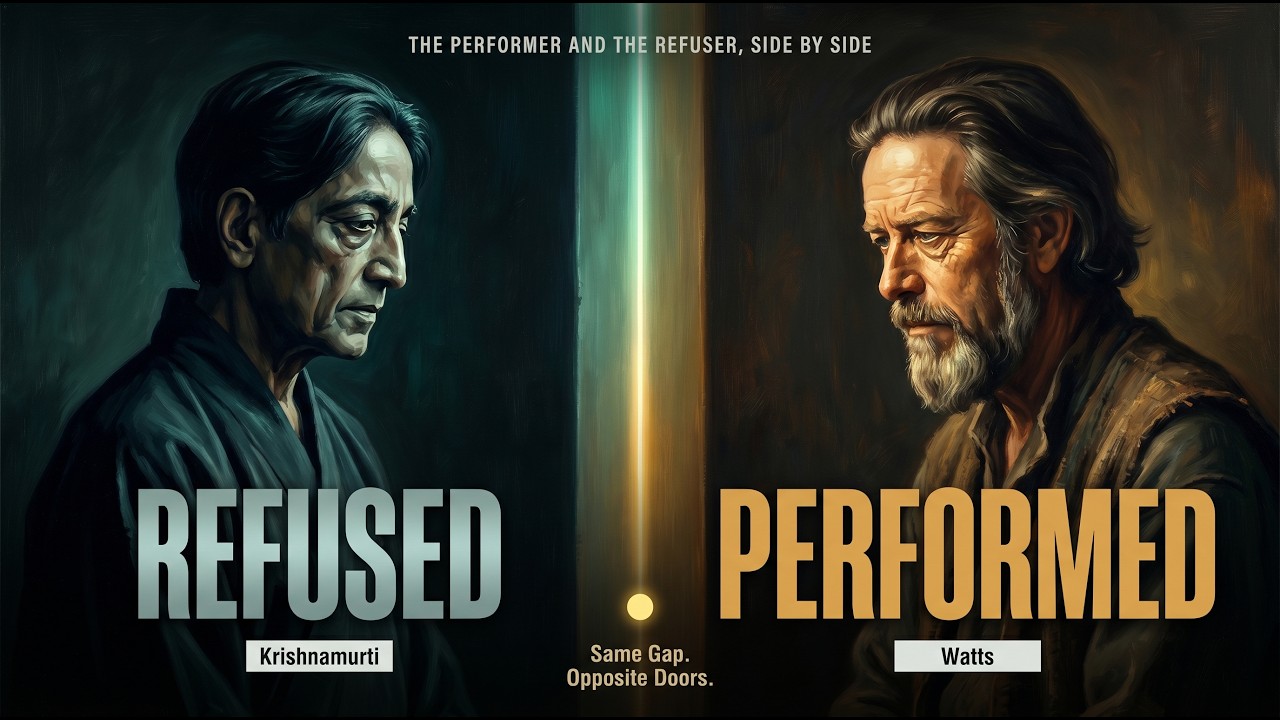
The amplifier blew because the circuit could not hold the current. Edging is the opposite failure: the circuit holds the current too well, and calls the holding itself the goal. It is containment without transmutation—the vessel sealed so tightly that nothing can break it open, including grace. In Tantric terms it is bindu conserved but never raised. In Zen terms it is the koan held as a fascinating object rather than allowed to dissolve the one who holds it. In Krishnamurti’s terms it is the “me” managing its own near-arrival—the subtlest leak, because it looks like discipline.
Satori is not the edge sustained. It is the completion of the circuit—which usually arrives as a spill you did not authorize. That is why the blown amplifier is more instructive than any technique: the current found the weak point and made it the door. Edging refuses the door. The practice you are describing—chanting, sitting, wu-wei, Watts’s humor, Krishnamurti’s flame, Jung’s mirror, kundalini’s ascent—is not a way to hold the edge indefinitely. It is a way to make the vessel transparent enough that when it breaks, the breaking is the message.
So: yes to the comparison, with one correction. The Chinese vessel does not solve the Euro-American bottleneck by being emptier. It solves it by letting the analytic wall and the synthetic space hold each other without either claiming the whole. And the answer to edging is not more edge. It is the willingness to spill—on purpose, into the world, where the message can finally be heard without the amplifier.“
(Can you dig it? In new left’s language
Warning unexpurgated)