The concept of anxiety in imitative arts

Anxiety, defined in medical terms, relates to an inner state of uneasiness and inquietude that usually comes in conjunction with such feelings as fear, apprehension and trepidation. Purporting a negative connotation, anxiety manifests through a series of external symptoms which earn it its place in the pantheon of physical disorders. A prolonged and poignant feel of anxiety can lead to numerous anxiety disorders, most common of which are: generalized anxiety disorder, panic disorder, social anxiety disorder, phobias, obsessive-compulsive disorder, and posttraumatic stress disorder (PTSD). These all come with their specific gesticulation.

In existential philosophy, anxiety is taken a notch up through the in-depth reflections of thinkers such as Søren Kierkegaard, through his work The Concept of Anxiety. By means of an existential dialectics, Kierkegaard ushers angst, the Danish equivalent of anxiety, into the heritage of human condition and equates it with the echo of freedom found reverberating within the walls of one’s own conscience. Anxiety creeps at the moment one is faced with the responsibility of making a free decision, anticipating therefore sin. Anxiety is not itself sin, but is the natural reaction of the soul when faced with the “yawning abyss of freedom.” In equal measure, the onus of sin brings about it a renewed sense of angst, a compounding of the anxiety of freedom. Later, in The sickness Unto Death, Kierkegaard describes how anxiety in reference to the self and confronting the eternal becomes despair.

You can imagine now how a palette of carefully yielded idiosyncrasies can torment one’s expressiveness into an exterior mirror of the agitated self. Starting with the last century, angst makes its way into painting and perverts the easel’s soft reality, lending it the rough edge of unabashed, qualmish distress.

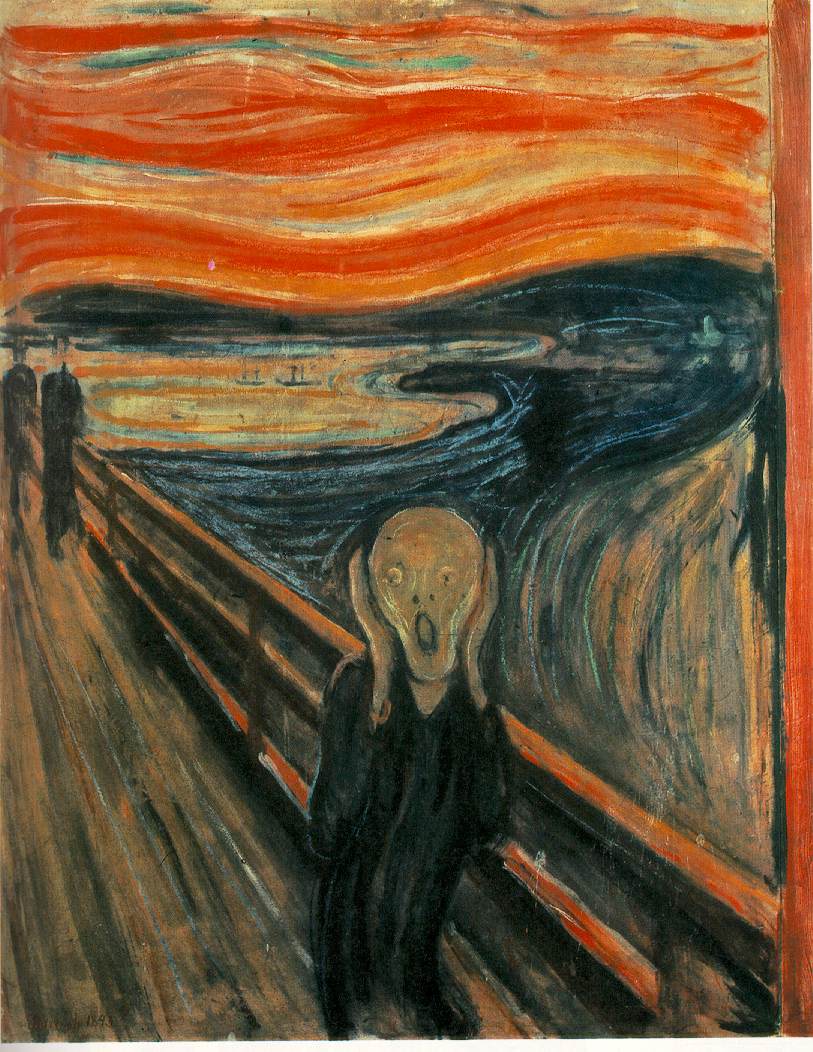
It’d be interesting to see how anxiety can influence and direct the output of an artist, and how it can relate to the critic’s eye. The most outspoken example is that of 20th century Expressionism, which centres mostly on the self’s struggle with its own demons. Munch’s Scream is a perfect visual example of modern anguish in staccato rhythm. The funereal central figure, the nuclear sunset, all on a background of still indifference convey the dismal tone of despair.

ibiblio.org/wm/paint/auth/mu … scream.jpg

What else ?

Horror movies? The literary work of HP Lovecraft?

Why would someone who suffers from anxiety wish to share that with the rest of the world? It doesn’t make it go away, and just makes others more likely to be anxious.

Nonetheless, I love Alfred Hitchcock’s movies.

I don’t know, maybe it acts as a katharsis. The exploration of one’s self with its abyssal dimensions can be a purgation. Or something.

I was thinking of this other work by Munch, Golgotha

I was reading Kierkegaard’s Sickness unto Death the other day, and his description of human despair in relation to the eternal prompted me to remember this painting.

There is nothing more crucial in an individual’s life than the moment he is before God - that is, when his inward movement becomes a rapport of itself to the infinite part of it. this is when the individual has a chance of becoming the Individual, when he makes the dialectical development towards faith, towards becoming a self before God. This dialectics can result in the Individual developing despair - the despair of not wanting to be himself, or the despair of wanting dearly to be himself.

In Munch’s painting Christ is pushed back, distant from the main observing point. In the foreground there are people, swarming and melding to form a deformed mass. Their faces are like grotesque masks. What’s interesting, among the mass of sloven mongrels, some avert their eyes and pull stupid faces. It’s like they can’t be witness to the grim spectacle. It’s like they can’t watch Christ dying on that piece of wood.

I find this very expressive, as it has some connection to Kierkegaard. In the face of Christ, confronted with the tormented, twitching silhouette of Christ nailed to the cross, some turn and look the other way. It is like, sitting before Christ and relating to Him, they cannot bear to withstand the decaying human corpus in which God is possibly incarnated. They see the paradox and scandal of Christianity that Christ proposes and Kierkegaard talks about and, in cowardice, they decide to eschew it. Their despair is the dialectical response to the desire to not be themselves - a gruesome, ironic act of denial vis a vis the proposal of Christianity to elevate the matter by means of faith and purification through suffering.

i think the connection between anxiety and art - or, more generally, creativity - is much broader than you have anticipated so far. for anyone undergoing mental anguish of any sort, self-expression (whether or not the result will be seen by others) is (as has already been mentioned) a great catharsis, and also makes possible the process of seeing the core of one’s anguish out in the open, expressed honestly. i always find it easier to, for example, write poetry when i am upset or worried than when i am happy; in moments of emotional or psychological weakness, one always feels the need to expel one’s demons, and often this is done through some kind of art or creative project.

Sure, you’re right. Not only modern art, but most art may be said to host some unresolved quandary.

I was also thinking of this painting by Grunewald, which I was intending to post for a while back, but had forgotten. Thanks for the refresh, soph.

I read about it first in Dostoievski’s The Idiot, where a reproduction of it usually made a powerful impression upon everyone beholding it. It basically tells the same story as Munch’s painting and recalls Kierkegaard’s anguish in front of Christ’s miser demise.

Grunewald understands the paradox of Christianity and exploits it with relentlessness, anticipating our Mel Gibson. Instead of the sublime Christ, that scrutinises the skies with big puppy-eyes, G. offers an in-you-face depiction of the Crucifixion, where Christ is shattered, torn, ground-orientated, pulled down by his own weight. He suffers greatly. Hence, one is shaken: is this the Son of God, our Saviour ?, for undoubtedly the actual historical film must have been even more gruesome than that. It is mind-boggling, strenuous, fierce to construct a religion around a bleeding body. Hence, the anxiety – whence does my faith come from ? Whither is it directed ? Am I strong enough to take upon me a similar quest ?

It is the expression of a tormented mind, expanded upon the canvas, curled among the thorns. One doesn’t depict suffering with an easy brush.

When I went to artschool, nothing made me relate to the meaning of art more than Edvard Munch’s Scream. To feel it without hearing it, internalizing the emotion in ourselves and better yet making us feel. To have art make us feel emotion is what moves us and makes it art.

I also love Alfred Hitchcock - love to hate him that is. His brain was so much more than the story itself and the films were famous for the odd angles making us feel like we were inside it. Wonderful. Thanks for mentioning him, siatd. I am going to go rent some this week.

But with The Scream, it’s interesting how everyone has a different perception and interpretation of this piece of artwork. Many believed the person in the image is projecting a silent scream that cannot be heard; others can recognize that the action of the person’s ears being covered suggests that it’s not the person who is screaming but, as mentioned, the scream comes from nature’s anxieties of life which distressingly is heard by the one person, while the others are deafened and not aware of it. It would probably create a little anxiety to you, the audience, looking at this artwork… what’s amazing about it is the fact that it creates such multiple meanings, yet conveys a universal emotion that is recognized and experienced by all.

I don’t know that at this time in my life I would want it yelling above my fireplace, but there was a time… ah yes, there was a time! :smiley:

One of the aspects I adore about Hitchcock is that some of his best films contain some of the least action that you’ll ever find in a horror movie. It’s primarily driven by excellent dialogue, timing, and the combination of unconventional camerawork and powerful music. Indeed, I would have thought the music will be one of the things you’ll notice when you watch them again.

And the presence of Grace Kelly. They just don’t build 'em like they used to.

He is a class act.

Yeah, tell me about it. Munch is like a funnel of suppressed emotions or unresolved anxieties.

This is called Puberty and it’s eerie.

I’ve read in an account of Freud’s patients and their dreams, that the self is usually present in the dream as a person of the opposite sex. Think of how intimate art is, and how some prefer to talk about the act of creation as a dream-like experience, and I guess we have the image of a very morose and sad teenage-Munch. The sense of vulnerability, the shadow of a gloomy past and sullen future, stuff like that.

“Sickness, insanity and death were the angels that surrounded my cradle and they have followed me throughout my life.” (Munch)