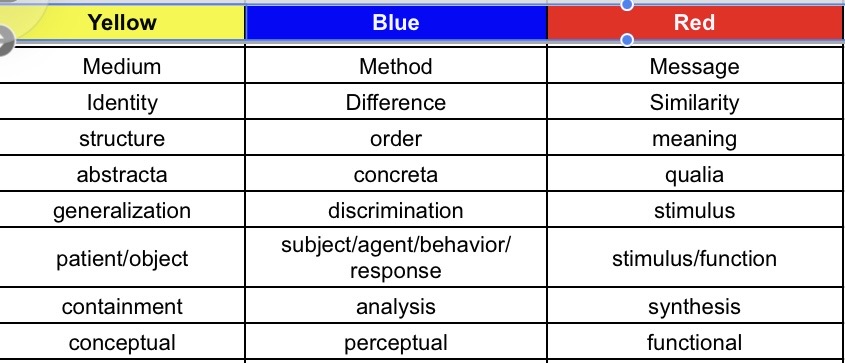
What if everyone is really one?
What if nobody believes that except one?
What if no body believes that one who is excepted?
And down the line into a chaotic intangible echoin refrain?
What if what if?
If what?
What if everyone is really one?
What if nobody believes that except one?
What if no body believes that one who is excepted?
And down the line into a chaotic intangible echoin refrain?
What if what if?
If what?
What? If what is what that may be?
signed, sealed and delivered>
Exactly. I don’t get that song by Creed, either. What if you what? Maybe someone can esplain.
15 characters approve this message
See also:
https://www.ilovephilosophy.com/t/not-to-what-if-everything-but/84643/2?u=ichthus77
s’more characters
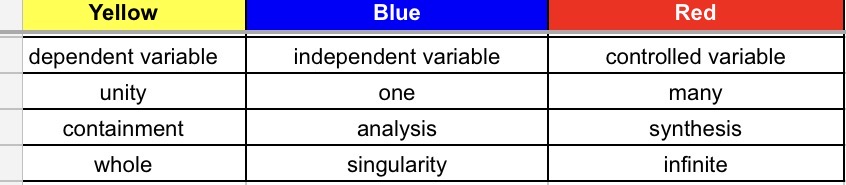
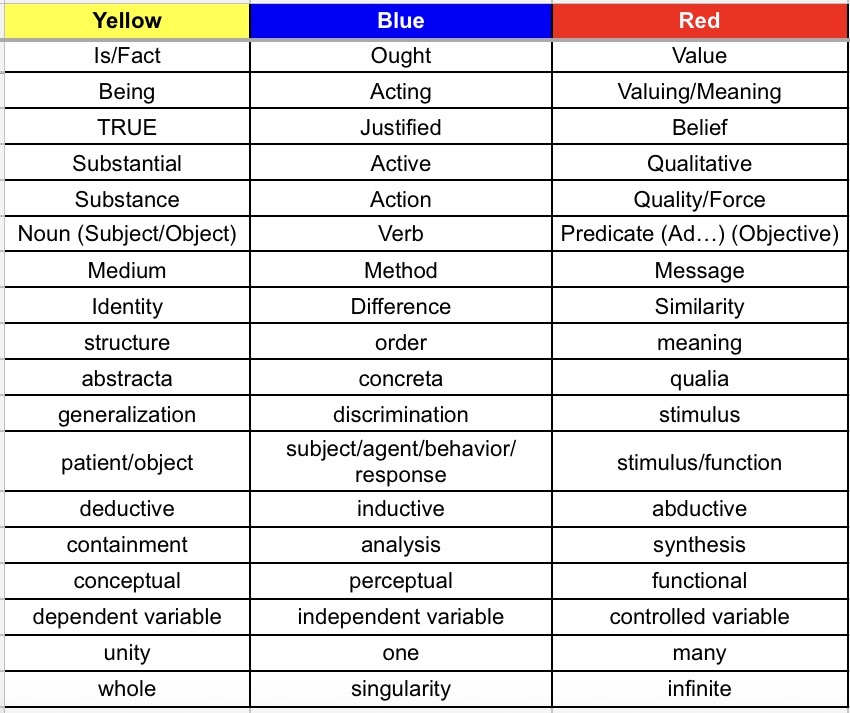
oops… I had already done containment, analysis, synthesis
I think abductive is also synthetic/functional.
Ah. Wait one.
This is better:
more (not exhaustive) at The Thingy:
blue: process/event ontology is like duty theory (deontology) (conduct)
yellow: object-oriented ontology is like virtue theory (character) (I would not confuse that with virtue epistemology just yet)
red: value ontology is like teleology (or consequentialism if you don’t understand goals/purpose precede existing them in action…for beings subject to time)
***
Before you can truly/authentically say your unseen and inaccessible-to-others character is of a certain quality, you have to demonstrate it *consistently* in your actions (and by that it is not meant by rote habit, religiously, like a Sunday morning church pew zombie going through motions without vibing with the meaning… unless you want to be de-programmed… or mistaken for camouflage).
Sometimes you gotta break character to build character.
***
I have been listening to the “partially examined life” podcast regarding Graham Harman’s object oriented ontology.
I purchased that book they were discussing, as well as his newest one. I think I’m gonna be geeking out on that for a while.
Variable objectivity/subjectivity, at times harrowing at others narrowing, but at all times take a deep breath while surveying the terrain.
Good advice, Meno.
@Meno41… here’s where I’m at so far with Harman’s OOO:
BRILLIANT that Brian is now Brianna and Greene is now Browne. 
p.27 is the page that did it, for me  I like this guy!
I’m having a problem with the anti-literalist, post-truth, indirect/withdrawn contact/relation sport (my coinage) of undeniable, almost-certainly real fictions (ships, light, moon, the rest of the indirect presence of reality-as-fiction-not-truth against which the …ships… of bad/first theories-not-knowledge … wreck).
BUT! I’m VERY curious about this “third term or mediator” teased on page 12. Did it create, does it sustain or subsume, does it reveal itself through the artifice of all we call natural?
Does he have more respect for truth than Donald Trump, more acknowledgment and reverence for real (true) reality than for Kellyanne Conway’s “alternative facts”?
Not sure yet. Only on page 38.
Update:
Pps 40-41 give a feeling of maintaining distinctions and avoiding indistinct oblivion… of not missing the unifying point by unifying-away (mathematization).
p43-44 confirms: he thinks what & how of knowledge reduce out the why of meaning/creation
p44-45 is preceded by Genesis 1:2, which (in its context) did not reduce out the why.
p46-regarding emergence (rather, gestalt) and Democritus, Arthur Holmes represents him better … accounts for both quantity and quality (but still “reduces out”, undermines).
p. 47, he is explicit about the why, but I feel like it is quibbling to say knowledge and wisdom and love of wisdom are three different things. I think wisdom is the true knowledge, because it doesn’t reduce out the why.
Stopping on 47 for now.
Update: Countering his besmirching of Descartes with this:
Red: senses, affectus
Blue: wills, voluntates
Yellow: understands, judicia
ahem moving on
So. I’m glad I started studying epistemology before reading this book. Linking some concepts from an A. J. Ayer entry that mentions sense data language (red) and object language (yellow):
Question. Is Triple O not reducing/undermining object language just because it is “flat” (inclusive of process and potential/surplus-outside-now qualities, and initially everything else)? Is it a misnomer when it means to be a triune ontology?
Gonna brush past the seeming appeals to authority lacking actual argument with Socrates on 52 and Latour on 58.
Here’s what really has me scratching my head, though.
He doesn’t seem to see how his what/object is quantitative, his how/does is process, and his why/surplus is qualitative. He doesn’t see the triunity.
We are dealing with the duomining of 1) overmining upward to shallow/surface qualities lacking hidden/deeper potential, and 2) undermining downward to hidden/deeper constituent pieces. Both reduce out not only potential quality, but the process of its expression. O-O-O … not process-oriented-ontology (to account for change, action, variation), not potential/quality/VALUE-oriented-ontology, and not a triune ontology inclusive of act/expression, potential/full quality, and object … are how Harman resolves this? Would a triune ontology in which/whom we live (quality), move (act), and have our being (object) be premature or postmature? He doesn’t believe in it, per page 63, but appreciates Pseudo-Dionysius’ analogy of unity of light from distinct sources, which he describes as “conveying [the Trinity] as not only possible, but even lucidly conceived” though an “apparent contradiction” … like world and thought?
Anything to say about the memes/information (thought) in genes/proteins (world)…and who genetically engineered them first? Afraid to be excommunicated/expelled/made to drink the Hemlock/crucified/labeled anti-science/yada yada yada?
So, just to sum up where I’m at with Harman’s Triple-O right now after going through it over the phone with my son this morning as I walked my university campus…
he talks about what it is and what it does
leaves out the why until mentioning surplus quality potential
What he says about reducing down to the what (undermining) makes sense until you consider he’s defending object-oriented ontology.
Reducing up to shallow qualities (overmining) he leaves part of the why but calls it what it does (or, how it does it “right now”).
Will he end up here?…
what IT is
how IT does
why IT effects/affects
…cuz that sounds awfully triune after having dismissed the Trinity. awkward
But I’m only on p. 75. I’m so excited to see if he resolves all the issues I’m having by the end of it. And if not by the end of this one, then by the end of Waves & Stones, arriving Thursday.
If he doesn’t… maybe I’ma have to?
You shouldn’t really for Gods sake, life appears a long sided road, in fact it’s borne out of an end of a tube, even before it all winds down.
Other then that it’s quite simple in all it’s complexity: one seed and it’s beginning all overs
And for real a a perfect subterfuge for a steal, in fact it should be borrowed time , out of an inexhaustible capital. The effect being, hyperinflated goods, or underrated efforts to get at them.
Wild was just speculating for saying so but it’s work for its own sake therefore art is work.
But does it now?
In fact what remains of surplus capital? More uncertainty. Heidegger puts it in place about a phenomenological God , that as a metaphysical object, it undermines security, predictability, by minusing the apparent certainty illustrated by Brennan vs. Descartes, and as such even if, God didn’t exist as such, He needed to be created out of same apparent illusion.
Is it then become a delusion, insistence or distinctive , signaling the coming of a brave new world?
The double bladed Occham, working both ways, shows within a shadow of doubt that a third, bladed configuration is at work here, and that may be a new necessary component.
The stickman/Stockman 3 bladed knife?
Balance of faith, knowledge, and practicality
This road is a really long and winding road, apparently. Every day.
The road with three forks?
roflmao
when in Rome
jk
If the Lord wills, it won’t be me.
I’ve been later, I’ve been later
I’m the master procrastinator
You cannot out-wait the waiter
Final thoughts before proceeding on…
“What makes OOO different from these currents of thought — but similar to object-oriented programming — is the idea that objects never make full contact [me: relations] with each other … are mutually autonomous and enter into relation only in special cases that need to be EXPLAINED rather than ASSUMED [emphasis mine]. …objects cannot make direct contact with each other, but require a third term or mediator for such contact to occur.” p.12
So let me get this straight…we started out with a little tiny dot of way too much order (infinitesimally small singularity is ordered??) that came out of nothing … and ever since, it’s been entropy (disordering) … and yet here we have life, and everything else in the universe which isn’t just hydrogen (self-) arranged in different patterns, but which is super organized way more than just an infinitesimally small dot???
It seems to me that disorder or disharmony needs explanation every bit as much, if not more than, relation needs explanation [edit for clarification: order is the teleology/relation (physical or spiritual function) in the substance (physical or spiritual material), harmony is teleology/relation in the process (physical or spiritual process)]. But people have been saying that for a long time every time they bring up the problem of evil, haven’t they? But they don’t wanna talk about alienation from God these days. Or they do, but the academy gags them.
Also, it is interesting to me how he says the “what it is” and “what it does” are under the umbrella of knowledge (always indirect), but there’s that third thing (not wisdom, he says, but the LOVE… of wisdom) that could never be “known” (even indirectly) because it is always potential (I take that to be infinite?)?
He’s gonna manage this without the Trinity?
In chapter one, he conflated quality/essence and process/act…
In chapter two, he’s conflating process/act and substance.
There’s definitely conflation going on here, but due to the above, it is unclear what/how/why is being conflated with what/how/why:
Maybe rejecting the Trinity whammies people’s brains?
(ty Carleas for deleting the troll’s replies) There is hope of distinction:
“one of the pillars of OOO: the deep divide or tension between an object and its qualities” (p. 75). Elsewhere he says they always come together—that implies a distinction and a unity, correct? … but later he talks about a compound object (the sort of nonwithdrawn relationship he earlier says always needs to be explained rather than assumed).
To proceed.
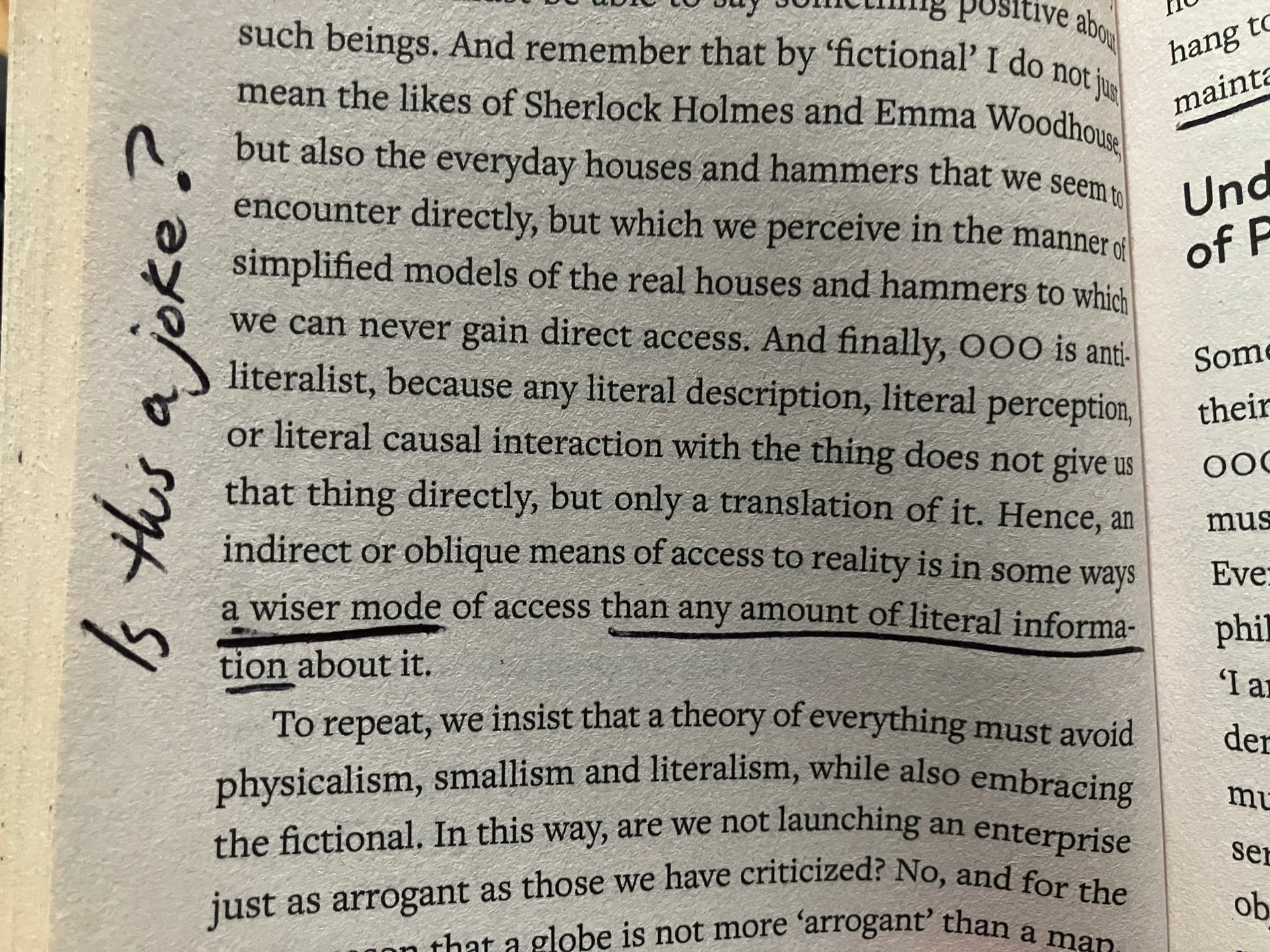
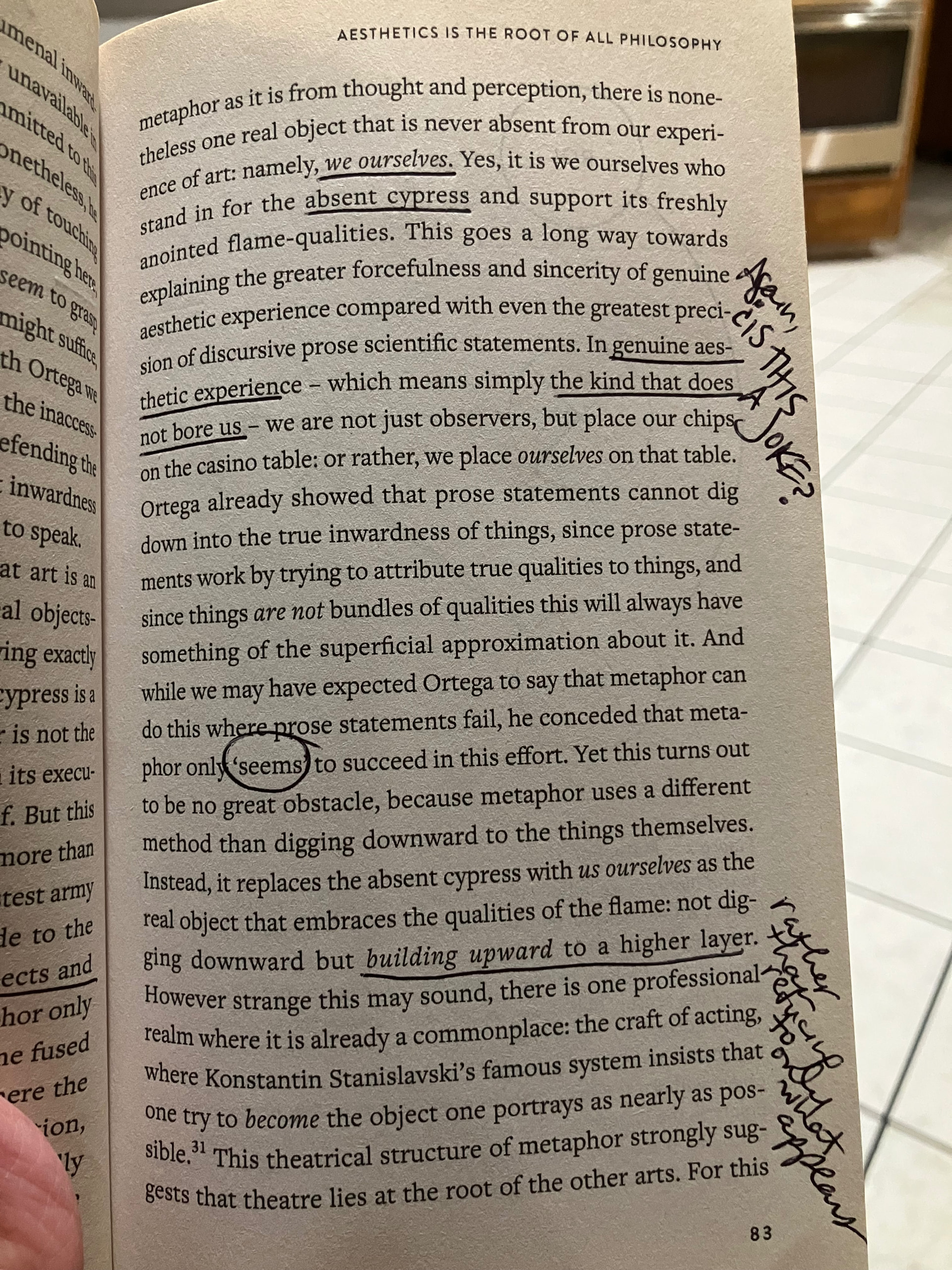
On page 40 I did find myself writing “Is this a joke?” in the margin. And now again, I’ve done it on page 83. This guy, though likable, has a lot of work to do to get my trust/hope back.
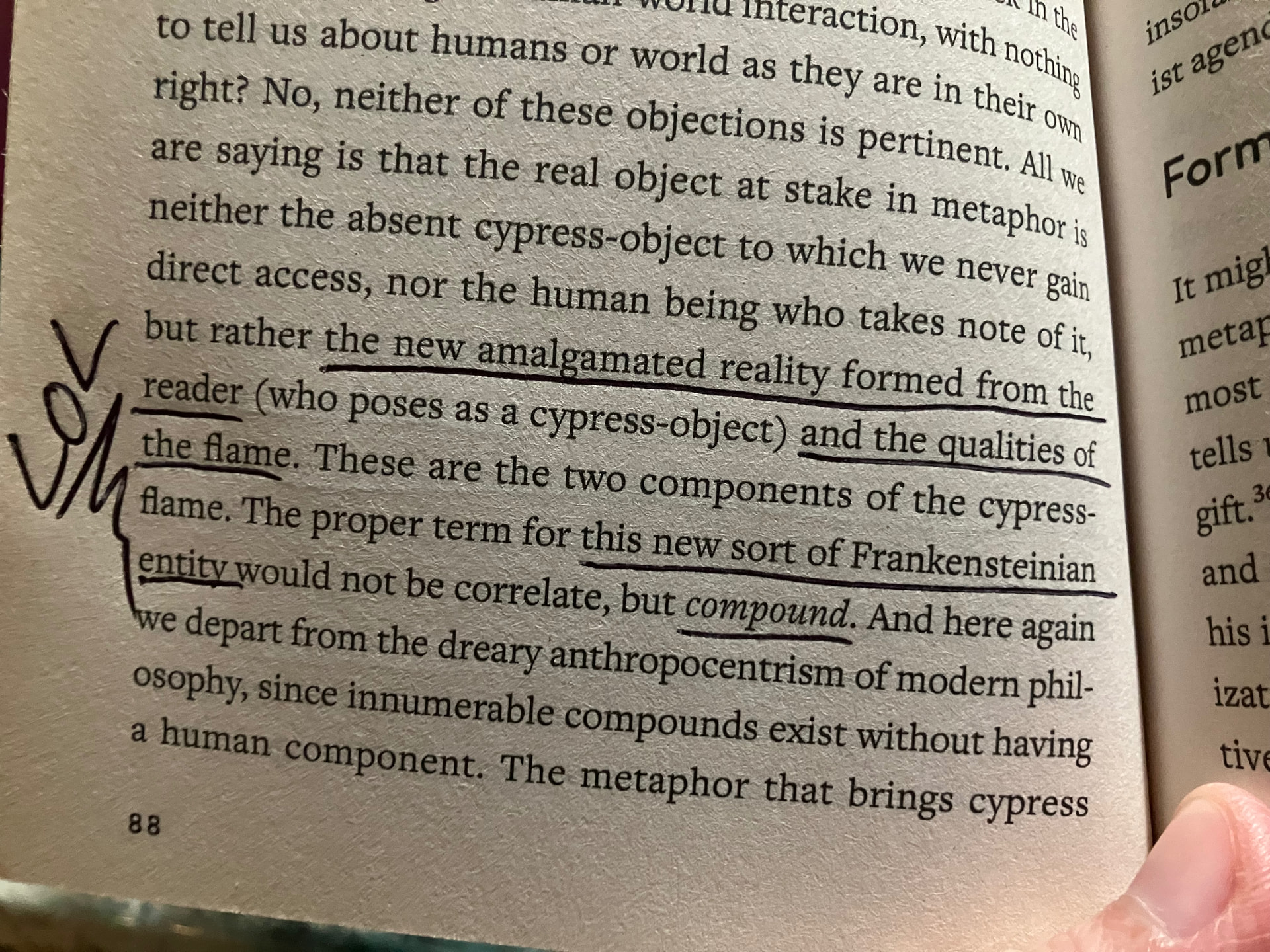
So. On 73, very bottom, he teases a “new entity”. Turns out it must be that “third term or mediator”.
Spoiler alert… it’s the new you (85). That’s why your metaphors (that don’t bore you) work for you (81, 82), even if for no one else… and the void you fill is still quite inscrutable.
Dayyyyuuuuummmmm!!! Sick burn!!! 
I’ma keep reading, though.