I agree there. There is no need to reduce the Overman to Nietzsche.
Maybe this is too Straussian for you, but It seems clear to me that the purpose of Nietzsche’s invention was an ideal for man to live towards. Not a way of honoring his person.
Am I sounding that way period, or am I sounding that way to you? (This is a rhetorical question.)
What the Hell do I care how I sound to you!
No, but should I look at myself from my hypothetical children’s perspective?
I better justify the fact that my parents put their lives in my service. Either that, or put my life in the service of children of my own - in the hope that they or their offspring will justify mine. But that means passing the task through…
I see now why your avatar is a rabbit.
The crucial thing is that the Overman is not an ideal. Consider the following:
“Here archetypal man was cleansed of the illusion of culture, and what revealed itself was authentic man, the bearded satyr jubilantly greeting his god. Before him cultured man dwindled to a false cartoon. Schiller is also correct as regards these beginnings of the tragic art: the chorus is a living wall against the onset of reality because it—the satyr chorus—depicts reality more truthfully and more completely than does civilized man, who ordinarily considers himself the only reality. Poetry does not lie outside the world as a fantastic impossibility begotten of the poet’s brain; it seeks to be the exact opposite, an unvarnished expression of truth, and for this reason must cast away the trumpery garments worn by the supposed reality of civilized man.”
[The Birth of Tragedy, chapter 8.]
Nietzsche would rather be a satyr than a saint. Thus the Overman is a satyr, the opposite of the “highest” and “best” man (the saint). Thus the Overman, in his nakedness, seems like a devil to the saint: he has horns, goat legs, and a tail…
The god to which the satyr jubilates is the mad god, Dionysus - the world.
It was just something to consider - not a thesis (that is rather that the Overman is false etc.).
“Cruel”, “false”, and “seductive” are anthropomorphisms, yes; but that precisely makes them more applicable to the Overman.
They are not value judgments, as Nietzsche does not say that it is right or wrong to be cruel or false. As for “without meaning”, I don’t see how that is a value judgment at all (“cruel” and “false” at least have a negative connotation).
Did not Heraclitus say that nature (phusis) loved to hide? Likewise, the Overman loves to hide: he is a trickster (see Nietzsche’s portrait of Dionysus in the penultimate section of BG&E).
I disagree.
Well, you can deceive yourself, of course (for instance your mind your body). But body and mind are one, and therefore it is always yourself that you dupe.
The sexual drive presupposes a telos. As Nietzsche says:
“Formula for our happiness: a Yes, a No, a straight line, a goal…”
[AC 1.]
The goal is not the happiness itself; the happiness is in the advancing toward that goal.
In this place in space-time (the modern “West”), this subject seems to be the ultimate test of how untimely one is.
Oh, wow!!! Nietzsche would have approved of steroids?!? The handling of N. here, as if his thought could be reduced to some single agenda, really makes response useless.
Steroids? What are you talking about, Ierellus!
Aren’t steroids a convenient way to create overmen? Ask Bonds. I find it unfortunate that your excellent knowledge of N.'s ideas does not allow you to examine the faults therein.
You still omit an r from my name.
Sorry, that was not on purpose. But who is Bonds? And I don’t see how it follows from anything I said that steroids are a convenient way to create Overmen. When I think of steroid-using bodybuilders, they don’t look anything like an Adonis or a Zeus (watch out, mild nudity).
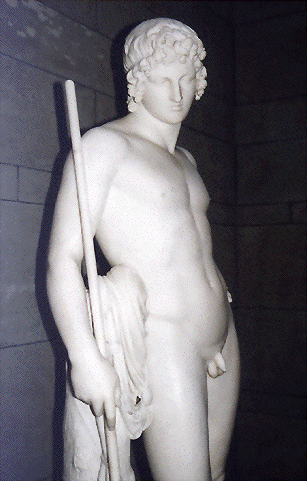

“In Thucydides (I) a Spartan king, Archidamus, agrees that by nature all men are equal. But he insists that as mere human beings they are little better than lazy beasts. What makes them something which counts, according to Archidamus, is twenty-three years (from 7-30) of Spartan higher education, that is, twenty-three years of the harshest military training. Graduates of that education emerged as pious Spartan warriors, something infinitely more precious to Archidamus, than merely being human.”
[Neumann, Liberalism, page 298.]
What is lazier than using “shortcuts” like steroids?
Barry Bonds, whose recent batting average record seems compromised by rumors of steroid use. It was other posts that suggested steriod usage, not yours; however, if the overman is the end-all, be all of human power, why shouldn’t it be achieved by any possible means?
For N., humans were an intermediary phase between the ape and the overman. He envisioned the overman as the next step in potential evolution; in this case it was a literal and not a metaphorical objective.
I know that can still only be done when the most superior men and women have sex then make more of their superior blood into bodies. That is why I was joking around at how the ubermensk should be quite the swinger, otherwise his race would simply never exist.
Indeed! But I doubt whether steroids can make an Overman (hence the word “shortcuts” between quotation marks). Still, I guess we should experiment with them; as with other “artificial” means (eugenics for example).
Absolutely. There are no more, or at least very few, Shakers left in Ohio, although we keep the name in places like Shaker Heights. They didn’t believe in sexual intercourse! Ancient Hebrews did, but they saw it as for the purpose of procreation only. If you spilled your seed, God would zap you (Onan). And isn’t seeing some destiny for evolution an ideal?
Oh please. He says that only once, in the prologue of Zarathustra, and there it is probably a simile: compare Heraclitus, Diels-Kranz fragment # 83:
“The wisest of men appears as an ape when compared with a god - in wisdom, beauty, and all other ways.”
Indeed, Nietzsche did envision the Overman as a kind of Greek god (especially an Epicurean god):
“The enkrateia [temperance] and askesis [ascetic exercise] is only a stage toward the heights: the “golden nature” is higher.
[…]
Higher than “thou shalt” is “I will” (the heroes); higher than “I will” stands: “I am” (the gods of the Greeks).”
[The Will to Power, section 940.]
“The one movement is unconditionally: the levelling of humanity, great ant-hills etc. The other movement, my movement: is conversely the sharpening of all antitheses and clefts, abolition of equality, the production of supreme men [Ãœbermächtiger].
The former generates the last man, my movement the Overman. It is absolutely not the intention to conceive of the latter as the lords of the former, but two species [Arten] shall exist alongside each other, - separated as much as possible; the one, like the Epicurean gods, unconcerned with the other.”
[Nietzsche, Nachlass.]
Overmankind has not yet existed, in this time-cycle. And indeed, it was Nietzsche’s will that an Overmankind be created. But individual Overmen have “appeared often” in the past (AC 3); are “constantly encountered in the most widely different places and cultures” (AC 4); and “have always been possible and will perhaps always be possible” (again AC 4).
How about artificial insemination?
My problem with Nietzsche is that his view of history was deterministic, just as Marx’s was. So how is this overman to materialize? By revolution? By evolution? If the overman is a natural outcome of human struggle, why does the 21st century find the majority of extant people so dependent on secondary sources of survival that a dirty bomb can depopulate a city, that a power outage can cause universal panic, that any charismatic asshole can lure millions into conflicts without resolution?
Nietzsche’s determinism was a quantum determinism (quantum mechanics avant la lettre): quanta of force, to which (force) he ascribed the will to power, in order to make it imaginable for us (we have to anthropomorphise in order to imagine anything). So the Overman is not the result of random collisions of particles or even quanta, but of will. And will is still possible in a deterministic universe:
“[F]ate is not something external that compels us against our will; it partly acts through our willing, and therefore gives no reason for resignation or passivity.”
[George Morgan, What Nietzsche Means, page 305.]
In this regard, “evolution” sounds too passive for my taste; but “revolution” suggests resentment. Instead of “evolution”, I would use “breeding”, “volition”:
“The problem I thus pose is not what shall succeed mankind in the sequence of living beings (—man is an end—): but what type of man shall be bred, shall be willed, for being higher in value, worthier of life, more certain of a future.”
[AC 3.]
And as for “revolution”, Nietzsche does say:
“The more similar, the more ordinary people, have always had and are still having the advantage; the more select, more refined, more unique, and difficult to comprehend, are liable to stand alone; they succumb to accidents in their isolation, and seldom propagate themselves. One must appeal to immense opposing forces, in order to thwart this natural, all-too-natural progressus in simile [continuation of the same thing], the evolution of man to the similar, the ordinary, the average, the gregarious—to the common!”
[BGE 268.]
So here again it is the will which is decisive: the will to thwart said evolution. (“Strong will” is the resultant of strong forces, strong urges which do not cancel each other out but rather amplify each other.) And this appealing to opposing forces: what, does Nietzsche not appeal only to such forces? I mean Nietzsche’s philosophy as a whole (including its “politically incorrect” aspects) - does it not appeal only to men who want to thwart this process?
I’m sorry, but my appreciation of Nietzsche’s writings comes from his constant disapproval of either/or contentions such as free will/ determinism, nature/nurture, evolution/revolution. He really didn’t like Hegel or Kant! His opus is large enough and varied enough for anyone to find support for their favorite pole of some imagined polarity. So I must simply agree to disagree.