The Resistance Begins

That’s why we need a grass roots uprising which causes at least one of parties to break away from the stranglehold of corporate interests and billionaires or a new party that will stand up to them.

Meanwhile according to today’s NYT:

”It is safe to say that the first 100 days of Donald Trump’s second presidency will be considered the most consequential of any in modern history. Since taking office, Mr. Trump has consolidated extraordinary power in the executive branch, dismantled large portions of the federal government, undone the military and economic alliances that were formed following World War II and torn up the policy consensus that has governed global trade for just as long.

But a consequential start does not in any way equate to long-term success. Mr. Trump’s approval ratings are already falling, and if past presidencies are any guide, the worst is yet to come. Now as in 2017, he is the only modern president to have a net negative approval rating at this point in his term. And as more and more Americans begin to feel the pain of his policies, we may well look back on his first 100 days as the prelude to a historically unpopular presidency.

Will Trump be bad enough to rouse ordinary citizens from their apathetic slumber and take the reins of democracy from the monopoly capitalists and billionaires who are destroying it? Stay tuned.

Between Covid and the Ukrainian Russian war there was nothing marking Biden’s economy as being strong or exceptional.

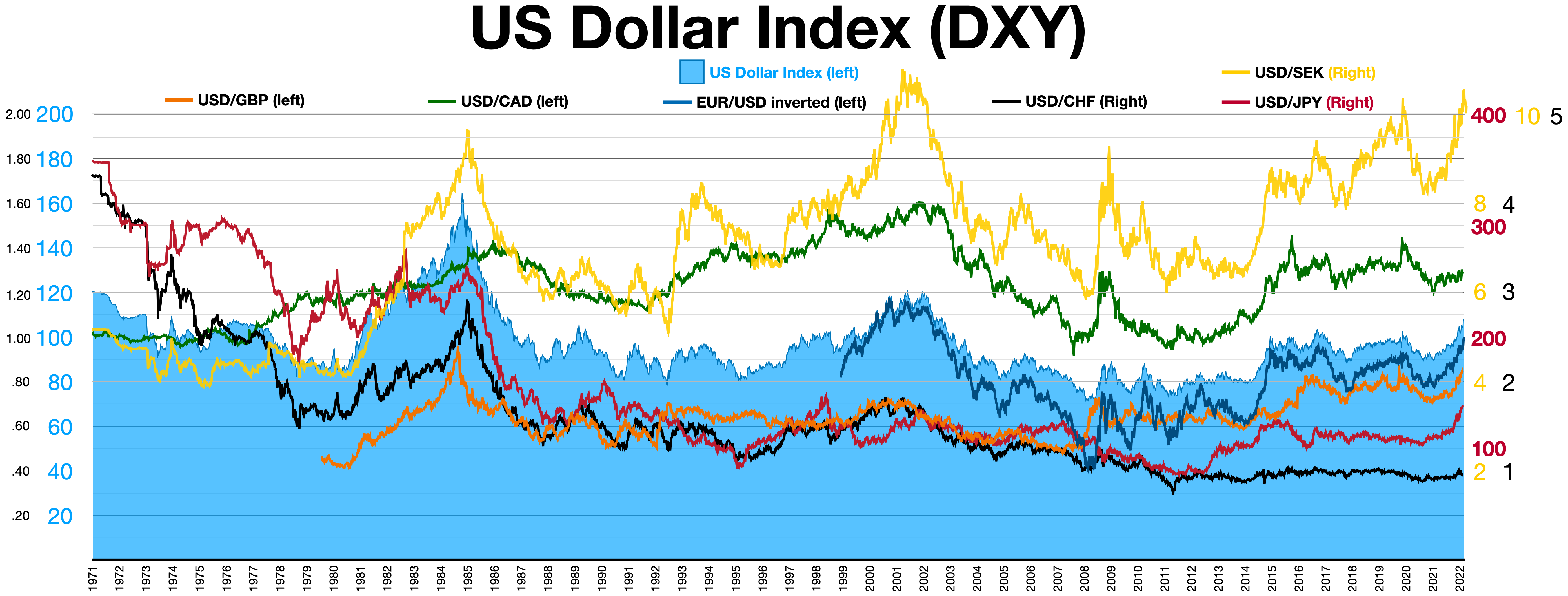
The economy and dollar has been in decline since Clinton’s NAFTA and WTO. Obama and Biden being just a continuation of those enacted policies.

I think bringing back manufacturing and infrastructure back to the United States is a good thing considering what has been going on the last thirty five years, but I will admit the way Trump is trying to achieve that is done poorly.

The median voter is the bourgeois and the bourgeois only cares about the bourgeois, they care about nothing else.

The democratic party doesn’t care about the working class anymore than the republican one. One could argue the democratic party hasn’t cared about the American working class since the time of Jimmy Carter or before.

So once again, what does the democratic party represent that is any different than republicans?

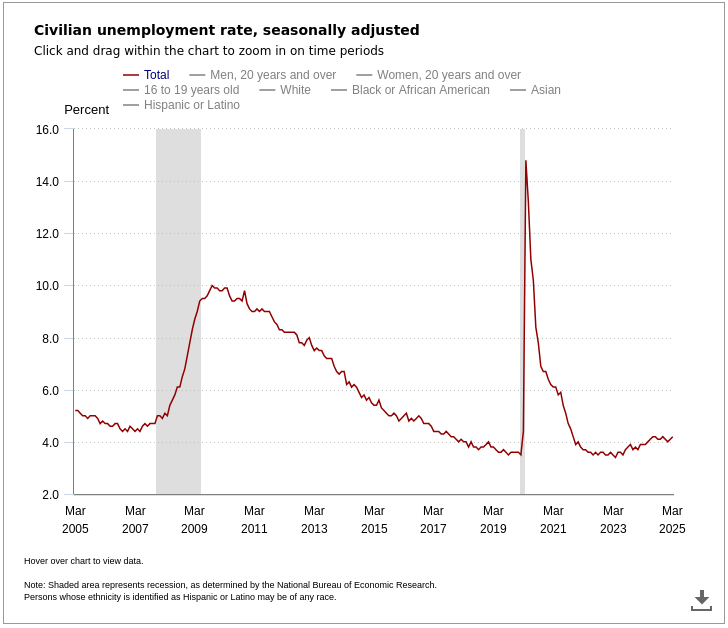
What? These aren’t economic indicators, and they didn’t start under Biden. Biden oversaw the recovery from Covid, and most economic indicators show a return to normal after a period of significant instability.

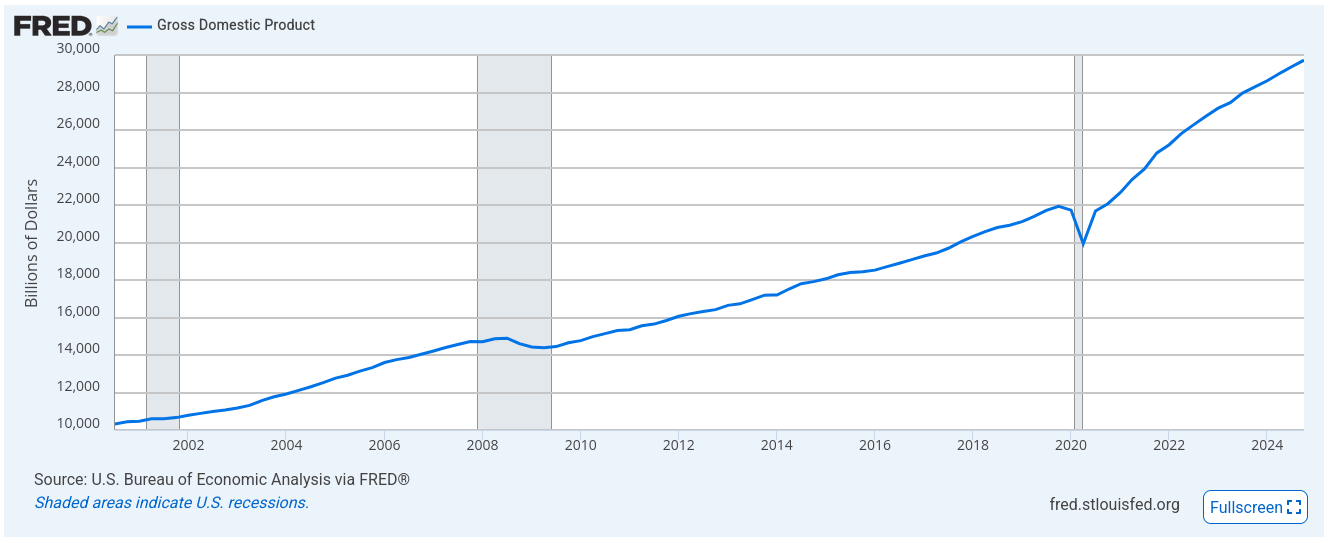
GDP? S&P 500? Unemployment? What indicator are you looking at that doesn’t show a strong economy during the Biden years?

This is just false:


The Dollar Index has been roughly flat for 50 years, and if there’s been a decline (which I don’t think that chart shows) it began before Clinton – 1992-2000 shows a local increase in the value of the dollar.

So, the Covid lockdowns worldwide was an economic boom in the United States and abroad? Current and past events play a huge role on the financial economy.

Return to normal? What is that economically?

We haven’t seen anything return to pre-2020 levels.

Those who have studied the economy and finance long enough know that the government provided statistics are false massaged purposefully for the capital class. They are intentionally false and misleading for public consumption.

Since 2008 the dollar index is manipulated by the buying of bonds and treasuries by the Federal Reserve, nothing authentic or organic about it at all which is why BRICS is becoming a popular alternative worldwide. If the dollar was so strong BRICS wouldn’t be possible on the world stage.

We’ve seen unemployment and GDP return to pre-2020 levels, those seem like relevant economic indicators:


What specifically has not returned to pre-2020 levels?

Two kinds of people in this world, those who accept things as they’re presented to them with little to no doubt or skepticism because what is presented is institutional simply just accepted as truth and those who know economics much like a lot of politics revolves around deception of the powerful plotting against the much weaker powerless. I don’t agree with the official statistics you present because they paint a picture that isn’t even real.

1 Like

If the rich get richer, and the poor get poorer, and the middle class disappears, is that considered economically strong? Asking for a friend.

1 Like

Yep. Well, Carleas is the type to believe stuff because of muh authoritay says so. Most on this website are the same. Most in society at large are also the same. Don’t expect otherwise.

But do wonder about the incentives and reasons behind these little “believies” claims. Because claims to support the Established Powers are either based on ignorance-brainwashing-low-IQ, or… well, let’s just say ‘some other system of personal incentive’.

1 Like

The latter of which, you really do not want to know. Just realize you will not change minds in that context, and move on.

Anyone who thinks for themselves, abandoning government-corporate propaganda and the fake left-right divide, will eventually ‘redpill’ themselves. The Walk Away Movement (walk away from the democrat party) was and still is very real and alive.

True, many previously redpilled folks have been absorbed back into the government fold by the Trump psyop. But that doesn’t disprove what I am saying. It only shows another example of human frailty and the great importance of being better than that.

Plus these days the tools are easily available to help with that awakening to real truth, at least for now anyway. I mean, people who don’t even take advantage of what is still freely available, …just wait until real censorship control falls down over us. This will be achievable soon enough with ubiquitous Technocracy.

The real Resistance is anyone who genuinely tries to think for themselves and doesn’t believe a word any politician or corporation tells them.

Show me unofficial statistics. Show me these tools. Present any evidence for your views. I’m pointing to things that support my beliefs, it’s fine if you reject them as unreliable (I disagree, but reliability matters), but point to the alternatives that support your beliefs.

You don’t get to claim superiority if you can’t even say why you believe what you believe.

1 Like

“From this wasteful and destructive incident, one useful lesson can be drawn. In recent years, many people who live in democracies have become frustrated by their political systems, by the endless wrangling, the difficulty of creating compromise, the slow pace of decisions. Just as in the first half of the 20th century, would-be authoritarians have begun arguing that we would all be better off without these institutions. ‘The truth is that men are tired of liberty,’ said Mussolini. Lenin spoke with scorn about the failings of so-called bourgeois democracy. In the United States, a brand-new school of techno-authoritarian thinkers find our political system inefficient and want to replace it with a ‘national CEO,’ a dictator by a different name,” writes Anne Applebaum in the Atlantic. How far down will we have to go before this generation learns this lesson again?

.
Getting the important things done!

2 Likes

1 important thing done. Millions to go!

.
I don’t recall you ever bemoaning Biden and his melee of madness.

The Trump administration has given America its reputation back.. contrary to what your Leftist grapevine is funnelling your way.

1 Like

Do you have any evidence to support your impression about Trump’s approval abroad. I doubt it. His popularity is falling here.

With President Donald Trump’s second term approaching its 100-day mark, 40% of Americans approve of how he’s handling the job – a decline of 7 percentage points from February.
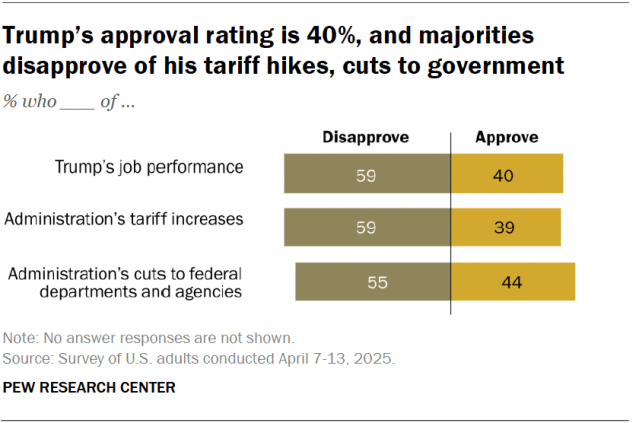
A diverging bar chart showing that Trump’s approval rating is 40%, and majorities disapprove of his tariff hikes, cuts to government.

And, even as Trump continues to receive high marks from his strongest supporters, several of his key policy actions are viewed more negatively than positively by the public:

  • 59% of Americans disapprove of the administration’s tariff increases, while 39% approve.
  • 55% disapprove of the cuts the administration is making to federal departments and agencies, while 44% approve.

Trump’s use of executive authority also comes in for criticism: 51% of U.S. adults say he is setting too much policy via executive order. Far smaller shares say he is doing about the right amount (27%) or too little (5%) through executive orders.

Note: This survey was conducted after Trump’s April 2 announcement of sweeping new tariffs on nearly all U.S. trading partners, which triggered several days of volatility in U.S. and global stock markets. The survey was in the field on April 9 when Trump paused tariffs on most countries but levied higher rates on China. Americans’ opinions (including those about the economy and tariffs) were largely unchanged throughout the April 7-13 field period.

With many of the administration’s actions facing legal challenges in federal courts, there is widespread – largely bipartisan – sentiment that the administration would have to end an action if a federal court deemed it illegal.
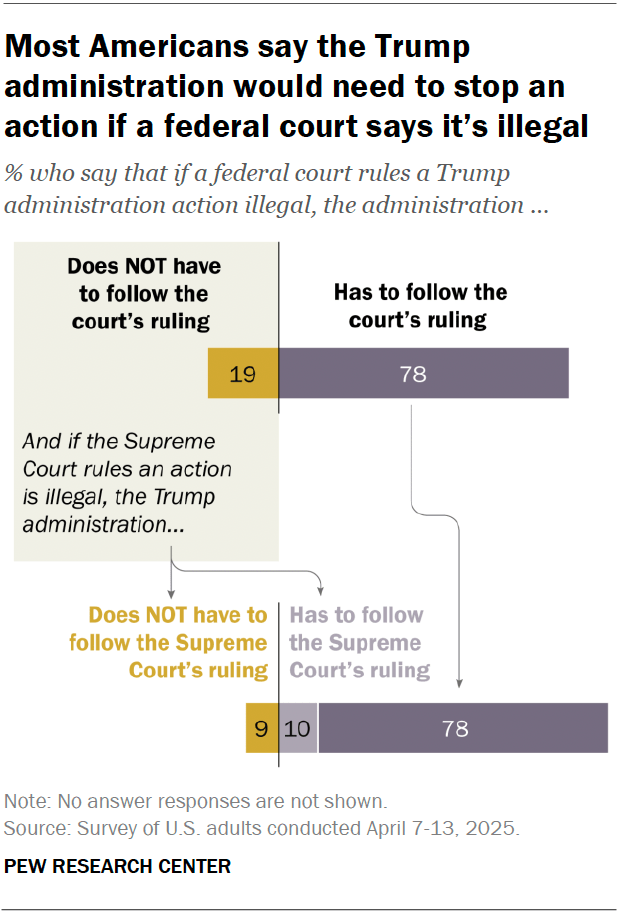
A diverging bar chart showing that most Americans say the Trump administration would need to stop an action if a federal court says it’s illegal.

  • 78% say the Trump administration should have to follow a federal court’s ruling, rising to 88% if the Supreme Court were to issue the ruling.
  • 91% of Democrats and 65% of Republicans say the administration would need to stop an action if a federal court ruled it illegal, rising to 95% of Democrats and 82% of Republicans for a Supreme Court ruling.

However, the latest national survey by Pew Research Center, conducted April 7-13 among 3,589 adults, finds much wider partisan differences in evaluations of Trump’s overall job performance and some key policies.

Seven-in-ten or more Republicans and Republican-leaning independents approve of:

  • Trump’s job performance (75%)
  • The administration’s cuts to government (78%)
  • Increased tariffs (70%)
  • Ending diversity, equity and inclusion (DEI) policies in the federal government (78%)

By comparison, even wider majorities of Democrats and Democratic leaners disapprove of:

  • Trump’s job performance (93%)
  • The administration’s cuts to government (89%)
  • Increased tariffs (90%)
  • Ending DEI policies in the federal government (86%)

Trump’s job rating compared with his first term and his predecessors
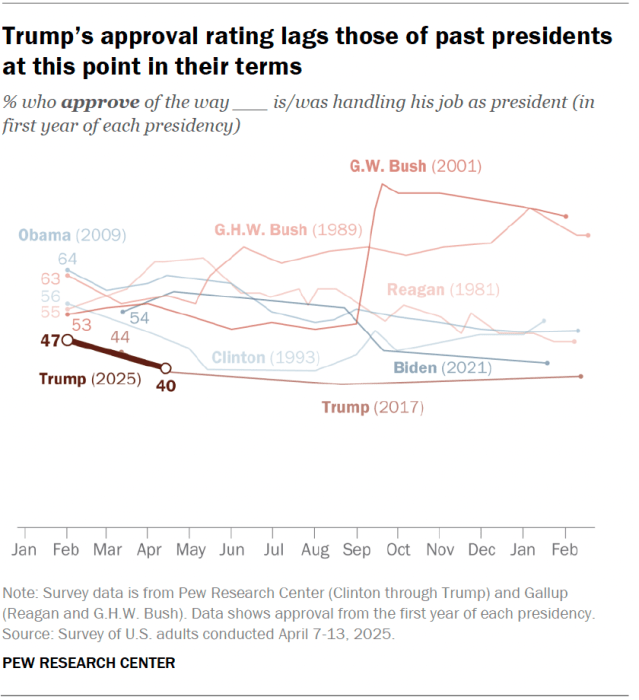
A line chart showing that Trump’s approval rating lags those of past presidents at this point in their terms.

Trump’s current approval rating of 40% is on par with his rating at this point in his first term. It remains lower than other recent presidents’ approval ratings in the early months of their presidencies.

Among Trump’s predecessors dating back to Ronald Reagan, the only other leader who did not enjoy majority approval at his 100-day mark is Bill Clinton (49% approval in April 1993).

In April 2021, Joe Biden’s job approval rating stood at 59% – though it would drop substantially to 44% by September of that year.

Read Chapter 1 for more on Trump’s approval rating and explore demographic breaks in the detailed tables.

In their own words: How Americans view the first months of Trump’s presidency

Asked to describe what they like most – and least – about the administration’s actions so far, similar topics come up in both questions, though to different degrees.

Immigration actions
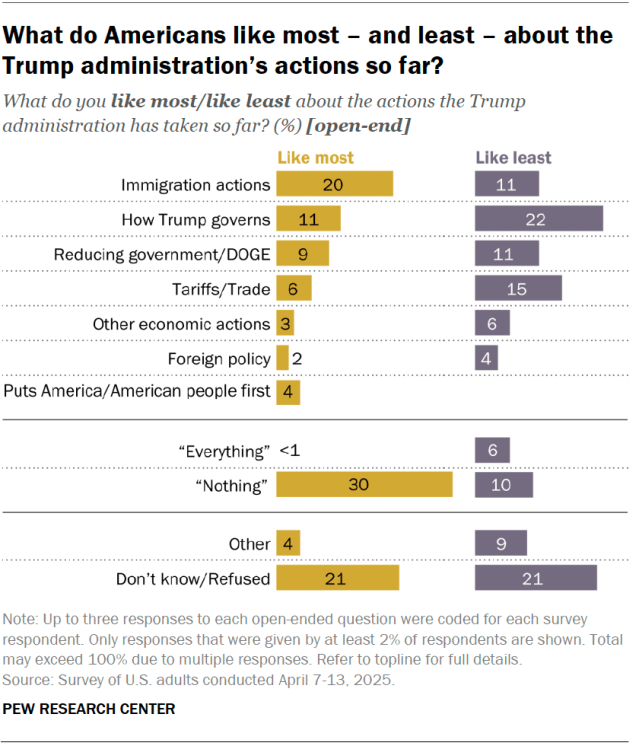
A bar chart showing what Americans like most – and least – about the Trump administration’s actions so far.

Trump’s immigration actions top the list of what Americans say they like most about the administration: 20% point to immigration, including 7% who specifically mention Trump’s deportation actions. But immigration actions, including deportations, also are cited by 11% of Americans as the thing they like least about the administration.

Related: Americans’ Views of Deportations

Approach to governing

About two-in-ten Americans (22%) describe an aspect of Trump’s governing approach as what they like least about the administration. This includes mentions of “carelessness” (3%), Cabinet and other staffing picks (2%), perceived targeting of law firms and universities (2%), and terms like “authoritarian” or “dictator” (3%). Conversely, 11% of Americans cite his “keeping promises” or “getting things done” as what they like most.

Tariffs and cuts to government

Tariffs and trade policy (15%) and government cuts (11%) are both mentioned by at least one-in-ten Americans as actions they like least. But these are also volunteered by sizable shares (6% and 9%, respectively) as aspects of Trump’s presidency they like most.

Views of cuts to the federal government

As the administration continues to plan and implement large-scale reductions across federal agencies, 59% of Americans say it is being “too careless” in how it makes these cuts. And the public is more likely to see the cuts having negative, rather than positive, effects.

  • 51% say the cuts will make the government run worse, while 36% say they will make the government run better.
  • 48% expect the cuts will cost Americans money in the long run. Fewer (41%) say the cuts will save money.

Read Chapter 3 for more on the Trump administration’s actions.

Other key findings
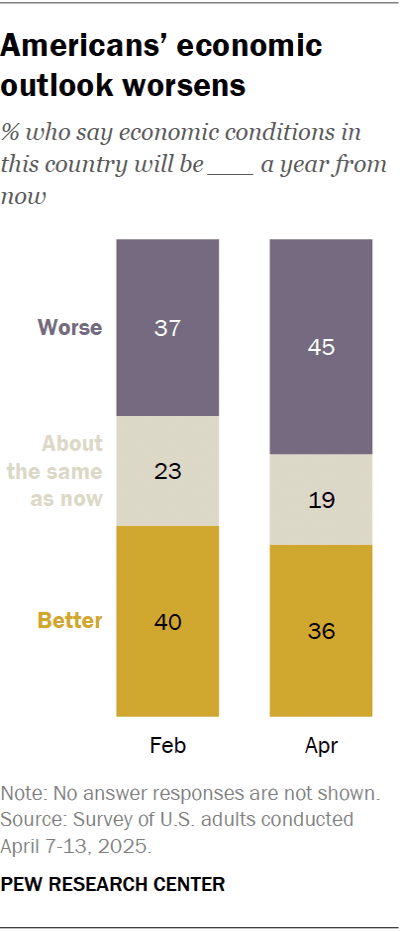
A stacked bar chart showing that Americans’ economic outlook worsens.

The public’s economic outlook has turned more negative. While current overall economic evaluations are unchanged from February, Americans are now more likely to say the economy will be worse a year from now (45% now, up from 37% then).

Read Chapter 4 for more on economic views.

Confidence in Trump’s handling of the economy – long a relative strength – has declined. Today, 45% express confidence in Trump to make good decisions about the economy, his lowest rating on this measure in Pew Research Center surveys dating back to 2019. Still, Trump’s economic rating remains higher than Biden’s was throughout his presidency. About half (48%) express confidence in Trump on immigration – his highest-rated issue.

Half of Americans say Trump’s policies are weakening U.S. standing in the world compared with Biden’s policies. About four-in-ten (38%) say Trump’s policies are putting the U.S. in a stronger position internationally. Views of the impact of Trump’s policies on the economy are nearly identical.

Read Chapter 1 for more on Trump’s handling of issues.

Related: Americans Give Early Trump Foreign Policy Actions Mixed or Negative Reviews

The GOP is viewed more favorably than the Democratic Party, a shift from recent years. Views of the Republican Party have trended more positive over the last year, and 43% now have a favorable view. Views of the Democratic Party are little changed over the last few years, with 38% now expressing a favorable view.
libs gonna lib.

nuthin to see here

1 Like

I started a thread on this forum protesting Biden’s unqualified support of Netanyahu’s ethnic cleansing in Gaza and the West Bank. If you don’t recall it, take a look, it’s still there.