irrellus, i think this agrees with what you said too…
J
like Buddhism and Hinduism [the source of the idea?] it relies though on an internal schism that divides reality into the false and the real. i would apply two fundamental universal principles to this; 1, duality does not exist ~ there are no absolutes. and 2, there is only that which is real.
the holistic, virtual or even the imaginary world is as real as its physical counterpart. secondly that they all correlate with one another. our vision for example is as you say an illusion created by the graphics card in our brain. we actually see in 2D, the colours and dimensions received by our eyes are simply converted to information which the brain puts together as an image. there is a degradation in the info exchange for sure, but there is also correctly transmitted info. most importantly, at no point is there a line we can draw to which we can attribute any distinct values such as real or illusory.
the brain, the eye and environment are all made of energy. they belong to the same sphere of interactions.
there is an intimacy between all things, due to nothing being distinct.
the information received from the eyes connects us intimately [literally, as in a river rather than a set of locks on a canal], with the light. if that info is disconnected as with the blind, then experiments are beginning to show that they can see again to a small degree by sound [like a bat i suppose]. to once the brain is given the correct information it can see!
this means that the source of information and its actualisation [seeing], may be indirect. here then we see the beginnings of a possible matrix, give the brain a secondary source of information and tell it that it matches reality [believe it], and the brain will produce a false reality.
if we were in a forest and this false info told us there wasnt a tree, we would still bump into it. so we must indeed count on information as being correct/matching its observation.
the next level would be that the observed reality [the real tree] can itself be falsified, if both of our sources are false we would not be able to walk into anything!
the final level is god as the maker of a false observed world to which he ascribes us a good perception of, so we think it is real. how though can god make a false world? …and are we in fact part of him? if all things are a gradient of the one, there is no matrix!
i think we have to get the fundamental questions sorted before this can be resolved. mainly the distinguishing of god and the created. if even that in truth either exist as we/anyone previously thought.
[b]You “eat and have sex with a virtual reality” by virtue of the sensory experience of eating and having sex, as that sensory experience is an aspect of the virtual reality that IS consciousness —something altogether distinct from the external world that (presumably) continues to exist if all consciousness were to disappear from the universe.
There are TWO distinct “realities”, the conscious reality, that disappears during dreamless sleep and death (if one does not subscribe to an afterlife), and the external reality—that which (presumably) existed before consciousness and which (presumably) continues to exist even beyond the existence of the last brain (if one subscribes to strict psychophysicalism). The “matrix” concept, in this sense–implies reality to be split into two: the conscious and the external.[/b]
Quetzalcoatl:
This idea of an internal schism doesn’t go all the way through. As Chalmers notes in The Matrix As Metaphysics, despite the fact that consciousness itself is, at the bottom level, a simulation of the external world (if one accepts Facsimile Realism), this does not mean that the ‘virtual’ world that IS consciousness is an illusion or is necessarily ‘false’. It is just as real as the external world. The ‘duality’ does not fall, then, between ‘real’ and ‘false’ but between ‘subjective’ v.s ‘objective’. Thus, (2) as mentioned above continues to stand, but in different modalities: with one aspect of the real being subjective and the other objective.
I agree. See above.
At least, that is the commonly accepted (and generally unquestioned) theory. Personally, I am suspect of psychophysicalism (the view that consciousness arises from the physical brain), but I like to take it for “tongue in cheek” granted as “true” for the sake of argument.
We can’t know this, as we can’t experience the external world to know that our subjective experience is “correctly transmitted” from the external world (WHATEVER it may be). Facsimile Realists can only possess aquasi-religious faiththat the content of consciousness is a reasonable facsimile of the appearance and behavior of the external world that exists beyond all consciousness (there is the question of whether or not it isonly visual perceptionthat is mimicked by the external world if FR is true).
Unless one embraces Solipsism or abject Super-panpsychism (the view that there exists only consciousness: the physical does not exist), or Type-A Materialism (the view that subjective consciousness does not exist, and that there is only the physical), one can argue that there is indeed a distinction between that which is subjective and the objective reality that it is believed to represent.
[b]Agreed. According to pertinent theory, we see this or hear that due to the function (and pattern of function) of a particular neural group that is “in charge” of representing and producing a particular conscious experience. The occipital lobe handles vision, while the cerebral cortex handles thought. A conscious experience depends upon the function of relevant neurons within the “correct” area of the brain. The occipital lobe does not (presumably) handle thought and the cerebral cortex doesn’t handle the vision that requires the occipital lobe to produce, for instance.
You can reproduce this, in theory, and still come up with a view of the world that does not agree with the external world: hence the thought experiment of the Brain-In-A-Vat:[/b]
[b]Sure, if the individual were wearing an apparatus or if the person’s brain were tampered with in such a way that the tree fails to be perceived (very good conceptual support for Facsimile Realism!)—but one can argue that even the bumping into the invisible (or non-perceived) tree is still an aspect of the GREATER simulated reality that may not reflect the nature of the external world, such that there may still not exist an external or real “tree” that the subject bumps into.
(Just as one can argue that our observation of the brain and it’s function and the verbal reports of patients stating that they have such and such experiences after certain neurological changes imposed upon them by doctors—are all aspects of a solitary simulation distinct from the nature of the external world, rather than there being any external-world brains, doctors, and so on.)
[/b]
Even if external reality is not anything like the contents of our conscious experience, it would not be a matter of “both our sources” (the brain and the external world) being ‘false’—they would be different types of ‘true’.
[b]I will address this last statement thus:
Critics of the Omphalos Hypothesis (in which God creates the universe in a state in which the age of the universe is “read” by man to be 15+ billion years old, when it is only 6000 years old) have stated that God would be a “deceptor” by virtue of the Omphalos Hypothesis (and by extension, the Matrix Hypothesis—IF the external world is nothing like the content of our conscious experience of a “world”).
[/b]
[b]However, one can argue that:
(a) God is not obliged to reveal the true nature of the external world. This is an ad hoc moral obligation heaped upon God by man that does not truly qualify. If God fails to reveal the truth, this does not denote that something is morally “wrong” with God (in the sense that God is a “liar”). Thus, God is within rights to create two distinct realities (one which is subjectively experienced v.s. one which lies beyond at least human perception). We simply come to believe that they mimic each other, with God having no moral obligation to reveal the truth if he should choose not to do so.
[/b] As it is written:
It is the glory of God to conceal a matter, but the glory of kings to search out a matter.
(Proverbs 25:2)
(The “God’s Word Translation” of the Bible says it better:" It is the glory of God to hide things but the glory of kings to investigate them.")
[b]2. One can disagree with the notion that we are a direct part of God, arguing that we are only a “part of” God in the sense of being an aspect of his omniscient imagination of a possible world (and even then, it is only our imaginary counterpart–not “us”). Thus, one can argue that there is no true gradient of one, and that we are, indeed, separate beings created by God but formed from substance not arising from the direct person of God.
One can stand resolute with this view by noting that it cannot be disproven, such that neither possibility can necessarily falsify the other.
Thus there is a “matrix”–in the sense that reality comes in “two”'s: the subjective and the objective.
[/b]
thanks. i think infinity is a kind of everythingness, some expressed some not ~ as time goes by. the expressed is the universe and perhaps eternity [still working on that one], there can be nothing else bar infinity and infinite sets of fractions of it, as infinity reaches parts other beers can’t reach lols.
J
to what would we confer consciousness? given that we have it and it is not physical then it belongs to the only other thing around, infinity/the whole. i think it is in the intimacy between things [in a manner of speaking], and/or the most subtle natures of expression.
what is infinity/the whole in this equation, objective or subjective? then what is its universality? then the specifics or ‘parts’ of reality… which bit is subjective.
…or are we saying that only consciousness is subjective?
as i think i would agree with that in empirical terms, but in quetz logic there are no distinctions we can fully attribute to any given example, it all comes in grades, nothing is fully itself.
‘the subjective and objective world are blended to such a degree that it is a rarity for them to not correlate!’
absolutely, it either does not exist at all which is quite absurd or it is something beyond the physical. as i see it, infinity is consciousness as stateless, we are expressions of that ~ such expression being what we commonly allude to with the term.
see above. we cannot begin at this point, we should - if i may, consider it so that there is no inner and outer on the primary level, such divisions appear further up the grades of manifestation. in all cases where subjective meets objective there is a hub of consciousness, kinda like a knot tying the two levels of experience together.
the experience of the ‘outer’ or external world is derived at the same source, we can take it apart and see all our views as subjective, but here we are making a collection of segregated elements and putting it together as a whole unto itself. we should look at each and every function and part as one entity ~ seeing their connections rather than divisions.
i don’t agree with isms lols.
indeed, it is most perplexing, ‘it’ would show us two false realities. that is if ‘it’ is an it aside from all it’s. as it is, all its are its. gasp
a ‘wise’ god [having infinite intellect n all that] would be obliged to show us only a true vision of things [to the n’th degree of his possibilities]. that is if he could! we may say that god cannot make anything as perfect as himself, just as we can say that any expression of infinity can represent what infinity is. this though would not be a purposeful desire, he would not be creating it to fool us.
what has he got to hide? things are only concealed when we don’t look for them. everything we find is there. the bible is incorrect by the way, if anything it would be; It is the glory of God to conceal a matter, but the glory of ‘philosophers’ to search out a matter.
since when have kings ever been wise and knowledgeable lols. you see how it is easy for even the bible to be somewhat wrong.
We can know of a part of infinity, that part of it that is our experience. Everything else, unfortunately, is pure conjecture and speculation that relies upon faith and belief to uphold.
I think a wise God could withhold the truth for awhile (for whatever purpose). And I think a wise God could “fool” humans in the same way that a schoolteacher “fools” his or here students with a particular question or problem before finally revealing the truth. There’s nothing morally wrong with such educational “duplicity”.
[b]It is not as if God has “anything to hide” in the sense of a weakness or flaw: God hides things in the sense of an educator hiding the solution of things from his or her students, with the intention of revealing the answer (or verifying it’s truth if guessed by the student) later on. When Paul stated that it was “impossible for God to lie”—he meant that if one asked God the truth about a thing, God would not fail to reveal the answer.
Good correction, replacing “kings” with “philosophers”. However, I think that in the “olden days”, kings were held at such high standards that they were held to be philosophers as well as political rulers—regardless of whether or not this is true of a particular individual who lucked into being king or not. The bible, in this case, simply follows suit.[/b]
[b]One substance that permeates everything? Isn’t there obvious circumscription to all things (such that there is a border to what makes up a table and a border to what makes up a human being? Is a tree the same thing as a squirrel, occupying the same place and time? Once again, non-empirical speculation bearing little fruit for real knowledge.
Quetz’s ideas are really the most logical given here. The idea of illusion as in anyway determing the human sense of reality has been, and is being, continually refuted by anyone with even a smidgen of knowledge about genetic and neuronal precedents of thought. Illusion, by definition, cannot be considered as in any way contributive to anyone’s sense of reality. Thus, the entire matrix argument is based on a false premise.
all notions are bound by their own logic ~ that is the root of all truths empirical or not?. if we accept infinite sets then infinity can be based off that. true there can be a lot of conjecture but i think this is where philosophy is prime, only via reasoned argument can we know anything about it outside of math. i think there are other forms of mathematical infinities ~ i am working on a few theories.
matrix = there is only faith?
true yes, here we are imagining perhaps an anthropomorphic god that acts as we may if we imagine ourselves as god. a god that makes decisions and acts upon them, decides to deceive or to teach wisdom, morals and ethics. with an infinite being all tasks and calculations are performed outside of time [instantly], and outside of our realms of thought. any deceptions would be in the woodwork - so to say i.e. built into the world.
if god has some kind of personality it is reflected in his vision ~ the world. we don’t see any lies and deceptions, wherever we look there is truth to be found! all that stands in our way is our own ignorance [on many levels]. hence i would think that god in action and perhaps thought would only wish to show the true vision of things. the duplicity would not and is not actual.
indeed, i dont think god is flawed. why would a teacher conceal truth in levels; the mind can only truly grasp 3 - 4 things completely at any one time, so teaching methods work with our limits to teach an ever increasing amount of detail and information.
what do you think god is concealing? all we can know about the world is done through science [if you accept the dawkins and empiricists perspective], and nothing is literally hiding from us.
so what is left that is being concealed; us! life! eternity! what we truly are, cannot be revealed by science, but we have to go to science first before we can go further into the mystery.
the future and each invention is a mystery until found, but that is not an attempt at concealment.
i see yes, like pharaoh’s kinda [its an illusion of course]. hmm it would then follow that they were ‘right’ in accordance with divine will, and hence their philosophy was the right one. the flaw is that historically there are plenty of cases where this is not so, unless we said that even bad outcomes were part of gods plan. presumably gods plan hasn’t herd of probability?
not one substance no and those borders are purely holistic. we have instead, one universal ‘entity’ [there is no word for it], and one energy that everything is made out of, this having a fundamental/overall value of zero the same as infinity. evolution is like a tree, time is also [in a sense] ~ everything goes back to shared origins. when we view this from the outside it appears as separate but if we watched the flow of change there would be no stop start points.
empiricism cannot fully describe THE TRUE NATURE OF REALITY, man must search if it is to be revealed. infinity has its own logic to some degree and helps us define the philosophical space.
nice post, again i am divided.
ierrellus, hi
indeed, we can start i think with the notion; illusion does not exist. so a perceived matrix would be a delusion in ones mind rather than any part of the real. its meaning turns itself on its head - so to say.
[b]I don’t think you quite understand what’s going on in terms of what makes up “reality”.
We can’t afford to contine to think of the world in terms of naive realism (see), such that the things that we perceive (i.e genetic and neuronal precedents) are the things-in-themselves. Reality, as far as we are can know, ONLY exists in the form of the first-person (“video-game” POV) subjective experiences of a single conscious being (in the form of visual, tactile, auditory, olfactory, gustatory, emotional, and cognitive experiences).[/b] We have no idea of what reality is like independent of this first-person subjective experience.
[b]We can only believe that when we fall asleep or that if we should, god forbid, die—that the reality that we can only know in the form of first-person subjective experience continues on in non-subjective form—and remains if all consciousness were to spontaneously cease to exist (and existed before there was such a thing as consciousness).
We subjectively experience genes (through visual perception):
But these are “real” (as far as we know) ONLY in the sense that they are visually experienced “things” having a particular shape, size, color, and circumscribed (bordered) limit—as perceived objects tend to extend only so long before they are terminate in spatial extent, with spatial extent and shape “filled in” on all sides by other objects having different (or similar) shape, size, color, etc.
Beyond the subjective experience of neurons and genes (and the motive correlations between objects that give rise to a belief that some sort of cause and effect relation takes place), we cannot know (through experience) if they possess non-subjective counterparts in the external world. We can only BELIEVE that “genetic and neuronal precedents”:
Have non-subjective external world counterparts, and that these counterparts:
Somehow give rise to non-physical thought. Given the secular belief that consciousness ceases to exist at death–it is negatively inferred that consciousness is something that must be created by the physical, as opposed to the physical (if the physical exists)–which is believed to be eternal (1st law of thermodynamics).
Finally, the idea of “illusion” implies that something is perceived to exist when in fact the object or state of affairs does not truly exist. This disconnect from the idea of illusion extends to the “Matrix Hypothesis” or the “Matrix Argument”, as these hold ONLY that there are two layers of reality:
That which is subjectively experienced and:
That which is believed to exist and would still exist if there was no such thing as consciousness.
Both subjective experience and the world that (presumably) exists if there were no such thing as subjective experience can be held to be real. Thus the “matrix argument” is not based on illusion v.s. reality, but on two different types of reality.[/b]
P-G,
Since when has experience, the only criteria for truth we actually have, become “naive realism”, a nonsensical phrase? It is an oxymoron, to say the least. Looking at reality from Aristotelian concepts of necessity and sufficiency, it is your assessments that deny both. You really need to bone up on current readings in which science and creative possibilites are not seen as opposites or enmities. (Doidge, “The Brain That Changes Itself”, etc.) God has nothing to do with it. The creations, if you believe in such, are real. The matrix is, as I said before, and you seem unable to counter, a social phenomenon, not an animal necessity, i.e,
the marix is human excess in thought, simlar to the excess of sperm put out to fertilize a single egg. Show me what the matrix, even in excess, has fertilized.
[b]All notions are indeed bound by their own logic, but I like to keep things simple. Logic, as I understand it, is simply a lack of contradiction between two or more ideas proposed to be true–with a logical concept being something that could be true (even if it is not), and something that cannot be ruled out even on further rational reflection.
Philosophy indeed contains a lot of conjecture, and I prefer the reasoned argument rather than the symbolism of math. However, it is when that which is non-empirical is asserted as unquestionable, absolute truth that things become objectionable.
Matrix= two distinct realities, one subjective, the other that which exists if there was no such thing as subjective.[/b]
I have to agree with this! And to note that the “deception” (our ignorance) is maintained only as long as one refuses to see the truth.
A teacher conceals truth not out of malice, but rather conceals it (one could say it is hiding in “plain sight”: the mind of the teacher itself!)in order to allow the students to make all sorts of guesses at the truth before finally revealing it. It’s a matter of getting the students to “think” about things rather than be handed everything off the cuff. And I think God works with our ability to grasp knowledge.
The “concealment” is the delay in one’s coming to a knowledge of the truth. Thus God conceals by allowing one to remain ignorant (for the time being). This is the photo negative of “concealing” through the active hiding or stowing away of something with the intent to keep the victim in the dark. The bible verse refers to the glory (or right) of God to withhold information from humans until the “right time”, not to maliciously hide information that humans may need.
If theological determinism is false, then one can question whether or not God computes probability into his plans.
[b]When I used to believe in the existence of the physical, I held just such a belief about the ubiquity of physical energy, discounting such things as psychic energy, etc.
Shared origins? Like every living organism arising from a single cell, or every being created by God?
True, empiricism cannot describe the (title of this thread) . There’s presumably something else going on beyond our conscious experience.
if we accept the mathematics of infinity, then logically we accept infinity.
or three, the schism that runs right through everything, according to it.
what if it is unquestionable ~ our opinions dont matter? i agree it can be objectional, but we can say X is our current reality map, a model that we know at the moment as a truth, due to its own logic. what happens if we hit on a model that is correct? for example we may lay a foundation stone as a basis by stating; there must be infinity. anything else would not extend to all, thus its concept is primarily a simple thing to which there is no reply.
yes, imho it is a subclass of earthling that simply refuses to see truth rather than ‘cannot’ see the truth. equally, to not search that it may be found, is a similar ignorance. there is though no ‘truth’! …only truths.
yet all info exist - so to say; we only learn what is there by seeing it or perceiving it, i mean to say that g?d does not hand it out and hence is not the teacher in that sense. we may say that he is the teacher in terms of existence being made by him, hence what we learn is the product of god. this though removes the ‘teacher’ + ‘concealing’ factor. can we then say that truth is simply there to be found, but there is no teacher of it only pupils and this applies god or no god.
in observed experiment probability shows itself to be non predictable, which is the basis of its meaning. so we would have to say that probability has no randomness [hence non computable] when it is a function of randomness?
good question! unfortunately the universe is not literally like a tree due to quantum natures [as you of course know] so the whole thing does not directly go back with all events connecting as like an ‘event tree’. the common origin as i see it would not be frozen in time - so to say, it would roll with times progress. an infinite source/the whole would effectively act like a continuum of creation, being always present. the important factor in all of this is that;
‘for a thing to exist, it must be entirely conducive to its environment’ [quetz], its a hand-in-glove thing.
the whole or infinity is ever-present, its laws, rules, sets and patterns continually moulding and equally being moulded by existence.
on the spiritual exploration side of this, i have recently considered the idea that this may be the actual nature of the soul ~ the reflection of us in infinity. for every finite based infinite set there would necessarily be a corresponding infinity of infinite sets i.e. of infinite cardinals rather than imagined finite ones. so you get an equation, by which we and all things are mirrored in infinite terms. perhaps the whole of history would be present forever in their infinite form = eternity.
[b]Experience qua experience is not “naive realism”, nor have I ever implied or stated this. “Naive realism” is the view that what one experiences is not a simulation of an object within the external world but the object itself.
The notion of naive realism is not an oxymoron—and it is certainly not a new idea: it simply didn’t have a name until someone came up with “naive realism” (i.e. one is “naive” concerning the nature of reality). For example:[/b]
Naive Realism:“Our sense perception of objects is itself direct and unmediated. In other words, we may come to know (see) that [a perceived object] is a cat (a fact) by the way it appears, but what we see (the object) is the cat itself, not its appearance.”
–Dretske, Fred, Seeing, Believing, and Knowing: D. N. Osherson, S. M. Kosslyn, & J. M. Hollerbach (Eds.) Visual Cognition and Action: An invitation to cognitive science. 129-148.
Anti-Naive Realism:"Indirect Realists maintain that we are directly aware of mental objects - images - in hallucinations and dreams. Aside from the cause of the experience, though, there is no reason to distinguish between these illusory experiences and our ordinary veridical perception of (physical) objects. In both cases we are directly aware of the internal mental representation.When we speak, as we commonly do, of seeing an ordinary object (like a cat), we are, if we speak truly, being caused to experience some catlike image by a real cat (a real cat that we do not directly perceive).When we hallucinate or dream of a cat, there is no such external cause - hence, we speak of these experiences as illusory. In all cases, though, it is the image that we directly experience. Only the cause of the experience is different."
–Russell, Bertrand: Our Knowledge Of The External World, Open Court Publishing, La Salle, IL., 1914
[b]In logic, the words necessity and sufficiency refer to the implicational relationships between statements. The assertion that one statement is a necessary and sufficient condition of another means that the former statement is true if and only if the latter is true.
* A necessary condition of a statement [u]must[/u] be satisfied for the statement to be true. Formally, a statement P is a necessary condition of a statement Q if Q implies P. For example, the ability to breathe is necessary to a human's survival. Likewise, for the whole numbers greater than two, being odd is necessary to being prime, since two is the only whole number that is both even and prime.[/b]

[b]* A sufficient condition is one that, [i]if[/i] satisfied, assures the statement's truth. Formally, a statement P is a sufficient condition of a statement Q if P implies Q. Thus, jumping is sufficient to leave the ground, since an intrinsic element of the concept jumping is leaving the ground. A number's being divisible by 2 is sufficient for its being even.[/b]
[b]P=Consciousness ceases to exist during periods of sleep and (presumably) upon death
Q=Consciousness is something distinct from the external world, which is believed to exist independent of the existence of consciousness
P is a necessary condition of Q.
P is also a sufficient condition of Q.
The assessment of P and Q above does nothing to deny the Aristotelian concepts of necessity and sufficiency.[/b]
[b]Who cares if science and create possibilities are no longer seen as opposites or enemies? Nothing emerging from science, either now or in the distant future, rules out these facts:
Reality, as far as we are concerned, exists ONLY in the form of first-person subjective experience (that subjective experience referencing a single fixed perspective or point)
This aspect of reality is intermittent during periods of sleep and (presumably) ceases to exist at death.
Unless one accepts solipsism, it is believed that non-subjective reality continues to exist with or without the existence of consciousness.
It is believed that the appearance and behavior of this non-subjective reality, luckily, resembles the content of visual experience (if no other conscious experience)
Science, and the veracity of scientific discovery, can be argued to vitally depend upon the truth of (4).
One could argue that it need not. If the external world does not resemble in the least the contents of visual experience, science would still remain a ‘virtual’ science. The world beyond it would be different from what we had always thought it was (not that we’d know it):[/b]
[b]Until recently, it has seemed quite obvious to me that brains in vats would have massively false beliefs. But I now think there is a line of reasoning that shows that this is wrong.
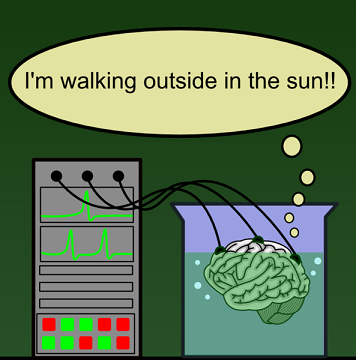
I still think I cannot rule out the hypothesis that I am in a matrix. But I think that even I am in a matrix, I am still in Tucson, I am still sitting at my desk, and so on. So the hypothesis that I am in a matrix is not a skeptical hypothesis. The same goes for Neo. At the beginning of the film, if he thinks “I have hair”, he is correct. If he thinks “It is sunny outside”, he is correct. And the same goes, of course, for the original brain in a vat. When it thinks “I have a body”, it is correct. When it thinks “I am walking”, it is correct. [/b]
[b]This is a familiar hypothesis. A version of it is believed by many people in our society, and perhaps by the majority of the people in the world. If one believes that God created the world, and if one believes that God is outside physical space-time, then one believes the Creation Hypothesis. One needn’t believe in God to believe the Creation Hypothesis, though. Perhaps our world was created by a relatively ordinary being in the “next universe up”, using the latest world-making technology in that universe. If so, the Creation Hypothesis is true.
I don’t know whether the Creation Hypothesis is true. But I don’t know for certain that it is false. The hypothesis is clearly coherent, and I cannot conclusively rule it out.
The Creation Hypothesis is not a skeptical hypothesis. Even if it is true, most of my ordinary beliefs are still true. I still have hands, I am still in Tucson, and so on. Perhaps a few of my beliefs will turn out false: if I am an atheist, for example, or if I believe all reality started with the Big Bang. But most of my everyday beliefs about the external world will remain intact.[/b]
[size=150]b The Computational Hypothesis[/b][/size]
[b]The Computational Hypothesis says that physics as we know it not the fundamental level of reality. Just as chemical processes underlie biological processes, and microphysical processes underlie chemical processes, something underlies microphysical processes. Underneath the level of quarks and electrons and photons is a further level: the level of bits. These bits are governed by a computational algorithm, which at a higher-level produces the processes that we think of as fundamental particles, forces, and so on.
The Computational Hypothesis is not as widely believed as the Creation Hypothesis, but some people take it seriously. Most famously, Ed Fredkin has postulated that the universe is at bottom some sort of computer.
I don’t know whether the Computational Hypothesis is correct. But again, I don’t know that it is false. The hypothesis is coherent, if speculative, and I cannot conclusively rule it out.
The Computational Hypothesis is not a skeptical hypothesis. If it is true, there are still electrons and protons. On this picture, electrons and protons will be analogous to molecules: they are made up of something more basic, but they still exist. Similarly, if the Computational Hypothesis is true, there are still tables and chairs, and macroscopic reality still exists. It just turns out that their fundamental reality is a little different from what we thought.[/b]
How do you know God has nothing to do with things?
[b]There is a misunderstanding.
When I use the term: “matrix” (also implied within Chalmer’s “Matrix Hypothesis”, see above), I’m using the film: “The Matrix” (and the concept of “The Matrix” in the film—a simulated reality created by artificial intelligence) as an analogy for the seeming fact[/b] that consciousness is actually a simulated reality, in the sense that visual consciousness is (presumably) a simulation of the appearance and behavior of the world that exists beyond one’s first-person experience. The topic of this thread has nothing to do with the definition of matrix as a social phenomenon that is not an animal necessity or a “human excess in thought” at all.
One more time. There is no such animal as a “pragmatic illusion”. Brains reduce genetic, somatic and sensory information to communicable ideas by ignoring much input that is tangential or extraneous. (I wish that could happen here, myself included. ) Reduction in order to facilitate function is not the making of a separate reality; it is a necessary pruning of existing reality. The separate reality business continues to make metaphysics bullshit.
Since this discussion is in the religion forum, I’m wondering if it was put here to convince anyone that religion requires an alternate reality.
[b]One more time (unless the obviousness of what follows below needs repeating).
There is no “pragmatic illusion”—just two layers of reality (if we’re not talking about dreams or hallucinations)–one subjective (waking reality), the other (whatever it is) that which existed before the existence of subjectivity and that which will continue to exist should subjectivity cease to exist.
The brain’s reduction of tangential input in order to facilitate function does not create a separate reality, the separate reality (whatever it is) already exists: the brain, it’s reducing function, and the consciousness to which it is believed to give rise are simulated or ‘virtual’ counterparts of this already-existing separate reality (if one accepts Facsimile Realism).
The “existing reality” that the brain supposedly prunes is subjective in aspect. Given that subjectivity can cease to exist, it is supposed that there is an objective counterpart to the subjective information (or that there exists an objective counterpart ONLY to visual experience).
The separate reality business is the most commonsense realization of the nature of existence.
a.[/b] Did anything exist before there was such a thing as consciousness? [b]If so, then there is a separate reality that exists independent from personal consciousness, and naive realism is false.
b.[/b] Does anything continue to exist should consciousness cease to exist? [b]If so, then there is a separate reality from consciousness, and naive realism is false.
Yes. Placing the discussion in the religious forum implies not that the truth of religion requires an alternate reality (how can we know, following the skepticism of Hume, that causality within the world is necessarily “physical”?), but that the truth of religion (Judeo-Christian religion) may lie in Non-Foundational Representationalism (first post). [/b]
Q_P,
A thoughtful and complex response, sir. I’ll have to mull over it for a day or so in order to reply. On first sniff, it appears that you and I probably agree more than disagree. Still, believing in pantheism to some extent, I find it difficult to envisage a reality that exludes me.
by what is it divided? it doesn’t matter really if we call the two things reality or illusion or anything else, two fields are presented as indicating a schism betwixt them. are the terms [and meanings] ‘subjective’ and ‘objective’ meaningful as the definitive rules of reality? should we not say that there is only reality, where thought and objects are considered as the same!
‘if our meanings are sourced in dualism then only dualism may arise from them’ [quetz].
i just don’t see it at all, but i have no common sense lols. i can only see that the philosophical space demands that everything in it is equally real and is in essence a oneness.
yes, we have plenty of evidence for the current scientific model, age of universe geology of earth etc. i presume then, that you are visualising a misinformation that shows us a reality that appears like that?
[b]Tell you what, quetz. I was at work, walking around in the middle of the night, and it hit me:
I was making a big semantic mistake.
In my ongoing mantra in this thread, I kept waving the semantic sign that said: “there are two realities”.
What I should have been saying all along was: “there are two aspects of the same reality” (or did I, but somehow went into the “two realities” thing without comprehending how it would semantically impact others? )
Apologies the you and Ierrellus for the misunderstanding. The idea of “two realities” is conceptually difficult even on the surface. I actually meant subjectivity and non-subjectivity to be “two aspects of the same reality”. Both (presumably) exist, and whether or not Facsimile Realism is true both, following Ierrellus, would be the shuffling around of currently existing stuff.
That said, if you really hold that there is one reality where thoughts and objects are considered the same, this is transparent in the sense that both thoughts and objects are real. The point I’m making is that both may differ in terms of essential substance, with the subjective being …well…subjective, and the “objective” being something that is non-subjective. As I asked Ierrellus time and time again, what does one believe existed before there was such a thing as consciousness, and what does one believe exists if all consciousness should cease to exist (afterlife notwithstanding)?
There’s no problem, I think, if we “say that there is only reality, where thought and objects are considered as the same”, if we mean to say that all is consciousness, and there is nothing that exists that is non-subjective (that is, something that exists independent of the experiences of any conscious being, and that is itself not conscious or “composed” of subjective experience). Either way, we’re all just blind men feeling the side of the elephant. But if one claims that non-subjectivity exists, then despite the fact that we can’t experience non-subjectivity and we have no idea what it “looks” like, then there may be one reality where thoughts and objects aren’t substantially and essentially the same.
I think that the issue may be whether or not non-subjectivity and subjectivity are the same thing, not whether or not both are aspects of one reality.[/b]
I was referring to the Omphalos hypothesis (for analogy):
The omphalos hypothesis was named after the title of an 1857 book: Omphalos, by Philip Henry Gosse, in which Gosse argued that in order for the world to be “functional”, God must have created the Earth with mountains and canyons, trees with growth rings, Adam and Eve with hair, fingernails, and navels (omphalos is Greek for “navel”), and that therefore no evidence that we can see of the presumed age of the earth and universe can be taken as reliable. The idea has seen some revival in the twentieth century by some modern creationists, who have extended the argument to light that appears to originate in far-off stars and galaxies, although many other creationists reject this explanation (and also believe that Adam and Eve had no navels).
A deceptive creator
From a religious viewpoint, it can be interpreted as God having ‘created a fake,’ such as illusions of light in space of stellar explosions (supernovae) that never really happened, or volcanic mountains that were never really volcanoes in the first place and that never actually experienced erosion, and the idea that God would create appearances that are so completely deceiving to every level of detail is not consistent with most benevolent theistic theologies.
This conception has therefore drawn harsh rebuke from some theologians. Reverend Canon Brian Hebblethwaite, for example, preached against Bertrand Russell’s projection of Gosse’s concept:
Bertrand Russell wrote, in The Analysis of Mind: ’
“There is no logical impossibility in the hypothesis that the world sprang into being five minutes ago, exactly as it then was, with a population that “remembered” a wholly unreal past’.”
Hebblethwaite: “‘Human beings’, posited in being five minutes ago with built-in ‘memory’ traces, would not be human beings. The suggestion is logically incoherent.”
The basis for Hebblethwaite’s objection, however, is the presumption of a God that would not deceive us about our very humanity — an unprovable presumption that the omphalos hypothesis rejects at the outset.
i see. well actually you did often allude to the singularity of meaning when speaking of a matrix in which we were actions of its making ~ or something like that.
if the matrix god is true then i would agree with Facsimile Realism. it is a powerful argument pertaining to a certain oneness, with which i think we have to say god is everything ~ good and evil, and is everything that we do and what everything does. there can be no parting of the waters - so to say.
.
i would think thoughts and objects are not the same, yet belong to the same thing. the whole is the actual reality within them both. i am undecided as to weather or not that whole is infinity or god. either way it is universal and in which it must have a gradient, then it also has a chaos nature that deteriorates order yet is also fundamental to it. if there were a matrix or divine order etc, then probability, entropy, relativity and QM would stop it from functioning!
consciousness is a manifestation of its infinite counterpart; as like time = timelessness in infinity, consciousness = infinite mental stillness or emptiness. consciousness exists in all things yet is largely unattached to anything. it is ‘attached’ by the degree of utility to which it is used.
But if one claims that non-subjectivity exists, then despite the fact that we can’t experience non-subjectivity and we have no idea what it “looks” like, then there may be one reality where thoughts and objects aren’t substantially and essentially the same.
how about; there is no subjectivity! can we not consider thought as objective? what else can anything be apart from objective in some way? i can visualise even infinity or buddha being as purely objective, just as relative time can be seen as such. this is why after a certain level the terms subjective and objective blur into each other ~ just as any meanings do eventually. this hints at the real nature of reality! ~ a truly universal entity. as i see it all we have to do is find out what universal truly means to understand the nature of things beyond and including the empirical.
if the Omphalos hypothesis is true then god has presented us with a false reality. if he is a matrix then he has presented himself with one!
tree rings are measured regularly and show us each successive ring since observations were first made. so this false reality would have to be recreated point by point, in which case we would have time and transformation just as we see it.
i would be amazed to see what theories you come up with if god didn’t have to deceive to make ones religion correct! sometimes i think many advanced christians like yourself are simply very clever people trying to hold together a philosophy that is simply outdated. sure its inner meanings remain, but what is on paper is pulp - if you’ll forgive me for saying so. the same applies to all religions, even buddhism falls apart under the scrutiny of the modern eye.
what i logically see of the future is firstly that, they will all blend, then that the new will be formed from that plateaux. personally i would like to subvert that vision and go straight to the result.
a) if we assume this is true, then what is making the false reality happen ~ an equally false reality! a true reality would produce a true world.
b) if we assume this is true, then by what mechanism is it possible. we could say that there is this thing and it just creates false realities, yet above and beyond such notions are principles and dimensions like infinity. i believe we can define reality without it being present.
c) where does it leave us if we conclude that our reality is false, it means that there simply is no way to say what anything is, hence all ideas about it are untrue.
d) here we see a gradual decline in verifiable information, in a poetic sense this means we are not following a true line of reasoning. this is making itself increasingly obvious the further we follow it.
thanks
quetz
ps. we should also try to define what we mean by ‘god’ in all of this.
Good post above. Very insightful. However, there are a few things I’d like to address:
“Subjectivity” is just “it’s happening to you”-ness. It’s a property of the conscious being (the central property): experience and the fact of being the one having such and such experience, etc. The “objective” as I am using it is anything that is not “you” or your personal and direct experience.
[b]Your concern was also Pastor Hubblethwaithe’s concern: the notion of a “deus deceptor” or God as Deceiver. I think, however, one could interpret the Omphalos Hypothesis as God’s creation of “a world” that is just as it is—with man coming along later forming calculations of time based upon how things simply happen to appear at the time of estimation. If true, then one could propose that God insinuates that their calculations are in fact incorrect by inspiring OTHER people to come up with the Omphalos Hypothesis, etc. Then it becomes a matter of whether or not one wishes to heed or believe God’s insinuations.
(When it comes to successive rings in trees, this could be a way to measure time from the point of human observation, but it in no way implies a necessity for such succession to extrapolate into the past. However, to go so far as to propose that trees were created with x amount of rings “from the start” only to grow more rings once a human begins to observe things does, admittedly, beg the question–though the more extravagant hypothesis may still be true, for all we know.)
Personally, I’m not married to the Omphalos Hypothesis. I think that it is a rather interesting theory, just like Bertrand Russell (who is atheist) and his “Five-Minute Hypothesis”, and so on.[/b]
[b]Ouch. Admittedly, you may be right about “holding together a philosophy that is simply outdated”, but then again, it may be that there is an aspect of reality that lies behind what modern science and philosophy discovers; one that is indestructible and that can be seen with a philosphically discerning eye. Is it that against the rules for the Genesis account to be true and for modern perception to simply be a faith-testing “simulation”? One could define a “lie” as;
A state of affairs that does not exist yet is presented as “truth”
An action involving the distortion or falsification of information with no intent or revealing the truth
However, what is believed to be a “lie” may simply be a TRUTH that one refuses to believe, or that one misinterprets as another “truth” (with one perceptually indistinguishable from the other), or a truth that is not revealed until one wishes for it to be revealed or understood.
For example, was natural selection and evolution known to human beings during the days of Julius Caesar, if “everything that is true is already revealed to us”? Was Einstein’s theory of Special Relativity known to Benjamin Franklin? Is it somehow “morally wrong” that Franklin or Caesar was ignorant of the relevant information? If God is behind things–is God morally “not in the right” for refusing to reveal Special Relativity to Ben Franklin or natural selection and evolution to Julius Caesar?
When it comes to the notion that God must “deceive” in order to make religion correct, I tend to think of it as God creating a stand-alone truth, but if the truth is inaccessible to human perception or is indistinguishable from a human’s interpretation (governed by their perception of the stand-alone truth), that God reserves the freedom and the right to conceal the truth until a time of his choosing to reveal it–and that it is not morally wrong to do so. It’s not as if he’s hiding something, just reserving the right to reveal certain things LATER rather than always “now” (like choosing to reveal Special Relativity to Einstein rather than to Franklin, or natural selection to Darwin and Mendes rather than to Caesar).
Sometimes truth hides in plain sight. Consider the Zombie Hypothesis, that states that there may be beings that possess the physical and functional attributes of a conscious being, but that lacks consciousness entirely. A zombie can come up, shake your hand, and tell you about it’s day—but in reality there is nothing going on inside–it is as conscious as a brick or a car.[/b]
[b]It’s not a matter of the reality being “false”–it is that the interpreted history of the world is false if the Five-Minute Hypothesis is true (what Russell may or may not have realized is that in order for the FMH to be true, the universe would have to spontaneously disappear and then reappear every five minutes, such as the “old” human who possess real experiences six minutes ago is replaced by a duplicate having memory traces of the experiences of the “old” being).
(One could also question Hubblethewaite’s rather ad hoc definition of what necessarily constitues a human being)
It comes down to a human’s perception of the history of the world, the human coming to believe that his or her interpretation of how the world began is true, and the human later coming to believe or comprehend that their former belief is false. Once again, Bertrand’s Five-Minute Hypothesis is a matter of a truth being interpreted to be a “lie” due to the fact that the accuser posited a different “truth” without realizing (or refusing to believe) the real state of affairs. Thus a true reality DID produce a true world—it is just the perception of the nature of the true reality happens to be false.
(You seem to think that there is a necessary connection between perception and reality, yet this connection, as I argue in the thread: It’s Absurd! Why Should Consciousness Arise From The Brain? seems to require a faith that the connection exists. One can argue that the idea that “true reality must necessarily give rise to true perception of that reality” does not follow if one considers the hypothetical logic of multiple realizability in the mechanics that enable perception (such as the Brain-In-A-Vat thought experiment) and real-life alternatives to perception, such as diseases that alter perception (color-blindness, left-handed aphasia, etc.) and hallucinations.
We don’t know why (supposedly) physical objects composed of a certain group of chemicals, passing chemicals of a certain sort through electrical flow between them, should give rise to subjective experience in the first place. It is going a step beyond the chain of logic to suppose that the conscious experience that arises MUST more or less infallibly reveal the world beyond that consciousness: if so, then WHY this particular apparatus, and WHY this particular physical object, if presumably no other physical object in the universe save the cerebral cortex possesses this special ability?)[/b]
We can’t really know the mechanism that would make such things possible. And the “thing” would simply create “realities” that are humanly interpreted as false. We can define reality without it being present, but one can argue that these definitions are only speculative ideas—without good ole’ experience to ground things. One could argue that there is no good reason to accept things as true unless a notion is somehow grounded (however tenuously) to experience. However, faith takes up the slack left by empirical inaccessibility.
One could argue that our reality is not ‘false’–it is just different from the one supposedly lying ‘behind’ it. If we were all brains-in-vats within a spaceship circling the Andromeda galaxy, we still have hands; I am still living in Austin, Texas, you still hail from Liverpool, England, and so on. It would be that we would have ‘virtual’ hands’ and live in a ‘virtual’ Austin or a ‘virtual’ England and so on. The ‘virtual’ world itself would not be false (in the sense that it actually exists); only our BELIEF in the nature of that world would be false.
And the world will be just what it is whether or not our line of reasoning is true or not (and it is not necessary that our information be infallibly verifiable.) Things are just what they are—our belief about them may not match up, but this does not indicate that it is somehow “wrong” or “incorrect” that our beliefs do not match up with the way of the ‘real’ world. Nor does it indicate that the way of the world is “wrong” or “incorrect” if our beliefs do not match up to it’s true nature. It is simply a matter of there being two aspects of one reality: one that is, the other that is interpreted or perceived “as such”.
hi J and thanks, this is a most profound debate ~ one of the better ones i have had.
.
.
what i was thinking would be that; if you had a cross section of the brain and more sophisticated instruments than currently available, we could watch each process and every aspect of it would be objective. we would see and record our thoughts and the information passing through them, yes, some of it would be false or interpreted, yet even that is still objective material! would there be a difference between that and any other EM and chemestry.
the subjective would come from us being entities utilising the human form as a tool of interaction with this world. however even with this view [which science would not agree with at the moment] i still see objectivity, even too in infinity.
.
.
nice turn of logic there. for the matrix god though, it would still be self deception! the easiest fit - if i may, is if we think of god as order that then degrades, then you get purer and lesser aggregates.
.
.
i just go with the idea that extravagant reasoning betrays the eventual simplicity of truth ~ like occams razor in philosophical terms. i think we will find more once we get beyond this.
i have read a little Bertrand Russell, and overall i can see a level past it, y’know like one can see the plateaux they are at. i am i hope as contemporary as it gets, i strongly believe that we are only now in a position to properly see through the veil ~ or perhaps not quite.
.
.
please accept my apologies for being so seemingly cut-throat, its a capricorn trait lols. quite a lot of the literature is questionable though e.g. its basis that; sin is the root of all ill, cane kills able and death is born, but no, …death and all ill’s exist irrespective to our sins! that would be quite a big flaw in my estimations.
that notion is certainly a good tool for finding out what is beyond. however, if we visualise the factual universe as like a machine then we come back again to the formula: ‘an environment must primarily be entirely conducive to its product/object’. so what lies within the known bubble remains the same irrespective of what lies outside of it. it is like saying 2 + 2 = 4 and that no other sum may change that sum.
any change or input into the bubble would necessarily follow that rule. however once we have objects creating objects the rule is broken to some degree. the rules of chaos then are the furthest from ‘truth’ in manifestational terms.
now if we imagine our creator as that which made and makes things, then he would have made himself into a likeness of the ‘primary’ event plane’’ ~ as he is the environment. so all that comes from god is truth, the greater the manifestation of a thing, the further it degrades from that truth. this is because the rule has to break for a secondary level of objects, perhaps this would be the at the quantum level then breaks increasingly thereafter.
the truth may also be an emptiness rather than a god, it is worth keeping that in mind too.
.
.
not that ole chesnut yes, we have atomic clocks that know the age of the world just as we have geology that spans the ages [same as tree rings]. i don’t see why the whole of science and the whole of god’s truth cannot be found!
.
.
link? i think there is a connection, but we focus on more than one thing at a time, and our brain also does its own thing. hence the connection is redirected on many levels. perception and reality [perception is also equally real] are directly linked as we the observer, perhaps it comes down to focus, as too how close to ‘reality’ we get. in short we have lots of realities going on which are all equally real yet the info which passes between them may be false to a degree.
.
.
indeed. mr dawkins would say we are all apes, yet once language is invented we create an increasingly complex holistic world ~ one which can change that which made it. this is the result of entropy and order, so is it the desire of the maker?
 i think infinity is a kind of everythingness, some expressed some not ~ as time goes by. the expressed is the universe and perhaps eternity [still working on that one], there can be nothing else bar infinity and infinite sets of fractions of it, as infinity reaches parts other beers can’t reach lols.



 . There’s presumably something else going on beyond our conscious experience.
 )
)