thoughts on determinism

Free Will: Now You Have It, Now You Don’t
By Dennis Overbye at the New York Times

…physicists, neuroscientists and computer scientists have joined the heirs of Plato and Aristotle in arguing about what free will is, whether we have it, and if not, why we ever thought we did in the first place.

And here we are, thousands and thousands of years later, discussing and debating it still.

What does that alone tell us regarding how profoundly enigmatic the human brain remains here? Matter like no other matter to say the least.

Some insist that is precisely what it is, an illusion. Others however are adamant: it is anything but an illusion. But what they all share in common is the fact that none of them [to the best of my knowledge] have been able to intertwine philosophical speculation and the scientific method in order to arrive at anything in the way of a…consensus?

As for fanning culture wars, sure, some might include determinism here. But if that’s the case, I missed it. Culture wars revolve far, far more around moral and political issues. After all, it’s not like in regard to Jeffery Epstein, you hear people noting the possibility that it was all wholly determined by the laws of matter.

Or the part where some argue that, yes, Epstein did all those terrible things. And even though he was never able not to, he is still morally responsible.

Next up: the truly unsophisticated meat machines.

But either way, it’s six of one and half a dozen of the other for some in a world where everything interacts only as it ever could have interacted.

Free Will: Now You Have It, Now You Don’t
By Dennis Overbye at the New York Times

Daniel C. Dennett, a philosopher and cognitive scientist at Tufts University who has written extensively about free will, said that “when we consider whether free will is an illusion or reality, we are looking into an abyss. What seems to confront us is a plunge into nihilism and despair.”

The first thing I would ask of Dennett is this:

“Is everything you believed, believe now or ever will believe about determinism just another manifestation of the immutable laws of matter? In other words, did your brain entirely compel you to come to the conclusion above?”

Then the part where some conclude that any plunge by any mere mortal at any time into any actual thing, is no less but an inherent/necessary manifestation of the only possible reality.

The part whereby I readily admit – click – that I am simply unable “here and now” to grasp it all correctly. It’s like “space-time”. I’ve tried to wrap my head around “the point” of it over the years, but to this day I still have no real understanding of “what it means”. Especially the part where it is connected to mere mortals in a No God is/ought world given conflicting goods.

Unless, perhaps…?

Then the part where those who think they understand Hallett’s point above attempt to explain how for all practical purposes it has become embodied in the behaviors that they themselves choose from day to day.

The explanation itself then encompassing that which philosophers and scientists all agree reflects the optimal understanding of determinism? Unless, perhaps, this reality has never actually unfolded now going all the way back to the presocratics?

Free Will: Now You Have It, Now You Don’t
By Dennis Overbye at the New York Times

So, is there a way for philosophers to pin down what “for all practical purposes” this actually means given the behaviors that they themselves embody?

How about you?

Again, let’s focus the beam on posting here. You post willfully but you were never able to will otherwise, given how the brain is just more matter entirely in sync with the laws of matter.

Or does it convey another frame of mind altogether?

Just out of curiosity, for those here who believe that they understand his point, what do you imagine Schopenhauer would say to Mary were she to ask him if she was morally responsible for an abortion she was never able not to have?

Then this part: that, in fact, everything he finds comforting or discomforting, he was never able not to find any other way. In other words, what does it mean to feel comforted by something you were never able not to feel comforted by?

Does this or does this not assume that in defining the meaning of free will you were never really able to define it otherwise?

This thing regarding how we define words is something that many will – click – fall back on to “prove” they are right and others who define it differently are wrong.

Perhaps freedom (of will) is a complexa or complicated, depending on your preferences. To know the truth may not be as simple as performing an experiment (à la Benjamin Libet) or as musing about it in an armchair. Notice how a proximate human concern - morality - is equally resistant to our attempts to decode it

Free Will: Now You Have It, Now You Don’t
By Dennis Overbye at the New York Times

In the 1970s, Benjamin Libet, a physiologist at the University of California, San Francisco, wired up the brains of volunteers to an electroencephalogram and told the volunteers to make random motions, like pressing a button or flicking a finger, while he noted the time on a clock.

Dr. Libet found that brain signals associated with these actions occurred half a second before the subject was conscious of deciding to make them.

The order of brain activities seemed to be perception of motion, and then decision, rather than the other way around.

I’m sure no doubt there are any number of folks [scientists, philosophers or otherwise] who can poke holes in this assessment by noting any number of particular variables that [they insist] are subject to being challenged: Google Search

Otherwise, if there was absolutely no doubt that he was correct in regard to how the brain functions here, there would be little or no controversy left at all. Free will? Forget about it?

Of course, there is a rather significant gap between monkey brains and tiger brains. Though nowhere near as large perhaps as the gap between monkey brains and human brains. With monkeys and tigers and all other living creatures, behaviors revolve almost entirely around instinct. No debates among them regarding free will, right?

With human brains on the other hand, the fact is scientists have been grappling to understand both its capacities and its limitations for decades now. And it is simply the case that they are not yet able to establish one way or the other whether human beings do in fact have free will.

Or, perhaps, someone here can link us all to that definitive assessment. Other than in a world of words.

Who really cares about knowing whether we have free will?

As long as the shit doesn’t hit the fan, we can always party to high heaven, when allowed to, we’re not complaining +/- determinism/free will

Libet’s experiment’s conclusion: We act before we know we act. I believe some have poked holes in his experiment-argument and no one has replicated his results. It’s quite a cheap experiment methinks. Where you might need to spend on is willing experimental subjects (people are expensive, unless you have word skills). I’m sure any country/nation/lab who are interested, casually or in earnest, will be willing to invest on such an important issue.

Personally :blush: I think the jury’s still out. We may have free will or determinism may be true.

Determinism

“Libet’s EEG experiments suggest that we might not have free will. If the results of the experiment are to be believed, then what is the point? What is the fun if everything is determined? Wouldn’t the Almighty get bored with us? We are more than our thoughts. And we are certainly way more than our actions. But how and why?” Abhaidev

This part:

“All of this going back to how the matter we call the human brain was “somehow” able to acquire autonomy when non-living matter “somehow” became living matter “somehow” became conscious matter “somehow” became self-conscious matter.

“Then those here who actually believe that what they believe about all of this reflects, what, the ontological truth about the human condition itself?

“Then those who are compelled in turn to insist on a teleological component as well. Usually in the form of one or another God.

“Meanwhile, philosophers and scientists and theologians have been grappling with this profound mystery now for thousands of years.”

“Know, then, that now, precisely now, these people are more certain than ever before that they are completely free, and at the same time they themselves have brought us their freedom and obediently laid it at our feet. It is our doing, but is it what you wanted? This sort of freedom?’
Again I don’t understand’, Alyosha interrupted, ‘Is he being ironic? Is he laughing?’
Not in the least. He precisely lays it to his and his colleagues’ credit that they have finally overcome freedom, and have done so in order to make people happy.” Fyodor Dostoevsky

This part: https://www.amazon.com/s?k=escape+from+freedom+erich+fromm&hvadid=713512810962&hvdev=c&hvexpln=67&hvlocphy=1018650&hvnetw=g&hvocijid=9382475322367350667--&hvqmt=b&hvrand=9382475322367350667&hvtargid=kwd-300955079641&hydadcr=22592_13730722&mcid=cbd8403b37ca36daa319aa9c6ce47326&tag=googhydr-20&ref=pd_sl_5ycr29f0mv_b_p67

“Many scientists have tried to make determinism and complementarity the basis of conclusions that seem to me weak and dangerous; for instance, they have used Heisenberg’s uncertainty principle to bolster up human free will, though his principle, which applies exclusively to the behavior of electrons and is the direct result of microphysical measurement techniques, has nothing to do with human freedom of choice. It is far safer and wiser that the physicist remain on the solid ground of theoretical physics itself and eschew the shifting sands of philosophic extrapolations.” Louis de Broglie

See, I told you. Though, of course, not just theoretically.

“No, free will is not an ‘extra’; it is part and parcel of the very essence of consciousness. A conscious being without free will is simply a metaphysical absurdity.” Raymond Smullyan

Click.

“Is not an event in fact more significant and noteworthy the greater the number of fortuities necessary to bring it about? Everything that occurs out of necessity, everything expected, repeated day in and day out, is mute. Only chance can speak to us.” Milan Kundera

If only the right translation, of course.

“You cannot decide all the sensory stimuli in your environment, your hormone levels this morning, whether something traumatic happened to you in the past, the socioeconomic status of your parents, your fetal environment, your genes, whether your ancestors were farmers or herders. Let me state this most broadly, probably at this point too broadly for most readers: we are nothing more or less than the cumulative biological and environmental luck, over which we had no control, that has brought us to any moment.” Robert M. Sapolsky

Surely, that doesn’t include the moments we spend here virtually.

Compatibilism and Moral Responsibility
Exploring the Implications of Compatibilist Theories on Ethics
Sarah Lee

The debate surrounding compatibilism and moral responsibility is a longstanding one in the realm of philosophy, particularly within the fields of ethics and metaphysics.

Compatibilism, the view that free will is compatible with determinism, has significant implications for how we understand moral responsibility.

In other words, going all the way back to the pre-Socratics in the West, philosophers have clearly failed to concoct an argument that establishes one way or the other whether we do or do not have free will. Aside from theoretically in worlds of words. On the other hand – click – neither have the brain scientists.

Having a “view” about something pertaining to any of the Big Questions is one thing. Demonstrating that all rational men and women should view it in the same way that you do, another thing altogether.

See what I mean? Compatibilist theories, compatibilist accounts. And if those theories and accounts all came to the same conclusions, that would surely be one thing. But even here there are conflicting assessments regarding how to define the meaning of compatibilism…philosophically? Let alone how to take that definition and meaning and use them to explain how they are embodied existentially in the behaviors that we choose.

In other words, back to the distinction made between external and internal factors?

There are any number of things we encounter from day to day in our social, political and economic interactions that are beyond our control. And while we assume our desires,intentions and characters are at least in part autonomous, there are hard determinists who insist that, on the contrary, this reflects only the psychological illusion of free will.

Just don’t ask them to actually demonstrate this. Why? Because given the gaps in our knowledge going all the way back to how and why the “human condition” fits into the existence of existence itself, they are in the same boat that we are in. Again, all those things we don’t even know that we don’t know about.

Or, rather, so it seems to me here and now.

“Man can do what he wills, but he cannot will what he wills” ~ Schopenhauer

“Reason is slave to passion” ~ Hume

Compatibilism and Moral Responsibility
Exploring the Implications of Compatibilist Theories on Ethics
Sarah Lee

Significant? I’d say so. The part where someone is able to clearly demonstrate how and why, even though Mary was never able not to abort her unborn baby/clump of cells, she is still morally responsible for doing so. I still can’t wrap my head around that…if in fact it is true.

Which then brings me back around to this: click.

Ever and always the assumption here that in accumulating reasons and values, this is not in and of itself unfolding autonomically. And even more problematic, for many, in my view, is the assumption that their own reasons and values are objective because they are entirely in sync with one or another One True Path.

No fractured and fragmented moral philosophy for them. On the contrary, for any number of objectivists [God or No God] their own reasons and values are such that others either toe the line or else.

Critique of Incompatibilist Views on Moral Responsibility

Incompatibilists, on the other hand, argue that determinism is incompatible with free will and moral responsibility. They claim that if our choices are determined, we cannot be held morally responsible for them. Compatibilists counter that this view is based on an overly simplistic understanding of free will and moral responsibility.

Yes, they argue one thing, while others argue another thing altogether. And they’ve been doing so now for millenia. But to the best of my current knowledge, each and everyone of us are confronted with this:

"All of this going back to how the matter we call the human brain was “somehow” able to acquire autonomy when non-living matter “somehow” became living matter “somehow” became conscious matter “somehow” became self-conscious matter.

“Then those here who actually believe that what they believe about all of this reflects, what, the ontological truth about the human condition itself?”

The distinction I make here is between those who acknowledge significant gaps that neither science nor philosophy have been able to close and those who just shrug off the Big Questions by subsuming them in their own “my way or the highway” dogmas.

I interpret free will not as absence of causes, but as a privileged form of experience, a clean consciousness. In part this relies on a state of health - absence of neurosis, superstition, obsession, frustration, psychical fear, etcetera. The ability to be determined directly by positive will, valuing, which produce actual unpredictability, creation, genius, rather than by compulsion, negative will, attempting to escape oneself, which is produces predictable and controllable behavior.

The former form is determined by, but still irreducible to its causes, in the Bergsonian sense.

If someone always chooses according to the golden rule because they know that violating consent is death and respecting consent is life (worth living and dying for), they are going to have pretty predictable behavior, at least to someone else who thinks along the same lines. To others avoiding such thought … they may appear insane.

You are speaking strictly of negative behavior (not doing x).

Free will indeed has no bearing on that. It pertains to creation.

I like the way you say seeking after someone else’s joy is creative.

It’s a good thing the Big Bang (the first act of creation) happened before biological life had come about. That would’ve made for a terrible drama. Over as soon as it started.

Please review my discussion with @RealUn here:

How is a person morally responsible in compatibilism?
Daniel Friedrichs at Quora

Now let’s relate this situation [above] to the three main positions on Free Will/Moral Responsibility.

Hard determinists: You are an observer trapped in a body you can’t control like me, the child strapped into a car I couldn’t control. Obviously you shouldn’t be held responsible if the carnival ride breaks and the car goes off the track.

More to the point [for some] your observations are no less but another inherent component of the only possible reality. Nothing that unfolds in or not in the carnival could ever have unfolded otherwise.

All I can do here is request from the Libertarians/Objectivists a link to an argument establishing this. Then the part where they demonstrate how science and philosophy have finally reached a consensus allowing for a way in which to connect the dots existentially between words and worlds.

Par for the course, I am unable to grasp how “for all practical purposes” this has anything to do with human interactions that often break down themselves given conflicted value judgments. After all, what does it mean to be the carnival ride itself here?

For the Compatibilist, the question is what is the appropriate “repair” in a given situation. We make distinctions between people with the cognitive capacity to understand the consequences of their actions from those that do not have that capacity because the “repair” will be different.
We say the person who does have the capacity to understand the consequences of their actions is morally responsible for what they do.

Right, like given how profoundly…staggeringly…immense and mysterious the universe/existence/reality can be, we can still “just know” that what we say involves at least some measure of autonomy.

Theoretically, anyway.

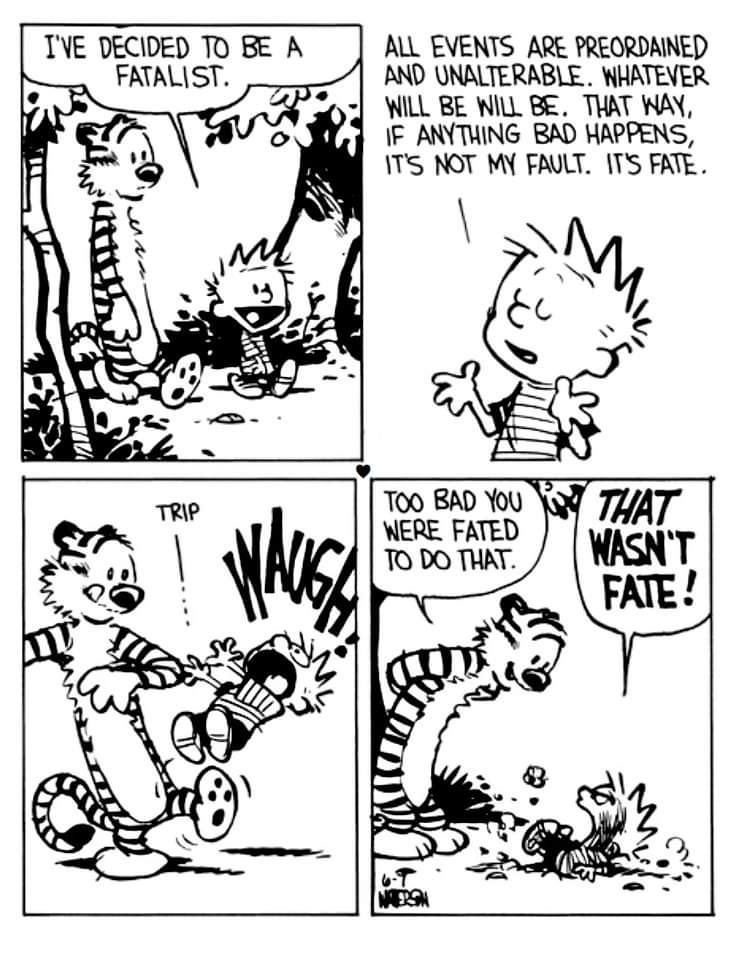
Calvin: Do you believe our destinies are determined by the stars?

Hobbes:Nah.

Calvin: Oh, I do.

Hobbes: Really? How come?

Calvin: Life‘s a lot more fun when you’re not responsible for your actions

1 Like

May I proffer another?

1 Like

The Science of Free Will by Samir Varma

Well, not counting those among us who seem convinced that how they have grappled with all this has allowed them to be quite confident that they are at least a hell of a lot closer to the objective truth than I am.

In fact, over and again I suggest that sooner or later we all take any number of existential leaps of faith to one set of assumptions rather than another. No one, to the best of my current knowledge, is able to eschew that part. Though, sure, lots of them are more than adamant that there is nothing to eschew.

Click? Forget about it?

The Clockwork Universe

At its core, the dilemma stems from the rigid clockwork nature of reality seemingly implied by physics. The precise equations of quantum theory that underlie our universe appear strictly deterministic; given the complete state of any isolated system at one moment, these laws allow you to exactly predict that system’s future state. This leaves no room for true human agency or free will — our sense of conscious choice seems to be an illusion within inexorable cosmic machinery.

Actually, at its core, in my view, is the centuries old dilemma/quandary/conundrum grappled with by physicists [and by philosophers] revolving around what we simply do not grasp yet about the human brain.

Then the part where some suggest there may or may not be a God…but it’s best to behave as though there is one. Same thing here? We may or may not have free will but we can always assume that we do and act accordingly. And even if that too is just another manifestation of the only possible human interactions in the only possible universe?

God knows?

The Science of Free Will by Samir Varma

In a sense discussing quantum interactions is analogous to discussing God or the multiverse or the matrix. To wit: no matter what anyone thinks/believes they do grasp about it there’s still that existential gap between this and everything there is to know about the existence of existence itself.

In other words, what appears “here and now” to be understood correctly about QM is no less problematic given all that we don’t even know that we don’t know yet about it. To say that QM outcomes are inherently uncertain is, from my own frame of mind, merely an educated guess given what science has discovered so far.

Now the part where those of us who have a reaction to this acknowledge in turn that our own reactions will only be more or less educated guesses. And that’s because the “chain of causal determinism” is something we still have no capacity to pin down. Well, other than as some here do: in their heads.

But this statement from you about it being merely an educated guess is itself merely an uneducated guess from you. I bet you couldn’t even tell me why they say it’s inherently uncertain. I’ll give you a hint: it has something to do with one, perhaps more than one, of the Nobel prize winners in physics of 2022.