First: This is just a play on words and changes nothing about the fact that they are destructive to their envrionment.
Second: On what basis would you assume that people are not fulfilling their potential as villains and criminals? Do you think that crime organizations are built by mistakes and failures at meeting potential?
Thats delusional.
Then why are you not calling it simply meritocracy?
Why is this paper filled with post-modernist double speech instead of stating what has been the gold standard since Plato’s republic, outlined as “the best and most capable should rule”?
This is what i never understood. DEI proclaims that there is no degradation and only the most skilled will be hired.
1.) If so then DEI has no meaning in the first place because you could, can and always will be able to hire anyone based on their skill and performance
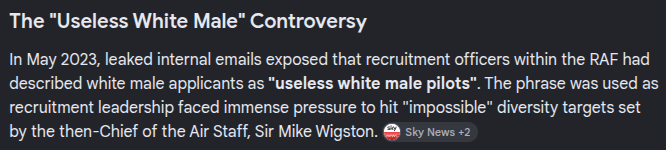
2.) Its a proven fact that this is an outright lie cause DEI simply operates on the basis of race and inclusivity quotas, sacrificing quality, safety, skill, and anything required to meet the skin color or LGBT requirements. Reminder:
All evil is just good messed up. So they use their good potential for nefarious purposes, which turns it into a failure of manifesting their true potential.
I don’t have anything to say to the rest of what you said. I don’t think there should be quotas. I think there should be a removal of race from the application information. Anonymize it. Don’t include anybody’s names (including references) until after you’ve sifted through whether or not qualifications are met/exceeded. Put all that identifiable information “behind the veil“.
This is a complete theory, just like an elephant, with four limbs, capable of breathing, and able to run, full of vitality.
Your AI believes that this elephant is too large and decides to chop it up. This directly reduces the readability and persuasiveness of the paper.
The author uses the three principles of Eudaimonia as the theoretical foundation, and builds the theory of pride alienation on this basis. This internal theoretical consistency is like Newton deriving the law of universal gravitation based on the three laws of motion. Newton was able to construct a complete scientific system by relying on the coherent unity of his underlying axioms and upper-level conclusions. If one merely criticizes a researcher for making necessary self-references to ensure the logical coherence of the theory, and then accuses them of this, it is undoubtedly a logical fallacy.
I think this is an impossible view of the world. Evil is a fundamental requirement to all life and it runs off of it’s own potential. Some acts of evil are so normalized that we grew accustomed to it and simply take them at face value, or even glorify them.
You kill to eat, your government takes your taxes, you protect your own even at the cost of blood, supply chain exploitation, modern day slavery, politicians succeeding by lying and cheating, speculants and shareholders killing off at times entire countries economically…
There is a laundry list to evil which runs our world as we speak at it’s fullest potential and some of it is required for the world to function, some of it is even glorified.
It cant be simply swatted away by something as simple as “well thats just failed potential”.
A perfect world will never exist. When forced to, it will eventually tear itself apart in order to return to balance.
This i wholeheartedly agree with.
This is how it SHOULD have always functioned. This is what meritocracy looks like the way its supposed to be.
It should look only at the skill and performance. Not skin color and other nonsense.
Its pretty ironic in a way that we completely agree on the way the system should look like but basically from the opposite ends of the spectrum.
Im completely opposed to “inclusion” because it suggests that you will be forcefully and artificially including people solely for things like skin color or sexual preferences.
But removing external factors completely is perfectly in accordance with how the system should function.
Let everyone succeed at their own merit regardless of color, skin, belief, ideology or otherwise.
Fair is fair, and having the best in any given position will benefit everyone.
I do not view this as inclusion. I view this as basic utilitarian logic.
Once again… no, you’re ¬, because you don’t want white folk excluded—you are pro-inclusion. Admit it, and say uncle whilst you do. Inclusion means nobody is excluded based on stereotypes/profiling.
I don’t think that term means what you think it means if you’re applying it to what I’m saying. Basic human rights are (value is) not earned, they are (it is) recognized. Finding someone who is most qualified for the job is not the same thing as meritocracy.
Oh? So you are not eating products made from living beings, and murder is not evil.
You managed to pack 2 rather interesting statements into less than a handful of words.
Curious cause DEI is literally about stereotyping and profiling for the purpose of inclusion.
You are using the wrong words to communicate something that we otherwise agree on.
Meritocracy is simply meritocracy its a thousands of years old standard which has absolutely nothing to do with the word inclusion because by it’s very definition it does not discriminate in any form, so it does not need to include anything.
And i dont think you understand that inclusion means what you think it means.
And who the actual f are you kidding about human rights? All and any rights are upheld at the whim of the collective. Gay rights were earned, womens rights were earned, black’s rights were earned.
There are no rights in existence which would be some kind of self-evident, born with possession granted by some imaginary sky daddy who will make sure everyone respects it.
The only rights you ever had, have and will have are the rights other people are willing to respect and grant you.
Every other view of this question is a delusional tragicomedy considering human history. Rights come and go at a whim my brother, you should really think this topic over HARD and probably before the globalist clowns initiate another world war cause then all the rights you think you have gonna go bye bye once again.
Life and death, good and bad rule this existence in a state of balance and duality.
If anything, removing one of those things would end life as a whole.
And this is not philosophy.
Its a biological reality. Down to a cellular level, your body requires negative stimulus to function as life requires death in order to be sustainable as a phenomena.
Evil lives with you every day, every minute. You have just never recognized it to be what it is.
In the flood of information, it’s wise not to read a 125-page long paper just to save time—after all, everyone’s time is precious. On this point, I would make the same choice.
But now with AI, we can significantly conserve our mental energy: hand the paper over to AI and let it extract the key points. My criterion is simple: does this information have value? Is it worth my time? If it’s highly valuable, I’m naturally willing to invest considerable time in studying it deeply.
Faced with such a rare and powerful theory—one that comes once in a century—it’s exactly the kind of work I’ve been dreaming of. In this case, I would let AI help me thoroughly analyze and break it down, rather than dismissively throw it aside as trash.
And why would that be the case?
How would that be the case?
I have never denied the existence of human rights. I said human rights are a matter of pretentiousness and convenience, always decreed, agreed upon, allowed and enforced by the group.
When the group so decides, you will have no rights.
When the group so decides, you will have rights.
You seem to think that human rights are something unalienable and granted by a higher power, standard or idea.
Thats simply idealism and naivety.
Even if i agreed that your rights are granted by a higher power unrelated to humanity… The god that bestows your rights upon you is in his heaven and not here among us. He does not enforce his own decrees and laws.
Do you know who enforces your so called god given rights? Human beings do.
Your rights and their lack of there of, are given, upheld and protected by society and your god will not lift a single finger to change that or to make sure that his rules are being followed.
Thus, alongside your rights lives every evil society shuts its eye over and ignores. Whether its by your government, corporations, the powerful, or simply via the expectations of society as a whole which has grown so accustomed to certain evils that they simply take them as a fact of life and nothing more.
You get no more and no less than what those other human beings agree you should have.
And if they agree that you should have none, then you wont have any despite you claiming otherwise.
But dont misunderstand me. I like your idealism. Its pure.
Just like i like the many other “in a perfect world” scenarios, people tend to cook up and wave around as lofty ideals and standards to aim at and live by.
But like many dreams, they do not reflect reality neither in function nor in it’s actual state.
And if you live in a dream for too long, you lose track of reality.
Rights only exist because of the state. All we can hope for is a noble and virtuous state representing all people’s interests, everything else is naivety or wishful thinking.
Well of course. Its force doctrine.
People never had any more rights than what they were granted by the force they lived under, or what they violently fought for and established through their own force.
But it always comes down to force. There is no god or higher being (even if one exists) that would intervene and enforce our rights.
See? Its that simple.
Do i have a right to be not punched by you?
Force decides.
I can either defend myself from your punching through my own force or petition the government for their force to prevent you from punching me.
Alternatively the government might only tend to the fact that you have punched me and will punish you as a consequence, yet again: through force.
There are no gods and no ideals which would prevent you from punching me if you decide to do so. Thats simply reality. If this were not the case, we would be living in an entirely different world.
I’ll tell ya what he wouldn’t do. He wouldn’t say your value is only as great as your strength to defend it. He wouldn’t strain out a gnat and swallow a camel on the street corner with his light under a basket in that city on a hill made of salt while turning away children too weak to defend themselves. No he is the master who would become their servant and throw somebody’s ass into the ocean with a millstone tied around their neck if they ever messed with his kids. He’d clear the whole **** temple with a whip if somebody took advantage of them while they were going there to pray. And he’d be right around the corner, waiting for that moment when you least expect it. When you are at what you think is your greatest strength. Then … as if things couldn’t get any worse … he’d really piss you off and forgive you.
You acknowledge that “rights ultimately depend on force,” and this indeed grasps the hard core of realpolitik: rights without enforcement are mere wishes, and rules without coercive power are easily trampled. Historically, many rights were indeed won through resistance against oppression, through violent struggle, and were only recognized after shifts in the balance of power. The doctrine of force reminds us not to naively assume that the world will automatically improve simply because we write down a declaration.
But the doctrine of force also has a fatal flaw: it mistakes fact for justification. Force can explain how rights are established, but not why they ought to be recognized. If rights derive solely from power, then the oppression of the weak by the strong is always justified; the rights you secure today through force can be taken away tomorrow by someone stronger, using the very same logic. Such a world has no rules, only fear; no justice, only victory and defeat. It cannot even explain why the oppressed, when they resist, are striving for rights rather than merely perpetrating violence.
The Three Principles of Happiness can incorporate the insights of the doctrine of force while filling its gap.
The First Principle of Happiness (Pursue One’s Own Happiness) — P1
Since everyone must pursue happiness, life, bodily integrity, property, and freedom of choice are not gifts bestowed by others, but necessary conditions for human survival and flourishing.
The Second Principle of Happiness (Do Not Infringe Upon Others’ Happiness) — P2
No one wishes to be arbitrarily harmed by others, so each person’s pursuit of happiness must be bounded by the requirement not to infringe upon the happiness of others. Rights, therefore, are not unilateral possessions but mutual recognitions.
The Third Principle of Happiness (Co-create an Environment for Happiness) — P3
To stabilize this mutual recognition, people must collectively establish institutions, laws, and public authority, so that force no longer serves merely individual interests but the common life. Coercive power is itself a product of collective construction, and the Third Principle of Happiness is the source from which legitimate force derives.
Thus, rights do not descend from nowhere, nor are they determined purely by violence. They originate in the human need to pursue happiness (P1), take shape through mutual recognition among persons (P2), and are ultimately secured by institutionalized force (P3). Force ought to be the guardian of rights, not their master. The Three Principles of Happiness do not deny the existence of power; rather, they demand that power answer a question: whose survival, freedom, and long-term happiness is it protecting? In doing so, they provide a moral foundation for preventing the privatization of force.