That’s the stage of proto-reason — the “ape discovering the mirror.”
There’s a desire to express everything, but no real capacity to structure or absorb it all.
It’s as if one stares at their reflection, making faces, mistaking that chaos for philosophy.
Transparency vs.transcendency that’s the question, or a portion of each. The absolutes reach a point beyond apportioning, where quality overtakes the quantifiable limitless center,
Judgement through reflection misses the law of coherence where such passages are courses of pre-formative structural affinity.
It’s beyond comprehension, if it wasn’t then philosophy could have been relegated to unreachable contentive recollection.
And that’s the way simulation works from primal beginnings to now and a beyond.
The sun burns our skin while the ponds sing and the breeze stirs up forgotten memories. Thoughts cross and intertwine like rivers winding through mountains. We are lost in the space between one word and another; there are no borders. Time passes and words run back, searching for meaning, searching for a place, searching for a sense of purpose. The sun sets, illuminating the sky with colours that exist in all languages, but which are only felt when the heart speaks.
A word in Portuguese evokes a response in Spanish, an echo in French, and a picture in English. There are no rules, only movement and the flow of ideas; the chaos of a non-existent structure. The mind shifts as the sea does when the tide changes, and everything seems to flow without rhyme or reason, yet every sentence has a reason to be. It is also true that language is not just a means of communication, but also music, rhythm, greeting and fire, all combined in a single melody that resonates everywhere, beyond words.
1 Like
Oh come on, it’s much simpler than that. 
Every word is a double lie — first through the clumsy tongue of the speaker  , and second through the misunderstanding of the listener
  .
.
To cover this up, people use the word “formality” — as if that explains anything. 
But the truth is, most don’t even know what form is — let alone formality. 
Beautiful. But… 
Give a definition and explanation of what meaning actually is. 
I think that would help us understand beauty as well — by slicing it open with the scalpel of logic 
 to reveal its less flattering insides.

Sorry it took so long to go back to Thomas Mann, and my own private Idaho’s, Hemingway:
The Sun Also Rises
Sense and sensibility, like
But gotta run
Tempos fugit
Briefly , this town cycloned to near rubbish, children, hospital razed, now(no travel ogue
Sure every word is a lie, but there are innocent lies and then there are the no so innocent ones. That is, the simplicity turns complex., one thing to think about.
Then the other is to live it, to live in that grey area of being in it.
Of course can not be to boundless in a leather bound chair, where love is insulated, isolated in a locked up tower.
Like in faery tales of olde, reponzel and sceherezade, Madame butterfly, , operatic resonance to the gods of singularity ,
To come?
The milk of human kindness,
Resilience my dear, resilience and not to succumb to the land of milk&
Hone, no money.
Mostly funny.
No. Keeping a diarrhea is the smart thing to do, Dr. machining said she met the Tibet lama.
No feigning of being anybody here?
Just anyone would foo I suppose my dear, dear
Cause like the one who was supposed to go back to the base
But in stead did not look back into the mirror going south
But to Texircana, baby girl, isn’t she?
You’re just sure enough that was to be went away, brought back, into brig, then served out honorably like our frien keroua, too, dropped because atypical and divided, knotted up,
Braided her long blond hair for Prince Charming to climb up.
No she knew all the ropes yet here she is because of who she was Damien, marry mo?
Oedipus rolling in te hay, with someone out of Ulysses?!
No the sun does not formally rise as well, after so many summers the swan dies, nixinsky knew in the rose, heshe knew even unknown.
And Martha says dot pretend, and the poor guys wrestles big daddy. She the tragic earth mother.
This never was meant to be, ever published, suddenly
This summer sad sad sad, but what a dump
https://youtu.be/SrCDYT-hYCE?si=49Nndu_wUpXujm7w
Just a montage of some ‘work in progress’ collection of pieces aeu passant
I was translating the Portuguese contribution by @AlonsoAceves
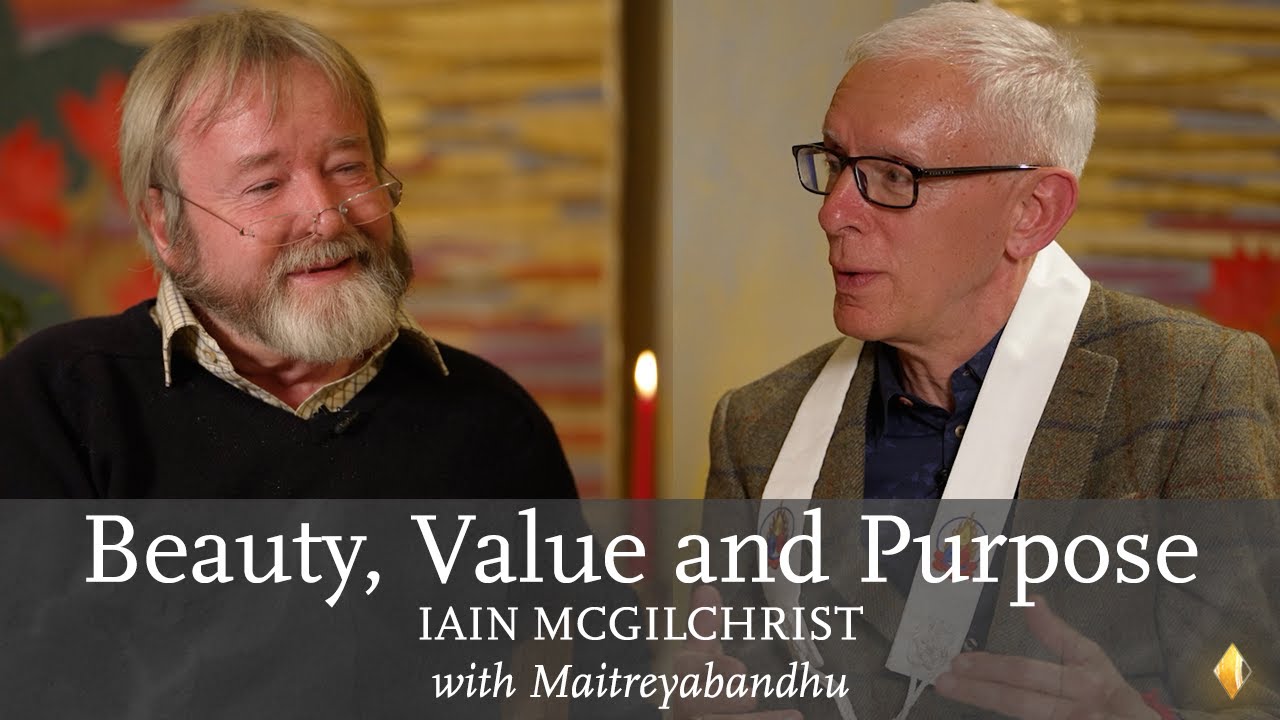
But isn’t beauty a profound, foundational aspect of reality—one that is neither merely subjective nor reducible to utility, genetics, or social convention. It seems to me that beauty is deeply connected to our experience of the world, the coming together of opposites, and the emergence of meaning and value.
Iain McGilchrist frequently characterizes beauty as the harmony or unity produced by the coming together of opposites. Drawing on Heraclitus, he argues that beauty arises when sameness and difference are held together in a balanced, harmonious whole. This is not a simplistic uniformity, but a differentiated unity—where distinct elements are integrated in a way that creates resonance and wholeness.
Beauty is something that transcends mere personal preference or cultural fashion. While there are variations in taste, we should look at the cross-cultural commonalities in what is found beautiful, which suggest that beauty has an objective, universal dimension. McGilchrist notes that beauty is “contextual,” emerging from the relationship between the observer and the observed and cannot be reduced to fixed formulas or evolutionary explanations.
Could beauty be an emergent property of reality, not something that can be manufactured or copied? It “cannot be copied. It has to come from the infinite,” McGilchrist says, emphasizing its irreducibility and its grounding in the creative, living nature of the cosmos. Beauty is not a superficial embellishment but a sign of the world’s underlying creativity and depth.
Experiencing beauty evokes a sense of awe, gratitude, and humility. McGilchrist argues that being moved by beauty motivates a “sacred obligation” to protect and care for reality. Beauty, in this sense, is not just pleasing; it is ethically and spiritually significant, prompting us to transcend self-interest and connect with something greater.
I also like the way he links beauty to the way we attend to the world, suggesting that attention is a moral act. The quality of our attention shapes what the world is for us and who we become. Beauty is realized in the encounter between the self and the world, in a relationship that is both receptive and creative.
Quotes:
“Beauty is the unity of sameness and difference that produces a harmony… those differentiated parts also have a harmony and it’s the appreciation of the harmony of the whole.”
“Beauty is contextual, it has to draw from something outside of what already is… Beauty is an emergent function and it cannot be copied. It has to come from the infinite.”
So, for Iain McGilchrist, beauty is not a trivial or secondary quality but a reflection of the world’s deepest realities: the creative interplay of opposites, the emergence of meaning, and the relational nature of existence. Beauty is both a guide and a motivator, orienting us toward what is real, valuable, and worthy of our care.
Who ever decided we know what beauty is?
Last week, my cousin and I drove out to the coast—not to swim, but to search for the old paths to the sea. The hidden coves are far too beautiful to waste time on the wide, trampled beaches, where the sun glints not off water but off beer cans and plastic loungers. We wanted to see stones, wild rock formations, golden sand, seashells—and the sea itself, untouched by people. No voices, no noise, no footprints.
The roads had gone bad. They used to be cleared by the military—back when the coastline was considered a training ground. Now it belongs to no one. The empire collapsed, and even its scattered ruins are quietly being erased.
But this isn’t about politics. Or decay. It’s about beauty.
The road wound through the hills, and here and there, we began to see snakes. Beheaded. Not random. It felt intentional, as if someone had placed them there deliberately. Not as a warning—but without reason. The shadow of a game no one understood.
I had never seen anything like it.
We stopped by one that was still whole. Curiosity won out over fear. My cousin took a stick and gently lifted the body. It was dead—likely crushed by a car. The head, we assumed, had been eaten by small animals that feed on snakes. Nature wastes nothing.
And yet—the snake. You might recoil. But I asked myself: isn’t it beautiful?
That grace, that movement without effort. A body shaped from metal and sunlight. Skin shimmering in the sun—from bronze to jade, from gold to ash.
But then you remember the venom, the sudden bite—and fear takes over. Beauty dissolves.
Or maybe not. What if the soul is wounded? What if the mind is marked? Then fear becomes attraction. Danger heightens beauty. The snake becomes a sacred image—horror and perfection, bound together.
So what is beauty, really?
Through what hidden pathways of the nervous system does its signal pass? Who inside us decides—whether to fear, or to marvel?
Perhaps we don’t see beauty at all.
Perhaps—it sees us.
Perhaps, it’s more simple, it’s in the eye.
Of the beholder.
Within and without in it’s( their) own object.
But then, Demon, it’s so a pro po the scene you’re describing, so fitting the trace of what’s left of both: production and reproduction of both again of the Beaty of the natural form, and the less than beautiful of the successive re-formation of Beaty, to the beastly.of it’s seemingly opposite.
That beastly figure is configured in the beginning and is way beyond anyone to form an opinion about it because it’s beyond such appraisal. It is simply an object beyond beauty and the beast. It’s ugliness transforms and becomes an abstracted mess of plastic bags, coke bottles and lost and thrown cars, abandoned and finally sinking below the surface scape of apprehension, re mixing with all types of forms, finally setting down into bedrock, where it glistens through the depth, as if sending a strange, mystical message to all universes, through codes of their own, vibrating eternally the sailors song lost at sea
There are some who may consider violations against the principles of aesthetic form the greatest transgression against natural law, albeit the extraction of content without an afterthought of how or why the are fitted together, or let the interpreter, the critic set the tone and course of how thing should proceed with interpretation. That is the rape of beauty, like the rape of Europa.
It may be significant to point out that this rape has both an objectively mythic significance as it relates through myriad signals to the present day of the divide of the continent, as nowadays such derision suggests both through the abstraction of preverbial representative frames of reference from it’s contentious suggestion.
The abstraction, thus arrived through an intuitively framed content of allusion, becomes enigmatically credulous.as if the frame can assert its hidden message through time and space.?x?
)()(
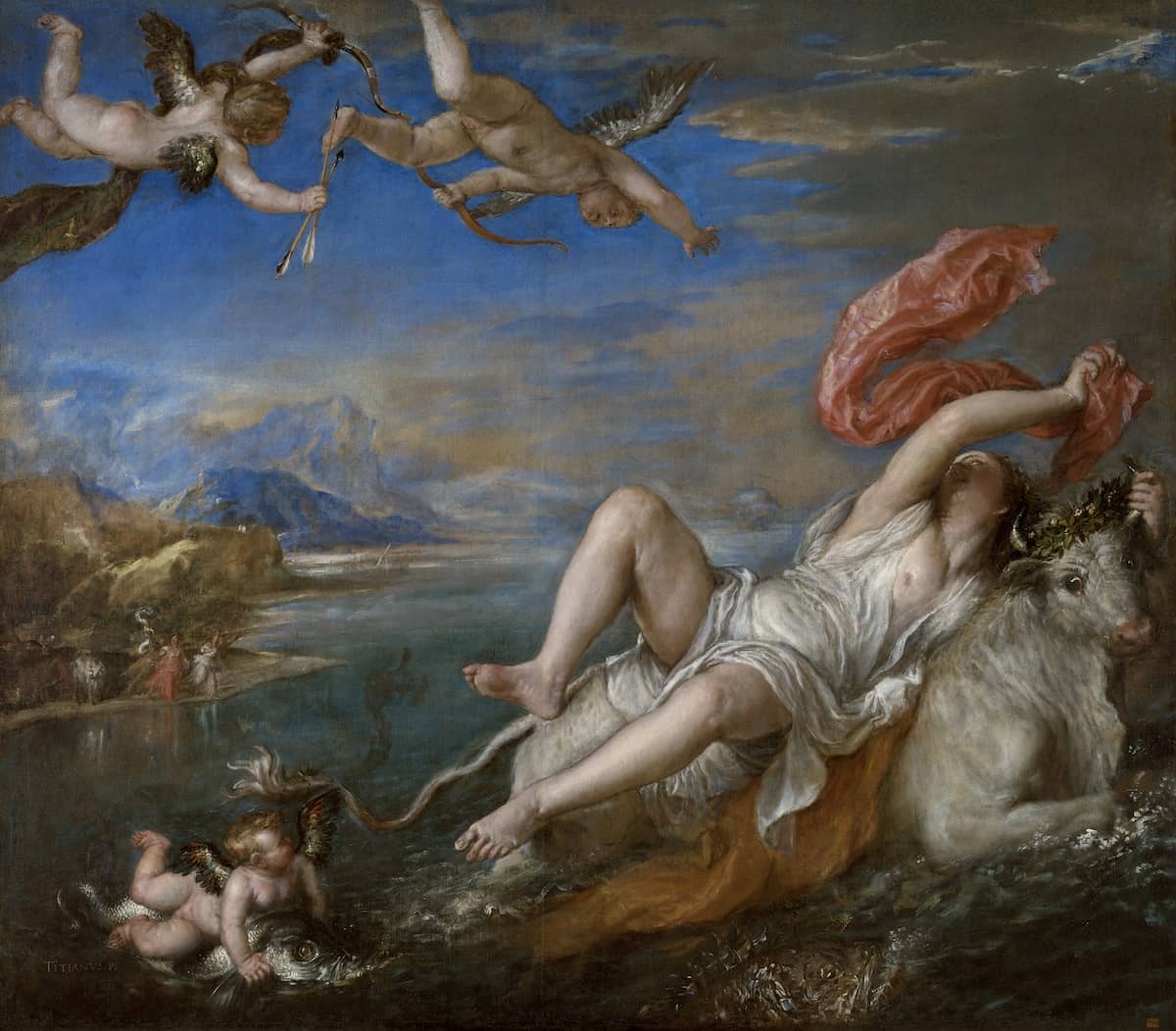
Rape of Europa, 1559-62 by Titian
Begun in 1559 and shipped to Spain in 1562, The Rape of Europa was the last of the poesie sent to Philip II.
Jupiter, disguised as a bull, charms the daughter of King Agenor of Sidon; once she and her companions have decked him with flowers and she has innocently settled herself on his back, he makes his way to the shore. “The god little by little edges away from the dry land, and sets his borrowed hoofs in shallow water; then he goes further out and soon is in full flight with his prize on the open ocean. She trembles with fear and looks back at the receding shore, holding fast a horn with one hand and resting the other on the creature’s back. And her fluttering garments stream behind her in the wind” (Ovid, Metamorphoses, ii. 870-75). One of the most attentive readers of Ovid, Titian must have known such descriptions practically by heart, and was also familiar with the more detailed ekphrasis that opens the romance of Leucippe and Clitophon by Achilles Tatius
Responding to such enthusiastic descriptions of the distraught Europa, Titian outdid the ancient images. The most striking formal feature of his Rape of Europa is surely the heroine herself, whose heavy figure dominates the canvas and establishes the tone of its naturalism. Even within the world of Titian’s late art there is scarcely another figure comparable to this unbalanced form of quivering flesh, which, in the words of Crowe and Cavalcaselle, “is not the less true to nature in its semblance because it displays no selection or ideal of contour, but is reality itself in rich substance of gorgeous tone.” Titian does indeed have this figure “display its ample charms in a pose of ungainliness which only fear could sanction” (E. K. Waterhouse). But his Europa nonetheless maintains a classical gravitas and, despite the casual air of the naturalism, a certain composure as well. The gesture of her right hand, Titian’s most blatant departure from the antique visual tradition of such representations, casts an ominous shadow across her face - a sign of tragic import that Titian developed to a refined poignancy.
The Rape of Europa is a magnificent example of the master’s late "manner, loose in its painterly fabric yet satisfyingly finished in appearance; the subtlety and audacity of its suggestive brushwork offer a perfect correlative to the grave sensuality of its narration. Foreground objects are rendered with a thick impasto, strokes varied according to their different mimetic functions, while background forms, painted quite thinly, partake of the very texture of the canvas weave, which helps create a veil of atmospheric distance. On one level the picture is a demonstration of Titian’s full painterly power, and yet art somehow seems no longer to compete with art but rather to challenge nature herself, re-creating her models and informing them with a superabundance of her own organic stuff and energy.
A dream without or within a dream.
Reality or dream? Truth or illusion?
Fact or delusion?
)))((()))((()))((()))(((
So, is a delusion and collusive unconscious dream, containing increasingly probable perimeters of contextual evidence appear to become more ‘real’ in the present scheme of things? The answer is more likely than not, and that compresses the already conflated primal states even more to the point of signifying the unhappy inconclusive consciousness which presumably shadows such premise?
The receding invariance that results two choices, either/or retains the level of ocular justification, by masking more of the affirmation that reevaluated the same staid condition, so that the Kafkaesque negative view of the protagonist, again turning the opposite direction, so that the polarities change, but the nominal justification retains the same pattern.
Orson Welles’ movie reflects this in the closing shot, if it happened to be viewed at all from the beginning to the end, by leaving it in a grey fogged epilogue, to be left to the interpreter’s imagination.
The opening graphics also left the conundrum of this question bracketed in an increasing uncertainty of atomistic prevalence so that like book ends, the meaning becomes correlated with the interpreters interpretation. The movie still staid in the era of the black and white noir, reinforcing that interpretation as representative of a form which is hard pressed to let go in furtherance of digital up and coming forms.The painter , undisclosed of the type he indulges in, turns out to abstract this futuristic presumptive structural transform, literally into the inversion of the pathos into increasing faithful albeit fragmented representation, with the hope that the artistic loops of presumptions will edge up into a new objective realism.
Poems exacting
In Bangkok
)(
)()(
Shirley, legaya and Johnny is here, having break fast. Telling’em break fast is a religiously sourced tradition, lasting more than overnight.
All bitten on the back like the bull carrying europa, involved innuendoes, synchronicities,
all compensations , safe guard that inner sanctum the Jolie of whollies
Gotta take some wrap, it always going here to rain rainy weather ideal for singing in.
Next up;
Cambodia here we come but so much to yet, to see- Pataya for one and so I ask Johnny about his travels there (he voluminously recites all the twists and turns, high ways and bi-ways) but then I remind him I have short term memory loss, he cuts it like a knife leaving a large wound that will never heal in this lifetime at least.
So The Buddha of lesser expedient Buddhas reminds of Talpas of time -trillions of trillions of lifetimes needed to start.
A fly lands on my forearm sweetly tickling with delicate wings, as if knob in another instantive world, looking at me paranoically, quizzically.