MENU
HOME » LIFESTYLE » RELIGION
THE KEY DIFFERENCES BETWEEN GNOSTICISM AND AGNOSTICISM
Gnostics and agnostics are two terms that are often used in discussions about religion and spirituality. While they may sound similar, they actually represent two very different approaches to understanding the world and our place in it.
Gnosticism, as mentioned earlier, is a religious and philosophical movement that flourished in the first and second centuries CE. It taught that the material world is evil and that true knowledge or insight (gnosis) can only be gained through direct experience of the divine. Gnostics believed that they were able to achieve this knowledge through various spiritual practices, such as meditation and asceticism.
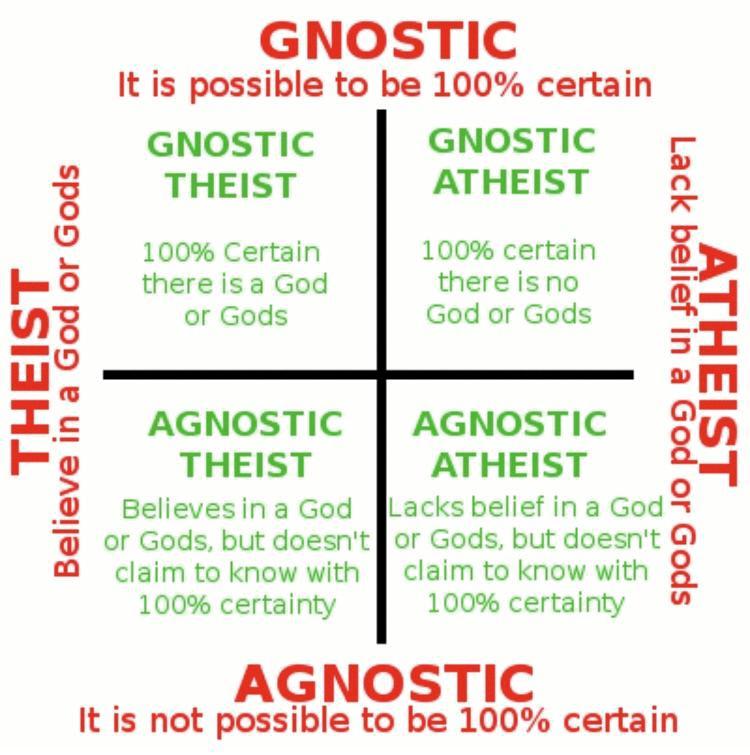
Agnosticism, on the oter hand, is a more recent term that was coined in the 19th century. It refers to the belief that the existence of God or any other supernatural beings cannot be proven or disproven. Agnostics do not necessarily deny the possibility of the divine, but they do not claim to have any certain knowledge of it.
To put it simply, gnostics believe that they have direct knowledge of the divine, while agnostics believe that such knowledge is impossible to attain.
Here are some key differences between gnosticism and agnosticism:
Beliefs:
– Gnostics believe in the existence of a divine being or beings, and that true knowledge can only be gained through direct experience of this divinity.
– Agnostics do not necessarily deny the possibility of the divine, but they do not claim to have any certain knowledge of it.
Approach:
– Gnostics seek to gain knowledge of the divine through spiritual practices and direct experience.
– Agnostics approach the question of the divine from a more skeptical perspective, acknowledging that it may be impossible to know for certain.
Attitude toward the material world:
– Gnostics view the material world as evil and believe that the true self is separate from the body.
– Agnostics do not necessarily have a particular attitude toward the material world, but they do not see it as inherently evil or good.
Gnosticism and agnosticism represent two very different approaches to understanding the divine and our place in the world. While gnostics seek direct knowledge of the divine through spiritual practices, agnostics approach the question of the divine from a more skeptical perspective. Both beliefs have their own strengths and weaknesses, and it is up to each individual to decide which approach resonates with them the most.
Gnostic Beliefs
Gnosticism is a complex and diverse set of religious beliefs and practices that emerged in the early Christian era. Despite its varied forms and expressions, Gnosticism shares some core beliefs and characteristics.
One of the most distinctive features of Gnosticism is its cosmological dualism. According to Gnostic teachings, the world is divided into two opposing forces: the material or physical realm, which is seen as corrupt and evil, and the spiritual or divine realm, which is seen as pure and good. This dualistic worldview is often traced back to the influence of Platonic philosophy on Gnostic thought.
Another central feature of Gnosticism is the emphasis on asceticism and renunciation of worldly pleasures. Gnostics believed that the material world and the physical body were impediments to spiritual enlightenment, and therefore advocated practices such as fasting, celibacy, and prayer as means of purifying the soul and attaining gnosis, or knowledge of the divine.
Gnostics also rejected the idea of a benevolent creator God, instead positing the existence of a distant and unknowable deity, often referred to as the “Unknown Father.” Some Gnostic sects also believed in a hierarchy of divine beings or archons, who maintained control over the material world and hindered human spiritual progress.
Docetism, the belief that Jesus Christ was a divine being who only appeared to have a physical body, is another hallmark of Gnostic thought. This belief reflects the Gnostic rejection of the material realm and the idea that the divine canot be contaminated by the physical.
Gnostics believed in the existence of a divine spark or seed within each human being, which could be awakened through spiritual discipline and ultimately lead to liberation from the material world and the attainment of gnosis.
Gnostic beliefs are characterized by cosmological dualism, strict asceticism, rejection of material creation as evil, docetism, and the existence of the divine spark in humans.
Do Gnostics Believe in Jesus?
Gnostics have a complex relationship with Jesus. Some Gnostics view Jesus as an embodiment of the supreme being, who became incarnate to bring gnosis to the earth. These Gnostics believe that Jesus was not just a human being but a divine being who had a special role in the salvation of humanity. They see Jesus as a messenger who brought a message of enlightenment and salvation to humanity.
On the other hand, there are Gnostics who deny that the supreme being came in the flesh. They see Jesus as a human teacher who attained enlightenment through gnosis and taught his disciples to do the same. These Gnostics believe that Jesus was not divine but rathr a human who had a profound understanding of spiritual truth.
It’s worth noting that there are many different Gnostic sects, each with their own unique beliefs and practices. Some Gnostic sects do not place a great deal of emphasis on Jesus, while others view him as a central figure in their spiritual tradition.
Some Gnostics do believe in Jesus as a divine being who brought gnosis to humanity, while others see him as a human teacher who helped others attain enlightenment. The beliefs of Gnostics vary widely, and there is no single answer to the question of whether or not Gnostics believe in Jesus.
The Meaning of Gnosticism in Religion
In religion, the term Gnostic refers to an ancient movement that emerged in the early Christian era, which emphasized the importance of knowledge or insight (gnôsis) as the path to salvation. Gnosticism was characterized by a complex set of beliefs and practices that combined elements of Greek philosophy, Jewish mysticism, and Christian theology.
Gnostics believed that the material world was a flawed creation of a lesser deity, and that the true divine reality was hidden behind it. They saw themselves as seekers of knowledge who sought to penetrate the veil of illusion that separated them from the divine. This quest for knowledge was seen as a spiritual journey that involved the development of a deeper understanding of oneself and the world.
One of the key teachings of Gnosticism was the concept of the demiurge, a lesser deity who created the material world but was not the ultimate source of divine reality. Gnostics believed that the true God was a transcendent, ineffable, and unknowable entity that could only be apprehended through direct experience or gnosis.
Gnostic teachings also emphasized the importance of the individual’s personal relationship with the divine, rater than reliance on an external authority such as the church. This led to a variety of practices, including meditation, prayer, and the use of visionary experiences to attain spiritual insight.
READ More: Pastors are Salaried Workers Too
Gnostic refers to a religious movement that emphasized the importance of knowledge or insight as the path to salvation, and which saw the material world as a flawed creation of a lesser deity. Gnosticism was characterized by a complex set of beliefs and practices that combined elements of Greek philosophy, Jewish mysticism, and Christian theology.
Gnostic Beliefs in the Modern Age
Gnosticism is a religious and philosophical movement that emerged in the early Christian era and has continued to evolve over time. Today, there are several modern Gnostic groups and organizations that trace their lineage back to the ancient Gnostics, although they are not necessarily connected to each other or to the historical Gnostics in any direct way.
One such group is the Ecclesia Gnostica, which was founded in Los Angeles in 1953 and is part of the larger Gnostic Church movement. The Ecclesia Gnostica is a Christian-based Gnostic organization that incorporates elements from various Gnostic traditions and practices a form of esoteric Christianity. They believe in the existence of a divine spark within each individual and seek to help people discover and connect with their inner divinity.
Another modern Gnostic organization is the Universal Gnostic Fellowship, which was founded in 1970 and has members around the world. They are a non-denominational group that draws on various Gnostic and mystical traditions, including Christian, Jewish, and Islamic traditions. The Universal Gnostic Fellowship emphasizes personal spiritual experience and encourages members to develop their own unique relationship with the divine.
There are also several smaller, more specialized Gnostic groups, such as the Johannite Church, the Apostolic Johannite Church, and the Order of the Black Sun. These groups focus on specific aspects of Gnostic teachings and practices, such as the role of Mary Magdalene in Gnostic Christianity or the use of meditation and ritual to connect with the divine.
Modern Gnostics are a diverse group of people who are united by their shared interest in Gnostic teachings and practices. While there is no single, unified Gnostic tradition or organization, thee groups continue to evolve and adapt the ancient Gnostic teachings to modern times.
The True God in Gnosticism
In Gnosticism, the concept of the true God is complex and multifaceted. It is believed that the true God is a divine entity that exists beyond the material world and is responsible for the creation of the universe. This being is often referred to as the Monad, the One, the Absolute, or Aiōn Teleos (the Perfect Aeon).
The Monad is considered the ultimate source of all things, and is often depicted as a transcendent, all-encompassing consciousness that pervades every aspect of the universe. It is said to be beyond human comprehension and can only be experienced through a direct mystical experience.
In addition to the Monad, there are other divine beings in Gnosticism that are seen as emanations or aspects of the true God. These include Bythos (Depth or Profundity), Proarchē (Before the Beginning), Hē Archē (The Beginning), the Ineffable Parent, and/or the primal Father.
While these divine beings are considered to be aspects of the true God, they are not worshipped in the same way as traditional gods in other religions. Instead, Gnostics believe in the importance of achieving a direct mystical experience of the divine, which can only be achieved through spiritual practices such as meditation, prayer, and contemplation.
The true God in Gnosticism is a complex and mysterious concept that is difficult to define in concrete terms. However, through spiritual practices and direct mystical experiences, Gnostics believe that they can gain a deeper understanding of this divine entity and teir place in the universe.
Gnostic Churches
Gnosticism is a religious movement that emerged in the early Christian era and has been associated with various religious organizations. In this article, we will explore some of the churches that identify themselves as Gnostic.
One of the most well-known Gnostic churches is the Ecclesia Gnostica, which was founded in the early 20th century in Los Angeles, California. This church draws its teachings and practices from a variety of Gnostic traditions, including those of the ancient Gnostics, the Cathars, and the Rosicrucians.
Another prominent Gnostic church is the Ecclesia Gnostica Catholica, which is affiliated with the Ordo Templi Orientis, a magickal and occult order. The Ecclesia Gnostica Catholica practices a form of Gnosticism that draws heavily on the teachings of Aleister Crowley and his Thelemic philosophy.
The Gnostic Church of France is another religious organization that identifies as Gnostic. This church was founded in the mid-20th century by a French mystic named Tau Jean-Baptiste, who claimed to have received direct revelations from Christ.
The Holy Gnostic Church and Friends is a small Gnostic church based in the United States that emphasizes the importance of personal spiritual experience and direct communion with the divine.
The Johannite Church is a Gnostic church that traces its lineage back to the early Christian era and claims to be the direct descendant of the original Gnostic Christians. This church has a strong emphasis on mysticism and esotericism and incorporates a wide range of spiritual practices into its worship.
There are a variety of churches that identify as Gnostic, each with its own unique teachings and practices. Whether you are interested in mysticism, occultism, or personal spiritual experience, there is likey a Gnostic church that will resonate with your beliefs and values.
The Four Gnostic Religions
Gnosticism is a religious movement that emerged in the early Christian era and has continued to evolve over the centuries. Today, there are several Gnostic religions that exist, each with its own unique beliefs and practices. In this article, we will discuss the four major Gnostic religions – Ecclesia Gnostica, Apostolic Johannite Church, Ordo Templi Orientis, and Gnostic Movement of Samael Aun Weor.
-
Ecclesia Gnostica: Ecclesia Gnostica is a Christian Gnostic church that is based in Los Angeles, California. The church was founded in 1956 by Tau Allen Greenfield and Tau Thomas D. Winters. Ecclesia Gnostica believes in the existence of an ultimate reality, which they call the Absolute, and that salvation can be achieved through knowledge of this reality. The church also incorporates elements of Hermeticism, Kabbalah, and other esoteric traditions into its teachings.
-
Apostolic Johannite Church: The Apostolic Johannite Church is a Gnostic Christian church that traces its roots back to the early Christian era. The church was founded in 2004 by Bishop T Allen Greenfield and Bishop James Foster. Apostolic Johannite Church believes in the existence of a divine spark within each person, which can be awakened through spiritual practice. The church also incorporates elements of Gnostic philosophy, Hermeticism, and other esoteric traditions into its teachings.
READ More: A Reminder of God’s Love and Abundance
-
Ordo Templi Orientis: Ordo Templi Orientis (OTO) is a modern Gnostic organization that was founded in the early 20th century. The organization was originally inspired by the teachings of Aleister Crowley and the Hermetic Order of the Golden Dawn. OTO believes in the existence of a divine spark within each person, which can be awakened through spiritual practice. The organization also incorporates elements of Thelema, Kabbalah, and other esoteric traditions into its teachings.
-
Gnostic Movement of Samael Aun Weor: The Gnostic Movement of Samael Aun Weor is a modern Gnostic organization that was founded in the mid-20th century. The organization was inspired by the teachings of Samael Aun Weor, a Colombian spiritual teacher. Gnostic Movement of Samael Aun Weor believes in the existence of a divine spark within each person, which can be awakened through spiritual practice. The organization also incorporates elements of Kabbalah, Hermeticism, and other esoteric traditions into its teachings.
These four Gnostic religions share a belief in the existence of a divine spark within each person, which can be awakened through spiritual practice. They also incorporate elements of various esoteric traditions into ther teachings, such as Hermeticism, Kabbalah, and Thelema.
The Gnostic Nature of the Gospel of Mary
The Gospel of Mary is considered a Gnostic text because of its similarities to other known Gnostic dialogues. Gnosticism was a religious movement that emerged in the early Christian era and emphasized the importance of secret knowledge or gnosis for salvation. Gnostic texts often feature a revelation discourse framed by narrative elements, and the Gospel of Mary follows this format.
The Gospel of Mary contains a dialogue between Mary Magdalene and the other disciples, in which Mary shares a vision she had of Jesus. The vision includes teachings that are not found in the canonical Gospels and emphasizes the importance of inner spiritual knowledge. This emphasis on secret knowledge and the importance of inner spiritual experience is a key characteristic of Gnosticism.
Additionally, the Gospel of Mary contains references to some of the key Gnostic beliefs, such as the idea that the material world is corrupt and that salvation coms through escaping this world and returning to the divine realm. The text also includes references to the Sophia, a Gnostic figure representing divine wisdom.
The Gospel of Mary is considered Gnostic because of its similarities to other known Gnostic dialogues in terms of its format and content. It emphasizes the importance of secret knowledge and inner spiritual experience, contains teachings not found in the canonical Gospels, and includes references to key Gnostic beliefs and figures.
The Founder of Gnosticism
Gnosticism is a religious movement that emerged in the early Christian era. However, it is important to note that the designation “Gnosticism” is a modern term used by scholars to refer to various religious groups referred to in ancient sources as “gnostikoi.” These groups were characterized by teir emphasis on spiritual knowledge or gnosis, which they believed was necessary for salvation.
Since Gnosticism was not founded by a single individual, it is difficult to identify a single founder. Instead, the movement emerged from a variety of religious and philosophical traditions, including Judaism, Christianity, and Greek philosophy.
Some scholars have identified Simon Magus, a figure mentioned in the New Testament, as one of the earliest Gnostic teachers. Others have pointed to Valentinus, a second-century Christian theologian, as a key figure in the development of Gnostic thought.
Despite the difficulty in identifying a single founder, Gnosticism had a significant impact on the development of Christian theology and spirituality. The movement’s emphasis on spiritual knowledge and mystical experience has influenced many religious traditions, including various forms of Christian mysticism, as well as esoteric and occult movements.
Source:
reddit.com
What Does the Gnostic Bible Teach?
The Gnostic Bible is a collection of texts that were written by varios Gnostic groups during the first few centuries of the Common Era. These texts are not considered part of the traditional Christian Bible, but instead offer a unique perspective on spirituality and the divine.
One of the key beliefs of the Gnostics was a dualistic worldview that separated the spiritual realm from the material realm. They believed that the material world was inherently corrupt and evil, while the spiritual world was pure and perfect. This dualistic perspective is reflected in many of the texts found in the Gnostic Bible.
Another important aspect of Gnostic belief was the existence of numerous divine beings or “aeons” that inhabited various levels of the spiritual realm. These beings were often depicted as emanations of the ultimate divine source, and were thought to have played a role in the creation of the universe.
The Gnostic Bible also offers a unique perspective on the nature of salvation. Unlike traditional Christianity, which emphasizes the need for faith in Jesus Christ as the path to salvation, the Gnostics believed that salvation came through knowledge, or “gnosis”. This knowledge was not simply intellectual, but was thought to be a direct experience of the divine that allowed individuals to transcend the material world and enter into the spiritual realm.
The Gnostic Bible offers a fascinating glimpse into the beliefs and practices of an ancient spiritual movement that has had a lasting impact on Western spirituality. Some of the most well-known texts in the Gnostic Bible include the Gospel of Thomas, the Gospel of Mary, and the Pistis Sophia.
Exploring the Nature of Gnostic Spirituality
Gnostic spirituality refers to a set of beliefs and practices that emerged in the early Christian era. The word “gnostic” comes from the Greek word gnosis, which means knowledge, and refers to the belief that true spiritual knowledge is attained throgh direct experience rather than through established religious institutions or dogma.
At its core, Gnostic spirituality revolves around the idea that human beings are manifestations of the divine, and that the material world is an illusion that obscures our true spiritual nature. This belief was seen as subversive and revolutionary in the hierarchical societies of the ancient world, as it challenged traditional power structures and emphasized personal spiritual experience over established religious authority.
Gnostic teachings also emphasized the importance of prayer and meditation as a means of achieving spiritual union with a transcendent deity or higher power. This union was often described as an ecstatic experience, in which the individual’s consciousness merges with the divine.
One of the most distinctive aspects of Gnostic spirituality is its rejection of traditional dualisms, such as the dichotomy between good and evil or the material and spiritual worlds. Instead, Gnostics believed in a more nuanced understanding of reality, in which all things are interconnected and part of the same divine essence.
READ More: The Key Differences Between Catholicism and Presbyterianism
Gnostic spirituality represents a unique and often misunderstood approach to spirituality that emphasizes personal experience, direct knowledge, and a rejection of traditional power structures and dogma.
The Difference Between Atheism and Gnosticism
When it comes to beliefs about the existence of a god, two terms that often get used interchangeably are “atheist” and “agnostic.” However, these two terms actually have distinct meanings.
An atheist is someone who does not believe in a god or gods. This can be for a variety of reasons, such as a lack of evidence or a rejection of religious teachings. Atheists may also believe in other philosophical or spiritual ideas, but they do not subscribe to the belief in a divine being.
An agnostic, on the other hand, is someone who does not believe that it is possibe to know whether a god or gods exist. Agnostics may feel that there is not enough evidence to support either belief or disbelief in a god, or they may believe that the question is inherently unanswerable.
It is possible for someone to be both an atheist and an agnostic, as the two terms are not mutually exclusive. For example, someone might not believe in a god due to a lack of evidence, but also acknowledge that it is impossible to know for sure whether a god exists.
While both atheists and agnostics do not believe in a god, the difference lies in their beliefs about whether it is possible to know for sure whether a god exists.
The End of Gnosticism
The eradication of Gnosticism, a complex and multifaceted movement that emerged in the early days of Christianity, cannot be attributed to a single individual or event. Rather, it was a gradual process that involved the efforts of many church leaders and theologians over several centuries.
One of the most significant figures in the fight aganst Gnosticism was Irenaeus, a bishop of Lyons in the second century. Irenaeus was one of the first Christian thinkers to systematically combat Gnostic teachings, which he saw as a threat to the orthodox beliefs of the church.
Through his writings, Irenaeus argued that the Gnostic teachings were not only false but also dangerous, as they led believers away from the true message of Christ. He also emphasized the importance of scripture and tradition in understanding the Christian faith, which was in direct opposition to the Gnostic emphasis on secret knowledge.
While Irenaeus’ efforts were instrumental in combating Gnosticism, it is important to note that other theologians and church leaders also played a significant role in this process. Among these were Tertullian, Clement of Alexandria, and Origen, each of whom contributed to the development of orthodox Christian theology and the rejection of Gnostic teachings.
In the end, it was the collective efforts of these and many other thinkers and leaders that helped to bring about the eventual decline and disappearance of Gnosticism as a major force within Christianity. While some Gnostic beliefs and practices still exist today, they are generally considered to be a historical curiosity rather than a viable alternative to orthodox Christian doctrine.
Do Gnostics Believe in the Crucifixion of Jesus?
Gnosticism is a religious movement that emerged during the early Christian era. It was characterized by a belief in secret knowledge that culd liberate the soul from the material world. Gnostics had a variety of beliefs about Jesus, and some believed that he was not crucified.
One of the key beliefs of Gnosticism is that the material world is evil, and the spiritual world is good. Some Gnostics believed that Jesus was a spiritual being who had taken on a human body. They believed that the body was not real, but only an illusion, and that Jesus had not really been crucified.
Other Gnostics believed that Jesus had been crucified, but that it was not really him on the cross. They believed that Jesus had switched places with someone else, and that the person who was crucified was not Jesus at all.
These beliefs were based on the idea that the material world is deceptive, and that the truth can only be found through spiritual knowledge. Gnostics believed that they possessed this knowledge, and that they could achieve salvation by attaining it.
It is important to note that not all Gnostics shared the same beliefs about Jesus. Gnostic texts are often fragmentary and difficult to interpret, and there were many different schools of Gnosticism. Some Gnostics believed that Jesus was a divine being who had been sent to save humanity, while others believed that he was a human teacher who had discovered the secret knowledge of the spiritual world.
While some Gnostics believed in the crucifixion of Jesus, others believed that he was not crucified. These beliefs were based on the Gnostic worldview that the material world is deceptive, and that the truth can only be found through spiritual knowledge.
The Leader of Gnosticism
Gnosticism is an ancient religious movement that emerged in the early Christian era. It was characterized by a dualistic belief system that posited the existence of rival deities, one good and the other evil. In this system, salvation was seen as an elitist enlightenment achieved through secret knowledge, and the ultimate goal was the release of the soul from the body.
One prominent leader of the Italian school of Gnosticism was Heracleon. He flourished in the 2nd century AD and was known for his teachings on the nature of Christ and the relationship btween the divine and human realms. Heracleon’s writings were highly influential in the development of Gnostic thought, and many of his ideas continue to be studied and debated by scholars today.
Conclusion
Gnosticism and Agnosticism are two distinct philosophical and religious concepts.
Gnosticism is a religious and philosophical movement that emphasizes the importance of gnosis or knowledge of the divine. It is characterized by dualism, asceticism, and the belief in the existence of a divine spark in humans. Gnostics view the material world as evil and seek to transcend it through spiritual enlightenment.
On the oher hand, Agnosticism is a philosophical position that asserts that the existence of God or any supernatural being is unknown and unknowable. Agnostics neither affirm nor deny the existence of God, but instead, they maintain that it is impossible to prove or disprove the existence of God through human knowledge.
While Gnostics seek to find knowledge through spiritual enlightenment, Agnostics acknowledge the limitations of human knowledge and the inability to know the divine through human means. Both concepts have influenced religious and philosophical thought throughout history and continue to have relevance in contemporary society.