Skimming ‘Putting the Rabbit in the Hat’
Brian Cox, touching nerves but can not buy it. On a steep decline. Want to lift it but recent indulagance in jarmia freezes me.
So full of characterizations of admirable actors.
Skimming ‘Putting the Rabbit in the Hat’
Brian Cox, touching nerves but can not buy it. On a steep decline. Want to lift it but recent indulagance in jarmia freezes me.
So full of characterizations of admirable actors.
_
Reading up on ancient-Europe onwards, to current climes.
Would you be so kind and tell something more about it?
Sorry for interruption for trying to post new topic , it was unsuccessful so, I am replacing current topic on books.
…genealogy, haplogroups, what constitutes/makes a European a European, the origins and admixture of Europeans, etc.
sounds interesting.
Meanwhile up and hangin’ by a silk tossed thread:
‘How to Know Hid’
Translated with commentary by:
Swami Prabbhavananda and Cristopher Isherwood
When the mind becomes clear, information is better understood/absorbed… all starts to make sense, but it is not for all to make sense of.
Need read ‘ sense and sensibility’ , meno : I thought it to be of philosophy, still will read it time willing
Outliers
Malcom gladwell
“Covid-19: The Great Reset” (Klaus Schwab). Original version.
What books I’d like to re-read
1The idiot -Dostoevsky
2 Magic Mountain T Mann
3 ? A thousand others
Peking Story, David Kidd
-amazing
How to Be a Stoic: Using Ancient Philosophy to Live a Modern Life
By: Massimo Pigliucci
“Stoicism taught me that regret is about things we can no longer change and the right attitude is to learn from our experiences, not dwell on decisions that we are not in a position to alter.”
We need to resist the impulse to react immediately and instinctively to potentially problematic situations. Instead, we must pause, take a deep breath, perhaps go for a walk around the block, and only then consider the issue as dispassionately as possible.”
“One of the first lessons from Stoicism, then, is to focus our attention and efforts where we have the most power and then let the universe run as it will. This will save us both a lot of energy and a lot of worry.”
all gems
The Visible and The Invisible ( 1st ‘timely’ attempt)
.
The Visible and the Invisible: The Intertwining—The Chiasm Maurice Merleau-Ponty
[Originally from The Visible and the Invisible, pp. 130-55 in the 1968 translation. This version from Maurice Merleau-Ponty: Basic Writings, ed. Thomas Baldwin, Routledge (2004).]
Introduction by Thomas Baldwin
This chapter comes from a manuscript which was incomplete at Merleau-Ponty’s death. In 1959 he converted his long-standing ambition to write a book about truth…into the project of a book about the visible and the invisible; in which he would move from a discussion of perception ('the visible’) to one of language and thence truth (‘the invisible’). The manuscript really addresses only the first part of this (though there are notes for the later parts); so it primarily represents his later thoughts about perception. In the first chapter Merleau-Ponty returns to his critique of realism and intellectualism. He then provides, in the second chapter, a decisive refutation of Sartre’s Hegelian account in Being and Nothingness of our being in the world (see p. 29). In the third chapter he discusses critically Bergson’s conception of ‘intuition’ and then begins to set out his own thoughts about temporality and language. But it is in the fourth chapter, reproduced here, that he breaks new ground.
The title of the chapter indicates his new conception of the body, as a ‘chiasm’ or crossing-over (the term comes from the Greek letter chi) which combines subjective experience and objective existence. His term for this new conception of the body is ‘flesh’ (chair) and he insists that it is an 'ultimate notion; a 'concrete emblem of a general manner of being; which provides access both to subjective experience and objective existence. The phenomenon he concentrates upon is one he had discussed earlier in The Phenomenology of Perception (PP 92 [106], that of touching one hand with the other hand. This phenomenon, he suggests, reveals to us the two dimensions of our ‘flesh’, that it is both a form of experience (tactile experience) and something that can be touched. It is both ‘touching’ and ‘tangible’: Furthermore the relationship is reversible: the hand that touches can be felt as touched, and vice versa, though never both at the same time, and it is this ‘reversibility’ that he picks out as the essence of flesh. It shows us the ambiguous status of our bodies as both subject and object. Thus Merleau-Ponty here qualifies his earlier view that gave priority to the ‘phenomenal; subjective, body over the objective body. For he now regards these as but two aspects of a single fundamental phenomenon: our reversible flesh’ (the influence of Husserl is perhaps apparent here: in Ideas II he had affirmed that 'the Body as Body presents, like Janus, two faces’, p. 297, though the ‘faces’ in question are not Merleau-Ponty’s alternatives).
Merleau-Ponty extends the application of this conception in two directions. First, he extends it from touch to sight, which he now models on touch–”the look we said, envelops, palpates, espouses visible things: So sight has the same ambiguous nature as touch, and it is from its own ‘objective’ side that the objectivity of the visible world is generated”. Second, taking the example of a handshake as exemplary, he extends his thesis to apply to our sense that others, like us, are both subjects and objects. Although these points are clear enough, and the chapter is not, as it stands, incomplete, it remains unclear how he intended to extend the line of thought further, since the manuscript ends at this point, and the notes that follow do not provide a connected discussion. Thus at this point there is a genuine sense of a thinker stopped in midair, and it is just not clear where the trajectory of his thought would have carried him. – TB
1
THE INTERTWINING—THE CHIASM
If it is true that as soon as philosophy declares itself to be reflection or coincidence it prejudges what it will find, then once again it must recommence everything, reject the instruments reflection and intuition had provided themselves, and install itself in a locus where they have not yet been distinguished, in experiences that have not yet been “worked over,” that offer us all at once, pell-mell, both “subject” and “object,” both existence and essence, and hence give philosophy resources to redefine them. Seeing, speaking, even thinking (with certain reservations, for as soon as we distinguish thought from speaking absolutely we are already in the order of reflection), are experiences of this kind, both irrecusable and enigmatic. They have a name in all languages, but a name which in all of them also conveys significations in tufts, thickets of proper meanings and figurative meanings, so that, unlike those of science, not one of these names clarifies by attributing to what is named a circumscribed signification. Rather, they are the repeated index, the insistent reminder of a mystery as familiar as it is unexplained, of a light which, illuminating the rest, remains at its source in obscurity. If we could rediscover within the exercise of seeing and speaking some of the living references that assign them such a destiny in a language, perhaps they would teach us how to form our new instruments, and first of all to understand our research, our interrogation, themselves.
The visible about us seems to rest in itself. It is as though our vision were formed in the heart of the visible, or as though there were between it and us an intimacy as close as between the sea and the strand. And yet it is not possible that we blend into it, nor that it passes into us, for then the vision would vanish at the moment of formation, by disappearance of the seer or of the visible. What there is then are not things first identical with themselves, which would then offer themselves to the seer, nor is there a seer who is first empty and who, afterward, would open himself to them—but something to which we could not be closer than by palpating it with our look, things we could not dream of seeing all naked” because the gaze itself envelops them, clothes them with its own flesh. Whence does it happen that in so doing it leaves them in their place, that the vision we acquire of them seems to us to come from them, and that to be seen is for them but a degradation of their eminent being? What is this talisman of color, this singular virtue of the visible that makes it, held at the end of the gaze, nonetheless much more than a correlative of my vision, such that it imposes my vision upon me as a continuation of its own sovereign existence? How does it happen that my look, enveloping them, does not hide them, and, finally, that, veiling them, it unveils them? [1]
We must first understand that this red under my eyes is not, as is always said, a quale, a pellicle of being without thickness, a message at the same time indecipherable and evident, which one has or has not received, but of which, if one has received it, one knows all there is to know, and of which in the end there is nothing to say. It requires a focusing, however brief; it emerges from a less precise, more general redness, in which my gaze was caught, into which it sank, before—as we put it so aptly -fixing it. And, now that I have fixed it, if my eyes penetrate into it, into its fixed structure, or if they start to wander round about again, the quale resumes its atmospheric existence. Its precise form is bound up with a certain wooly, metallic, or porous configuration or texture, and the quale itself counts for very little compared with these participations. Claudel has a phrase saying that a certain blue of the sea is so blue that only blood would be more red. The color is yet a variant in another dimension of variation, that of its relations with the surroundings: this red is what it is only by connecting up from its place with other reds about it, with which it forms a constellation, or with other colors it dominates or that dominate it, that it attracts or that attract it, that it repels or that repel it. In short, it is a certain node in the woof of the simultaneous and the successive. It is a concretion of visibility, it is not an atom. The red dress a fortiori holds with all its fibers onto the fabric of the visible, and thereby onto a fabric of invisible being. A punctuation in the field of red things, which includes the tiles of roof tops, the flags of gatekeepers and of the Revolution, certain terrains near Aix or in Madagascar, it is also a punctuation in the field
2
of red garments, which includes, along with the dresses of women, robes of professors, bishops, and advocate generals, and also in the field of adornments and that of uniforms. And its red literally is not the same as it appears in one constellation or in the other, as the pure essence of the Revolution of 1917 precipitates in it, or that of the eternal feminine, or that of the public prosecutor, or that of the gypsies dressed like hussars who reigned twenty-five years ago over an inn on the Champs-Elysées. A certain red is also a fossil drawn up from the depths of imaginary worlds. If we took all these participations into account, we would recognize that a naked color, and in general a visible, is not a chunk of absolutely hard, indivisible being, offered all naked to a vision which could be only total or null, but is rather a sort of straits between exterior horizons and interior horizons ever gaping open, something that comes to touch lightly and makes diverse regions of the colored or visible world resound at the distances, a certain differentiation, an ephemeral modulation of this world—less a color or a thing, therefore, than a difference between things and colors, a momentary crystallization of colored being or of visibility. Between the alleged colors and visibles, we would find anew the tissue that lines them, sustains them, nourishes them, and which for its part is not a thing, but a possibility, a latency, and a flesh of things.
If we turn now to the seer, we will find that this is no analogy or vague comparison and must be taken literally. The look, we said, envelops, palpates, espouses the visible things. As though it were in a relation of pre-established harmony with them, as though it knew them before knowing them, it moves in its own way with its abrupt and imperious style, and yet the views taken are not desultory—I do not look at a chaos, but at things—so that finally one cannot say if it is the look or if it is the things that command. What is this prepossession of the visible, this art of interrogating it according to its own wishes, this inspired exegesis? We would perhaps find the answer in the tactile palpation where the questioner and the questioned are closer, and of which, after all, the palpation of the eye is a remarkable variant. How does it happen that I give to my hands, in particular, that degree, that rate, and that direction of movement that are capable of making me feel the textures of the sleek and the rough? Between the exploration and what it will teach me, between my movements and what I touch, there must exist some relationship by principle, some kinship, according to which they are not only, like the pseudopods of the amoeba, vague and ephemeral deformations of the corporeal space, but the initiation to and the opening upon a tactile world. This can happen only if my hand, while it is felt from within, is also accessible from without, itself tangible, for my other hand, for example, if it takes its place among the things it touches, is in a sense one of them, opens finally upon a tangible being of which it is also a part. Through this crisscrossing within it of the touching and the tangible, its own movements incorporate themselves into the universe they interrogate, are recorded on the same map as it; the two systems are applied upon one another, as the two halves of an orange. It is no different for the vision—except, it is said, that here the exploration and the information it gathers do not belong “to the same sense.” But this delimitation of the senses is crude. Already in the “touch” we have just found three distinct experiences which subtend one another, three dimensions which overlap but are distinct: a touching of the sleek and of the rough, a touching of the things —a passive sentiment of the body and of its space—and finally a veritable touching of the touch, when my right hand touches my left hand while it is palpating the things, where the “touching subject” passes over to the rank of the touched, descends into the things, such that the touch is formed in the midst of the world and as it were in the things. Between the massive sentiment I have of the sack in which I am enclosed, and the control from without that my hand exercises over my hand, there is as much difference as between the movements of my eyes and the changes they produce in the visible. And as, conversely, every experience of the visible has always been given to me within the context of the movements of the look, the visible spectacle belongs to the touch neither more nor less than do the “tactile qualities.” We must habituate ourselves to think that every visible is cut out in the tangible, every tactile being in some manner promised to visibility, and that there is encroachment, infringement, not only between the touched and the touching, but also between the tangible and the visible, which is encrusted in it, as, conversely, the tangible itself is not a nothingness of visibility, is not without visual
3
existence. Since the same body sees and touches, visible and tangible belong to the same world. It is a marvel too little noticed that every movement of my eyes—even more, every displacement of my body—has its place in the same visible universe that I itemize and explore with them, as, conversely, every vision takes place somewhere in the tactile space. There is double and crossed situating of the visible in the tangible and of the tangible in the visible; the two maps are complete, and yet they do not merge into one. The two parts are total parts and yet are not superposable.
Hence, without even entering into the implications proper to the seer and the visible, we know that, since vision is a palpation with the look, it must also be inscribed in the order of being that it discloses to us; he who looks must not himself be foreign to the world that he looks at. As soon as I see, it is necessary that the vision (as is so well indicated by the double meaning of the word) be doubled with a complementary vision or with another vision: myself seen from without, such as another would see me, installed in the midst of the visible, occupied in considering it from a certain spot. For the moment we shall not examine how far this identity of the seer and the visible goes, if we have a complete experience of it, or if there is something missing, and what it is. It suffices for us for the moment to note that he who sees cannot possess the visible unless he is possessed by it, unless he is of it,[2] unless, by principle, according to what is required by the articulation of the look with the things, he is one of the visibles, capable, by a singular reversal, of seeing them he who is one of them.[3]
We understand then why we see the things themselves, in their places, where they are, according to their being which is indeed more than their being-perceived and why at the same time we are separated from them by all the thickness of the look and of the body; it is that this distance is not the contrary of this proximity, it is deeply consonant with it, it is synonymous with it. It is that the thickness of flesh between the seer and the thing is constitutive for the thing of its visibility as for the seer of his corporeity; it is not an obstacle between them, it is their means of communication. It is for the same reason that I am at the heart of the visible and that I am far from it: because it has thickness and is thereby naturally destined to be seen by a body. What is indefinable in the quale, in the color, is nothing else than a brief, peremptory manner of giving in one sole something, in one sole tone of being, visions past, visions to come, by whole clusters. I who see have my own depth also, being backed up by this same visible which I see and which, I know very well, closes in behind me. The thickness of the body, far from rivaling that of the world, is on the contrary the sole means I have to go unto the heart of the things, by making myself a world and by making them flesh.
The body interposed is not itself a thing, an interstitial matter, a connective tissue, but a sensible for itself, which means, not that absurdity: color that sees itself, surface that touches itself—but this paradox [?]: a set of colors and surfaces inhabited by a touch, a vision, hence an exemplar sensible, which offers to him who inhabits it and senses it the wherewithal to sense everything that resembles himself on the outside, such that, caught up in the tissue of the things, it draws it entirely to itself, incorporates it, and, with the same movement, communicates to the things upon which it closes over that identity without superposition, that difference without contradiction, that divergence between the within and the without that constitutes its natal secret.[4] The body unites us directly with the things through its own ontogenesis, by welding to one another the two outlines of which it is made, its two laps: the sensible mass it is and the mass of the sensible wherein it is born by segregation and upon which, as seer, it remains open. It is the body and it alone, because it is a two-dimensional being, that can bring us to the things themselves, which are themselves not flat beings but beings in depth, inaccessible to a subject that would survey them from above, open to him alone that, if it be possible, would coexist with them in the same world. When we speak of the flesh of the visible, we do not mean to do anthropology, to describe a world covered over with all our own projections, leaving aside what it can be under the human mask. Rather, we mean that carnal being, as a being of depths, of several leaves or several faces, a being in latency, and a presentation of a certain absence, is a prototype of Being, of which our body, the
4
sensible sentient, is a very remarkable variant, but whose constitutive paradox already lies in every visible. For already the cube assembles within itself incompossible visibilia, as my body is at once phenomenal body and objective body, and if finally it is, it, like my body, is by a tour de force. What we call a visible is, we said, a quality pregnant with a texture, the surface of a depth, a cross section upon a massive being, a grain or corpuscle borne by a wave of Being. Since the total visible is always behind, or after, or between the aspects we see of it, there is access to it only through an experience which, like it, is wholly outside of itself. It is thus, and not as the bearer of a knowing subject, that our body commands the visible for us, but it does not explain it, does not clarify it, it only concentrates the mystery of its scattered visibility; and it is indeed a paradox of Being, not a paradox of man, that we are dealing with here. To be sure, one can reply that, between the two “sides” of our body, the body as sensible and the body as sentient (what in the past we called objective body and phenomenal body), rather than a spread, there is the abyss that separates the In Itself from the For Itself. It is a problem—and we will not avoid it to determine how the sensible sentient can also be thought. But here, seeking to form our first concepts in such a way as to avoid the classical impasses, we do not have to honor the difficulties that they may present when confronted with a cogito, which itself has to be re-examined. Yes or no: do we have a body—that is, not a permanent object of thought, but a flesh that suffers when it is wounded, hands that touch? We know: hands do not suffice for touch—but to decide for this reason alone that our hands do not touch, and to relegate them to the world of objects or of instruments, would be, in acquiescing to the bifurcation of subject and object, to forego in advance the understanding of the sensible and to deprive ourselves of its lights. We propose on the contrary to take it literally to begin with. We say therefore that our body is a being of two leaves, from one side a thing among things and otherwise what sees them and touches them; we say, because it is evident, that it unites these two properties within itself, and its double belongingness to the order of the “object” and to the order of the “subject” reveals to us quite unexpected relations between the two orders. It cannot be by incomprehensible accident that the body has this double reference; it teaches us that each calls for the other. For if the body is a thing among things, it is so in a stronger and deeper sense than they: in the sense that, we said, it is of them, and this means that it detaches itself upon them, and, accordingly, detaches itself from them. It is not simply a thing seen in fact (I do not see my back), it is visible by right, it falls under a vision that is both ineluctable and deferred. Conversely, if it touches and sees, this is not because it would have the visibles before itself as objects: they are about it, they even enter into its enclosure, they are within it, they line its looks and its hands inside and outside. If it touches them and sees them, this is only because, being of their family, itself visible and tangible, it uses its own being as a means to participate in theirs, because each of the two beings is an archetype for the other, because the body belongs to the order of the things as the world is universal flesh. One should not even say, as we did a moment ago, that the body is made up of two leaves, of which the one, that of the “sensible,” is bound up with the rest of the world.
There are not in it two leaves or two layers; fundamentally it is neither thing seen only nor seer only, it is Visibility sometimes wandering and sometimes reassembled. And as such it is not in the world, it does not detain its view of the world as within a private garden: it sees the world itself, the world of everybody, and without having to leave “itself,” because it is wholly—because its hands, its eyes, are nothing else than this reference of a visible, a tangible-standard to all those whose resemblance it bears and whose evidence it gathers, by a magic that is the vision, the touch themselves. To speak of leaves or of layers is still to flatten and to juxtapose, under the reflective gaze, what coexists in the living and upright body. If one wants metaphors, it would be better to say that the body sensed and the body sentient are as the obverse and the reverse, or again, as two segments of one sole circular course which goes above from left to right and below from right to left, but which is but one sole movement in its two phases. And everything said about the sensed body pertains to the whole of the sensible of which it is a part, and to the world. If the body is one sole body in its two phases, it incorporates into itself the whole of the sensible and with the same movement incorporates itself into a "Sensible in
5
itself" We have to reject the age-old assumptions that put the body in the world and the seer in the body, or, conversely, the world and the body in the seer as in a box. Where are we to put the limit between the body and the world, since the world is flesh? Where in the body are we to put the seer, since evidently there is in the body only “shadows stuffed with organs,” that is, more of the visible? The world seen is not “in” my body, and my body is not “in” the visible world ultimately: as flesh applied to a flesh, the world neither surrounds it nor is surrounded by it. A participation in and kinship with the visible, the vision neither envelops it nor is enveloped by it definitively. The superficial pellicle of the visible is only for my vision and for my body. But the depth beneath this surface contains my body and hence contains my vision. My body as a visible thing is contained within the full spectacle. But my seeing body subtends this visible body, and all the visibles with it. There is reciprocal insertion and intertwining of one in the other. Or rather, if, as once again we must, we eschew the thinking by planes and perspectives, there are two circles, or two vortexes, or two spheres, concentric when I live naively, and as soon as I question myself, the one slightly decentered with respect to the other…
We have to ask ourselves what exactly we have found with this strange adhesion of the seer and the visible. There is vision, touch, when a certain visible, a certain tangible, turns back upon the whole of the visible, the whole of the tangible, of which it is a part, or when suddenly it finds itself surrounded by them, or when between it and them, and through their commerce, is formed a Visibility, a Tangible in itself, which belong properly neither to the body qua fact nor to the world qua fact—as upon two mirrors facing one another where two indefinite series of images set in one another arise which belong really to neither of the two surfaces, since each is only the rejoinder of the other, and which therefore form a couple, a couple more real than either of them. Thus since the seer is caught up in what he sees, it is still himself he sees: there is a fundamental narcissism of all vision. And thus, for the same reason, the vision he exercises, he also undergoes from the things, such that, as many painters have said, I feel myself looked at by the things, my activity is equally passivity—which is the second and more profound sense of the narcissim: not to see in the outside, as the others see it, the contour of a body one inhabits, but especially to be seen by the outside, to exist within it, to emigrate into it, to be seduced, captivated, alienated by the phantom, so that the seer and the visible reciprocate one another and we no longer know which sees and which is seen. It is this Visibility, this generality of the Sensible in itself, this anonymity innate to Myself that we have previously called flesh, and one knows there is no name in traditional philosophy to designate it. The flesh is not matter, in the sense of corpuscles of being which would add up or continue on one another to form beings. Nor is the visible (the things as well as my own body) some “psychic” material that would be—God knows how—brought into being by the things factually existing and acting on my factual body. In general, it is not a fact or a sum of facts “material” or “spiritual.” Nor is it a representation for a mind: a mind could not be captured by its own representations; it would rebel against this insertion into the visible which is essential to the seer. The flesh is not matter, is not mind, is not substance. To designate it, we should need the old term “element,” in the sense it was used to speak of water, air, earth, and fire, that is, in the sense of a general thing, midway between the spatiotemporal individual and the idea, a sort of incarnate principle that brings a style of being wherever there is a fragment of being. The flesh is in this sense an “element” of Being. Not a fact or a sum of facts, and yet adherent to location and to the now. Much more: the inauguration of the where and the when, the possibility and exigency for the fact; in a word: facticity, what makes the fact be a fact. And, at the same time, what makes the facts have meaning, makes the fragmentary facts dispose themselves about “something.” For if there is flesh, that is, if the hidden face of the cube radiates forth somewhere as well as does the face I have under my eyes, and coexists with it, and if I who see the cube also belong to the visible, I am visible from elsewhere, and if I and the cube are together caught up in one same “element” (should we say of the seer, or of the visible?), this cohesion, this visibility by principle, prevails over every momentary discordance. In advance every vision or very partial visible that would here definitively come to naught is not nullified (which would leave a gap in its place), but, what is better, it is replaced by a more exact vision and a more exact visible, according to
6
the principle of visibility, which, as though through a sort of abhorrence of a vacuum, already invokes the true vision and the true visible, not only as substitutes for their errors, but also as their explanation, their relative justification, so that they are, as Husserl says so aptly, not erased, but “crossed out.”… Such are the extravagant consequences to which we are led when we take seriously, when we question, vision. And it is, to be sure, possible to refrain from doing so and to move on, but we would simply find again, confused, indistinct, non-clarified, scraps of this ontology of the visible mixed up with all our theories of knowledge, and in particular with those that serve, desultorily, as vehicles of science. We are, to be sure, not finished ruminating over them. Our concern in this preliminary outline was only to catch sight of this strange domain to which inte
Dr Faustus Thomas Mann
.

Roger Ebert May 08, 2005
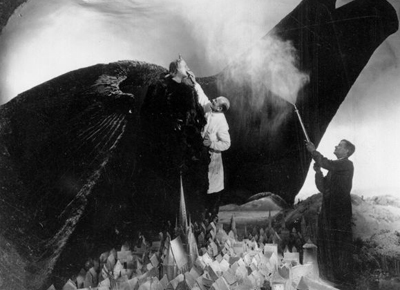
Crew members touch up the character of Mephisto in “Faust” (1926) for a scene that illustrates director F.W. Murnau’s bold imagination and distinctive skewed perspective, as Mephisto’s dark wings obscure the sky as he hovers above a little village.
NOW STREAMING ON:

The greatest master of horror in the silent era was a cheerful man, much loved by his collaborators, even though they might lose consciousness from time to time while enveloped in clouds of steam or surrounded by tongues of flame. F.W. Murnau (1888-1931) made two of the greatest films of the supernatural, “Nosferatu” (1922) and “Faust” (1926), both voted among the best horror films of all time on the Internet Movie Database: “Faust” surprisingly in fourth place, just ahead of “The Shining,” “Jaws” and “Alien.”
ADVERTISEMENT
Murnau had a bold visual imagination, distinctive even during the era of German Expressionism with its skewed perspectives and twisted rooms and stairs. He painted with light and shadow, sometimes complaining to his loyal cameraman, Carl Hoffmann, that he could see too much – that all should be obscured except the focus of a scene.
“Faust,” with its supernatural vistas of heaven and hell, is particularly distinctive in the way it uses the whole canvas. Consider the startling early shot of Mephisto, his dark wings obscuring the sky as he hovers above a little village that huddles in the lower right corner. Murnau treated the screen as if it offered a larger space than his contemporaries imagined; long before deep focus, he was creating double-exposures like shots in “Faust” where a crowd of villagers in the foreground is echoed by faraway crowds in the upper corners.
ADVERTISEMENT
His screen encompassed great breadth and depth, so that when Mephisto takes Faust on a flight through the sky, we really do seem to see the earth unreeling beneath them: towns and farms, mountains and rivers. Murnau used a model of the landscape, of course; as his art director, Robert Herlth, remembered, “there were pines and larches made of reeds and rushes, glass-wool clouds, cascades, fields of real turf carefully stuck on plaster. When Murnau saw us at work, he bent his great height to help us make our little rocks and trees.”
Like all silent-film directors, Murnau was comfortable with special effects that were obviously artificial. The town beneath the wings of the dark angel is clearly a model, and when characters climb a steep street, there is no attempt to make the sharply angled buildings and rooflines behind them seem real. Such effects, paradoxically, can be more effective than more realistic ones; I sometimes feel, in this age of expert CGI, that I am being shown too much – that technique is pushing aside artistry and imagination. The world of “Faust” is never intended to define a physical universe, but is a landscape of nightmares. When the elderly Faust is magically converted by Mephisto into a young man, there is a slight awkwardness in the way one image is replaced by another, and oddly enough that’s creepier and more striking than a smooth modern morph.
ADVERTISEMENT
Murnau and his contemporaries were inventing their techniques while they were using them. Herlth recalled that while Murnau was filming an opening scene of an archangel enveloped by clouds, the director “was so caught up in the pleasure of doing it that he forgot all about time. The steam had to keep on billowing through the beams of light until the archangel – Werner Fuetterer – was so exhausted he could no longer lift his sword. When Murnau realized what had happened, he shook his head and laughed at himself, then gave everyone a break.”
Yes, but he was entranced again in the scene where Camilla Horn, playing the beautiful Gretchen, “had to spend hours tied to the stake, with flames leaping round her from 20 lykopodium burners. When she fainted, she was not acting.” And the famous Emil Jannings, who played the doorman in Murnau’s “Last Laugh” and is Mephisto here, stood for hours above three powerful fans which blew clouds of soot to make his cloak billow 12 feet above his head. All of these facts I take from the book*Murnau,*by the invaluable critic Lotte Eisner, who never met Murnau but talked to his collaborators after his death in 1931, at 43, in a traffic accident.
ADVERTISEMENT
“Faust,” the story of a man who sells his soul to the devil, was long a European legend before Goethe spent 50 years writing a two-volume version of the myth. Because Goethe was beloved by the Germans, some audiences for Murnau’s film were outraged by the liberties he took with the story, not least in shaky central episodes where Faust falls in love with Gretchen, demands to be made young again, and then woos her while Mephisto distracts her Aunt Marthe with his own romantic designs. Somehow it diminishes Mephisto to assign him carnal desires – particularly since, as an angel, he presumably lacked all inclination and equipment for such pursuits.
ADVERTISEMENT
The film’s greatness resides in its majestic opening scenes and its horrifying conclusion. Most viewers dislike the courtship between Gretchen and young Faust, although it is essential to set up her eventual fate – an ending so bleak that there is not much consolation when the archangel informs Mephisto that “Love” is stronger than all the powers of darkness. Tell that to Gretchen, burning at the stake, and Faust, transformed back into an old man and throwing himself into the flames at her feet to beg forgiveness.
Some of the early scenes remind us of “Nosferatu” in their evocation of a terrified population. Faust (played young and old by Gosta Ekman) is seen as a bearded scholar, surrounded by his books, until the plague strikes the land. From his window, he sees hooded figures carrying corpses to a charnel-pit; he is called to the bedside of a dying woman, but all of his wisdom and art are helpless to save her, and after praying to God, he is tempted to invoke Mephisto. There is true horror as he burns his books and stands within a ring of fire to call down the devil; when he finds he has the power to cure dying villagers, he thinks he has made a good bargain, but soon his power intoxicates him.
ADVERTISEMENT
Mephisto offers him the beautiful Duchess of Parma; he prefers the sweet and innocent Gretchen, and demands the gift of youth so that he can woo her. That way tragedy lies. Mephisto is crafty in his techniques; at first he offers Faust a 24-hour trial of satanic powers, no strings attached, but soon Faust is ready to sign anything to win poor Gretchen. So much for the plague victims.
Silent films like this deal more in broad concepts than in the subtleties of personality. Like Greek myth and comic books, they present characters clearly defined by their strengths and weaknesses. There’s no small talk. Ekman creates an elderly Faust in anguish over his inability to cure plague victims and too proud to admit defeat. The young Faust is led astray by the stirrings in his loins, and the function of Gretchen, I am afraid, is to be the innocent victim of his lust; she wanders through a blizzard with her innocent infant and burns at the stake, all because of her love for the unworthy Faust.
ADVERTISEMENT
It’s worth mentioning that William Dieterle, who plays Gretchen’s brother Valentin, fled Hitler, came to Hollywood and had a long career as a director, distinguished by “The Devil and Daniel Webster” (1941), itself a version of the Faust legend.
Murnau died before he was able to express himself fully in the sound era, where there is no telling what he might have accomplished; soon after he moved to America, his “Sunrise” (1927) shared the first Academy Award for best picture. In death, he is surrounded by legend, not least in E. Elias Merhige’s strange film “Shadow of the Vampire” (2000), where John Malkovich plays the director as a man whose star, Max Schreck (Willem Dafoe), is in fact a vampire. Murnau promises Schreck that he can eat the leading lady as his payment, but the vampire grows hungry and devours the cinematographer, and in desperation, Murnau muses, “I do not think we need the writer.” The movie is not, by the way, a comedy, but feeds on the real horror that Murnau created. He was an original, and no one else ever made films that looked like his. They are strange and haunted; you reflect that if such satanic dealings were possible, they would probably look very much like this.
Great Movie reviews of “Sunrise” and both the Murnau and Herzog versions of “Nosferatu” are online atrogerbert.
Hamlet:
An Elaboration and Synthesis
William R. Brashear
I When Hamlet remarks on how “the native hue of resolution is sicklied d’er with the pale cast of thought” and on how he has thought “too precisely on th’ event” [Italics supplied], his choice of words would suggest that he himself regards as a distinct weakness the power of mind which dissolves meaning and pur- pose into nothingness and ultimate futility. And within the context of his role or character as Prince of Denmark and wronged and traumatized son he is justified in considering it in this light, for it hinders him from making such decisions and taking such actions as are expected of him or imposed upon him by the milieu in which he exists as character or personality, the stage and setting of his temporal being. Most critics who have found in Hamlet’s reflective powers the primal cause of his in- action and indecision have agreed with him that this is weak- ness or imbalance, and here we must acknowledge the persisting influence of the theory of tragic flaw. Not only is something
rotten in Denmark, but something must be “wrong” with Hamlet.
most a ain insecta on it and a propationate a versions tended to see themselves in Hamlet, and it has been especially remarked that Coleridge saw in him much of his own reflective
and vacillating temperament; but it should in addition
(re: An unknown authorship on ‘Nietzche on Hamlet)
.
https://scholarworks.iu.edu/journals/index.php/plath/article/download/4771/4404/14678
.
Note “‘native hue of resolution (re-solution) is sickled d’’er with the pale cast of thought”
.
as significantly omitting a primal cause, hence his reflection offers other opportunities to fill that gap.
When what’s missing most of all is in my opinion as primary concern with Other than,
The familial (revenge) the secondary, familiar thoughts of today should have shifted to concern for another Other.
()()()
My thoughts here if the relationship between Christian moralism(love your brethren as you would yourself) and prior to that searc for wisdom which is left unfulfilled , re that of the question arising: whether Hamlet’s soliloquy plies both of primary and secondary allusion in Shakespeares and Thomas Mann’s son’s respective minds.
Not even referring to the disconcerting element of ‘magical thinking’ in Levi Bruhl’s magical mysterious ‘back to the future’ or even it’s subjugation of not seeing with his back turned.
()()))

(This great audio cut has been blocked, sorry to other(s) so deprived
())()()
https://www.gutenberg.org/cache/epub/638/pg638.txt
…
Masonic historians are quick point out some of the connections between Freemasonry and the cathedral builders, the Knights Templar, the Royal Society, Hermetic tradition, alchemists and Qabalaists, however the connection between Freemasonry and the Gnostic schools is often overlooked- even though it is perhaps the most prevalent.
Gnosticism is a school of thought originally developed in the ancient pagan world and championed by philosophers like Pythagoras, and later instrumental in the development of early Christianity, in which an initiate can attain a Gnosis – or direct knowledge of the divine. In fact, the word “Gnosis” means “knowledge” in Greek, and it was a divine knowledge that could be achieved through the study of nature, personal initiation, and divine revelation. As a result, schools of initiation were set up by the Gnostics in order to engage in study and initiation, and to attain connection with the path of Sophia- the Greek word for “wisdom”. In fact, this is where the word “philosophy” comes from- as it is from the Greek words “Philo”- meaning “to love”, and “Sophia”, being the goddess of wisdom. The term philosophy is believed to have been coined by Pythagoras, and some have associated Pythagoras’ school with a form of Pagan Gnosticism. Gnosticism therefore showed the connection between God and Nature, and contributed to the esoteric sciences of alchemy and sacred geometry. The “G” emphasized in Freemasonry may therefore have other implications! It has also been argued by many researchers that Gnosticism was a new label for the pagan philosophies and doctrines found in Hermeticism, which had just been rewrapped in new packaging. Indeed, Hermeticism and Gnosticism share many fundamental details, and the influence of Hermetic thought and Hermes in particular could be a whole separate article. Therefore we will just explore Gnostic connections in this article.

Gnosticism and Gnostic thought are mentioned several times in the Scottish Rite degrees, and we can see it as a general theme in Freemasonry, though it is rarely mentioned specifically by name outside of the Scottish Rite. This is partially due to the fact that the Gnostics generally considered themselves their own form of religion, and as Freemasonry accepts brothers of all faiths, it is important not to make the mistake of portraying Freemasonry itself as a Gnostic religion. That being said, the idea associated with Gnosticism can be found in almost all religions, and as such, it can be viewed as more of an esoteric philosophy that unites people across various religions- though some people today claim to be Gnostics as a religion. For example, the ideas associated with a Gnostic Christian are fundamentally almost identical to a Buddha or Boddisatva in the Buddhist religion, Gnanis in Hinduism, an Arif in the Islamic tradition, and a “knower” in the Taoist tradition, and it is for this reason that it is believed that Gnosticsm had an influence on all of these religious philosophies as it spread between Egypt and Tibet, and likewise these other schools contributed to Gnostic doctrine. Though Gnostic philosophies vary somewhat depending on the school, in their essential details and philosophy they are mostly the same. The Gnostic philosopher Mani alluded to this universality when he said, “But my hope will go to the West and to the East. And they will hear the voice of its teaching in all languages and they will teach it in all cities. Gnosticism surpasses in this first point all earlier religions, for the earlier religions were founded in individual places and in individual cities. Gnosticism goes out to all cities and its message reaches every land.”1 Therefore it is important to explore some of these ideas and see how they relate to Freemasonry.
To begin with, there is a lot of confusion when it comes to ancient Gnostic thought, with most scholars explaining Gnosticism as a form dualism in which there is a god of darkness and a god of light who are battling for the souls of humanity. In my opinion, this is kind of a way over simplified version of Gnosticism, and one that is potentially more tied with modern Christian ideas, though there certainly were different types of Gnostic schools and some likely had a more dualistic way of interpreting Gnostic philosophy, and we particularly find this in some later Gnostic movements like the Cathars of southern France. We must remember that much of what had been written about the Gnostics prior to the wide spread translation of Gnostic texts, consisted of harsh critiques by the Roman Catholic Church, which view Gnostcism as a rival movement. Therefore we would also expect a harsh and biased interpretation of Gnostic doctrine. A more correct and widespread view of general Gnosticism, in my mind, would be to suggest that there is a single God, which manifests itself into two forces. These forces have been labeled as Spirit and matter, light and darkness, yin and yang. Gnostics believed that the world of spirit is always subtly directing the world of matter, in order that we, as conscious beings, may grow and become more in line with our spiritual potential. Understanding God’s laws of spirit in matter could enable one to come to a better comprehension of God. This moment of “ah-ha”, or awareness of God’s work, is the Gnosis. It was believed by Gnostic schools that this divine knowledge was necessary for humanities salvation- as it was a personal knowledge of God, and to the Gnostics it was represented by Light. “Gnosis” then, in many ways is similar to ideas associated with “revelation”, “enlightenment” and “nirvana” from different traditions.
)()(
.
.
.
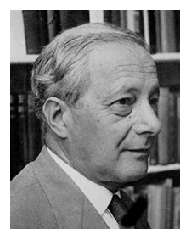 Michael Polanyi and tacit knowledge. Michael Polanyi helped to deepen our appreciation of the contribution of ‘tacit knowing’ to the generation of new understandings and social and scientific discovery. We briefly explore his relevance to educators.
Contents: introduction · tacit knowledge · conclusion · bibliography · how to cite this article
Michael Polanyi (1891-1976) made a profound contribution both to the philosophy of science and social science. Born in Budapest into an upper class Jewish family, he studied at the University there (gaining doctoral degrees both in medicine and physical science) and at Karlsruhe. His initial work was as a physical chemist – undertaking significant work at the University of Berlin (and other universities) on crystal structure and reaction kinetics. With the rise to power in Germany of Hitler, Michael Polanyi emigrated to Britain and became Professor of Physical Chemistry at the University of Manchester (1933-1948). In a significant shift, following his growing contribution to the literature of social science and philosophy, Michael Polanyi then became Professor of Social Sciences at Manchester (1948-58). He also lectured as visiting professor or senior fellow at the universities of Chicago, Aberdeen, Virginia, Stanford and Merton College, Oxford.
Central to Michael Polanyi’s thinking was the belief that creative acts (especially acts of discovery) are shot-through or charged with strong personal feelings and commitments (hence the title of his most famous work Personal Knowledge). Arguing against the then dominant position that science was somehow value-free, Michael Polanyi sought to bring into creative tension a concern with reasoned and critical interrogation with other, more ‘tacit’, forms of knowing.
Polanyi’s argument was that the informed guesses, hunches and imaginings that are part of exploratory acts are motivated by what he describes as ‘passions’. They might well be aimed at discovering ‘truth’, but they are not necessarily in a form that can be stated in propositional or formal terms. As Michael Polanyi (1967: 4) wrote in The Tacit Dimension, we should start from the fact that ‘we can know more than we can tell‘. He termed this pre-logical phase of knowing as ‘tacit knowledge’. Tacit knowledge comprises a range of conceptual and sensory information and images that can be brought to bear in an attempt to make sense of something (see Hodgkin 1991). Many bits of tacit knowledge can be brought together to help form a new model or theory. This inevitably led him to explore connoisseurship and the process of discovery (rather than with the validation or refutation of theories and models – in contrast with Popper, for example).
We must conclude that the paradigmatic case of scientific knowledge, in which all faculties that are necessary for finding and holding scientific knowledge are fully developed, is the knowledge of approaching discovery.
To hold such knowledge is an act deeply committed to the conviction that there is something there to be discovered. It is personal, in the sense of involving the personality of him who holds it, and also in the sense of being, as a rule, solitary; but there is no trace in it of self-indulgence. The discoverer is filled with a compelling sense of responsibility for the pursuit of a hidden truth, which demands his services for revealing it. His act of knowing exercises a personal judgement in relating evidence to an external reality, an aspect of which he is seeking to apprehend. (Polanyi 1967: 24-5)
Michael Polanyi placed a strong emphasis on dialogue within an open community (a theme taken up later strongly by the physicist David Bohm). He recognized the strength by which we hold opinions and understandings and our resistance to changing them. Unlike many of his contemporaries he placed his thinking within an appreciation of God and of the power of worship – especially in his later writing (see, for example, Meaning). In his earlier work (especially in Personal Knowledge) Polanyi seems to be preoccupied with ‘setting forth ways to think about religious meaning as an articulate system or framework related to other articulate systems’ (Mullins undated). Later Michael Polanyi attempted to extend his model to describe the nature of human knowledge found in art, myth and religion.
In respect of the philosophy of science, it can be argued that Michael Polanyi helped to pave the way for Thomas Kuhn’s groundbreaking work on the structure of scientific revolutions. Perhaps the strongest echo of his work that we encounter as educators comes through the work of Donald Schön and Chris Argyris on knowing in action, and in Eisner’s consistent arguments for connoisseurship and criticism in evaluation. It also has parallels in Jerome Bruner’s (1960) distinction between mediated and immediate cognition or apprehension.
By paying attention to Polanyi’s conception of the tacit dimension we can begin to make sense of the place of intuition and hunches in informal education practice – and how we can come a better understanding of what might be going on in different situations. Significantly, his attention to passions and commitments throws fresh light on the praxis (informed, committed actions) that stand at the heart of informal education.
Mullins, P. (undated) ‘Michael Polanyi 1891-1976’, deepsite.org, http://www.deepsight.org/articles/polanyi.htm. Visited October 2, 2003. Useful introductory overview of Polanyi’s contribution with special reference to religious thought.
Polanyi, Michael (1958, 1998*) Personal Knowledge. Towards a Post Critical Philosophy*. London: Routledge. 428 pages. The classic statement tacit knowledge.
Polanyi, Michael (1967) The Tacit Dimension, New York: Anchor Books. (108 + xi pages). Based on the 1962 Terry lectures (Yale) this book provides an overview of tacit knowledge. He looks at tacit knowing, emergence and the significance of a society of explorers.
Polanyi, Michael (1997) Science, Economics and Philosophy: Selected Papers of Michael Polanyi. Edited with an introduction by R.T. Allen. New Brunswick (USA) and London: Transaction Publishers. Essays from 1917 to 1972 that includes an annotated bibliography of Michael Polanyi’s publications on society, economics, and philosophy and summaries of unpublished papers.
‘Soul on ice’
Eldridge Cleaver
.
Synopses:
Leroy Eldridge Cleaver was one of the best-known and most recognizable symbols of African American rebellion in the 1960s as a leader of the Black Panther Party and the Black power movement. In the 1970s, he became a born-again Christian and later an active member of the Republican Party.18 Dec 2023
In 1971, Cleaver was expelled from the Panthers by Huey Newton; while Cleaver argued for an escalation of urban guerilla tactics , Newton increasingly suggested a less militant approach. Following his expulsion, Cleaver converted to evangelical Christianity and moved to Paris.
.
…a very interesting man indeed… especially him becoming a Republican. I wonder what his Black Panther peers felt/thought about him doing so/that?