See, this:
This is the kind of thread I want to get involved in.
But I’m too thick.

See, this:
This is the kind of thread I want to get involved in.
But I’m too thick.

Thanks for that shite.

Mexico, the only nation I can think of where the criminals have better sophisticated weapons than the national military does and where the Mexican military flying helicopters are worried about criminals having heat seeking rockets to shoot them down. That’s how powerful the cartels are currently.

Think of the cash they have at their disposal, they probably have even more than heat-seeking rockets..
Did you ever watch the “El Chapo” thing on Netflix? The Mexican language one? (They dubbed it but you can switch that off) Thought that was brilliant, and it showed the resources they have at their disposal, and the political influence they are capable of. People don’t understand why the government don’t just round them all up like MS13 in El Salvador, hah, there is much more power at play in Mexico, the cartels are just as powerful as the government, in some ways more..
Enough mucking around.
Woah! That’s pretty fuckin cool. So your phone hears scrambled sounds that execute codes in the phone? What, like the phone mic picks it up? But how is the sound translated into code wtf.
“mangled voice commands hidden in YouTube videos can be used as a manner in which to insert the malicious code”
https://www.psafe.com/en/blog/hackers-can-get-device-youtube-video/
That is very cool. The sound is translated into code because it’s sent as a voice command which is spoken out loud in the YouTube video. This is probably over-simplistic, but as long as voice commands are activated, then the YouTube video makes a voice command while it’s playing. You won’t recognise it, because it will be encoded in a way so that only the voice app can hear and translate it, this can be done with some sort of waveform magic, which is magic I don’t know anything about, but it certainly exists. Some artists do it with their Spotify tracks to fuck up AI that might be trying to steal their tunes and beats, you can’t hear it, but the computer certainly can, and when the eventual track is played back, it’s full of distortion.
The sound is translated into code by simply instructing the voice app to download malware. There might be a bit of Trojan horse stuff going on to get you to activate the malware, but once it’s running, you’re fucked.
There is a few problems though, first of all voice commands need to be activated, and only the user can do that. Second, YouTube can update their algorithm to scan for these things, and probably will in the future. Third, the voice app itself can be patched to not allow for the hack to take place (by ignoring the tricks used by the hack).
As computers are more and more talked to using natural language, this kind of thing is going to happen a lot more..

This guy worked out how to do something similar, by poisoning the music he published to Spotify. It sounds fine, but when AI scrapes it and reconstitutes it into something else, the sound is garbled..
I found it.
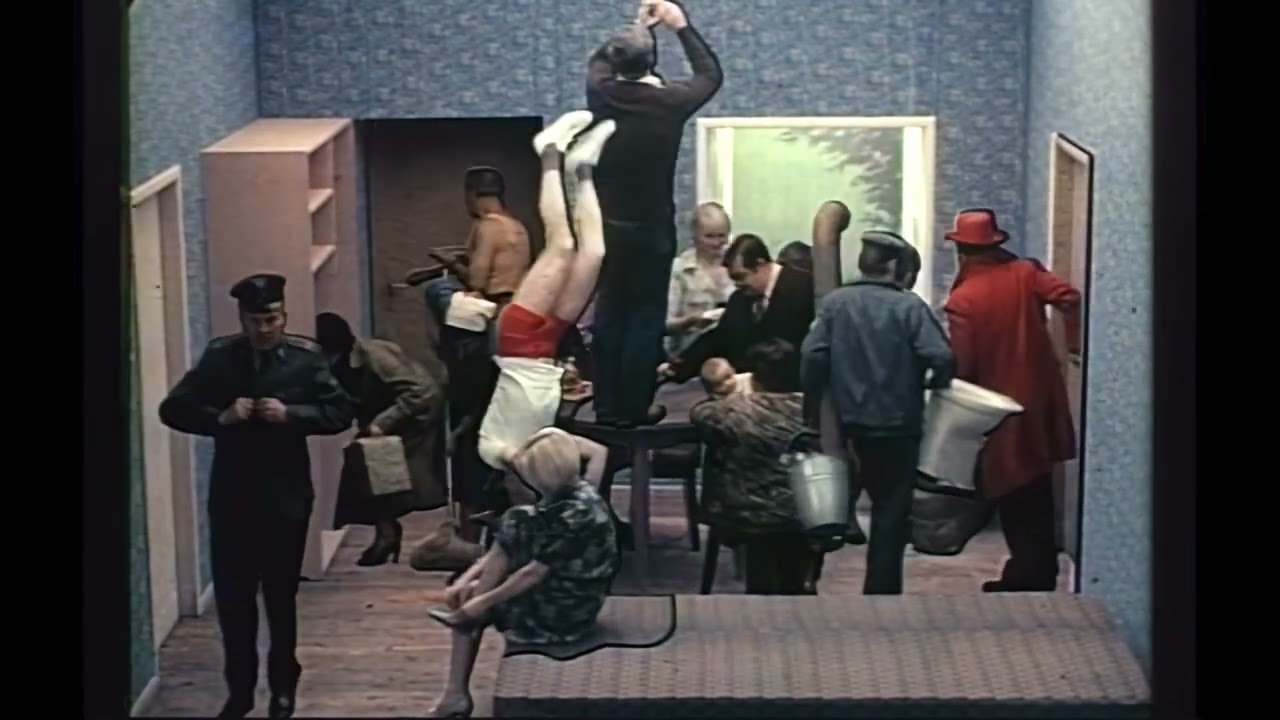
I’ve been looking for this for over 20 years. I saw it when I was a kid, maybe 8 or 9. All I had was a vague memory of it, I just remember it being the “life of a room”, stop-motion animation, and that there was music in the background.
AI helped me find it:
I’m trying to find something I saw as a child. The year was perhaps 1983 or slightly later. It was a student type film which depicted a room from a fixed angle. Many things happened in the room, on repeat, the scene becoming busier as it all progressed. I think the animation was stop motion. The whole scene was as if to tell the story of the “life” of the room, and everything it saw. There was music in the background, perhaps a cello, or similar instrument. Can you help find it?
The film you’re searching for is almost certainly “Tango” (1980) by Zbigniew Rybczyński. It matches your memory almost perfectly.
 Why “Tango” Fits Your Description
 Fixed Angle & Repetition: It uses a static camera focused on one room. Actions repeat in loops, with the scene becoming progressively busier as more characters are layered in .
 Animation Style: It’s a live-action animated short using a frame-by-frame, optical-printing technique that gives it a distinct, stop-motion-like feel .
 “Life” of the Room: It depicts the entire cycle of life within that room, from a baby to the elderly, with 36 characters going about disconnected rituals .
 Music: It is a film without dialogue but with a strong, rhythmic musical score, which could easily be remembered as a solo cello piece .
 Timing: It won the Oscar for Best Animated Short Film in 1982 (for films made in 1981), placing it right in your 1983 timeframe .
I hope this helps you rediscover that childhood memory. You can easily find “Tango” on video-sharing sites like YouTube to confirm if it’s the one.
And here it is: