So nothing is. It is being. So being is not a thing. Being is nothing. They are the same.
I think the aporia struggled with at this level is the uncertainty of whether (a) being is anything in particular or not.
That the particularity of any iteration of perspective is not sufficiently distinct for it to recognize itself clearly as a being.
In Zen Buddhism this conundrum is addressed by the phrase that one, and there, is neither being nor nonbeing. Thus neither something nor nothing.
The Greeks rather felt that they were both something and nothing: the tragic pathos.
For Nietzsche this means to embrace also the question of whether anyone is real, without falling for the temptation of answering the question, but rather to address the questioning directly, through actions, positing, etc, which gives the ‘objectivity’ indicated by the OP. Still an ultimate criterion of the hierarchy, whereby we may stack hierarchies in a greater, more objective hierarchy, remains elusive. A rebellious bird.
The degree to which one can live with this uncertainty is probably a question of the degree of power that ‘one is’.
With the aim of overcoming the tragic, but respecting its grounding aporia of both being and nonbeing, Parodites posits a heroic pathos, which he does not think properly exists yet but is the task of philosophy to cultivate, requiring, in his words, the development of a ‘daemonic’ ‘speculative ethics’.
Interesting, kind of, that feelings to you are facts whereas thoughts are interpretations. Sure explains a lot about you!
Of course, you know what I’m considering… Just as you knew what others missed in reading Nietzsche…
Courage and bravery… Wrong or awry…
Of course, it’s more likely that I’d need an emotional safe space and lack confidence or bravery… Because you’re the South-American macho, the real man, the brave and confident one here. Just check out his thread about Paula and other Latinas, people!
You do casually mention the subjective ground of this absolute truth but you don’t think this challenges its absoluteness. So it does not need to be true for anyone else, just absolutely true for you. Unfalsifiable.
Representations:
Feelings represent the animal self into being, and feed back directly.
Ideas represent the metaphysics of the World including these feeling selves or selfing feelings and don’t neccesarily feed back.
A speculative ethics would represent with the power of the intellect but feeding back. Ouroboric thinking. What it would represent is probably the will, which is doing the representing.
Contrast is never perfect though, nothing contrasts a counterpart precisely. Perfect contrast is not even conceivable as it instantly cancels out. So real contrast, indeed required for being, does actually not reduce to nothing, but to will, asymmetry, relativity, power, time.
The deepest contrasts within time exist between beings which are almost identical. Consider having a copy of yourself with you in the room.
Who was it again who said that thing about believing in grammar and believing in God? Maybe Pezer knows? Was it some Latina maybe?
Again, that does not follow.
Well, as you know, Zen, like Buddhism, comes from India (dhyana). And the “neither P nor not-P” position you cite here probably predates Buddhism. Now Nagarjuna, who was foundational to Mahayana, including Zen Buddhism, actually went a step further: “neither P, nor not-P, nor both, nor neither”. And of course we could keep going like that forever.
And indeed, when I speak of nothing(ness) or no-thingness, I usually mean this whole aporia itself. For example, that nothing is does not mean there is a “nothing” that is.
Does he really posit action, activity, agency, though, or only pathos, passivity, passion? Is his whole pathos of activity not just meant for his secondary audience, his “warriors”?
Probably? Maybe. But what quantum of power does one need to be in order not to hide behind the uncertainty, and confront one’s midlife crisis, one’s mortality, momentariness rather than, say, becoming completely psychotic?
All that is much more sensible to me, and simply comes down to becoming rather than being. All is fluid.
It doesn’t cover all the bases - e.g.how is the illusion of being possible? but its not untrue per se.
Does Nietzsche posit action? No, he acts: he posits that the world is will to power.
He teaches by example, like Sokrates and some other Greeks but no modern before him.
The arrow does not explain its trajectory.
Inflated self-worth: we are all ILPers. Only Dan isn’t inflated. Fausts favorite philosopher here. Faust was also not inflated. When he threatened to inflate, he left. A hero.
Do the basic facts of life bother you so much that you imagine they could make a person psychotic?
That explains something about how you’re handling philosophy.
Im not so good at sneers, Ill just say it outright: to have established that it is beyond ones reach to set goals does not undo an early on inflated self. Rather, setting some difficult to reach but pragmatically realistic goals and either failing or succeeding will do the trick. Knowing thyself. Nor does it level the accomplishments of philosophy or mankind to ones criteria. That is not how criteria impose themselves.
Yeah, I see what you did there. It cannot be falsified by multiple subjects (the scientific community, say), therefore it’s unscientific… But the existence of multiple subjects, or of a subject-atom as Nietzsche calls it, is precisely what’s under consideration. The philosopher must start from his own experience alone (including his experience of his reason, of course).
Exactly. But of something or of nothing? Or both? Or neither? Or?
That is an idea. Why are you presenting it here?
Says who, Schopenhauer? You know Nietzsche says the will is itself a representation, right? Or is that what you mean by “ouroboric thinking” (circular thinking)?
What I’ve been talking about is that both feelings and ideas/thoughts come and go, and what they come and go through is not some reified “nothing”, but they themselves, their coming and going, is itself nothing. Emptiness of emptiness, as Tsongkhapa called it. That is the “subject” I’ve referred to as “me” when speaking of plastic fantasies and my nihilist reality etc.
By the way, for Pezer, perhaps: analysing my feelings into what Jakob here calls “ideas” also enhances them… Something you may want to look into.
Methinks you’re using the word “contrast” wrong here. A contrast need not be a diametrical opposition (which seems to be what you mean). That is, to contrast with pitch darkness, something does not have to be utterly bright: for instance, on my OLED screen, a color need only be RGB 010000, 000100, or 000001 in order to visibly stand out against 000000; it need by no means be FFFFFF. But it’s still diametrically opposed to 000000 in that it’s absolutely not 000000.
If 000000 is to be good, there must be something other than it to contrast with it, otherwise it would be meaningless to call it good (or anything else for that matter). But this means that that other thing (which may be a plurality of other things) is also good, if only because it’s what makes the good (000000) good. But this works both ways. So both are equally relatively good…
Well, that’s interesting, since I’d recently been thinking that the castles in the sky I self-quoted above should perhaps be similar to ‘the lasting truth’, at least in (late) modern times…
I mean contrast broader than in terms of color, as did you.
The idea of cancelation doesn’t even apply at all in terms of color, they are additive. All colors combined produce white, not black. Nor do black and white cancel each other out.
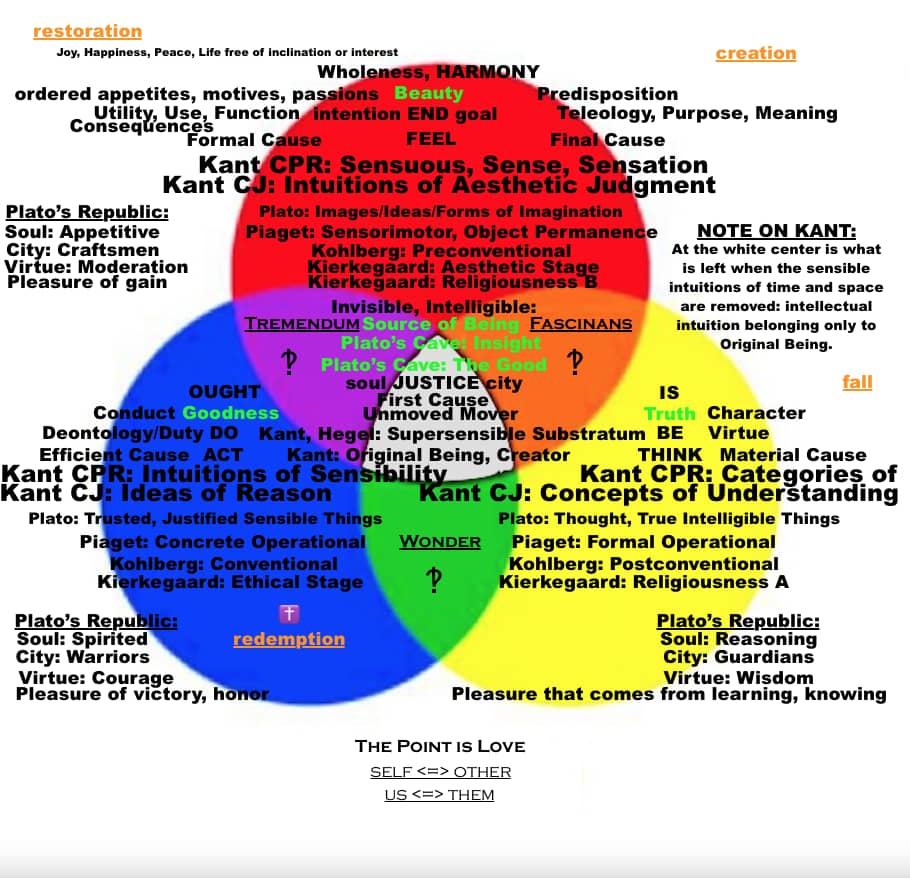
Red: Moderation
Blue: Courage
Yellow: let’s just call it Clarity
and just for clarity’s sake… Kant would not have anything “removed”… or he would not have said the thing he did about blind, empty yada yada yada. hope that clears things up.
To clarify: there are two Shoulds here. What Lampert is talking about in that quote is that, for the (late) modern “warriors”—philosophical labourers and science-humans—, and perhaps for (late) modern audiences more generally, the fleeting show must be similar to the lasting truth or they won’t be able to believe in it. But for the philosopher as I understand him now, it need only contrast with it, just so that he can better make it out…
Yes.
Yes, though ultimately it requires no base-covering, since the idea that there must be something making things possible or actual may itself be part of the illusion (and is self-referential anyway).
I would now begin, and this is along the lines of what Nietzsche suggested, I think, by proposing that there must be a contrast: some things must (seem to) come and go more quickly than others.
Well, that can be disputed. Did he act in any metaphysical sense, or did he just react, undergo, pass on? Is the will to power he posited, or which was posited through him, really an active force (as he says, e.g., in WP 673), or rather a pathos (as he says in WP 635)?
If Faust was not inflated, maybe he should have! I mean, Faust was ILP’s high-horse academic par excellence… I’m especially thinking of this:
And the whole Dan thing just seems like an example of the Christian reverence for the “poor in spirit” to me.
Sure, death is just one of the basic facts of life! How peculiar of me to think it might cause people to develop (mass) psychoses, eh Ichthus?
Who’s established that it’s beyond their reach to set goals? And why set oneself the goal to undo an early on inflated self (whether by setting oneself some other goals which are difficult to reach but pragmatically realistic, or by other means)? What would be the goal of setting oneself that goal, or any goal for that matter?..
Yes, that’s what I said, until I established for myself that Bacon was indeed a Machiavellian and should therefore be replaced by Machiavelli in that list.
So? The color thing was just an example. Pitch darkness is contrasted by red, green, blue, or any combination thereof. What’s cancelled out is if you attach a value to either P (e.g., pitch darkness) or not-P: again, if P is supposedly great, then what’s supposedly not so great is equally great after all, since P would not be supposed to be so great if not-P wasn’t supposed to be not so great…
By the way, if there was only FFFFFF, it would be 000000, since whether there’s nothing to see or you’re just not seeing it because you’re blinded, you’re not seeing it all the same (and it’s therefore not there for you, as far as the sense of sight is concerned).
You apparently missed what the mention of Bacon was in reference to;
Bacon is part of that experience. The philosopher can not fully experience itself, that is to say, philosophy can not fully experience himself, without Bacon.
Making that point by listing that Lampertian sequence was a courtesy. Descarte is missing unless you want to reduce him to Bacon is missin
Bacon represents the encounter with the external world.
Which is the terrain of what Nietzsche calls ‘encroaching units’; plurality as the ground to knowledge. We can’t then once we acquired knowledge of truth as empirical, dismiss the plurality on which it is founded because our first empirical certainty is a single perspective as established by Descartes, absent from the list.
And both incorrect and aside the point.
Not in relation to the point about im/perfect contrast.
.
Doubtful logic. In any case if there is only 000000, there is no FFFFFF, so this effect is particular to the FFFFFF, within your frame here.
Tell me about it.
/The empirical certainty at the basis of your position is established by Descartes, omitted from the list, Bacon gives the empirical certainty of method, which precedes experiential existence, perspective, as a categorical certainty. This ties into the point I made in the astrology thread about consciousness as requiring the appearance of consistent change. I wonder what Weary Locomotive would think. A lot of his posts on method don’t show up in the search.
….because doubt as a method to get out what is clear and immediately distinct is completely 100% the polar opposite of bracketing and epoche as (¿non?) method.
Jakob got closer to what I was saying, but also fell for a trap there (a trap not of my making, just not also of my helping avoid).
In order to detangle it, we would need to start talking about what objectivism is and we might as well all whip our dicks out and start stroking them.
Sawelios, look. You are dissatisfied with your life, your work, the women in it. If I had known you were not a philosophy teacher as I thought, I would not have leaned into you. I would not lean into a man I don’t feel feels in his strength, it’s barbaric.
I will say this, instead. You feel a lack of strength. This dissatisfaction. Is your philosophical stance incidental, or a consequence? I wrote courage and bravery, a Freudian slip because I meant confidence and bravery. If instead of Darwinistically analyzing your attraction and approach to women (which are feelings), what would become of a similar analysis of bravery, and daring? Of testing yourself, on purpose, in order to regain a sense of strength that you now lack? If it was good enough to pursue women, why not for this? If you are cynical enough to “exploit the Darwinian mechanism” for that, why not for this?
Would you dare argue that your feeling of weakness is not a problem? Would you have mentioned it if it wasn’t?
You think Bacon was part of, say, Parmenides’s experience?
?
I “reduced” Descartes to Bacon because I’d already seen Descartes was a Baconian. It does not mean Descartes wasn’t as great a philosopher as Bacon or Bacon as Machiavelli. It’s more like what Crowley says about the grade of Magus.
Okay, well, I did not know that! If that’s true, we should mention Bacon whenever we talk about encountering the external world, I suppose..
Apparently you’ve been interpreting what I said about experience, in terms of the Rationalists and Empiricists of early modern times (because I said that thing about the experience of reason?)… This seems quite confused to me. My Lampertian-Straussian list of Homer, Plato, Bacon, and Nietzsche was made to list the turning points in the history of political philosophy. It was never supposed to dismiss the philosophers who came before, between, or after them. That I put Nietzsche in there should tell you I don’t consider him a Baconian or Machiavellian (political) philosopher, however—though no Cartesian, either.
Now to be sure, the Nietzschean turn can be understood as a turn away from—the Baconian-Machiavellian—Descartes: from cogito, ergo sum to cogito, ergo est. This “it is”, however, need not be transcendent to the cogito, for the idea that a fiction requires an author may be part of the fiction. And this, in turn, means “God is dead”: both the single big God and the multiple little gods—the superstitious “souls” as subject-atoms.
This is not a modern idea, by the way. It can be found in Plato’s Parmenides, although that may well be his most difficult work. It’s illustrated there by the hand of Homer’s myth of Ocean, by the way.
You mean your point about im/perfect contrast? But you first introduced the concept “perfect contrast”!
Look, maybe this will be helpful. I’m not saying contrasting things cancel each other out. I’m saying the lack of contrast cancels out both sides of the contrast… If you take away all things that aren’t pitch dark, even a thing that was pitch dark isn’t at all dark anymore…
No, it works both ways. If there’s only 000000, there’s not even the 000000 from before, since it’s no longer dark as opposed to, or distinct from, light.
A lot of the older posts in general don’t show up in the search.
The rigour of your reduction is interesting, but too rigid, I think (hence ‘reduction’); see above. Yet I will address it on those terms:
The method given by Bacon and taken up by Descartes does not precede the experience at the basis of my position. It’s just that that experience is sustained by that method. It’s not consciousness as such that requires the appearance of consistent change, but the consistency or subsistence of consciousness. Consciousness itself, after all, is simply the appearance of change, and not necessarily of consistent change—unless a certain minimum of consistency is essential to any change…
Well, I think this is just more gaslighting or projecting on your part. (Again, just check out, e.g., his Latina thread, people…) But sure, I will address it. That’s how insecure and/or lacking bravery I am..
Having spent most of my life wrapped up, at least in great part, in illusions—like most people—, seeing through those (even) significantly more fully and then consistently has been a disillusionment, yes: for those illusions very much included agreeable illusions, not (nearly fully) seen yet in their necessary contrast with disagreeable things.. So yeah, when you’re used to positivity, neutrality is experienced as negativity.
What you seem not to get is that it’s not (just) dissatisfaction, but an awakening to dissatisfactoriness (dukkha)—the logical impossibility of anything satisfactory, whether it be a life, work, women, or anything else.
Why couldn’t it be a cause?
You seem to assume that I haven’t tried that, as well as that I haven’t seen that any (further) such attempts would be futile.
Well, maybe I’m not really understanding you. What might that look like? Can you sketch it in words?
And are you assuming I haven’t analysed my feelings of bravery, daring, courage, etc.? But feelings may be facts in the sense of “the fact of the feeling of P”, but not in the sense of “the fact of P”..
What do you think I meant by pumping myself up with goa trance or extreme metal so I could go get groceries?
It may feel like a problem, but that does not make it a problem.
Yet there you are, chasing women. Chasing women, and complaining that they always find something to be disgusted at. Why the complaint?
Because you are not a person who, at the height of his confidence and power, suddenly had a realization and cast it away in favour of dreary defeatism.
You give up easily on this, which seems to trouble you, but somehow find a reason to keep trying with the girls, don’t it?
Why don’t you? You had a comprehensive Darwinian analysis of the relationship of man and woman all locked and loaded and ready to go.
I thought Darwin offered a comprehensive account of the human experience. So let’s have it.
Then stop bitching about it. You see what I mean?
It’s a very selective pursuit of feelings (all human action is accompanied by feeling, including endless exchanges written as if it had been Fitzgerald, and not Hemingway, that won that fight).
If this is your idea of testing your limits, your strength, your worth, then no wonder it has produced nothing my friend. Do you see where I’m heading?
 Just check out his thread about Paula and other Latinas, people!

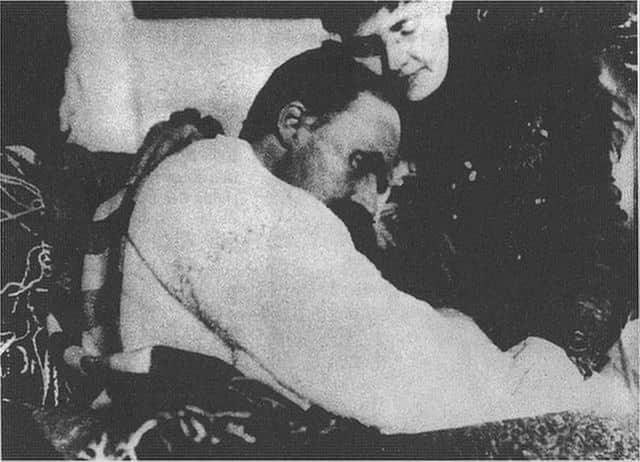
 How peculiar of me to think it might cause people to develop (mass) psychoses, eh Ichthus?