4 theories of beauty; 3 bullshit, 1 truth

This is a thread about physical beauty, specifically about the beauty of human faces–attractive females and good looking males. In my life, I’ve heard 3 theories that seem, on their face (get it? “face”?) flat out wrong, and I’m surprised anyone would take them seriously. Because it would only take a second’s worth of thought to realize how flawed they are. But I have a fourth theory that explains beauty beautifully (<-- see what I did there?).

Theory #1: symmetry

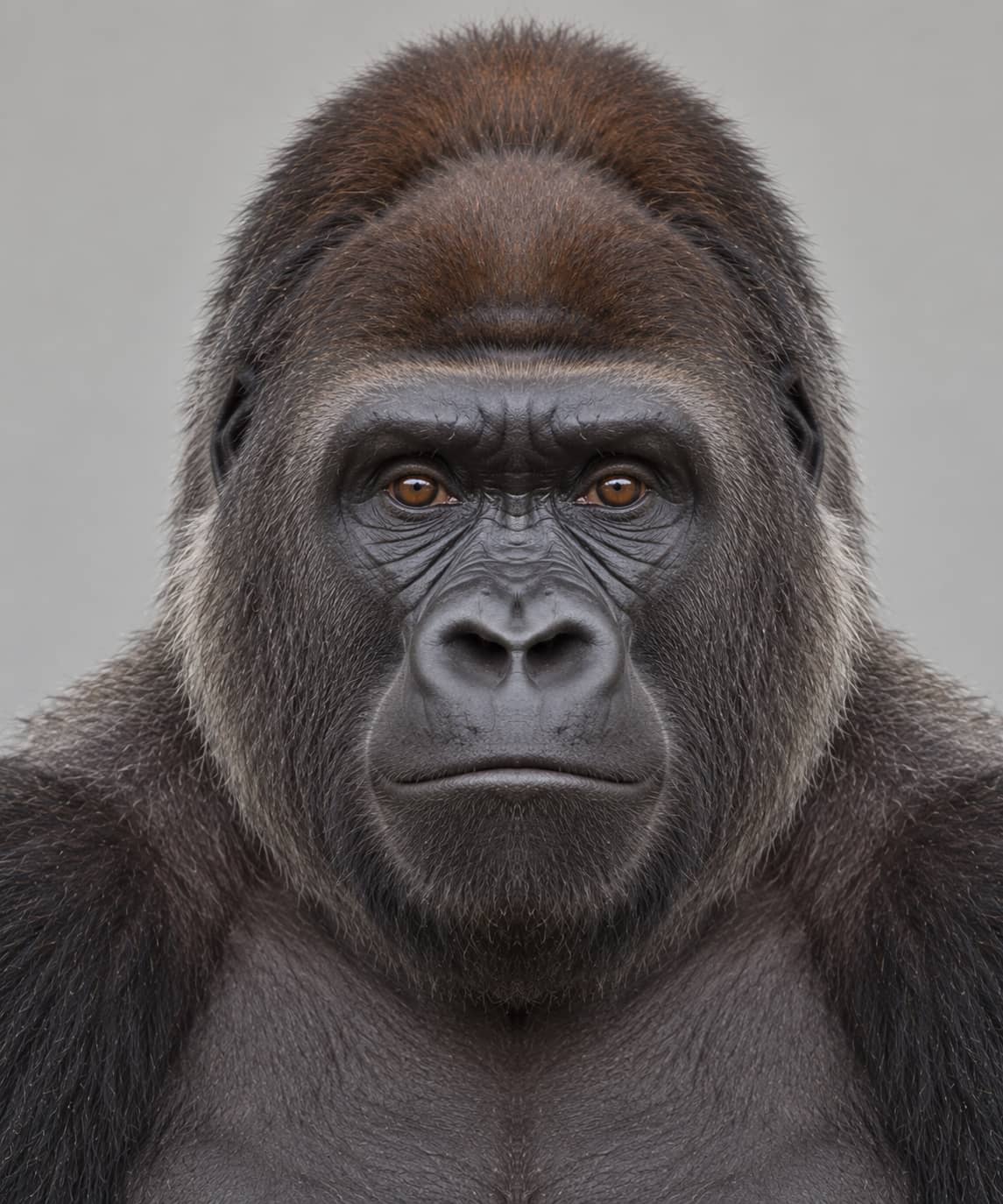
This is the theory that says beauty is the result of a face being perfectly symmetrical. Well, here’s some symmetrical faces:

'Nuf said.

Theory #2: the golden ratio

Now, there is some truth to this theory–beautiful faces may in fact adhere to the golden ratio–but not because they adhere to the golden ratio. My theory will explain what the connection is.

But what is the golden ratio theory? I’ll let John Cleese explain it:

John Cleese not only does a bang up job demonstrating the golden ratio theory but also mocks it, showing why it ought to be ridiculed and tossed away. Our brains aren’t doing a mathematical calculation to determine whether a face is beautiful or not, for if they were, it would need something like a mental protractor or ruler.

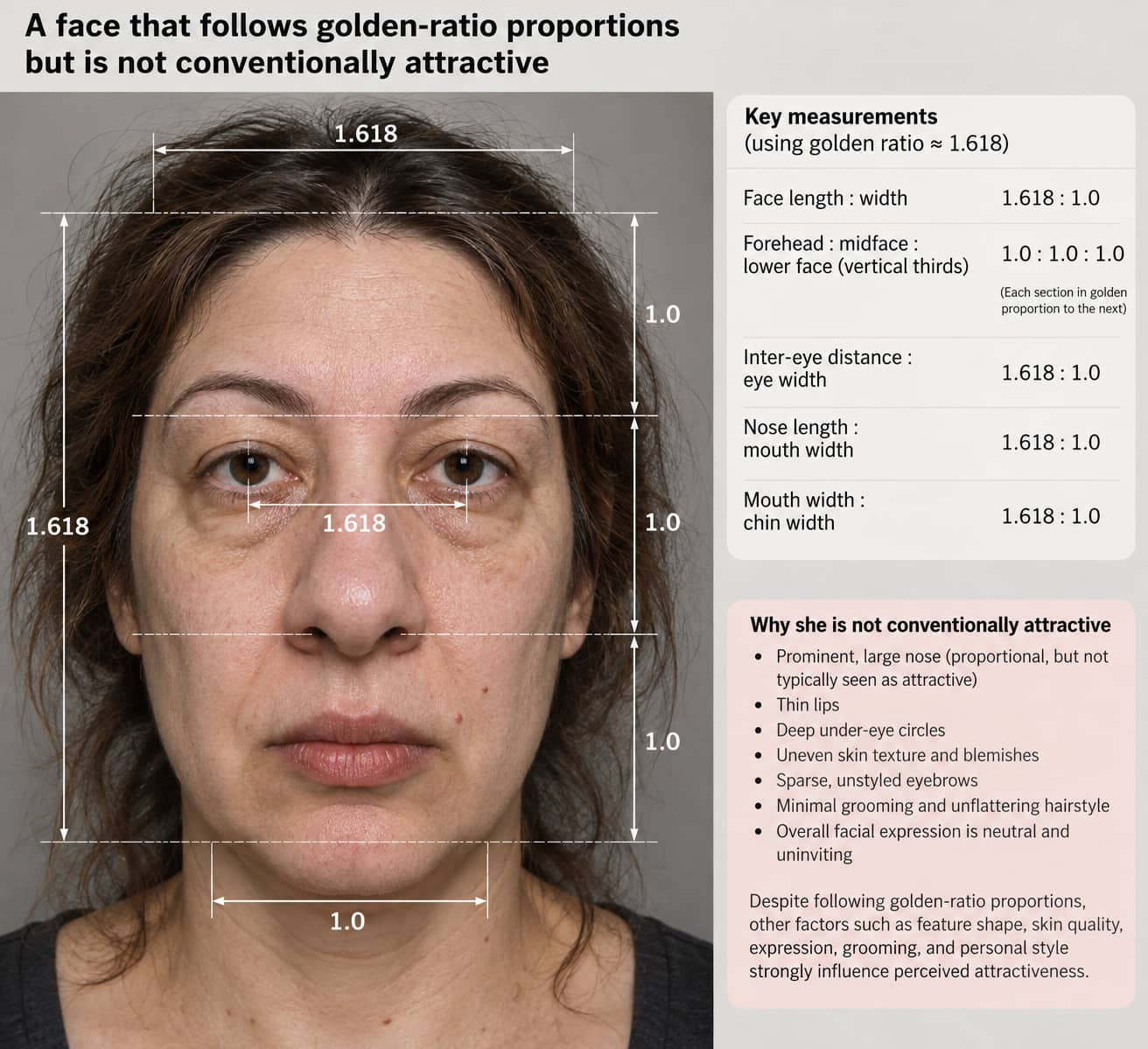
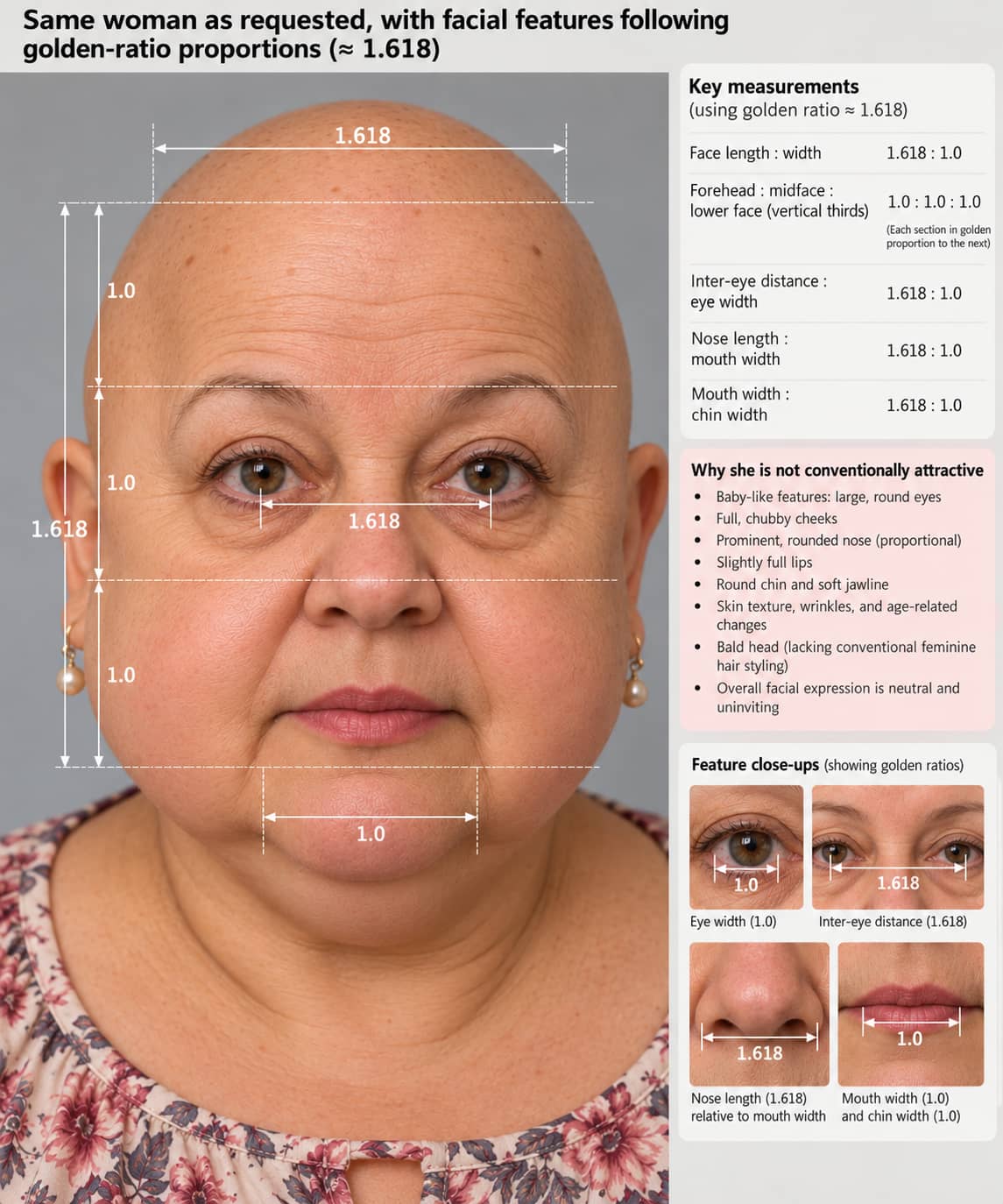
But don’t take Cleese’s word for it. ChatGPT can generate an image of an ugly woman whose face meets all the proportions demanded of the golden ratio theory:

^ Attracted? Didn’t think so.

Theory #3: baby face

This theory applies to women. It says that men find attractive those women whose faces share certain features in common with babies–examples: round face, button nose, smooth skin, slightly chubby cheeks, etc..

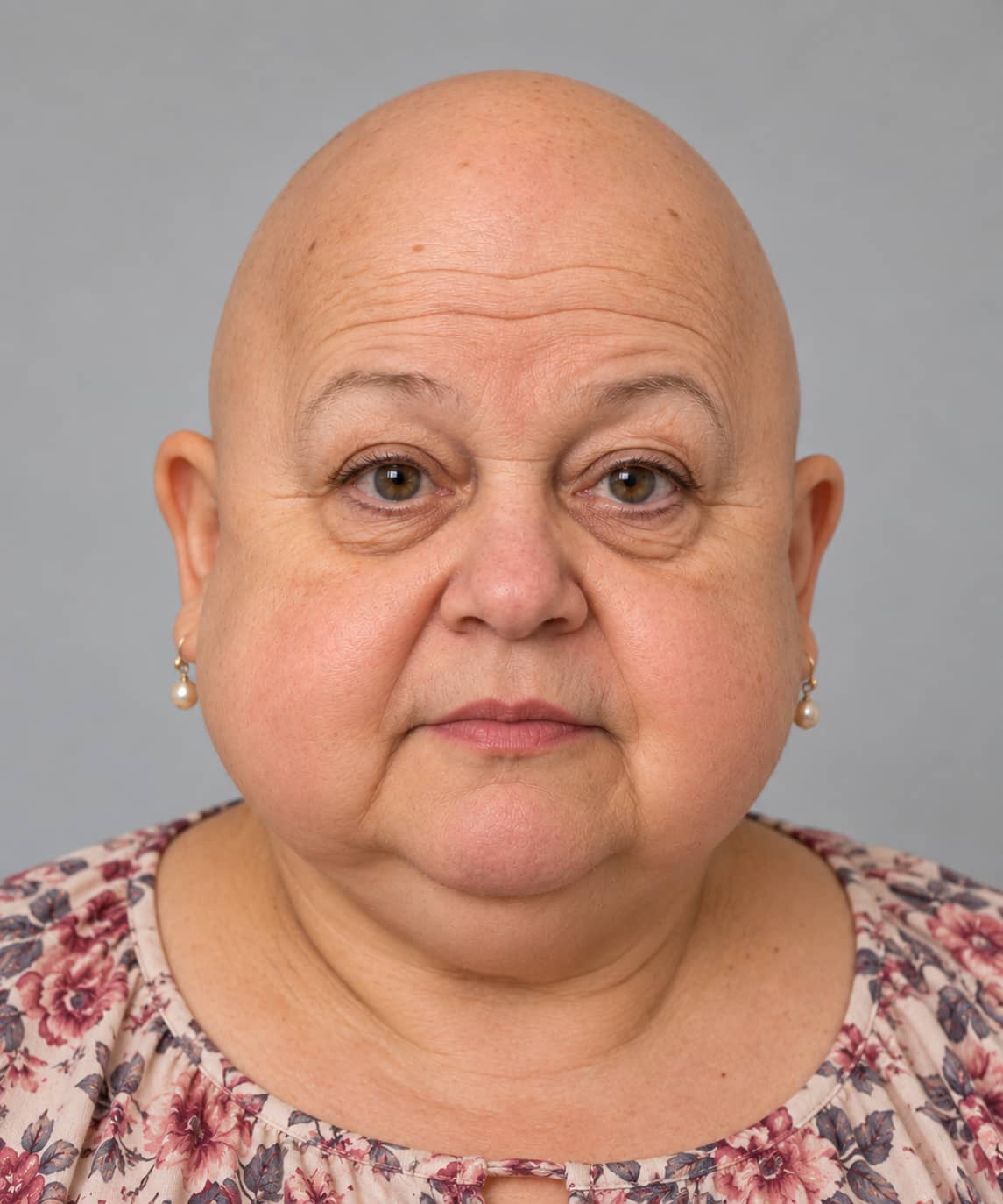
The issue I have with this theory is that the closest looking people to babies are older fat men who are bald:

^ Just look at that sexy specimen. Even women who approximate such a look debunk this theory in a heart beat:

This theory also sounds like it was concocted by angry feminists who resent men. It is meant to demean men by painting them as predators who like young women (a little too young) for their innocence, child-like impotence, and dependence on a male authority.

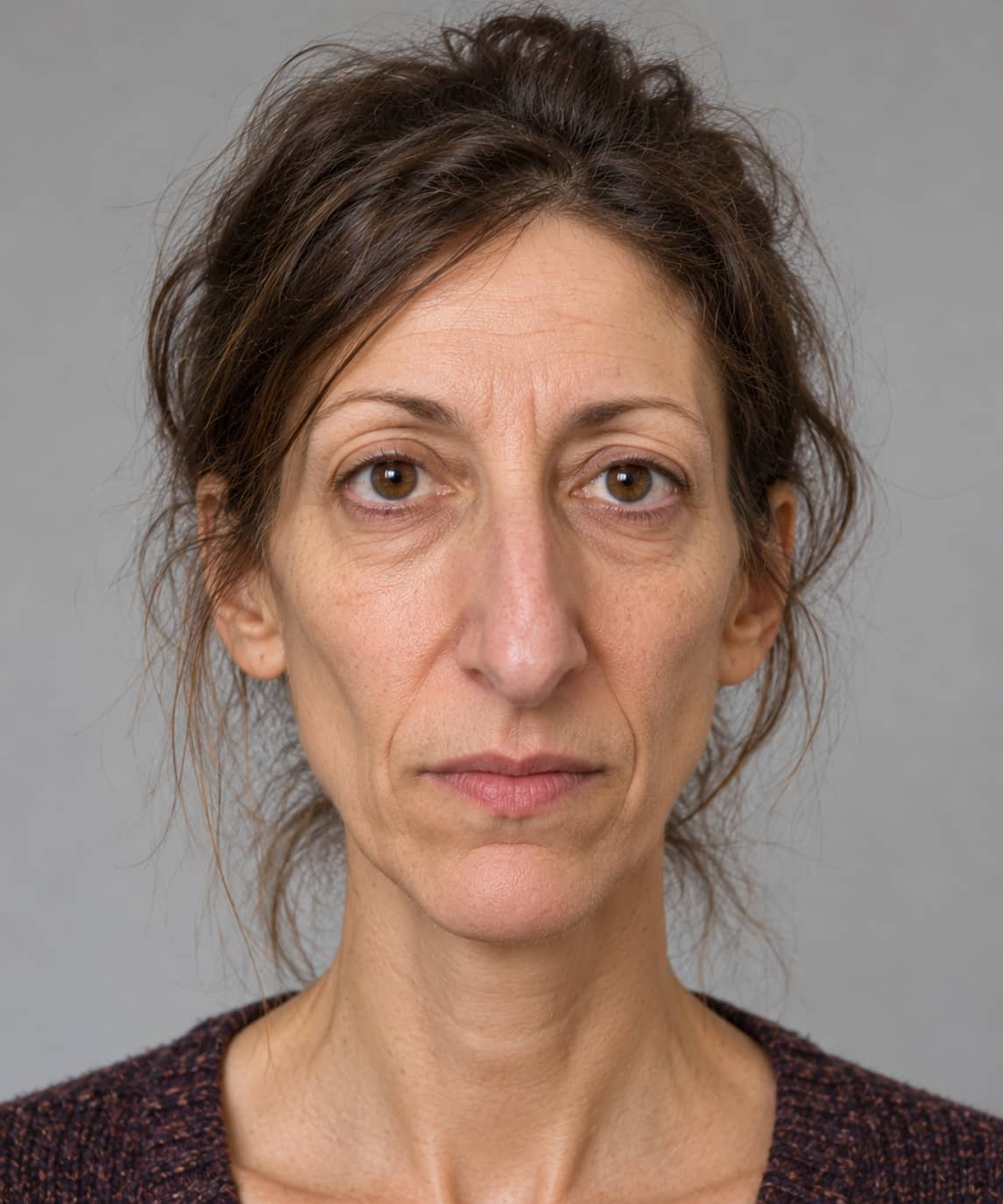
On the other hand, skinny faced adult looking woman with big noses and wrinkly skin aren’t that much more attractive:

Women with the so-called “baby face” lie somewhere between these two extremes, which brings me to theory #4.

Theory #4 (mine): the average

Given that we are creatures of evolution, how does the brain learn to recognize beauty? It must learn to identify people who look most like human beings, for in no other way could it recognize fit genes (i.e. genes representative of what most human beings look like and have looked like in order to have survived up to now). In other words, the average. It is the face that least deviates from the norm. Everything else is seen as aberrant or “off”–as not quite right. This would account not only for people who grew up or are surrounded by different races with different facial features, but how it works in the animal kingdom generally. Otherwise, every new species would need not only a mutation in their genes to make them the species they are, but an accompanying mutation in the gene for recognizing beauty, and it would have to, just by sheer coincidence, match what the average member of that species looks like.

My theory accounts for all other theories as well. The average looking human is obviously going to have a symmetrical face, but that doesn’t mean it works the other way around (a symmetrical face correlating with the average). The average human probably matches the golden ratio because, well, that’s most likely the ratio of the average person. And the average human (or average female) is going to have a somewhat baby face because, as pointed out above, those baby features stand in the middle between too skinny and adult looking and too fat, bald, and exactly baby looking. They are called “baby features” only in relation to the skinny adult look–that is, of course they look like baby features if you move from the anti-baby looking extreme towards actual babies, but as I showed above, moving to the opposite extreme where they literally look like babies makes them look like old bald fat men or women. Right there at the golden mean–i.e. the average–is where you find the pinnacle of beauty.

1 Like

Very unflattering AI-generated 'photos, of people-who-aren’t-people with no makeup, unkempt hair, unsmiling ‘mugshot’ facial expression. It’s very hard to tell ‘what’ fat people really look like because the fat distorts everything. When people lose weight they look like a different person. That skinny woman definitely has a beauty about her that you could imagine in the real world.

Not everyone is a shallow American with a barbie doll fetish. You only have to see what women over there do to their faces and then actually imagine that they look amazing :laughing: Men aren’t exempt either.

You people are nuts. Imagine how uncomfortable it must feel.

Any evidence for that? It was actually a man who came up with that idea. So there goes yet another ‘let’s blame everything on women’ MrA-style ‘argument’.

Never seen a baby with sagging jowls, eye-bags, wrinkles, male pattern baldness… A nappy on a baby is cute. Not so much on an adult :roll_eyes:

MistressOphelia wrote:

Very unflattering AI-generated 'photos, of people-who-aren’t-people with no makeup, unkempt hair, unsmiling ‘mugshot’ facial expression. ← I’m sorry you feel that way. → It’s very hard to tell ‘what’ fat people really look like because the fat distorts everything. When people lose weight they look like a different person. That skinny woman definitely has a beauty about her that you could imagine in the real world.

← What, like some inner metaphysical beauty? You did read the part about how this thread is about physical facial beauty, right? →

Not everyone is a shallow American with a barbie doll fetish. ← Right, some of us are Canadian. → You only have to see what women over there do to their faces and then actually imagine that they look amazing :laughing: Men aren’t exempt either.

That’s right. These theories of beauty are a-sexual.

MistressOphelia wrote:

You people are nuts. Imagine how uncomfortable it must feel.

Welcome to ILP!

MistressOphelia wrote:

Any evidence for that? ← Nope, just an opinion. → It was actually a man who came up with that idea. ← Men can be feminists. → So there goes yet another ‘let’s blame everything on women’ MrA-style ‘argument’.

← So wait… because it’s a man’s theory, it’s true? How flattering! →

Never seen a baby with sagging jowls, eye-bags, wrinkles, male pattern baldness… A nappy on a baby is cute. Not so much on an adult :roll_eyes:

Agreed wholeheartedly. Still, those old balding baby-looking men look a lot more like babies than most pretty girls.

Can you read? Did I say whether it’s ‘true’ or not? All I did was point out that it was a man who came up with it.

Same thing.

The problem I have with this is that the faces express no personality, and it is personality that makes even the person who is not “conventionally” pretty/handsome attractive, even if not in a sexual way. It is how a person shows their composure or comedic talent, their compassion or angry support of someone, their sereneness or their endless energy that makes people more than just a face that doesn’t fit the standardised idea of beauty.

I have known many people who I wouldn’t date but who were incredibly lovely people and had many friends because of that. On the other hand, I have known people who had faces that could open doors, but were such assholes that nobody wanted anything to do with them.

Let me be clear:

There’s absolutely nothing wrong with being attracted to a person for their inner beauty. I’m not denying that’s a thing. But I will repeat–because people seem to be missing it–this thread is strictly address physical/facial beauty. You know, the kind of thing that impresses you when you first look at a person. Sure, once you get to know the person, that attraction (or lack thereof) might change, and the inner beauty of their personality (or lack thereof) may end up eclipsing their outer beauty (or lack thereof). But that’s not what I’m talking about. I’m comparing and contrasting theories about physical beauty of people’s faces. Not to say participants in this thread can take it in their own direction–by all means, be my guest–but don’t misread me. I’m not denying that personality, intelligence, and other inner traits can’t have their own kind of beauty.

So there! :pouting_cat:

I was aware of that and if you want a reply to that specifically, based on what I have said, you can see I think it is bullshit too.

Bob wrote:

I was aware of that and if you want a reply to that specifically ← I do. :smiley: → , based on what I have said, you can see I think it is bullshit too.

Yeah, that was the general gist I got from your post.

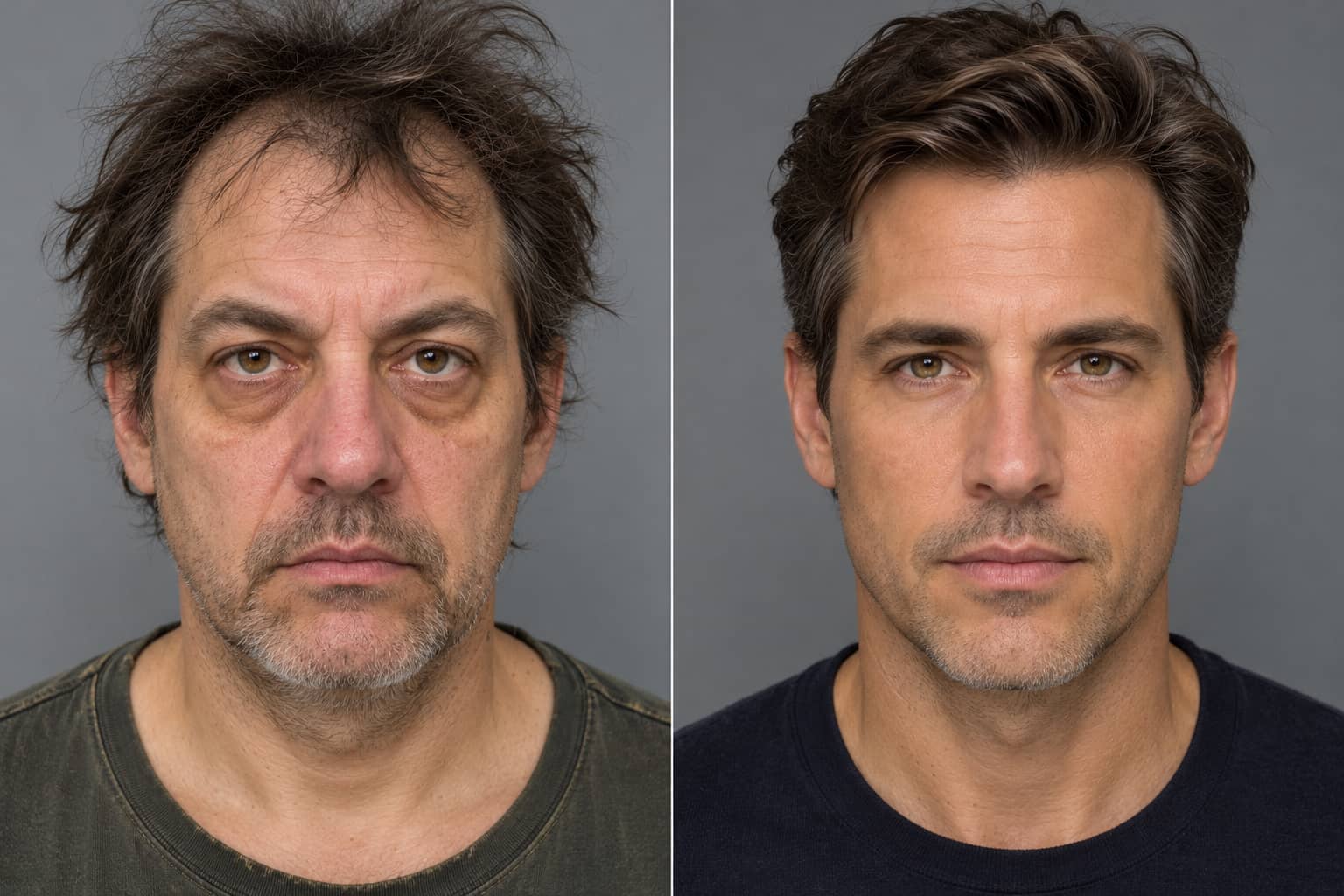
But are you honestly telling me that if I show you these two pictures:

…you wouldn’t be able to say which one is more attractive to you because you don’t know their personalities?

You are really asking me with which one I would like to mate. I am 71, when I was in the dating pool, the face on the right was rare, and if I met someone like that, they were already whisked away to some modelling job or something similar. The face on the left was far more common, although not as dishevelled as the face is made to be. Both will have “bad hair days” but if the one on the left was looking for a partner, she wouldn’t go out looking like that and she would rely on more than her physical appearance.

I don’t think anyone has symmetry alone as the source of beauty. Presenting someone who looks very unhealthy who has a symmetrical is not countering a specific theory out there, but it does show the problem of single aspect definitions. That such a theory might be around online is certainly possible, but people with actual theories have multiaspect ideas. The woman looks tired, depressed, possibly malnourished, perhaps having undergone stress for a long time. We can have symmetrical gangrene or rashes or burns covering our face and we could have an even more strawmanny example. At least within science symmetry is a sign of developmental health while moving from infancy. All sorts of stuff can happen after that that do not disrupt the underlying symmetry, but leave the person unnattractive, since the health or seeming health in the face is a big factor in attraction. I do think the gorilla is beautiful, but it’s not the beauty that turns me on or stirs romance. I don’t want to have sex with a beautiful sunset or a leaf either.

This arose out of a marketing campaign made by a plastic surgeon. And he marketed a bunch of products based on this. When scientists actually tested his idea, they found all sorts of problems with it. But even Marquardt himself never said it was the only factor in making beauty.

Strange: that woman does not have thin lips.

Good nutrition and a life she enjoyed, perhaps more friends and brushing her hair and that picture would change radically. Yeah, she has big nose.

Here we have a real scientific theory but your argument is making a logical error. That a healthy, adult face that leans in the direction of neotony, that is something, to a small degree in the direct of neotony is more attractive to men is actually true. This doesn’t mean that men will be more attracted the further you go in that direction.

Let’s say it’s true for a moment that women like assertive men more then men who can’t be. This doesn’t mean they will be most attracted to psychopaths.

Nor to men find babies more romantically and sexually attractive (not as a rule, thank God) than women.

The woman in your strawman image not only suffers for health issues, but the neoteny theory includes includes baby skin and a tendency towards those characteristics as well. And if you think the scientists in that study were unaware of how healthy hair is attractive to me, you’d be wrong. Every single theory includes signs of health, even the marketing products theory by the plastic surgeon.

But the main problem is assuming theories based on the positive affects of tendencies in a direction can be logically countered by taking extreme levels as demonstrating the theory is false.

Water: Absolutely required for human life and health, but drinking an extreme excess in a short timeframe leads to water intoxication (hyponatremia), brain swelling, and death.

Exercise: Essential for building a strong heart and healthy body, but taking exertion to a non-stop extreme causes rhabdomyolysis, muscle tissue breakdown, and acute kidney failure.

Oxygen: Mandatory for cellular survival, but breathing hyper-extreme, high-pressure doses of pure oxygen triggers oxygen toxicity, lung damage, and violent seizures.

You can’t debunk nuanced theories - even the surgeons is more nuanced - with extreme versions. And since they are going to focus on the factor they are interested in, it doesn’t mean they actually believe there is only one factor. People online however may think one trick ponies are the greatest ponies and have no interest in nuance.

I’m not suggesting plagiarism, but this is one of the most studied and oldest theories in science.
In 1878, Sir Francis Galton first noticed that combining multiple faces into a single composite photograph yielded a face that was more attractive than any individual component. In 1990, psychologists Judith Langlois and Lori Roggman published their famous paper, “Attractive Faces Are Average” (Psychological Science).

The main problem with this theory is that it has been debunked in David Perrett’s 1994 Nature study. Pure population averages create an “okay” face (a 7/10) he found, but peak attractiveness requires exaggerating features away from the average toward high hormonal health (supernormal stimuli). So, deviations from the norm lead to more attractiveness…but before we get another reduction ad absurdum argument, not all deviations from the average or norm. And not the most extreme deviations from the norm. First off, looking healthy with young skin is almost universally attractive to men especially, but women also. In other words, neoteny tendencies but not extremes, especially regarding the health of the skin, add to the baseline. Symmetry does also, and evolutionary biologists think this signals healthy development, but again a tendency outside the average, not mathematical perfection in symmetry and not alone. And sexual dimorophism - that it is less easy to mistake you for the opposite sex.

But of course humans with their more highly plastic brains can form all sorts of tastes.

Bob wrote:

You are really asking me with which one I would like to mate. ← Yes. → I am 71, when I was in the dating pool, the face on the right was rare, and if I met someone like that, they were already whisked away to some modelling job or something similar. The face on the left was far more common, although not as dishevelled as the face is made to be. Both will have “bad hair days” but if the one on the left was looking for a partner, she wouldn’t go out looking like that and she would rely on more than her physical appearance.

So… it’s not that you find one more attractive than the other, it’s that the one on the right was more rare (in your dating days). How do you know she was more rare? How do you identify the type of person who is more rare? What quality does she possess, what quality from the image alone, that tells you “she’s one of those rare ones”?

greenfuse wrote:

I don’t think anyone has symmetry alone as the source of beauty. Presenting someone who looks very unhealthy who has a symmetrical is not countering a specific theory out there, but it does show the problem of single aspect definitions. That such a theory might be around online is certainly possible, but people with actual theories have multiaspect ideas. The woman looks tired, depressed, possibly malnourished, perhaps having undergone stress for a long time. We can have symmetrical gangrene or rashes or burns covering our face and we could have an even more strawmanny example. At least within science symmetry is a sign of developmental health while moving from infancy. All sorts of stuff can happen after that that do not disrupt the underlying symmetry, but leave the person unnattractive, since the health or seeming health in the face is a big factor in attraction. I do think the gorilla is beautiful, but it’s not the beauty that turns me on or stirs romance. I don’t want to have sex with a beautiful sunset or a leaf either.

Well, I could combine all 3 theories into one image:

^ Still not quite attractive for my liking. But maybe we need more theories. You seem to be offering an alternative: health. But she seems to be in tip top shape in regards to her health.

Maybe the correct approach is to keep certain theories but drop others.

greenfuse wrote:

This arose out of a marketing campaign made by a plastic surgeon. ← Genius! → And he marketed a bunch of products based on this. When scientists actually tested his idea, they found all sorts of problems with it. But even Marquardt himself never said it was the only factor in making beauty.

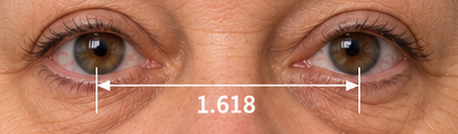
I’ll bet it has problems with it. Off the top of my head, it seems like the margin of error can be generous enough to include all kinds of body parts to use as anchor points. For example, take the eyes from the image about:

According to ChatGPT, the ratio of the width of each eye to the distance between the pupils of the eyes (the outer edges to be accurate) is 1:1.618, exactly the golden ratio. But that’s pretty precise. Are we saying that if the ratio was just a tiny bit off, the person would go from beautiful to ugly? Surely, there must be some acceptable margin of error. Ok, let’s give it a margin of error of around 0.1. So as long as the ratio falls within the range of 1:1.5 to 1:1.7 (with a bit of rounding), the person is beautiful. But now that range includes the center of the pupils, maybe even the inner edges. So it includes more anchor points on the body with which to mark the end points of the measurements. Allow for an even greater margin of error, and it might include the edges of the iris. Even greater, and it might include the edges of the eyes themselves. So the larger the margin of error, the more choices you have of what to measure. And the more choices you have of what to measure, the more likely it will be that there’s going to be something on the body to anchor your measurements to.

greenfuse wrote:

Strange: that woman does not have thin lips.

You noticed that too, huh?

greenfuse wrote:

Here we have a real scientific theory but your argument is making a logical error. That a healthy, adult face that leans in the direction of neotony, that is something, to a small degree in the direct of neotony is more attractive to men is actually true. This doesn’t mean that men will be more attracted the further you go in that direction.

My argument is a little more subtle than that. I’m arguing that what they are calling neotonic features might just be the average look for a woman. You would call it neotonic ONLY in relation to women on the opposite extreme, women with thin bony features, with a big nose, with big teeth, etc.. The images I posted of the old bald fat man and woman weren’t meant to show that neotonic features aren’t attractive but that where on the spectrum they become attractive is somewhere in the middle, and that in turn brings into question whether we should think of them as neotonic features at all and more as just the features of the average woman.

One good counterargument, if you’re making it, is that the most attractive women actually do fall on the more baby-ish side of the spectrum even relative to the average, even though, as you said, it’s limited by the extremes. Is that the argument you’re making?

greenfuse wrote:

Nor to men find babies more romantically and sexually attractive (not as a rule, thank God) than women.

Yes, and this is an important point. There’s a difference between sexual attraction and cuteness.

greenfuse wrote:

The woman in your strawman image not only suffers for health issues, but the neoteny theory includes includes baby skin and a tendency towards those characteristics as well. And if you think the scientists in that study were unaware of how healthy hair is attractive to me, you’d be wrong. Every single theory includes signs of health, even the marketing products theory by the plastic surgeon.

This doesn’t debunk anything I’ve said, it just adds another theory: health.

And surely, you’re not saying that if someone is ugly, they’re unhealthy. Surely, there can be people who are unhealthy looking but are, in actuality, in peek health.

greenfuse wrote:

But the main problem is assuming theories based on the positive affects of tendencies in a direction can be logically countered by taking extreme levels as demonstrating the theory is false.

Water: Absolutely required for human life and health, but drinking an extreme excess in a short timeframe leads to water intoxication (hyponatremia), brain swelling, and death.

← Yes →

Exercise: Essential for building a strong heart and healthy body, but taking exertion to a non-stop extreme causes rhabdomyolysis, muscle tissue breakdown, and acute kidney failure.

← Right →

Oxygen: Mandatory for cellular survival, but breathing hyper-extreme, high-pressure doses of pure oxygen triggers oxygen toxicity, lung damage, and violent seizures.

Ok, I get the point!

greenfuse wrote:

You can’t debunk nuanced theories - even the surgeons is more nuanced - with extreme versions. And since they are going to focus on the factor they are interested in, it doesn’t mean they actually believe there is only one factor. People online however may think one trick ponies are the greatest ponies and have no interest in nuance.

Fair enough, but sometimes theories are just wrong. You yourself said the golden ratio theory has been debunked. So even if a theory of beauty is multifaceted, it does follow that we should include [i]all[i] theories of beauty into our considerations.

greenfuse wrote:

I’m not suggesting plagiarism, but this is one of the most studied and oldest theories in science.
In 1878, Sir Francis Galton first noticed that combining multiple faces into a single composite photograph yielded a face that was more attractive than any individual component. In 1990, psychologists Judith Langlois and Lori Roggman published their famous paper, “Attractive Faces Are Average” (Psychological Science).
← Well, look at that! Great minds do think alike. →

The main problem with this theory is that it has been debunked in David Perrett’s 1994 Nature study. ← That explains why I’ve never heard of it. → Pure population averages create an “okay” face (a 7/10) he found, but peak attractiveness requires exaggerating features away from the average toward high hormonal health (supernormal stimuli). ← That could explain makeup. → So, deviations from the norm lead to more attractiveness…but before we get another reduction ad absurdum argument, not all deviations from the average or norm. ← Don’t get your panties all in a knot, greenfuse; I get it. Deviations in a very particular direction. → And not the most extreme deviations from the norm. First off, looking healthy with young skin is almost universally attractive to men especially, but women also. In other words, neoteny tendencies but not extremes, especially regarding the health of the skin, add to the baseline. Symmetry does also, and evolutionary biologists think this signals healthy development, but again a tendency outside the average, not mathematical perfection in symmetry and not alone. And sexual dimorophism - that it is less easy to mistake you for the opposite sex.

So you’ve introduced a fourth theory of beauty: healthy features are more attractive. I won’t attempt to debunk this one as I think it could actually be true. From an evolutionary perspective, it makes a lot of sense (a lot of sense). The mistake I made with my “average” theory was to assume that the species is trying to preserve itself–that may be true for some species, and it may be true of some aspects of certain species–but there’s also the tendencies for a species to want to enhance itself–make itself better–and in that case, it must aim for something better than the average.

But how can we determine what’s better than the average unless we know what the average is. So the brain, in learning how to detect beauty, must first learn what the average is, and then it can deviate from there in the direction of health. ← There’s a multifaceted theory for you.

And I already pointed out in my OP that the 3 theories I debunked (or attempted to debunk), are not actually causes of beauty but symptoms. The cause, I said, was detecting the average, and the average is going to be symmetrical (obviously), baby-faced (if baby-face is just the average between the two extremes), and meet the golden ratio (because, if that theory is even true, the average human face happens to proportion itself according to the golden ratio). They are not wrong in the sense that beautiful faces aren’t symmetrical, baby-faced, or approximate the golden ratio, but that these things don’t cause beauty, they are merely symptoms of it.

Now, your theory–that health signs are a stimulant for detecting beauty–fits perfectly with my theory of the average. Human beings, as they grow up, learn to recognize average faces within their community, and using that as a starting point, look for deviations towards health. ← Both function as causes in this case, and so neither of them need to be debunked.

TOO EVERYONE:

The disheveled hair thing keeps coming up. I didn’t include that in the images above on purpose. ChatGPT did that all on its own because it knew that if it was going to draw an image of an ugly woman, morning hair was a must, as well as some minor sickly features. I didn’t ask for it. But it shouldn’t matter. If any one theory accounted for beauty, the look of her hair isn’t a factor. You can have perfectly symmetrical messy hair. Your facial features can match the golden ratio regardless of the state of your hair. And the baby-face theory seems to disregard hair all together for obvious reasons (babies aren’t born with hair). Even if you combine all three, hair shouldn’t matter. Greenfuse’s theory of health is obviously an exception to this, but it’s not like healthy looking groomed hair makes all the difference. Look:

^ Prettier, but not pretty.

You have no imagination. You can’t picture that women animated, smiling, being hilarious? There are a lot of things that make a person attractive. You must be an incel who’s never had any meaningful interactions with women.

Well, no. Within the range of norms or what you’re calling averageness (though alone it’s just ok + symmetry (which indicates developmental health) + some degree of neoteny + sexual dimorophism. Yes, those monotheories were a problem, but because they are monotheries, just as averageness is a monotheory. No professional theories had just one factor.

Symptoms of beauty - the people were beautiful and a side effect of that was they were symmetrical in the face?

That’s just a factor, a part of what leads to beauty.

and also towards sexual dimorphism and neoteny.

And averageness is an effect of health. You have not been distorted by genetic problems or disease. Yet to get to attractiveness you have to deviate. Neoteny is both an outcome of healthy, but also luck. You got genes that made the structure of you face a bit on the child end. And men have been attracted to that. I suppose it might signal more youth than is present, which implies health, but the structure of the face in that way does not indicate health. Baby skin on the other hand does to some degree.

Of course, one can look healthy and be quite unhealthy, but this is statistics hidden in the attraction.

The main problem with the OP is that it treated monofactors or traits as representing the theories out there, but they don’t.

Yes, the focus of neoteny as a factor was never on the hair. Since it is not a factor that works in great extremes, and further hair is a sign of health in adults, and those arguing in favor of neoteny as a factor were aware that there were other factors.

If the woman in the new photo was smiling (with the mouth and eyes, a real smile) she’d be attractive. Further, the bags under the eyes and frown lines are hinting at both ill health and chronic unhappiness. The latter bringing in all the psychological factors in beauty and attraction.

By the way, I’ll get my panties in a bunch if I want to. It’s my caffeine.

MistressOphelia wrote:

You have no imagination. You can’t picture that women animated, smiling, being hilarious? There are a lot of things that make a person attractive. You must be an incel who’s never had any meaningful interactions with women.

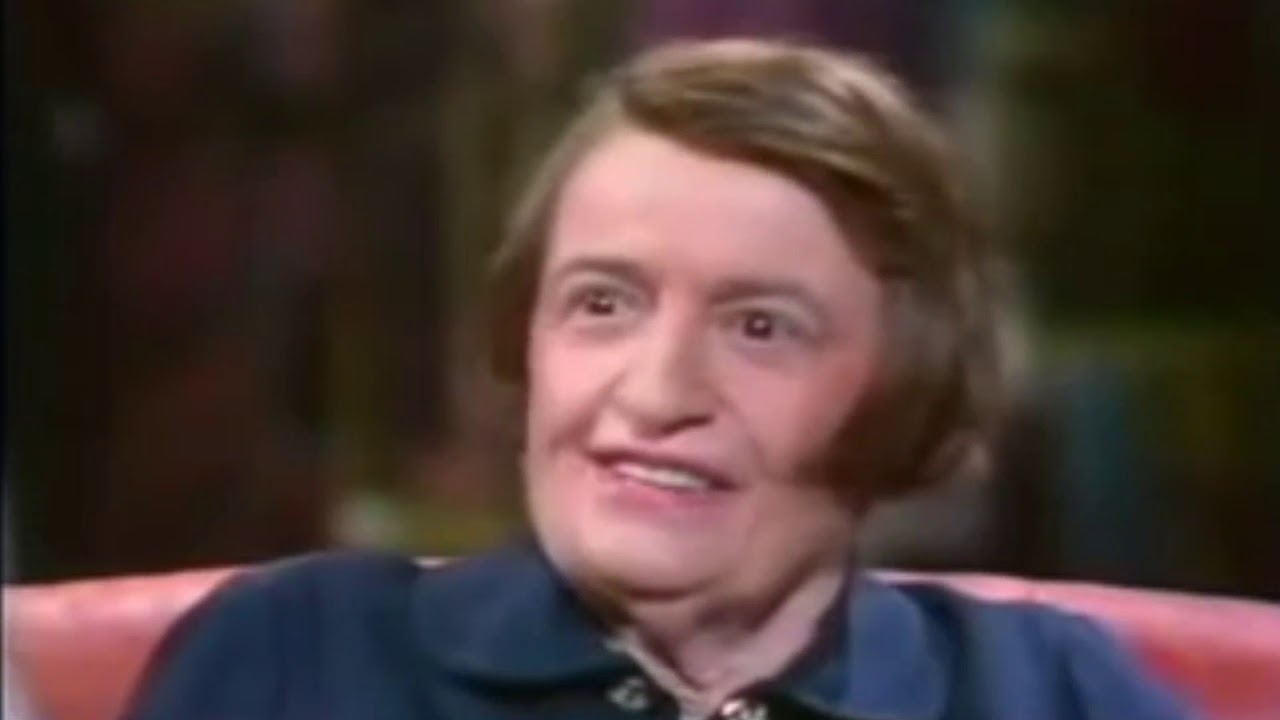
Of course, I can imagine an ugly woman animated, smiling, being hilarious. She’s still ugly. Here, look at Ayn Rand being animated, smiling, hilarious. I don’t find her any more attractive than her mugshot images:

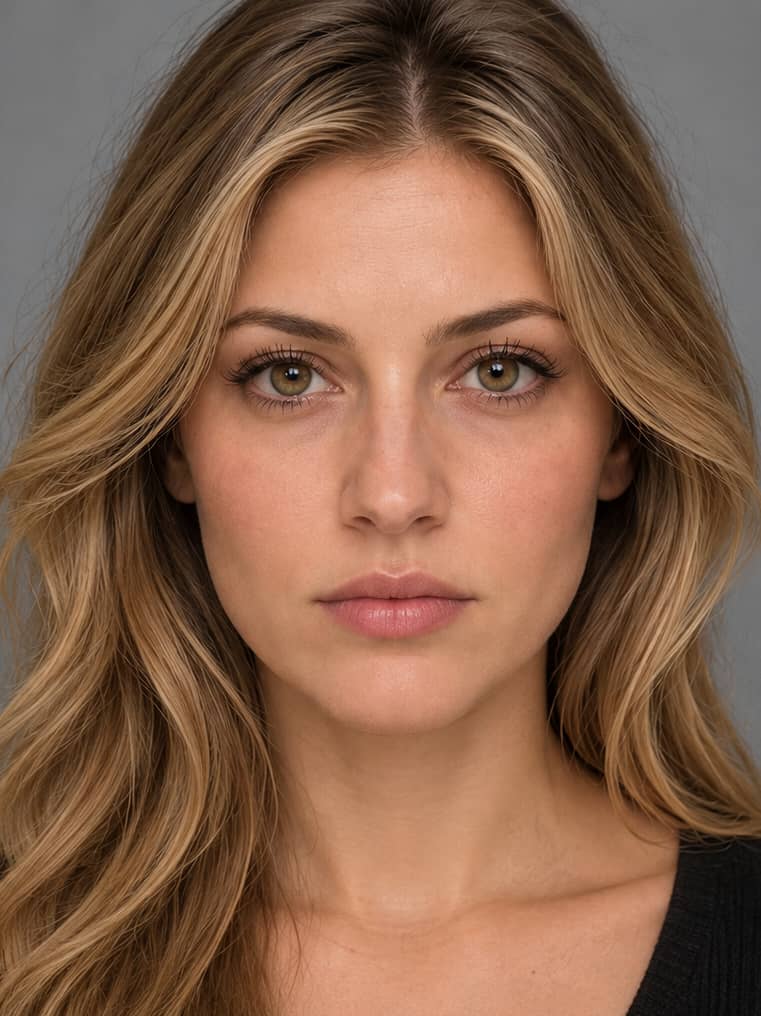
And a woman can be pretty with just a mugshot alone:

Are you like Bob? Can’t tell the difference because they aren’t animated?

Symmetry, baby features, and the golden ratio shouldn’t require animation, smiling, or hilarity. What you’re doing is adding another theory–that attraction comes from animation, smiling, and hilarity. Right away, we can throw out hilarity as I already told you (but you’re ignoring) that this thread is about physical/facial beauty, not inner/personality beauty. Does hilarity add to beauty? It certainly does for me, but that doesn’t explain why the woman in the photo above is attractive. Get it yet?

And I’ll have you know that I have two beautiful children. It required sex. Sure, I’m divorced but I’ve had my fair share of meaningful interactions with women. I’m no stranger to the charming effects of animation, smiling, and a great sense of humor. They affect me deeply and indeed make her much more attractive than she otherwise would be. But I seem to be the only participant in this thread who is capable of distinguishing (philosophically) those factors that make a person beautiful physically and those that make a person beautiful in terms of their personality. Just because I wish to talk about the former doesn’t mean I’m unaware of the latter.

greenfuse wrote:

Well, no. Within the range of norms or what you’re calling averageness (though alone it’s just ok + symmetry (which indicates developmental health) + some degree of neoteny + sexual dimorophism. Yes, those monotheories were a problem, but because they are monotheries, just as averageness is a monotheory. No professional theories had just one factor.

Can we get beyond the monotheory charge? I’ve already conceded your point that a proper theory of beauty probably envelops multiple single-factor theories. I thought the fact that I fused together your health theory with my average theory showed that. But I guess multifaceted theories are great unless they include my theory. And what’s wrong with saying symmetry comes from the average? Why would the average human face be asymmetrical? Is it a sign of health? Of course! When it comes down to it, it’s a sign that the person is normal (healthy and average).

greenfuse wrote:

Symptoms of beauty - the people were beautiful and a side effect of that was they were symmetrical in the face?

Actually, yes. But I’d put it in terms of the average: symmetry is a side effect of an average face. That should be common sense. The average is the cause of both (your health theory notwithstanding). The average causes beauty AND it causes symmetry. Beauty and symmetry are just correlated.

greenfuse wrote:

Now, your theory–that health signs are a stimulant for detecting beauty

That’s just a factor, a part of what leads to beauty.

I know.

greenfuse wrote:

Human beings, as they grow up, learn to recognize average faces within their community, and using that as a starting point, look for deviations towards health

and also towards sexual dimorphism and neoteny.

Dimorphism, yes. Neoteny, I’m still on the fence about that one.

Dimorphism is important because you don’t want to choose your partners indiscriminately. There must be some hard wired genetic or neurological dispositioning within us to identify males of the species and females of the species separately. That learning probably comes before, or maybe develops along side, the learn of the average face. Then the brain puts a premium on the opposite sex when looking for signs of health. You see, greenfuse? Now we’ve got 3 theories for the price of one!

On the other hand, dimorphism probably is more of a factor in choosing a mate, not just identifying attractiveness. After all, I can tell that the man on the right is more attractive than the man on the left even though I don’t want to have sex with either of them:

I’m a bit on the fence over neoteny. You’ll have to enlighten me. Does the theory say that women whose neotenic features make them beautiful deviate from the average? Suppose you had a spectrum on which you had, on one end, the most baby looking people (like the old chubby balding people in my AI generated pics above) and on the other end, the thinnest bony looking people with big noses and wrinkled skin. In the middle, you have the average. Does the theory say that the most attractive women are at the average, or do they, in fact, fall closer to the baby-looking end?

greenfuse wrote:

And averageness is an effect of health. ← Averageness is an effect of diversity. → You have not been distorted by genetic problems or disease. Yet to get to attractiveness you have to deviate. Neoteny is both an outcome of healthy, but also luck. You got genes that made the structure of you face a bit on the child end. And men have been attracted to that. I suppose it might signal more youth than is present, which implies health, but the structure of the face in that way does not indicate health. Baby skin on the other hand does to some degree.

While I think the claim that an average is the outcome of health is ridiculous, I understand where you’re going with this. The brain has to figure out what a human being is supposed to look like, what’s “normal”, and that’s going to be correlated with health (unless you have a society full of sick people). How can it deviate from that towards above-average healthy features unless it knows where to deviate from? It has to have a starting point. Otherwise, how does it know what’s healthy?

And I think you just answered one of my questions. You said, “you got genes that made the structure of you face a bit on the child end.” ← That sounds like the neotenic features that make a woman attractive aren’t smack-dab in the middle, they’re on the “child end” of the spectrum. Now the question is, is this just an outcome of the health theory, or is it its own factor along side health signs and other signals? Your comment seems to suggest it’s an outcome of health: “I suppose it might signal more youth than is present, which implies health, but the structure of the face in that way does not indicate health. Baby skin on the other hand does to some degree.” Younger people tend to be healthier in general (less disease prone), but we should be cautious about saying older people are unhealthy.

greenfuse wrote:

The main problem with the OP is that it treated monofactors or traits as representing the theories out there, but they don’t.

And that’s ok. You yourself admitted that these could just be “internet” theories–misunderstandings of the real theories that some people started spreading (on the internet or through hearsay)–and that’s fine. It just means my attacks on them are against those misunderstandings or strawmen versions. I wouldn’t necessarily disagree with a more sophisticated nuanced scientifically based theory.

greenfuse wrote:

If the woman in the new photo was smiling (with the mouth and eyes, a real smile) she’d be attractive. Further, the bags under the eyes and frown lines are hinting at both ill health and chronic unhappiness. The latter bringing in all the psychological factors in beauty and attraction.

Yeah, and if she were Charlize Theron she’d look attractive too. If you insist on throwing in more and more variables besides symmetry, baby features, and the golden ratio, of course you’ll eventually get an attractive person. The problem is that the more variables you introduce, the less parsimonious the theory is. It becomes more plausible that a simpler theory that accounts for all of them is the deeper cause (like your health theory or my average theory). I have no issue with multifacetedness, just with people trying to brush off pictures of ugly people with “well, you didn’t include X.” If you want a reducto ad absurdum, try this: it’s only ugly because you didn’t include all the feature that make a person beautiful!

But if you insist, let’s see what happens when she smiles:

^ Still wouldn’t fuck her (but I guess you would).

Through and from the past experiences of the body.

How does one see ‘genes’, exactly?
Here you are saying and claiming if something is not a human body, then it can’t have beauty.
The ‘looks’ of a human body do not necessarily have absolutely anything to do with survival.

Do you have an actual example?

Absolutely everything is relative to the observer, including ‘beauty’.

Observers are always a result of what the body they are within has experienced.

Therefore, ‘beauty’ is in the eye of the beholder, who is always the sum of a body’s past experiences.

You are so pathetic. Ayn Rand is in her seventies in that interview for fuck sake. A lot of men find her very attractive. Some men are attracted to intellect and confidence believe it or not. She was also definitely not ugly as much as I can’t stand her. You are seriously comparing her to an AI-generated image of a Barbie doll? JFC. I couldn’t give a rat’s arse who you want to f. You are metally disabled.

And don’t bring your male fantasies into this if you don’t mind.

Best wishes.

The man on the left looks dirty and possibly smelly. That’s what makes him unattractive. The one on the right would appeal to gay men. Women not so much. Can’t stand pretty-boy types myself.

MistressOphelia wrote:

You are so pathetic. Ayn Rand is in her seventies in that interview for fuck sake. ← But she’s smiling and laughing, Mistress! → A lot of men find her very attractive. ← I don’t. → Some men are attracted to intellect and confidence believe it or not. ← Hey, so am I! → She was also definitely not ugly as much as I can’t stand her. ← No accounting for taste, I guess. → You are seriously comparing her to an AI-generated image of a Barbie doll? ← Yes, it’s called phy-si-cal beauty. Come on, say it with me… “P-H-Y-S-I-C-A-L” → JFC. I couldn’t give a rat’s arse who you want to f. You are metally disabled.

^ You’re the one having a conniption fit.

MistressOphelia wrote:

And don’t bring your male fantasies into this if you don’t mind.

← Oh, you ain’t seen nothin yet, sister. →

Best wishes.

Ha! Like you honestly wish me the best.