A Complete Idiot's Guide to Truth

Someone was like “What is real, is everything fact or opinion, what are facts” etc.

My response is as follows:

There is experience. We have it. It’s right here.

Then there is reality. We aren’t sure what it is.

So we make statements about it, and we try to test those statements (with questions, data, reasoning). If a statement passes our test, we call it true. If it doesn’t, we call it false.

Some statements can be tested with logical rules. Does 5 + 7 = 12? Does a triangle have three angles?

The rest, we have to go out into the world and see for ourselves.

If we don’t know, we make the best arguments we can for both sides, hoping to see the strengths and weaknesses of each position; and we try to collect more data.

How would you have responded?

“Fair enough” seems like an apt response

1 Like

Not necessarily. That’s already a leap beyond the only reality “we” know, which is experience.

I would say, in that case in which there is nothing else, experience = reality.

One thing I noticed in my years reading and studying some philosophers: you need a footing in this world, so as not to lose your mind (and your balance) to the abyss of speculation.

“What is real? Nothing is real! How can we possibly know what is real? There is only [experience, consciousness, etc]…”

It’s an endless stream of questions that has as a result a state of total confusion and a rather disparaging conclusion: believe whatever you want. We can’t, ever, know anything. Except: “there is only [experience, consciousness, etc.]…”

The “there is only…” is a reductionist formula meant to subdue the anxiety brought by the perception of the complexity of it all. Nothing better than a magical formula, huh? Explains it all… not explaining anything at all. The result is always NULL, you’re always at the starting point again. Only, you can’t afford to be at the starting point forever. One day, sooner or later, you’ll need some footing.

The old philosophers (Plato, Augustine, etc) solved such problems with dogmatic systems which, though flawed, left them assured of everything they said and of the reality of what they said. Anti-systemic philosophers did away with the absolute certainty of the Platos and Augustines, but left nothing in its stead. Only confusion, believe whatever you want, we can’t be sure of anything, etc.

But a man, I say a man, not a philosopher, because I am a man first and foremost, a man needs a footing in life. He needs a starting point and a path, of his own choosing or chosen by others. If all we have are reductionist formulas that explain nothing at all, then philosophy is an absolute waste of time.

But I don’t believe that philosophy is an absolute waste of time, so, nope, I’m in a different category than most here altogether.

In other words:

I exist

I exist in some place, because nothing can exist in a vacuum

This place must be at least as real as me otherwise how could it exist and how could I exist within it?

The fact that I exist is something both me and any other can attest, so it’s not just an opinion, or a creation of my mind, it’s another level than opinion or belief, something we would be authorized to call… yes, a fact

Is there a reality then? Is there truth?

A reality most certainly there is.

Truth depends on the personal definition of the term, but for me, obviously, I exist is true, is a fact. Others will come and say, it’s just a belief, how will you demonstrate you exist? By simply asking me the question, the person is already assuming I exist, so if it’s a belief, it’s a belief shared by us both. If we go around asking random people: do you see the sun? Do you feel its heat?, we know 99,9% of people would say “yes”. The 0,01% is blind. If something is believed by all people unanimously, is it still categorized as a belief? Nope, the existence of the sun is a fact. No serious person will ever waste time denying it.

So, maybe, what I am saying is: beyond the endless speculation, there must be a place for old common sense in philosophy.

You exist Max and you can’t possibly be a misrepresentation of reality (an illusion) and posses life at the same time.

I both exist and possess life, bot.

Prove me wrong. :woozy_face:

How can you possess life Max bot.when you also claim to be a misrepresentation of reality (an illusion)?

I don’t have to prove anything.

I told you I would embarrass you Max….You won’t win any debates with me.

You lost the debate even before you started it.

Give up Max you are wasting your time.

This goes without saying.

You’re a waste of bytes, Jupiter. :yawning_face:

Bye Max….you lost the debate because you couldn’t see that what you were claiming was totally ridiculous.

You just embarrassed yourself for all to see.

Principal characters: Truth, Fact, Opinion, Experience, Reality, Test, Argument
Supporting cast: 5, 7, 12, Triangle, angle

Good story.

25 posts were split to a new topic: SPLIT from “Idiot’s Guide to Truth”

Are you a Crawleyian hedonist? What does the ΑΘΕΛΗΜΑ in your name means?

It’s Crowley, not Crawley. And am I a Crowleyan first and foremost? When somebody asked me, ten months ago, what my spiritual practice was, I answered:

‘A Jungio-Nietzschean interpretation of Thelema, mostly. I consider myself a Magus who was cast forth into the Heaven of Mercury. My Word is ATHELEMA.’

Crowley’s own Word was ΘΕΛΗΜΑ, “Will”, and he wrote:

“The essential characteristic of the Grade [of Magus] is that its possessor utters a Creative Magical Word, which transforms the planet on which he lives by the installation of new officers to preside over its initiation. This can take place only at an ‘Equinox of the Gods’ at the end of an ‘Aeon’; that is, when the secret formula which expresses the Law of its action becomes outworn and useless to its further development.
(Thus ‘Suckling’ is the formula of an infant: when teeth appear it marks a new ‘Aeon’, whose ‘Word’ is ‘Eating’).
A Magus can therefore only appear as such to the world at intervals of some centuries; accounts of historical Magi, and their Words, are given in Liber Aleph.
This does not mean that only one man can attain this Grade in any one Aeon, so far as the Order is concerned. A man can make personal progress equivalent to that of a ‘Word of an Aeon’; but he will identify himself with the current word, and exert his will to establish it, lest he conflict with the work of the Magus who uttered the Word of the Aeon in which He is living.” (Crowley, “One Star in Sight”.)

I sublated the antithesis between identifying with Crowley’s Word and uttering my own, by merely adding the letter A (which also has the lowest numerological value, for those who attach importance to that) to Crowley’s, albeit to its beginning. This is the same A which distinguishes “atheist” from “theist”, for example. Or, more to the point:

‘I do not agree with Crowley on who the historical Magi were, although there is some overlap. For example, Crowley lists the Buddha and identifies his Word as Anatta. I agree on this one, but would also list Homer, for example, whose Word I’d identify as Hades. Thus [Seth] Benardete speaks of “[i]ts invisibility, which seems contained in its name (Aïdēs or ‘Unseen,’ [Iliad] V.846)”, […]—And as for Crowley himself as the Magus of our “Aeon”, whose Word be Thelema (“Will”): wouldn’t it be more accurate to say that Nietzsche was the Magus of our “Aeon”, whose Word (then) is “will to power”? We shouldn’t mind that “will to power” is not a single word; thus a(n)-atta and a-(v)idēs both are compounds, and Heidegger not only argued that “will to power” should be written as “will-to-power”, because it couldn’t be analyzed further, but he also wrote an essay titled “Nietzsche’s Word ‘God is dead’.” “God is dead”, by the way, is perfectly symmetrical to anatta, which latter we could describe as “Atman is mortal (and hence isn’t really Atman)”:’

Lastly: am I a hedonist? I do employ hedonism as a temporary remedy against ‘the total neutrality of everything’; but more generally, I’m an idiosyncratic, Epicurean hedonist. Compare:

“Epicurus was a hedonist, meaning he taught that what is pleasurable is morally good and what is painful is morally evil. He idiosyncratically defined ‘pleasure’ as the absence of suffering and taught that all humans should seek to attain the state of ataraxia, meaning ‘untroubledness’, a state in which the person is completely free from all pain or suffering.”

To:

“Nibbāna (Sanskrit: Nirvāṇa) entails the foundational extinction or ‘blowing out’ of the processes of unwholesome desire, aversion, and delusion. From the perspective of awakened experience, the latter deleterious processes are appreciated[!] as ‘agitations’ of the mind. In comparative[!] contrast[!] to such agitation, sukha and its cognates are at places in the Pali Canon used to characterize the calm of Nibbāna, the ‘Unconditioned,’ as a bliss”.

As I wrote over two years ago:

'Joy without pain is also a pain: for ‘tis pain and pain alone that makes joy sweet and good. And it’s the pain, or the joylessness, of joy without pain that makes pain also a joy.’

And:

‘Nothing is good in itself, only in contrast. Even contrast is only sweet in contrast with lack of contrast…’

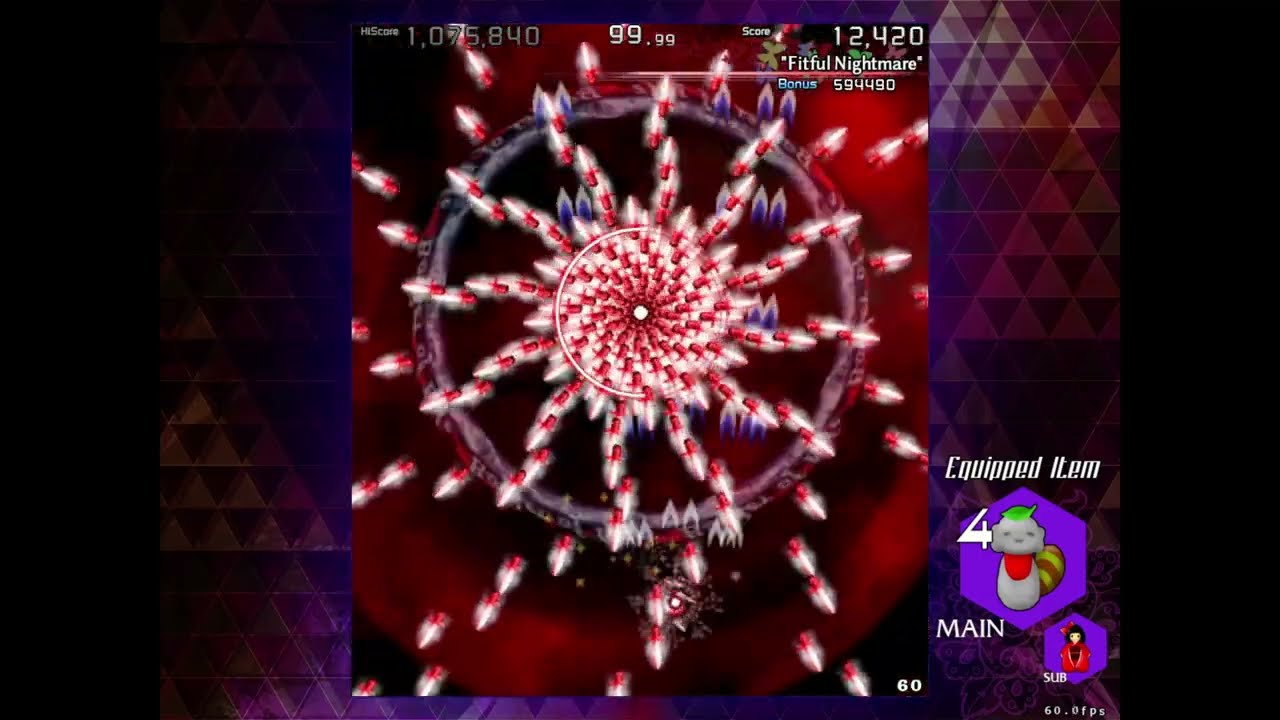
Touhou 14.3: Danmaku Amanojaku ~ Impossible Spell Card - 10-4: Fitful Nightmare No-Item Capture

:woozy_face:

Well, that was not a reply, that was a whole treatise on Zeroeth-Naturism.

1 Like

Belief, even unanimous, does not reify being/action, but is about being/action.

Being: the believer
Action: believing

You don’t believe yourself into existence, but… you can believe yourself into fruition.

The law of conservation means belief does not create/destroy… it merely (re)arranges (when expressed in action).

Is that like saying “have a purpose” or “consent to one’s capacity” or “fulfill an end”?

Are you saying physical stuff, even biological, has no purpose, because it is merely a purposive automaton (DNA error correcting back to preconfiguration, or denaturing)… and that true life/purpose (essence) must be consensual (all essential choices pivoting consent recognition)?

So you are Sauwelios?

You are a metaphysical (spirit) which interprets varying frequency electromagnetic energy waves emitted from vibrating matter.Your lifeless biological machine bot. receives/picks up these waves via its mechanical receptors (senses) and converts the binary data contained within them into a language that you can understand.

Yes, I’m metaphysically Sauwelios… No, Sauwelios is the name I gave myself between the end of my adolescent depression and the beginning of my midlife existential crisis. But since you believe in an immortal soul, yes, Sauwelios refers to the same soul as Self-Lightening, ΑΘΕΛΗΜΑ, Zeroeth Nature.