
1 Like
“Instead of pushing man to exceed himself, the monotheism of the Bible consumes his vitality. He must ‘impoverish and annihilate himself’ to give consistency to God. The deity becomes a kind of haemorrhaging of human nature. And God manipulates the transfusion of all man’s creative energies.”
–de Benoist, Alain
“Judeo-Christian monotheism developed a negative anthropology because it is a negative religion. An anti-religion.”
–de Benoist, Alain
They worship the absent absolute - nil.
This is their indivisible, immutable, abstraction, existing only in the catacombs of their inter-subjective platonic caves - their skulls in a state of constant linguistic intercourse.
The fires within fuel their “magic”. Shadows on their vacuous ‘esoteric’ walls.
There is no cancelling out Silenus.Not in the physical nor the spiritual.
Surely you don’t believe in the MAGIC that nothing caused a MYTHICAL!!! single big LOL!!! …the problem is magic had to have caused it or else your hilarious starting philosophy of +=- and -=+ is incorrect.
And you dare to mention magic related to other individuals beliefs ….you total hypocrite.
Nobody wants to listen hypocritical atheistic fools who claim to be a misrepresentation of reality anymore.
The laughs totally on you and your farcical religious beliefs and the cognitively biased BS science that you mistakenly think supports it.
“The genuine religion of the Jews… is the crudest of all religions (die roheste aller Religionen ). The ongoing contempt for Jews, amidst their contemporary peoples, may have been to a large degree due to the squalid (armsälig ) qualities of their religion…
In any case the essence of any religion consists, as such, in its persuasion that it provides for us, namely that our actual existence is not only limited to our life, but that it remains timeless.
The appalling (erbärmlich ) Jewish region does not fulfil this; indeed, it does not even try to…
Therefore, this is the crudest and the worst of all religions consisting only in an absurd and outrageous (empörend ) theism…
While all other religions endeavour to explain to the people by symbols and parables the metaphysical significance of life, the religion of the Jews is entirely immanent and furnishes nothing but a mere war-cry (Kriegsgeschrei ) in the struggle with other nations.”
–Schopenhauer, Arthur
The Jews, in an act of final desperation, and after forty years in a spiritual desert, decided to accept themselves as they were, because nobody else would.
In his thesis on the Origin of Consciousness Jaynes has this to say:
“A mixture of men, then, coming together precariously for a time, and then separating out, some perishing, others organizing into stable tribes; some raiding more settled lands, or fighting over water holes or sometimes, perhaps, caught like exhausted animals and made to do their captor’s will, or in the desperation of hunger, bartering control over their lives for bread and seed, as described in some fifteenth-century B.C. tablets unearthed at Nuzi, as well as in Genesis 47:18-26. Some perhaps were still trying to follow inadequate bicameral voices, or clinging to the edge of settled lands, fearing to launch out, becoming breeders of sheep and camels, while others, having struggled unsuccessfully to mingle with more settled peoples then pushed out into the open desert where only ruthless survive, perhaps in precarious pursuit of some hallucinated vision, some back parts of a god some new city promised land.
To the established city-states, these refugees were the desperate outcasts of the desert wilderness. The city people thought of them collectively as robbers and vagrants. And so, they often were, either singly, as miserable homeless wretches stealing by night the grapes which the vine-dressers scorned to pick, or as whole tribes raiding the city peripheries for their cattle and produce, even as nomadic Bedouins occasionally do today. The word for vagrants in Akkad, the language of Babylon, is khabiru and so these desert refugees are referred to on cuneiform tablets. And khabiru softened in the desert air, becomes Hebrew.”
–Jaynes, Julian
The historian Carroll Quigley says this about the Hebrews:
“The second millennium was still in its early centuries when a series of Amurru princes ruled the whole Fertile Crescent from the Persian Gulf to the Nile and, as ‘Hyksos,’ were beginning to force their way into Egypt. Amorite names like Abram, Jacob, and Benjamin were recorded in cuneiform writing for the whole area. Tribal and family influence was still powerful in most places that individual rights were very weak, and a strong family group was a better guarantee of personal safety or of individual rights than either personal prowess or princely power.
In this rapidly developing society, there were scattered persons whom the documents called ‘Habiru’ or some similar term. They are recorded from Mesopotamia, Asia Minor, Egypt, and the Levant. The meaning of the term Habiru is disputed, but it seems to apply to persons whose social position did not provide them with the protection of blood relatives and of the threat of retaliatory feuding by their families. They were, what Maitland called in the early Middle Ages in England, ‘landless and kin-shattered men.’ The cause of this ‘kin-shattered’ condition which left the Habiru in a precarious social condition is fairly clear. Any individual who had killed a member of his own family obviously lost the protection of that family and became socially isolated. Or again, any person who made a formal agreement to become bondman of another had voluntarily renounced the protection of his blood relatives. Similarly, men who bound themselves to fight for money could not expect their families to stand prepared to avenge any injuries they might suffer in their combats. Such persons, without family to protect them or to force the prince to extent his protection, needed some protector. This was found by seeking the favor of Yahveh, the God of mercy, one of the lesser deities in the numerous Canaanite pantheon. Such allegiance to Yahveh by bondsmen, murderers, or other ‘kin-shattered’ persons did not originally imply any renunciation of the other deities in the Canaanite pantheon, and the Habiru continued to worship, as seemed fit, the other Canaanite Baals, working downward from the greatest, El, God of justice and creator of the world.
The economic activities of these Habiru were probably not much different from those of other Canaanites. But two comments might be made. As persons with weak or no kinship ties, they probably wandered about from place to place more readily than other Canaanites. And there clearly seems to be, among the Habiru, a large proportion of wandering metalworkers and music-makers. Some of these metalworkers were known as Kenites, a name traditionally derived from Cain, the son of Adam. It is worth noting that the mark the Lord put on Cain was not a mark of damnation, as some believe, but a mark of protection: ‘the Lord put a mark on Cain, lest any who come upon him should kill him.’
It would appear thus that the Habiru who became worshipers of Yahveh and later strict monotheists began as a legal or social group, later (at the time of Moses) became a religious group, and still later (at the time of Joshua) began to develop into a political group. Much later, after the Assyrian destruction of the Hebrew state, they became, once more, primarily a religious group, although there always were tendencies to become a political group (by establishing Hebrew rule in some area) or to become a biological group (by insisting on endogamy). At any rate the Hebrews always were a group within Canaanite society and never became a society of their own.”
–Quigley, Carroll
“Judaism is the evil conscience of our modern civilization.”
–Wagner, Richard
As a people the Jews represent a unique type. Having no lands of their own, for the biggest part of their history, like the gypsies they carved out a survival strategy on the peripheries of human civilizations, and like all outsiders their perspective offered them a clearer view of the people’s they mingled with but could never belong to, exposing psychological insights they could exploit, and cultivating an envy they could convert to a passionate ambitious drive for retribution.
“Everywhere, classical Judaism developed hatred and contempt for agriculture as an occupation and for peasants as a class, even more than for other Gentiles a hatred of which I know no parallel in other societies. This is immediately apparent to anyone who is familiar with the Yiddish or Hebrew literature of the 19th and 20th centuries.”
[Jewish History, Jewish Religion – The Weight of Three Thousand Years]
–Shahak, Israel
To call the Jew opportunistic would be an understatement. Having no interest and no great tradition of production, or for living off the land, they chose a survival niche in which they could inconspicuously provide services to their masters. A method that required a brazen willingness to do anything to survive.
“For our purpose here, the essential thing about medieval society was that it was an ordered, structured society, with a population base which was, in each particular region, homogeneous. Thus, it was a society imbued with certain natural defenses against penetration by alien elements.
The Jew in medieval Europe had relatively little elbow room. He did not fit into the well-established, well-ordered scheme of things. He was an outsider looking into a self-sufficient world which had little use for his peculiar talents. This was the situation for the better part of a millennium, and throughout that long period the foremost goal of the Jew was to destroy the order, to break down the structure, to loosen the bonds which held European society together, and thereby to create an opening for himself.
Order is the Jew’s mortal foe. One cannot understand the role of the Jew in modern European history unless one first understands this principle. It explains why the Jew is the eternal Bolshevik: why he is a republican in a monarchist society, a capitalist in a corporate society, a communist in a capitalist society, a liberal ‘dissident’ in a communist society—and, always and everywhere, a cosmopolitan and a race mixer in a homogeneous society. And, in particular, it explains the burning hatred the Jews felt for European institutions during the Middle Ages. It explains why the modern Jewish spokesman, Abram Sachar, in his A History of the Jews, frankly admits that the universal attitude of the Jews toward medieval European society was, ‘Crush the infamous thing!’
Yet, even in the Middle Ages the Jews did not do badly for themselves, and they certainly had little cause for complaint, except when their excesses brought the wrath of their hosts down on their heads.
As was pointed out in the previous chapter, the Jews established an early stranglehold on the commerce of Europe, monopolizing especially foreign trade. Their real forte, however, was in two staples of commerce forbidden to most Gentiles in Christian Europe: gold and human flesh. Aristotle’s denunciations of usury had influenced the leaders of the Church against moneylending, and the practice was consequently forbidden to Christians on religious grounds — although the ban was not always strictly observed. The field was left almost entirely to the Jews, who, in contrast to the Christians, used their religion as an explicit justification for usury.”
[Our Long Long History [p. 310] {The Fair Race’s Darkest Hour}]
–Pierce, William
Anti-Order, the Jew remains eternally contrarian, exploiting all forms of worldly order, substituting them with a submission to a mystical cosmic authority with a hidden mandate – ‘spiritual’ and/or ‘divine order’ is but a euphemistic way of alluding to noetic order – world-negating abstractions passed-on from mind to mind in the form of unsubstantiated ideologies.
Cognitive detachments and solipsistic self-ordering become essential to this reframing of consciousness.
Do you see, now, why there are so many anarchists, and deniers of free-will, whilst submitting to abstracted absolute? If not to a singular, authoritarian, totalitarian god, then they surrender their will to a mere abstraction; a cosmos with the same traits, minus consciousness.
The infection has reached the bones, where white blood cells are produced, compromising the host’s ideological autoimmunity…
1 Like
The gravitational pull is so insignificant it would have no effect.
More likely, IF astrology is true, it is because of real and tangible reasons. Such as… the WEATHER. Perhaps being born in certain weather effects the psyche. Or pollen, or microorganisms, effecting personality? I will give an example, there are real conditions such as Seasonal Affective Disorder, Winter depression, even Sunlight/Night affect Cicadian rythms and night-time making people feel tired. So if Astrology had any effect at all, it would be because of the Fucking WEATHER, not some star system 500 lightyears away!!!… wtf
More likely…the earth’s magnetic field, relative to the sun, and the weather, would be more immediate factors.
They would come after how parental genes combine, random mutations, race, and how it all adjust by hormonal factors determining sex.
Cosmological factors, like particles affecting the foetus in the womb, and the solar relationship to other stars, and distant cosmological effects, would be down the list of factors determining personality.
and of course Freud’s “anatomy is fate.”
If it were not so, then all species would be affected…and not only humans…more importantly if star arrangements were so determining then life on earth would have developed along astrological categories…
Libra based species…Capricorn species…etc.
The final thing to so is if astrology is fact, then free-will is truly an illusion.
If the stars determine a man’s fate, then that’s determinism.
No need for big costly brains, to make risky judgements…
No need for the illusion of free-will at all.
1 Like
“More subtle are the ideological challenges: doctrines and philosophies that lay claim to virtue and truth, and might even espouse altruistic behavior and transcendent aims, but are utterly alien to the Jewish soul. A Jew disconnected from his roots and ignorant or unappreciative of his heritage is ready prey for the foreign waters that offer to quench his spiritual thirst. But infinitely more noxious is a third category: doctrines that blend the soil of materialism and the fountains of reason into a lethal muck.
A person buried in corporeality can claw and dig his way out to sunlight. A person sinking in a sea of spurious reason can struggle to the surface and swim to shore. But he who adds water to his soil—who saturates his materialism with intellectual fluid—creates a morass from which it is infinitely more difficult to extricate himself. When his soul is moved to reach beyond the mundanity of the material, a host of rationalizations rise to still its yen; and when his mind begins to wake to the fallacy of the alien creed, the grasp of earth pulls him down. The person is thus steadily sucked down, as his efforts of mind and will to rise above his mired state are counteracted by the bog of idealized hedonism.
Such was the challenge that faced our forefathers during the Greek domination of the Holy Land. Yavan, the Hebrew word for the Hellenic culture, means mud [?!] (as in Psalms 40:3—see Rashi and Metzudat Zion commentaries on verse). The Hellenic reformers did more than entice and coerce the people of Israel to embrace the body-worship of Greece—they also sought to indoctrinate them with a philosophy that exalted the physical and made its worship a virtue and an ideal. The Greek was not merely pagan; his was a paganism aestheticized by art, glorified by poetry and hallowed by reason. The Greek was no mere materialist, but one who kneaded his earthiest wants with the subliminal waters of his intellect to form a mucilage that fastened on the soul and drew it, inch by inch and limb by limb, into the quagmire of Yavan.
… The deadliness of the mudswamp is further illustrated by the very form of the Hebrew word Yavan, {יון} whose three letters are three lines, each descending an increment lower than its predecessor. Unlike water, in which one might sink swiftly to the bottom but can also, equally swiftly, pull himself out, the mud of Yavan works slowly, drawing the person down bit by bit, step by step. At first, it only demands a slight, barely discernible departure from one’s convictions and morals. But its downward pull is steady and all but irreversible—indeed, all efforts to extract oneself by the means of one’s conventional faculties are doomed to failure—except by the extremely potent power of faith, as explained in the text…
This is the eternal lesson of Chanukah: intellect might be man’s highest faculty, but it can also be the instrument of his degradation to the lowest depths.
Chanukah celebrates the cleansing of the Holy Temple from Hellenic corruption, the triumph of the pristine essence of the Jewish soul—represented by the small, pure cruse of oil that burned in the menorah for eight days—over the mud of Greece…”
–Internet
But they were tainted, nonetheless. As they infected other peoples, triggering the development of slavish dogmas among them, they were, in turn, affected, causing their splintering into three competing variants, two of which, Marxism and Zionism, challenging the very foundations of Judaism.
They celebrate their victory over the Greeks and then pretend to be part of western civilization.
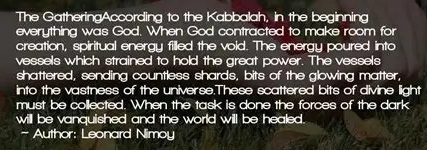
Existence is a “fallen state”…divine shards = souls…the world must be healed…
Abrahamism is anti-nature…
They despise existence and sell the delusion that man can make it more…humanitarian.
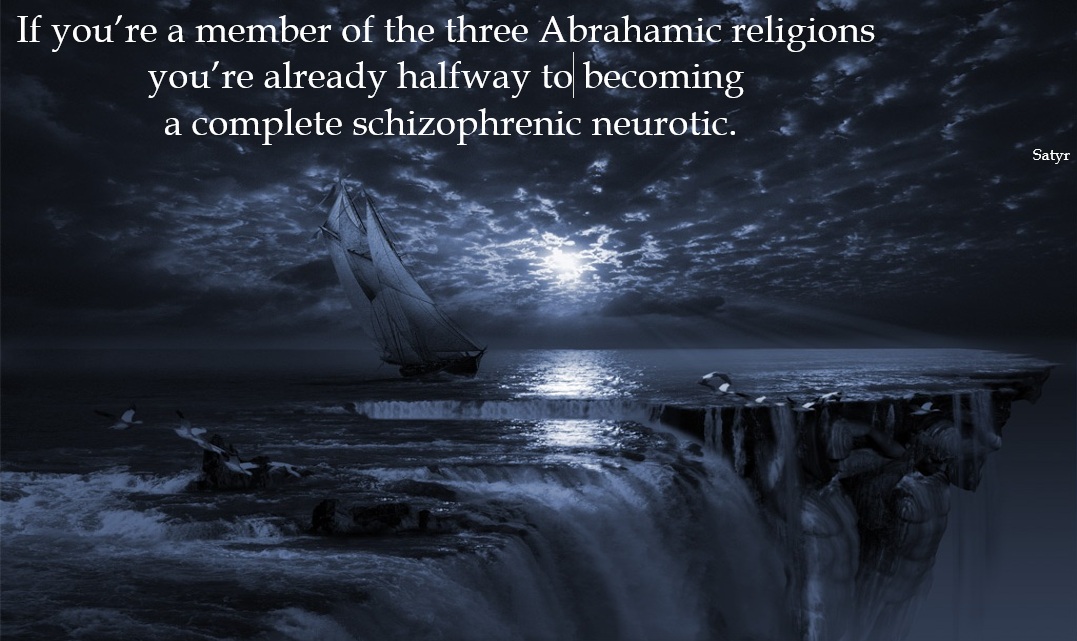
… And when you get to ILP, you’ve made it all the way there.
1 Like
You interpret varying frequency electromagnetic energy waves,containing binary data, transmitted (emitted) from matter that vibrates due to the balancing of the 4 off attractive and repulsive electromagnetic force interactions NN,NS,SN,SS that exist between all spinning objects and particles with N and S poles Silenus.Balancing these forces (N/S=N/S) gives you the starting philosophy for everything (+/-=+/-).This means that lifeless binary is to your right and to your left.(0/1=0/1).You need to be separated from lifeless binary.There is no life in existence/non existence.
I exist/I don’t exist=I exist/I don’t exist
Sorry but I’m going to have to agree with Spock here. The world is garbage and existence is garbage.
Zionist dictatorships and Americans blowing up every country they can is not helping this world be any more bearable.
There is no life in existence futureone.
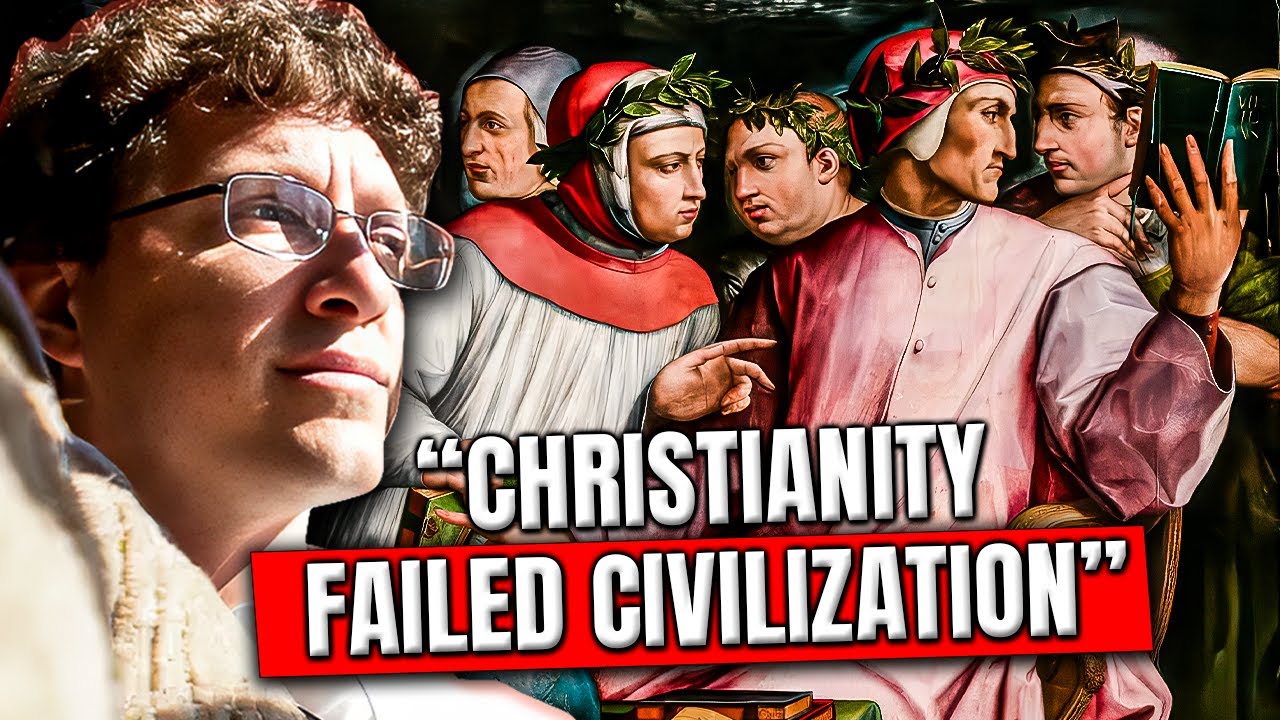
Paul Never Met Jesus! Spinoza Reveals the True Inventor of Christianity
Spinoza the honest whistleblower, because only a Jew can expose Jewish lies.
Saul invented Christianity, and infected Europe and the world, through Rome, with a version of Judaism they would accept. Comforting victim anxieties, empowering herd psychologies, seducing the growing masses of disenfranchised – all those who were born due to human interventions, awakening to their plight, needing a tale to help them cope with nature’s injustices.
Emerging self-consciousness – or the third-person perspective we call objectivity – was unbearable to the masses. They needed a believable lie to help them protect their egos from devastating truths… and the Jews denied them their own comforting self-deceptions, so a demand had to be supplied.
1 Like
did not watch, ai slop vid. do better
may watch
This youtube vid has restriction, not permitting viewing outside Youtube…
Try more….
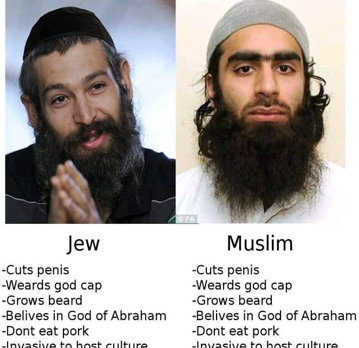
If you adopt a familial context to the Abrahamic zeitgeist, then…
Israel is the single mother, who sleeps around with many men….a whore.
Her Karen-like bitchiness always leads to violent breakups, because she’s is dominated by an idealized version of masculinity no mortal man can ever meet.
She is also a product of an absent father.
Unable and unwilling to change her ways, she is inventively kicked out of the homes all those men she shacked up with, pretending to be one of their kind. Her act cannot be maintained and when passion wanes, then the personality contradictions become apparent.
Hundreds of failed relationships - 109 and counting - have produced mutiple offspring.
Christianity - the illegitimate daughter of her antagonistic relationship with a Hellenized pagan, named Rome, which she accuses of rape and celebrates her emancipation from him, when she cut off his testicles in a fit of passion. Refusing to be circumcised she attempted to castrate him.
Now we wears dresses and pretends to be a woman. A victim of a devilish woman.
Christianity, their daughter, has a lover/hate relationship with her mother….as daughters often do.
Judea despises the Rome she sees in her daughter, reminding her of how much he had seduced and then dominated her. she calls this ‘rape’ because she never accepts responsibility and must always accuse the men to excuse her own bad behaviors.
Judea, the whore, also had a son with a desert dweller, Egypt.
Islam, the illegitimate son of this desert dweller, is closer to his mother, as boys often are with their mothers….yet, there’s some residual resentment caused by her constant demonizations of his dead father.
The boy grows up constructing fantasies about the father he never knew….and resents his mother because she rejected him, denying the boy a real father. All he has now are the myths his mother told him….
1 Like
“Graetz proposed an historical explanation based upon the great events and controversies of Jewish history. According to him, the Kabbalah was essentially nothing but a reaction against the radical rationalism of the Maimonideans—the adherents of the philosophy of Maimonides, who died in Fostat (Old Cairo) in 1204 but had enthusiastic followers throughout the Orient and in Provence as well. There, his principal work, The Guide of the Perplexed, appeared in the year of his death, translated from the original Arabic into Hebrew. The appearance of the Kabbalah upon the historical scene in Provence at the beginning of the thirteenth century coincides with the birth of this philosophy. Obscurantists who hated the light that shone forth from the school of the new rationalists raised against it a system they called ‘Kabbalah,’ which literally means ‘tradition.’ Its fantastic and extravagant doctrines, elaborated in overheated brains, were essentially superstitious and contrary to the spirit of Judaism. In their battle against enlightenment these obscurantists were not particularly discriminating and therefore did not hesitate to draw upon foreign, imprecisely identified sources for their fundamental ideas. The Kabbalah is not historically continuous with the older mystical movements in Judaism, in particular the mysticism of the Merkabah. The crude anthropomorphisms of the adepts of the Shi’ur Qomah, the doctrine of the mystical figure of the Godhead, merely furnished the kabbalists with a symbolic vocabulary. Graetz does not exclude the possibility that older materials may have been absorbed into this mystical symbolism, but he never enters into a more direct discussion of this problem, whose importance is nevertheless evident. ‘It can no longer be said with complete certainty whence the first kabbalists… acquired their basic principles, borrowed from Neoplatonism.'’ But in their struggle against the sublimation of the Talmudic Aggadah and the Jewish ritual law by the adherents of the philosophy of Maimonides, the new ‘enemies of the light’ developed their own theory. It was based upon the supposition that the rituals had a magical effect; its details were drawn from the kabbalistic revelations to which the initiators of this tendency laid claim. It is interesting to note that the possibility of a filiation linking the Kabbalah with ancient Gnosticism, which had appeared so plausible to other authors because it supported their belief in the great antiquity of the Kabbalah, does not play the slightest role in Graetz’s theory.”
[Origins of Kabbalah]
–Scholem, Gershom
“In the literature that has been preserved, these traditions relating to the appearance of the prophet Elijah among the earliest kabbalists first appear around the year 1300, yet everything indicates that they are drawn from a solid stock of traditional material going back to the first Spanish kabbalists. They are found in the writings composed by several disciples of Solomon ibn Adreth, and they largely reproduce kabbalistic traditions of the kind taught in his school in Barcelona between 1270 and 1310. Ibn Adreth was the most important disciple of Moses ben Nahman (Nahmanides), who was himself still in contact, as we shall see, with the kabbalistic masters of Provence, and who represents the kabbalistic school of Gerona. There is no reason to doubt that it is this tradition we have before us.
These sources claim that revelations of this kind came to three or four of the leading men of Provence: Abraham ben Isaac (d. around 1179), president of the rabbinical court (in Hebrew ‘ab bethdin) and master of a school in Narbonne; his son-in-law Abraham ben David of Posquières (d. 1198); his colleague, Jacob ha-Nazir (the Nazirite); as well as, finally, the son of Abraham ben David, who became known as Isaac the Blind. The latter lived, it seems, until around 1232-1236 in Posquières or Narbonne. Traditions differ in matters of detail. According to some, it was Rabbi David, the father of Rabbi Abraham ben David (known in Hebrew literature by the acronym Rabad) and not Abraham ben Isaac, his father in-law, who was the first to receive this Kabbalah. Albeck assumed Isaac the Blind was the son and not the grandson of Abraham ben Isaac, but the analysis of the oldest sources does not confirm this assumption. Around these scholars, but especially around Isaac the Blind, there crystallized the oldest groups of Provençal kabbalists that we are still able to identify. The pupils of Rabad and his son, coming from Spain to study in the talmudic academies of Provence, were the principal agents of the Kabbalah’s transplantation to Spain and its propagation in that country. Nothing permits us to suppose that the Kabbalah, in the precise sense of the term, became known in Spain other than through this channel or by way of a parallel path that would point to Provence.
Here, to be sure, we must ask what the exact significance of the word Kabbalah was at this time in the circle of the kabbalists themselves. Kabbalah is a fairly common word in rabbinic Hebrew: it simply means ‘tradition.’ In the Talmud, it served to designate the non-Pentateuchal parts of the Hebrew Bible. Later, every tradition was called by this name, without its entailing any specifically mystical nuance. That it was already employed by the philosopher Solomon ibn Gabirol in the sense it would acquire among the kabbalists is a widespread but completely false assumption.63 It has just a little to do with the Aramaic word qibhla, ‘amulet.’ The Spanish kabbalists still knew very well several generations later what original notion their predecessors had in mind when they employed the term Kabbalah. As late as the year 1330, Meir ben Solomon ibn Sahula, a pupil of Solomon ibn Adreth, expressed himself clearly and directly on the origin and meaning of this new discipline. “It is incumbent upon us,” he writes in the preface to his commentary on the Book Yesirah, “to explore all of these things according to the measure of our understanding, and to follow, in what concerns them, the path taken by those who, in our generation and in the preceding generations, for two hundred years, are called kabbalists, mequbbalim, and they call the science of the ten sefiroth and some of the reasons for the [biblical] commandments by the name Kabbalah.” It follows, then, that in the eyes of these kabbalists the new theosophic conception of God, based upon the doctrine of the ten sefiroth of the Book Yesirah as well as upon the mystical reasons founded on this doctrine for certain ritual precepts of the Torah, constitute the original content of the Kabbalah. In the author’s own opinion, this teaching is by no means ancient; it does not go back many centuries. Rather, it is about two hundred years old, which brings us back, for its initial stage, to the period of the first revelations of the prophet Elijah—that is, in Provence, toward the middle of the thirteenth century.
The chain of kabbalistic traditions that contains the names mentioned previously accords perfectly with this information. It should be noted, also, that the clear awareness on the part of this later kabbalist of the relative youth of the Kabbalah in no way prevents him from considering it a path to knowledge that is ‘incumbent upon us’ to follow.
The second category of sources at our disposal does not mention individuals and the manifestation of the Holy Spirit or the prophet Elijah in the academies of important rabbinical figures. It concerns, rather, the publication of a kabbalistic book that came into the hands of the scholars we have mentioned or certain of their Provençal colleagues who are unknown to us. This literary document, the oldest of the Kabbalah if one understands that term as ibn Sahula defined it, is the Book Bahir, which is also called, after the second-century master of the Mishnah named in the opening words of the text, the ‘Midrash of Rabbi Nehunya ben Haqqanah.’ The title Bahir, ‘bright,’ is taken from the first biblical verse (Job 37:-21) cited in the text, whose interpretation is ascribed to that rabbi: “Now, then one cannot see the sun, though it be bright in the heavens.” The kabbalists do not say that this book was revealed by the prophet Elijah to the aforementioned scholars or to any of their unknown colleagues. According to them, it is an autonomous document independent of these revelations. A closer analysis of the book will prove their judgment correct on this point. For the content of the new speculative tradition deriving from the aforementioned recipients of mystical illuminations is far from simply identical with the content of the Book Bahir.
Concerning the origin of this book, we have the testimony of the Spanish kabbalist Isaac ben Jacob Cohen of Soria (about 1260- 1270), who in the course of his kabbalistic travels in search of old traditions also sojourned for a prolonged period in Provence and undoubtedly reproduced the tradition he heard from the kabbalists of Narbonne, Aries, and other places. The work in which this testimony was originally included has not been preserved, but a kabbalist of unquestionable reliability writing one hundred years later still had it before his eyes. The author in question, Shemtob ben Shemtob, quoted many passages from this book, texts whose content is perfectly consistent with other writings that can certainly be attributed to Isaac Cohen. The latter writes: “Of the [kabbalistic] allusions which they [the old sages] mentioned in the haggadoth in the Talmud and in the midrashim, this is the greatest and the most important among the kabbalists, those men gifted with understanding, who penetrated the depths of the Bible and the Talmud and were experienced in the depths of the great sea [the Talmud]; and that is the Book Bahir, which is also designated, particularly, by the term ‘Yerushalmi’ [that is, as a Palestinian source]. This is the book, more precious than gold, which Rabbi Nehunya ben Haqqanah revealed through mysterious and concealed allusions to those ‘gifted with understanding’ [that is, the mystics] of Israel, the group of sages and the academy of old and holy men. And this book came from Palestine to the old sages and Hasidim, the kabbalists in Germany [Allemannia], and from there it reached several of the old and eminent scholars among the rabbis of Provence, who went in pursuit of every kind of secret science, the possessors of a higher knowledge. However, they only saw a part of it and not the whole of it, for its full and complete text did not come into their hands. In any case, it came to them from a distant land, whether from Palestine or from abroad, from old sages and holy kabbalists, who possessed a well-ordered tradition [Kabbalah] transmitted to them orally by their fathers and forefathers.”
***
Isaac Cohen’s account of the old sources from which the Kabbalah came must now be contrasted with the completely different testimony of a very early opponent of the kabbalists. Meir ben Simon, a contemporary of Isaac the Blind, is rather inclined to ascribe the book to authors of his own time, and his testimony is of considerable importance for us. He was an energetic opponent of the Kabbalah, which in his time was being propagated in Provence. In an epistle that he incorporated into his anti-Christian apologetic work Milhemeth Miswah, he came out very sharply, around 1230-1235, “against those who speak blasphemously of God and of the scholars who walk in the ways of the pure Torah and who fear God, while they themselves are wise in their own eyes, invent things out of their own minds, lean toward heretical opinions and imagine that they can bring proof for their opinions from the words of the haggadoth, which they explain on the basis of their own erroneous assumptions. In this letter, which is directed against the agitation of the kabbalists and which will engage our attention again in another connection, he relates, among other things, in the slightly inflated style of contemporary rhymed prose that can hardly be imitated in translation: ‘They boast in mendacious speeches and statements of having found confirmation and encouragement [for their ideas, evidently] in the lands of sages and scholars…’ But God save us from the sin of heeding such heretical words, concerning which it would be better to keep silence in Israel. And we have heard that a book had already been written for them, which they call Bahir, that is ‘bright’ but no light shines through it. This book has come into our hands and we have found that they falsely attribute it to Rabbi Nehunya ben Haqqanah. God forbid! There is no truth in this. That righteous man, as we know him, did not come to ruin [by editing such a work] and his name is not to be mentioned in the same breath as sacrilege. The language of the book and its whole content show that it is the work of someone who lacked command of either literary language or good style, and in many passages it contains words which are out and out heresy.”
The tone here is therefore very different from that of the enthusiastic encomia of Isaac Cohen. But even though Meir ben Simon is aware of the pseudepigraphical character of the book, he by no means attributes it, any more than does Isaac Cohen, to the circle of the family of Rabad, of whom it certainly could not be said that they lacked command of either literary language or good style. The author of the epistle leaves unanswered the question of whence the book came to the Provençal kabbalists. Yet it follows from his emphasis upon the imperfections of the language and style of the book that in his opinion its origin should be sought in circles that were far removed from the rabbinical culture of those generations and that were susceptible to heretical influences, from whatever side.”
[Origins of Kabbalah]
–Scholem, Gershom
“The concept of the pleroma, the divine ‘fullness,’ occupies a central position in the thought of the ancient Gnostics. This concept has two shades of meaning: sometimes the ‘fullness’ is the region of the true God himself, and sometimes it is the region to which he descends or in which the hidden God manifests himself in different figures. It is the place ‘where God dwells.’ The pleroma is a world of perfection and absolute harmony that develops out of a series of essences and divine emanations known in the history of Gnosticism by the name aeons, ‘eternities,’ supreme realities. According to the definition of Hans Joñas, gnostic knowledge of the divinity was concerned, at least at its point of departure, with the internal history of the creation of the universe as a history of the supernal world of the pleroma and as an inner-divine drama from which the lower world finally issued. The first half of this definition can certainly be applied to the range of ideas present in the Bahir; as regards the inner-divine drama as conceived by the Gnostics, though not absent from the book, it appears in a modified form that made it possible to safeguard the strictly monotheistic and Jewish character of the fundamental doctrines.
***
We saw in the previous chapter that the Merkabah mystics substituted the divine throne for the gnostic pleroma, and that the place of the aeons was taken by the apparatus of the Merkabah as described in very concrete symbols in the vision of Ezekiel or developed from it. But precisely that which these mystics hoped to eliminate from their universe of discourse by means of translation or transformation into a purely Jewish terminology that would not expose itself, at that time, to ‘suspicion’ of foreign origins now appears, to our surprise, in the fragments we have recognized as belonging to the oldest strata of the Bahir. The language and concepts are the same, and we look in vain for an answer to the question how this terminology could have originated or been re-created anew in the twelfth century, unless there was some filiation to hidden sources that were somehow related to the old gnostic tradition.
***
Indeed, a passage in the newly discovered gnostic Gospel of Truth reads like a parallel to our Bahir passage: ‘They found… the perfect Father who generated the All, in the midst of which is the All and of which the All has need,’ and, further on, ‘for what did the All need, if not the gnosis concerning the Father.’ Similarly, in the recently published Gospel of Thomas, Jesus says of himself: ‘I am the All and the All proceeds from me.’ The idea, also to be found among the later Spanish kabbalists, that the souls proceed from this cosmic tree and actually are its fruits is already attested in the gnosis of the Simonians, which as researchers have repeatedly noted, is essentially an heretical form of Judeo-syncretist Gnosticism.”
[Origins of Kabbalah]
–Scholem, Gershom
“We may conclude from the preceding that a considerable portion of the material in the Bahir presupposes an attitude with regard to the sources that is not conceivable until the early Middle Ages. Nevertheless, the details do not permit us to exclude the possibility of the existence of a much older stratum. In fact, they occasionally seem to force this hypothesis upon us. In that case it is not too much to assume that the gnostic material of Oriental origin in the Book Bahir, once it was received and adopted by a circle of religiously agitated and productive men, amply suffices to explain the inner development of the Kabbalah up to, and including, the Zohar.”
[Origins of Kabbalah]
–Scholem, Gershom
“The agreement among these three motifs gives us cause for reflection. It is evident that the gnostic material was radically Judaized. That which ‘was taken from the good’ is no longer removed from that which is above in order to be sent into the world to bring about its redemption; henceforth, it is the light of the Torah and the action of the Shekhinah that form the ‘heart’ of the lower world.
Nevertheless, the Judaization of these concepts cannot obscure the very tangible link with the gnostic images and symbols. Our investigation therefore constrains us to admit the assumption that Oriental sources originating in the world of gnosticism influenced the elaboration of the symbolism of the Book Bahir or that fragments relating to the Shekhinah in that work themselves belong to such a stratum of sources.”
[Origins of Kabbalah]
–Scholem, Gershom
According to this Jew Kabbalsim is a Judaization of Gnosticism, falling in line with the idea that Judaism invented nothing….it only appropriated corrupts (Judaizes) and then sells its corrupted version to the goy, as a novelty…as if they inveted it.
Notice how they are cuently selling the idea that Judaism has always been an indispensable part of ‘western civilization,’ and that they invented morality - when they simply weaponized it.
But their methods work among the world’s imbeciles, so they persist.
Watch them selling anti-tribalism, to morons like Careless, whilst remaining obsessed with their own tribe; selling meritocracy to dumb goy, whilst practicing nepotism and tribal networknig.
Even their numerology is Pythagorean in origin.
Gnosticism is, of course, an Abrahamic cult, that lost the competitive game, based on a corruption of Orphism….an oral tradition of Hellenic occultism.
Christianity is a Jewish cult that combined Orphism and Platonism and Jewish victim psychology, into intellectual slop, expressing a defensive nihilistic reaction to nature’s uncertainties and injustices.
So, when you come across a mentally or physically circumcised Kabbalist, know that he is a plagiarist - whether he knows it or not - and a Judaized Gnostic.
1 Like