Plato came to the conclusion that Fine is what is hard, and I think he had a good point. Belief in God is often attacked in this forum in part because we don’t discuss enough the possibility of belief outside of religion. They attack a product consumed by millions, be it Christianity or Islam.
But why believe in the first place?
I believe that belief is part of our nature. Our interaction with reality is indirect, requiring interpretation from us. Even in science the case emerges again. To quote Vattimo, “…what we call nature is only accessible to us through scientific paradigms fraught with historicity and loaded with theory, hence with ‘prejudice’ (lacking which, for that matter, we would be unable to know anything), we can no longer tranquilize ourselves by pretending to stand with our feet on the ground observing things as they are…”
Belief has to be recognized as it is because the value of belief, why it is fine, is precisely given by how hard belief is. It can exact mental disturbance to coherently grasp this proposition that takes the rug from under our feet, but it is only after that happens that we can raise ourselves to the level of authenticity. Belief grows from within quietly and over time as a person mulls with insecurity what his beliefs are. This, I think, is a better position, regardless of the challenges one faces, than the acquisition of a product for consumption, be it a religion or ideology. We cannot be entirely free from either, as culture is the ground that sustains us, but even within, we are involved in a dialogue, picking and choosing how we are defined because, if we are honest, doubt can be heard and must be given its time.
Good post.
K: excellent post, however I have a few umm, qualms about it. I believe our interactions with reality is
direct. I see tree, I recognize tree by comparing it to other tree’s I have seen. Now I may say, I believe
that tree is an oak tree. I can turn belief into a reality by researching that tree and confirming that
it was an oak tree. this method of turning belief into reality could be called the “Scientific method”.
I have no need to believe that the tree is in fact an oak tree, I have by a book about tree’s, ascertained
that the tree is in fact an oak tree… The scientific method removes the need for belief. I see a star and
by my handy phone app, (which uses science and technology) I use that app to discover that star is
actually Jupiter or Mars or perhaps it is a star, perhaps Sirius. I have no need for belief in
any of this. The interpretations you speak of, I believe, (that’s a joke son, in my best foghorn leghorn voice)
even in scientific paradigms, leave beliefs out. That is kinda the point of science, to remove beliefs.
If you cannot prove something or create a theory that can be verify, you don’t have science, you have
something else, but not science. You cannot take anything on belief in science because that isn’t science.
If you follow science, there are really no facts, only theories. Gravity is a theory, not a fact, but as of right
now, gravity is the best explanation for the unification of the solar system, with no need to resort to belief.
Come to think about it, I reject using believe as a viable method of looking at the universe.
Your move
Kropotkin
Hello PK
The Oak tree example is good but not what I meant. suppose you see a tree. It looks like an oak. But you want to corroborate. You pick up a book and look for the picture of an oak. There is no logical necessity that the book is accurate. Same with your perception. You could be mistaken. Now, you probably are correct and so is the book but how do you know for certain? You trust your senses and you trust the accuracy of the book and without this trust, which is an interpretation of the quality of available information, there would be no science.
I will agree with you that there is little interpretation involved when the object is here available to our senses. This is not always the case and science goes far beyond the taxonomy of trees.
Gravity was a hard sell for the materialistic worldview. How could something affect another at a distance? But the main difference between a theistic and an atheistic interpretation of such force is the character of the force. For deists that did not subscribe to the idea of a God who performed miracles then gravity and science were no threats. How we think about gravity or the nature of the cosmos, finite, infinite, within time or timeless depends not on what we know with the certainty we know the oak tree but on the interpretations we assume as valid. The constant nature of, well, constants, is an inference, an interpretation of infinity based on finite events.
As for the oak tree: do you perceive form or essense? You Perceive form and infer essense. Essense is the interpretation. I know that this is splitting hairs but that is the basic situation we accommodate ourselves to.
I agree belief is a part of our nature, in fact it is a VERY critical part of our nature, otherwise the human species could have been extinct by now.
When our ancestors heard a noise amongst the bushes, based on past experiences and the related fears generated, they had to spontaneously believe and jump to the conclusion that it has to be a sabre-toothed tiger for REAL and ran away from the area.
It is not only a belief in a saber-toothed tiger upon hearing noises in the bushes but our ancestors had built up a range of beliefs that had facilitated their survivals and thus ours.
It is the mother of all beliefs that is leading most humans to the idea of God. This neural mechanism operate very subliminally and many are not aware of its inner workings and how they end up with a belief in God, independent soul, absolute freedom and immortality.
IMO, scientific knowledge is limited in understanding reality. To understand reality we need a wide range of knowledge, organized systematically that converge on the issue on hand and thus facilitate the necessary justification of whatever the stance we take.
I see a tree outside my window. I can walk to it and touch it. My neighbors see it also and agree that it is a tree we are sensing. Even the dog uses the tree for his own territorial ritual. Human and animal experience something out there that can be experienced beyond belief. It matters not what the tree is composed of; it is there to be experienced. I think it is that sort of certainty that guides science in general.
I experience my “isness”, my basic being. So does everyone else. Descartes’ I think; therefore I am, should have been I am; therefore I think. Being is an experience, regardless of belief.
I do think belief is a plus for humans, if it is like a searchlight, scanning the unknown in search of the knowable.
To put it in perspective,
Descartes;
- I am experiencing -real
- I am thinking - real experience
Therefore, - I am - inferred from 1 and 2
You
I. I am -inferred from what?? - groundless!
Therefore,
2.I think- real experience
In an improvised Descartes’ case, the syllogism is valid but not sound as the “I AM” which is an independent soul that survives physical death cannot be proven to be real.
In your case, you simply jumped to an inference from no where thus groundless and baseless.
Your logic is invalid.
I was simply making statements. You created a syllogism in order to refute it. Myself, my neighbor and my dog experience a tree in the yard. While we three may have different ideas about the tree, experiencing it is a given among us. We do not have to believe the tree is there in order to experience it. That I can still have such experiences is proof that I exist. I made no speculation about a soul.
Beliefs may be just the propositions we default to because they have not yet been demonstrated false. Probability is not a matter of belief. It’s an approximation, a more or less. A particularity although less likely can always fall within the margin of error. At best, belief implies doubt. Belief and doubt roll over on each other like equally matched wrestlers on the mat. Whichever is on top at the moment, they exist in constant tension and depend on each other dialectically. Why bother with the effort it takes to believe? Just take your place in the center and watch the game?
[quote=“omar”]
Hello PK
The Oak tree example is good but not what I meant. suppose you see a tree. It looks like an oak. But you want to corroborate. You pick up a book and look for the picture of an oak. There is no logical necessity that the book is accurate. Same with your perception. You could be mistaken. Now, you probably are correct and so is the book but how do you know for certain? You trust your senses and you trust the accuracy of the book and without this trust, which is an interpretation of the quality of available information, there would be no science.
I will agree with you that there is little interpretation involved when the object is here available to our senses. This is not always the case and science goes far beyond the taxonomy of trees.
Gravity was a hard sell for the materialistic worldview. How could something affect another at a distance? But the main difference between a theistic and an atheistic interpretation of such force is the character of the force. For deists that did not subscribe to the idea of a God who performed miracles then gravity and science were no threats. How we think about gravity or the nature of the cosmos, finite, infinite, within time or timeless depends not on what we know with the certainty we know the oak tree but on the interpretations we assume as valid. The constant nature of, well, constants, is an inference, an interpretation of infinity based on finite events.
As for the oak tree: do you perceive form or essense? You Perceive form and infer essense. Essense is the interpretation. I know that this is splitting hairs but that is the basic situation we accommodate ourselves to."
K: are we talking about the “essense precedes existence” problem?
Kropotkin
I have no doubt that there is a tree in the yard. I do not philosophize about the thing in itself when I touch the tree; nor do I question my senses. To do so would be to question the senses of my neighbor and the dog, both of whom recognize there is something out there we humans call a tree.
Hello PK
No. I mean that we capture surfaces. We see surface, we touch surface. What looks like an oak tree might very well be a prop for a movie, a fake. But when you say “Oak tree” you might have had in mind the referent of a natural tree as it’s essense, but which is not available to observation because it is a metaphysical feature. You can name a list of characteristics associated with what you mean by “oak tree”, but these are arbitrary and ignore evolution of a species. When does an ape become a man?
You “see”? Outside? Touch? It? What do these expressions mean? These are mind interactions. “I” exists in the mind. Seeing is an interpretation of impulses captured or recreated by the mind. It would not be impossible to ask someone: “Close your eyes and tell me what do you see”. Everything we do is mental. We expand what we know to include an outside world, but there is no independent corroboration to settle all doubt. I can dream that I am watching a tree outside of my window, but as real as that may seem what I mean by “tree” is quite different. These things matter.
Suppose I hear a voice in the sky. No one can dispute my claim. The electrodes showed the increased brain activity associated with listening. But the question is with the origin of the experience. Am I crazy? Was I asleep? Or was God talking to me? The experience, as you call it, requires an interpretation. It is not given to us, along with the experience, what it was.
You experience being, but what is “you”, or “I”? That is NOT given by being. Being is becoming, and thus you are not what was nor that which will be. Identity is an aggregate of separate personas, and memories, into a coherent whole, or narrative. As you grow older your memory might not be as it once was, then who “are” you? I am not here to refute your sense of identity, only to mention that it is just a sense, unreasonable, apriori and immaterial.
The tree is your representation. Check again and it may be gone because experience teaches that every phenomenon of experience has a finite duration. The tree is, as omar said, “becoming”. And everything that is becoming is also begoing. Thus, with respect to being, all phenomena also combines non-being. From this, we learn that we ourselves are finite. So, it seems to me, warranted to view beliefs dialectically. That is, they are relational, contextual, conditional. Of course, conditional implies unconditional. The Unconditioned occupies the place of God. But, what can we say about it? “It” is not even an “it”. It cannot exist as an entity for to exist is to be conditional. Is the unconditioned the mystery of mysteries or just an empty category? Faith only “knows”.
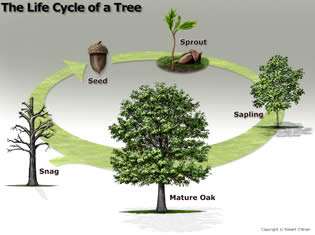
Is an acorn an Oak Tree?
Is a sprout an Oak Tree?
Is a sapling and Oak Tree?
Is a mature oak an Oak Tree?
Is a snag an Oak Tree?
What is a tree is more ambiguous than people imagine.
When we see “acorn” we do not see it as “oak tree”.
When we see “oak tree” we do not see it as “acorn”.
There is no precise moment where a transformation occurs and one is destroyed and the other is created.
They are on the same continuum and one is not different to the other.
The only thing that distinguishes the two in our minds is our belief.
When we internalize this process … we experience authenticity.
I seem to be the only realist left in this forum. For me, idealism does not describe what I experience directly.
Ierrellus,
If one thing I have tried to make clear is the weaknesses of “ism”. I agree with realism in that there is a world independent of the mind. But I don’t know that. I believe that. I agree that truth means correspondence with reality, but as before, I don’t know that, I simply believe that. It is not necessary that there be such correspondence with reality. We see the world static. We see the sun rise in the east and set in the west. This is what we experience and yet it is not corresponding to actual facts.
Suppose you see angels, the way others in the movies could see ghosts, while no one else could see them. How would you determine reality? That’s a funny thing about reality. We don’t always trust our experience (see experiments about social pressure affecting eye-witness) and check with others because we are aware of the fallibility of our senses: “Did you see that?”
The world is not idea. Reality is not idea, but what we think of the world, of reality, the mental picture that “corresponds” is mediated by our senses. The sky is blue to me, but not necessarily to a dog.
K: This idea that reality is mediated by our sense is simply not true. The world is idea.
I know this is hard to do because of who we are but try this.
Pretend you are a baby. for our experiment this baby can walk, but babies don’t walk at 6 months and this
baby is 6 months old.
As a baby, you walk through a room (although at this age, you don’t even know room as a concept)
You walk through this room and (I am looking at my living room right now)
you feet are walking on something that’s hard, then you are walking on something softer,
you have this big thing on the one side and one big thing on the other side. They are facing each other.
and one of the big things is a making disturbing noise. As I walk along, I see something that has very
colorful things on it. Now each thing seems to be shaded differently, it looks different.
Now what really happened. First you walked on hardwood floors than carpet. The two objects
opposite each other are the TV and the couch, then there is a TV tray with remotes on it.
The couch is green whereas the TV is sitting on an entertainment center which is black as the outside
of the TV is black. The TV tray is brown wood. As you walk through the room, you just see objects that
don’t mean anything and why don’t they mean anything? Because you needed concepts to properly
understand what you are looking at. As you walk past the couch, you don’t know what a couch is
unless it is explain to you or you see someone sitting on the couch. It takes context before
something like a couch is recognized otherwise it is just an random object. Once you understand
what the function of a couch is, than and only than will you will able to identify
a couch as a couch. A couch is an idea, not something that is mediated by the senses.
Because as you say, senses can be mislead, you can make a mistake with your sense.
Put 500 different couches in a room and you can tell that they are couches because
you already have an idea of what a couch is. Without this concept of couch, they are just random
objects in a room. Now does this mean Plato is correct in that what we see as couch is
an temporary object, a poor imitation of some eternal couch, the two world theory.
no, there is only one world and this poor couch is the representation of a couch.
There is no couch out there that is the perfect and eternal couch. there is just my couch
and later today, I intend to take a nap on that couch.
Kropotkin
Is there still not awareness of I and it in a baby, even before the it becomes a concept of types of things? (See Piaget on child development.)
Hello PK
As Ierrellus points out the child is not left without an impression simply because he lacks a concept of a couch. What that object looks like is affected by her/her senses. At our level we see a table and feel a table as a very smooth surface but at a smaller scale we find that the surface is rough. So what is the surface of the table like? Well it depends on who or what you ask. The reality of the table, how it appears to our minds, is determined by the situation of our senses.
The acquisition of reality is not impeded. I’m not saying that the child is blind until he/she learns a concept but in fact that even in the absence of a concept and even a sensation, the mind contains pattern with which to order the world.