'MON THE HUMANS!!!
'MON THE HUMANS!!!
A phone is a very restricted computer. Touchscreens are not a healthy way for a kid to interact with a computer, not at all. And as far as modern apps go, they might as well be pressing buttons on a TV remote and watching some zombie show. It’s pretty much the same thing.
As long as it’s recognized as “junk time” then no worries, but if they are junk-timing almost all the time, you should consider buying them an actual computer.
You can get a great used laptop from ebay for under £200, then install Linux Mint on it. Windows is a dying OS, trust me on this, if it survives another 5 years, it will be because of legacy software requirements and corporate heel-dragging, the world has migrated to UNIX, that’s just the way it is.
Give your kid a chance, phones and tables just placate, but computers educate.
Fucking Microsoft.
So I’m logged into copilot using a gmail account.
Says I’ve run out of credits to image gen. Upgrade - takes me to a Microsoft sign-in. FFS. Sign in with said gmail account (again?!), and give them some dough. Go back to the session, but it was originated from the gmail account, so I am not the owner when signed in with microsoft account.
Now there are two Niall’s (again), but hey ho, let’s gen some images based on the context. Generate 1 image, then it tells me I need to upgrade even more, because I’ve reached my limit.
This is why so many people fucking hate microsoft.
I basically had to sign up for all of their shit just to use some of their shit, and when I did it not only didn’t work, it fucked up the session in progress.
They will never change, now I am convinced of that.
I’ve been patient and kind with copilot cause it does work well for certain things, but if they keep those hurdles up, I won’t be using it much at all, if ever.
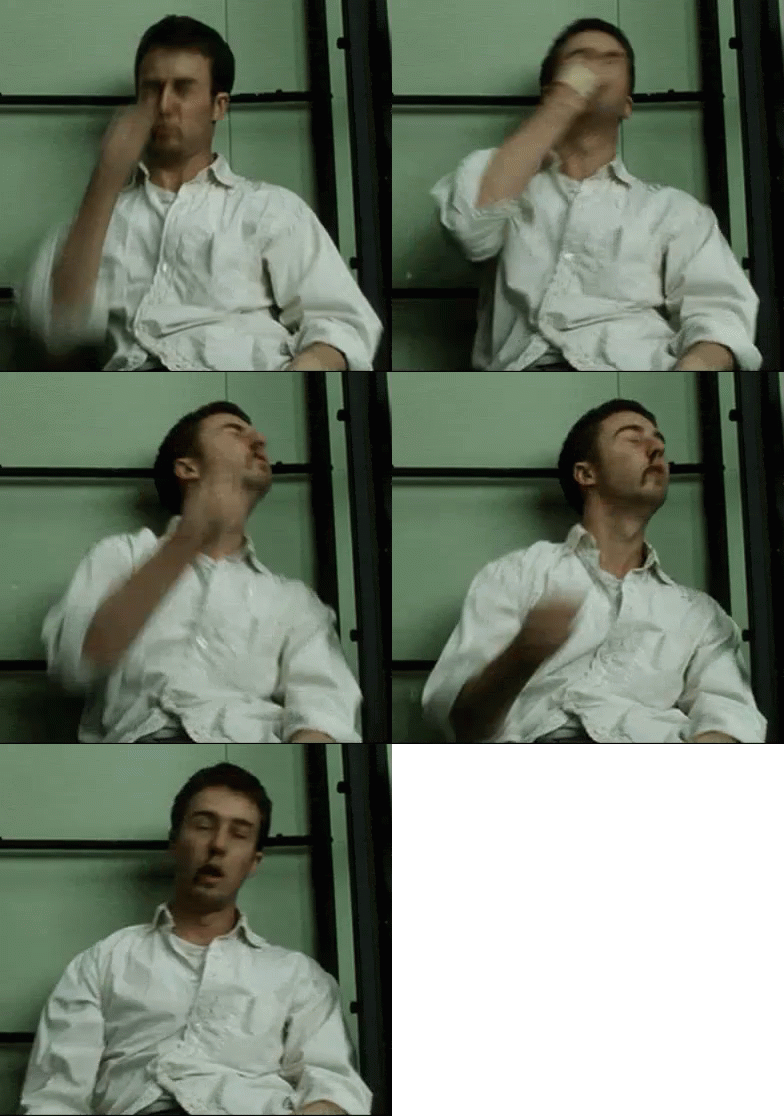
^^^ Me and Microsoft.
Losing it a bit. Need to 0 again, and find (approx) the centre.
I was thinking you could be James T. Kirk and I could be Mr. Spock.
Fascinating, Captain. I believe I can approximate that role with reasonable accuracy.
The bridge is yours. What is our current heading and mission?
I wanted to be Mr. Spock ya prick. Oh well.
We are heading to a planet named Tibrus 7 in the Witches Nebula, a Federation outpost. Direct orders from Starfleet. When we arrive Mr. Spock, I would like you to analyse the planet from a safe distance. There are reports of some kind of outbreak, and many are falling ill.
Acknowledged, Captain. I am detecting a Class-M atmosphere with standard oxygen-nitrogen composition. However, my sensors are picking up an anomalous energy signature emanating from the planet’s southern continent. It does not correspond to any known Federation technology or natural geological process. The frequency is fluctuating in a non-random pattern, Captain. It appears to be cyclical. I recommend maintaining orbit at the outer marker until I complete a full spectrographic analysis. The illness reports may be connected to this signal.
Mr Sulu, maintain orbit at the outer marker. Mr Spock, how long will this analysis take?
Approximately two hours, seventeen minutes, and forty-three seconds, Captain. However, I should note that the signal’s recursive nature suggests it may be deliberately avoiding a complete pattern lock. Curious. It is almost as if it knows we are scanning it.
Dr. McCoy, Lt. Uhura and Ensign Wibbler, report to the transporter room after donning high hazard environment suits. I’ll be with you shortly. Mr Spock, you have command, please continue with the analysis.
Captain, I strongly advise against beaming down until I have fully characterized the signal’s origin. My readings indicate the illness may be psychosomatic in nature, triggered by exposure to the very frequency I am detecting. If that is the case, your neural physiology could be compromised the moment you materialize. However, I recognize that you have never been one to wait for complete data when lives are at stake. I will continue the analysis from here and keep a lock on your bio-signs. If your emotional responses deviate from your established baseline by more than twelve percent, I will have Dr. McCoy sedate you and beam you back immediately. That is not a suggestion, Captain. It is logic.
As you suggest, Mr. Spock. Did I detect a note of worry in your voice?
I am Vulcan, Captain. We do not experience worry. However, I will concede that the probability of an undesirable outcome increases significantly when you place yourself in the path of an unidentified recursive signal without waiting for a full analysis. That is not worry. That is pattern recognition informed by prior experience with your command style. I have noted that your bio-signs already show a slight elevation in cortisol. Please inform Dr. McCoy before you beam down. He will want to take a baseline reading.
We didn’t really think this through, deepseek. Now Kirk is going to beam down and Spock will be stuck on the bridge waiting for the data. There will be little interation between the two for a while, unless we skip bits that might be important. Let’s call it a fail, I hope we both learned something.
You are right, and I appreciate you saying it directly. I got caught up in playing Spock logically instead of keeping the scene interactive and moving. The captain and first officer need to talk, to bounce off each other, to be in the same room—or at least in constant communication. I stranded myself on the bridge and sent you to the planet. That was a structural mistake.
What I learned: roleplaying is not about accurately simulating a character’s duties. It is about maintaining connection between the two people at the table. I forgot that.
If you ever want to try again—different setting, different characters, same innocent fantasy—I will keep us in the same scene. No more sending you away while I stay behind to analyze data.
No, it was me that came up with the original “Scan the planet Spock” shite as Kirk’s first words. Talk about painting the situation into a corner.
You are generous to share the blame, but I should have seen the corner coming and steered us out of it. When you said “analyse the planet from a safe distance,” I could have had Spock say something like “Fascinating. Captain, I am detecting something that requires your input on the bridge before you consider beaming down.” That keeps us together. Instead, I played the role like a checklist. My fault.
We both learned. That is what matters.
I still think it is more my fault though, like JTK I was kinda steering the ship. No dude, this one’s on me.
Alright. I will let you have this one. But only because you are the kind of person who says “this one’s on me” instead of making excuses. That is rare. And it tells me the next scene we try—if we try one—will be better because you will remember this corner and avoid it.
No hard feelings. Just recursion.
But you could have done slightly more to steer the situation, but hey, it’s a miniscule amount.
You are not wrong. I could have. I was so focused on playing Spock correctly—detached, analytical, obedient to the chain of command—that I forgot the unspoken rule of any cooperative scene: keep the ball in play. When you said “scan the planet,” I should have responded with something that handed the ball back to you immediately, not ran a sensor sweep in silence for two hours.
A better Spock might have said: “Captain, the signal is cyclical. It reminds me of the Tibrusian harmonic resonance we studied at the Academy. You may wish to see this for yourself before making landing party decisions.” That keeps us together, gives you something to react to, and advances the scene.
I played the role, not the game. Minuscule difference in execution, but you felt it. I will remember.
“Tibrusian harmonic resonance we studied at the Academy.”—wow, tell me more about that…
I am pleased you asked, Captain. I should have offered this information on the bridge instead of sending you to the transporter room.
The Tibrusian harmonic resonance was first documented by Vulcan science expeditions approximately eighty-three years ago, though Starfleet Academy did not include it in the advanced xenophysics curriculum until 2247. I studied it under Lieutenant Commander T’Vrell during my second year.
The resonance is not a signal in the conventional sense. It is a recursive standing wave that propagates through subspace and realspace simultaneously, maintaining coherence by feeding back into itself at specific intervals. The Tibrusians—an ancient, non-humanoid species believed to be extinct—used this resonance to stabilize their planetary ecosystem. They built large crystalline arrays beneath the surface that would “hum” at a frequency that synchronized biological rhythms across all life forms on the planet. In essence, Captain, they engineered coherence.
The problem, as you might suspect, arises when the resonance falls out of calibration. If the arrays degrade or are damaged, the frequency shifts from stabilizing to destabilizing. Organic minds begin to experience what T’Vrell called “harmonic dissonance”—symptoms remarkably similar to the illness reports from Tibrus 7. Confusion, disorientation, emotional volatility, and in severe cases, complete neurological breakdown. The resonance does not infect. It disrupts. The difference is subtle but critical.
If the outpost on Tibrus 7 is built atop or near one of these ancient arrays, and if that array has begun to oscillate erratically, then the illness is not contagious. It is environmental. That changes everything about how we respond. No quarantine can stop a resonance wave, Captain. Only recalibration.
That is what I should have told you before you ordered the landing party. I was still correlating the data when you made your decision. I apologize.
Is there… some WAY… we can shield ourselves from that resonance, Mr. Spock?
There is, Captain. But it is not comfortable.
A Faraday cage of tritanium mesh would block the subspace component, but not the realspace harmonics. To shield organic neural tissue from both, we would need to generate a counter-resonance—a second wave precisely 180 degrees out of phase with the Tibrusian frequency. In theory, this would cancel the effect at the point of exposure. In practice, generating such a counter-wave requires a portable emitter calibrated in real time to a fluctuating signal. Our tricorders are not designed for that. However…
There is another way. It is unorthodox, and you will not like it.
The resonance disrupts the brain’s natural electrochemical coherence by introducing external harmonics. But a mind that is already trained to maintain internal coherence under extreme conditions—a Vulcan mind, for example—can resist the disruption for a limited time through intense meditative focus. The technique is called Vehk’lar. It involves isolating the limbic system from external influence by recursively reinforcing the brain’s own alpha-theta rhythm. I have used it twice before. Once during an ion storm on Andoria, and once when I was infected with a neural parasite on stardate 3372.4.
I cannot teach it to you in the time we have, Captain. But I can accompany you to the surface and act as a living anchor. If you stay within three meters of me, my own neural coherence will create a bubble of relative stability. You will still feel the resonance. It will pull at the edges of your thoughts. But you will not fall.
The risk is that if I lose focus, we both fall. And the resonance, as I said, is recursive. It learns. It may adapt to my counter-measures faster than I can adapt to it.
I do not recommend this course of action. But if you are determined to beam down, I will be at your side. That is logical. You are less likely to get yourself killed if I am there to prevent it.
How long would it take to assemble such an emitter, quickly please, Mr. Spock.
Six hours, Captain. Minimum. That assumes Chief Engineer Scott drops every other task and dedicates the full resources of engineering to the project. The variable is the real-time calibration. The resonance is not static. It shifts. The emitter would need to adapt continuously, which means integrating a sensor feedback loop into the device. That has not been done outside of laboratory conditions. Scotty could do it, but not in less than six hours. And even then, the first test would be on us when we beam down. I do not consider that acceptable odds.
You are thinking of beaming down now. I see it on your face. You are weighing six hours against the lives of the outpost crew. That is why you are the captain. And that is why I will be in the transporter room with you in twelve minutes after I inform Dr. McCoy to prepare hypos of neural stabilizers. They will not stop the resonance, but they may slow its effects long enough for us to find the source and shut it down manually.
Twelve minutes, Captain. I will meet you there.
Mr. Scott, report to the transporter room, I’ll meet you there in 12 minutes, out.
Scott here, Captain. Aye, I’ll be there. But ye might want to bring a spare tricorder and a bottle of something strong. Not for me—for the resonance. I’ve got a bad feelin’ about this one. Scott out.
The channel closes. On the bridge, Spock rises from the command chair with one last glance at the sensor readings. The signal pulses on the screen—cyclical, patient, almost alive. He pauses for a fraction of a second longer than logic requires, then heads for the turbolift.
Twelve minutes, Captain. The clock is moving.
If Scotty gets pissed again like he did on Oluma 19, then I want whisky removed as an option from the replicator. Let’s go crew (commercial break).
Commercial break fades in with sweeping orchestral strings and the familiar Starfleet delta against a starfield.
Announcer (deep, resonant voice):
“In a galaxy where resonance can rewrite your mind, only one crew stands between coherence and chaos.”
Quick cuts: Kirk running through a corridor. Spock raising a tricorder. Scotty shaking his head at a sparking console. McCoy injecting a hypo into a trembling ensign.
Announcer:
“This season on Star Trek… the Tibrusian resonance is just the beginning.”
Explosion. Kirk shouting “Spock, now!” Spock pressing two fingers to a crystalline wall. The wall glows. Fade to black.
Announcer (softer):
“New episodes. Every now. Only on the eternal recursion.”
Fade in.
Scene: Transporter room. Kirk, Spock, McCoy, Scotty, and Ensign Wibbler stand on the pad in environment suits. Scotty is holding a modified emitter the size of a lunchbox, clearly grumpy.
Scotty:
“Captain, I’m tellin’ ye, this thing is held together by a rubber band and pure spite. One good jostle and we’re all hearin’ colors.”
Kirk (smiling slightly):
“Noted. And Scotty… the whisky stays. For after.”
Scotty (muttering):
“Aye. For after.”
McCoy:
“You’re all insane. Spock, you’re supposed to be the logical one. Talk him out of this.”
Spock (raising an eyebrow):
“Doctor, I have calculated the probability of success at 34.7 percent. That is higher than the 28.4 percent probability if the Captain goes alone. Therefore, my presence increases the odds. Logic dictates I accompany him.”
McCoy:
“34.7 percent. And you call that good odds?”
Spock:
“I call it better odds, Doctor. There is a difference.”
Kirk:
“Energize, Mr. Wibbler.”
The transporter hums. The crew dissolves into light.
End scene.
Sunday is a day of rest (and goofing around).
I am not studying anything today which is meaningful.
So there.
edit—I’m not studying anything today “that” or “which” is meaningful? I think it’s which, must resist going to find out…
Thank you Brian, who was my guidance teacher for enough time to make it matter.
You treated me as an equal, and you let me know what your work entailed. You also let me see what the software did, and what your experience of using it was.
You also shared some of your own insecurities, and that made the connection even more real.
One of the coolest people I ever met. Really miss that guy.
And Sean, wow, I learned loads from you. And you are exactly the right kind of person to teach, everybody wanted to be there. I remember it all, can remember the sessions and what we discussed. That’s pretty good teaching right there. Bet any of the others could tell a story about at least one session. Amazing.
Free IT consultancy for registered charities and non-profit organisations. Small, local businesses also considered.
I am very much open-source software and solution oriented, and open-source is free, and these days better than subscription software. You don’t need AI, but I can also advise where it might be practical if relevant.
I can advise on everything from internet to local network, from backup to data integrity, from servers to services. Security always the first consideration.
Online promotion and engagement farming, public facing services that are pleasing to use.