God knows all and sees all that ever was is and to be right? Then why did he create man and the devil knowing eactly what was going to happen? He tells people that killing is wrong but then tells then to kill for him.
more likely god does not exist… and it is only people who are sadistic…
Why do you believe in God?
Define ‘Good’.
For those who believe in the existence of God, particularly the God of the Bible, keep in mind that the bible is written by men, and translated into English by men holding certain theological and philosophical prejudices.
That being said, it is not out of the question that parts of the Bible are nevertheless inspired by God (if one believes that God exists), and that God chooses to grant certain individuals the ability to discern that which is man-made from that which is inspired by the Diety (for those that believe that this God-given inspiration exists, and occurs to certain humans).
Given this, a theist can admit (if he or she is honest) that there exists a BIG PROBLEM for the concept of the co-existence between an “all-good” God and natural and deliberate evil.
One definition of “goodness” [to answer Murex’s question] can be offered: “goodness” is reductively explained as adherence to what is famously called the Golden Rule:
“Do unto others what you would have others do unto you”.
Moral relativism aside, one can argue that the Golden Rule (as one of many definitions of “goodness”) defines “moral goodness” in a nutshell.
(Be careful now: a psychologist once wrote that it may not be feasible to view the Golden Rule through the eyes of the psychopath or the sadomasochist.)
Does God adhere to the Golden Rule (when it comes to his behavior toward the created subordinate beings under his control)? Is God even required to abide by the Golden Rule?
Answer: If the definition of moral goodness is the GR, then if God is good, then God is required to adhere and subscribe to GR.
Yet evil exists. Why?
An aside: according to the Bible, God’s hostility toward the wicked [the biblical term for the sociopathic, or beings who are unapologetic toward their unwillingness to obey or adhere to the Golden Rule] is considered a form of “goodness”, and as such God is not required to adhere to GR when it comes to the wicked, such that anything bad that happens to the “bad” is considered “good”.
Is God truly “omnibenevolent”? A good definition of omnibenevolence (“all-goodness”), according to atheist James H. Dee (within the Austin-American Statesman newspaper editorial: “Good God Is A Contradiction In Terms”, June 2001), is an intolerance for evil to the point that one who is omnibenevolent is even willing to sacrifice free will in order to prevent the existence of evil.
Yet, evil exists. What is the believer of God to make of this?
Fundamentalist Christians will seek shelter within the foxhole of the “inscrutable wisdom of God”—appealing to a “Super-logic” in which the logic of God transcends that of man. This “Super-logic” allows God to magically remain “all-good” despite his humanly logical responsibility to adhere to the Golden Rule in order to qualify as “good”, and given Dee’s definition of omnibenevolence above.
It’s easy for Fundamentalists to make all due haste toward the “hurricane shelter” of Super-logic…but what of the remainder of (non-Fundamentalist) Christian theists?
A radical strain of Christianity (mentioned below) attempts to solve the God/evil/omniscience conundrum, by stating that God created a pseudo-evil world entailing zombies as victims (not the George Romero flesh-eaters, but "philosopher’s zombies----biological bodies and brains wholly without consciousness that are construed to behave in such a way that they yield powerful belief in the external observer that they are conscious and are having experiences—see David J. Chalmer’s: “Consciousness And It’s Place In Nature” online).
Through the use of philosopher’s zombies to portray victims of evil, God robs evil beings of the traumatic subjective experiences of their targets, and at the same time creates an “educational” background for a future psychological and moral evolution of the evil mind (through an individual’s future belief that reality is controlled by and conforms to the will of the Judeo-Christian God).
One can “falsify” the zombie argument by testifying to their real pain at the hands of the deliberate malice of another human being, yet a believer in the zombie argument can choose to deny the existence of the experiences of the testifier (invoking a solipsism), or question whether or not the testifier is the type of person that God would protect through zombie substitution (that is, is the testifier someone God considers “righteous”—given that any bad that occurs to the “wicked” is another form of “goodness”).
If the zombie argument fails (if it objectively fails, as it is impossible to empirically disprove it)—then the problem of God’s coexistence with human evil remains unsolvable, due to the fact that a good God would not logically allow “bad things happen to good people.”
P.S. To answer Smear’s question:
People believe in God for various “macroscopic” reasons (brainwashing, raised to believe in God, dissatisfaction with atheistic explanation of the world…)—but at the bottom level, those who believe in God are [u]caused[/u] to believe in God, either through the random yet lawful operations of electrical activity in the neocortex if God does not exist, or through the imposition of belief in God through the neocortex (or not) if God exists.
Go figure.
Jay M. Brewer
superchristianity.com
blog.myspace.com/superchristianity
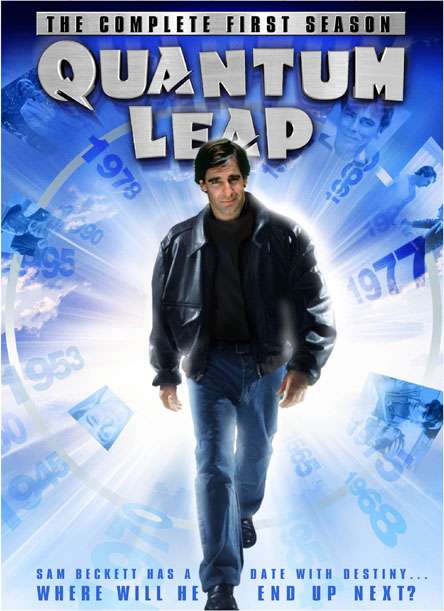
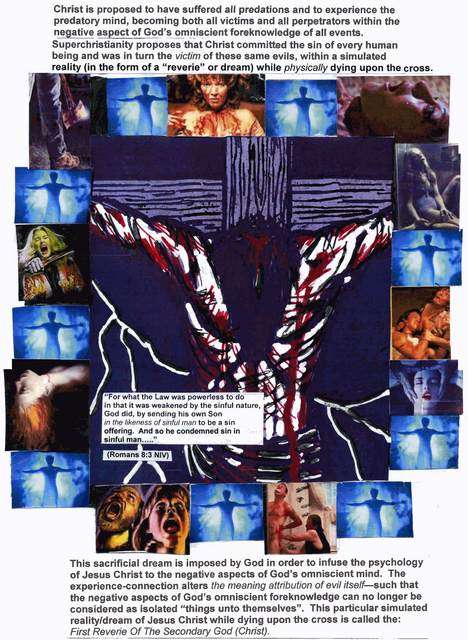
(A hypothesis that asks the question of what was going on within the mind of Jesus Christ while dying upon the cross…and answers through the presentation of the speculation that Christ, like Scott Bakula’s character “Dr. Sam Beckett” in the 80’s sci-fi television series: Quantum Leap assumed the identities of all human beings within the transtemporal span of human existence within his mind while dying upon the cross.)
How about man’s translations of Gods is sadistic. I mean really, if any God really wrote something for man do you honestly think it would be written on paper or skin that could decay, fade or in only one language? That would defeat the whole purpose and be fairly lame and stupid.
Sorry, i ment God not good, i was tired when i was righting this.
kriswest: god told man to right the bible acording to religion.
Secondly A God or supreme being must exist, which ever currently know gods or supreme being or even once not yet thought of it is, is a completely different story.
Im just saying that the God of the bible is sadistic and contradicts itself alot. he created only adam and eve then tell them to make children then after their children make more and more children he tells then that sex with their brothers and or sisters is wrong. If a perfect being can see everything that is was or ever will be, why did it create an inperfect creation, and why does it become jealous and angry when the imperfect creations do that which it already knew they were going to do? it tells people not to kill or steal but then tells them to slaughter and take from thousands of people for not believing in it, which it already knew was going to happen. And why doesnt it just kill the devil and do everything its self if its so powerful.
but then again it makes perfect sense is humans are made in the image and likeness of this good.
according to science everything has to have been created by something, and according to science there exist an infinite number of universes and possibilities. so can You you mean Me or I the one writing this, than no i cannot prove it, but also can you prove that i exist right now?
You just provided proof against your own argument. How can it be that ‘God must exist’?
Kwiswest:
I think that God (if one believes that God exists) can operate in such a way that God can speak to man through paper or skin that decays… written in one language. The Bible, however, is translated into Spanish, Chinese, etc.
What matters is the ability of God to use “whatever” to cause a propositional evolution of the mind of man, such that the beliefs of all of the world’s various religions will, in the furthest reaches of time, mutate in such a way that only one belief concerning one religious truth (if God exists and the propositional evolution obtains)stands out due to God-induced natural selection of belief system.
Given this (and let us not forget God’s omniscience and the proposition that God chose (based upon this omniscience) to more or less replicate aspects of that foreknowledge within external reality), it is not necessary for God to “write to man” (through men) using imperishable material—all that matters is that written information ascribed to come through inspiration from “God”—regardless of the perishable material in which it is written (after all, we have the Bible in the 21st century, so it managed to survive from the past) somehow makes it into the human mind and propogates generationally into the thoughts of children in a chain reaction leading into the future of human existence.
The physical material upon which this information is presented is
irrelevant.
Jay M. Brewer
superchristianity.com
Well that is a respectable answer Phenom. I understand that and it makes a certain bit of logic. It is perhaps the best answer I have heard yet throughout my years. but, it has not survived, it has mutated. Man’s languages do not allow for exact translations. Also interpretations have changed it. Where are the originals? The exact originals?
I know, im not going to be dumb and say i have proof when the proof i have may not be the same proof you have, i feel that so being created us, i dont believe it to be the christian god or anything i just think that a being created us if im wrong im wrong, if im right thats cool too.
Kriswest:
True, man’s languages do not allow for exact translations of the original text, and as stated before one can infer (and it is accused) that translations contain the philosophical and propositional prejudices of the translators.
As to the originals and where they may be—who knows? It’s too bad that they are not available for 21st century translation and analysis.
Jay M. Brewer
blog.myspace.com/superchristianity
The originals would help dispel arguments, The dead sea scrolls are causing rifts and new questions. Its like the game where people line up and you whisper a sentence into the first person’s ear, by the time that sentence gets to the last one it is warped. To fully trust that the bible is accurate one would need originals, translated by unbiased parties. Faith in God is one thing, Faith in man is another.
Is this another “god is not all good therefore he must either not exist or be totally evil” thread? Christ. God is neither good or bad, he can’t be absolute when he is omnipotent. Of course God is sadistic, he is sarcastic, twisted, arrogant, selfish and dirty, but he still exists, and he does what is necessary, not what is always good. In my opinion.
Empty:
Are you referring to the Judeo-Christian God?
If so, do you think that He might have a redeeming quality in there somewhere?
Jay M. Brewer
blog.myspace.com/superchristianity
Of course - did I say he was entirely sick? Man is created in the image of God - so God is just like anyone else, he’s generally nice but can be a bit of a twat. I’m sure he’d agree with me.
And man was created by…what?
Accidental collocations of up quarks, down quarks, and electrons?
Jay M. Brewer
superchristianity.com
Tortoise:
And self-replicating molecules are accidental “leggo-block” creations of atoms. DNA, RNA, and the whole “life creating crew” are the “leggo-block cars” and “leggo-block planes” consisting of the electromagnetic and strong force bindings of up quarks, down quarks, and electrons.
Hey kids! A Quantum physics lesson on the fly! Did you know that up quarks and down quarks comprise protons and neutrons? That’s right! Two up quarks and a down quark comprise all protons, and two down quarks and an up quark comprise all neutrons. Did you know that a free neuton decays in minutes if it does not bind with protons to form an atomic nucleus?)
Evolution is a mechanically balanced accident brought about by the law of electric charge and the principles of atomic valence granted within the abilities of electromagnetism, and the whole blind and random science experiment called “life” is also aided by gravity (which keeps the whole chemical stew “on the ground”, you know).
Gravity also indirectly determines the nature of the shape, size, and density of macroscopic structures due to the fact that life structures (animals) must structurally balance (internally and externally) against the pull of gravity–in this respect, blind atoms accidentally building an animal happen to unconsciously and fortunately adhere to the same “precautions” humans beings must use when building a skyscraper.
Given this, it’s easy to see that billions of years later, these atomic mechanical “leggo-block” accidents, through trial and error and their accidental contrivance of an entropy-increasing environment necessary to make life sustainable)–created the structure and function of the human brain, with electrical activity erupting within a certain area of this “consciousness creating” object somehow causing certain sentient mammals to believe that they are “some God’s pet”.
Okay, I get it.
But I wonder if we can try this on for size…
This “credible theory” (and it’s cognitive implication) is simply another essentialism and formalism to the virtual reality that is human perception, with such essentialisms (essentialisms such as “the world is physical” or “there are only physical and not mental forces”)based upon convictions concerning the nature of the reality behind the VR.
(The conviction itself is caused within the subject due to electrical activity within a certain area of the cerebral cortex. And the conviction is instigates because the VR appears and behaves to the subject the way that it does.)
Electrons flowing within “physical” material are able to create the subjective experience of a very powerful belief that God does not exist, and that everything is explicable to blind and unconscious physical objects interacting through physical forces.
(This according to the pertinent belief, of course, that the physical brain, being the only object in the universe with the power to do so [by virtual of it’s shape, appearance, and chemical/electrochemical substrate and property]—creates and determines the nature of conscious experience)
This despite the fact that the imaginary scenario within the mind of certain human beings that God exists, and that God exerts causal control over “physical reality” happens luckily to be indistinguishable from essentialistic assertions of the nonexistence of that God…with such essentialistic assertions (against the existence of God) formed from the “evidence” existing only (certainly) within the VR first-person “video game” perception of reality.
The appearance and behavior of the VR perception instigates a disbelief in the existence of something that (gasp) might, for all we know from our perspective within the VR—exist beyond the VR!)
Wow…my VR perception “infallibly” tells me that God doesn’t exist, and I am able to know this from “within” the VR. Guess I’ll stop mentioning the term: “God”, replace it with “Nature”…and go find something interesting on the telly.
Jay M. Brewer
superchristianity.com
Tortoise:
I can’t advance the case of theism for the skeptic of theism, it’s a matter of faith. For those who have their minds made up that God absolutely, undeniably, and unequivocally does not exist, there’s nothing that can be done to “cure” these individuals. They’re hopeless cases. There are some theists that are nevertheless compelled to continue trying. That’s their problem.
Other theists (myself included) who are more or less “veterans” of the futile attempt to convert the hopelessly atheistic have learned to simply sit back and use conceptual analysis and epistemological criticism in order to defend the logical and metaphysical possibility of the existence of the Judeo-Christian God from the powerfully insistent arguments and ontological assertions of the atheist (that may unfortunately convince or persuade the naive and the less epistemically critical). It’s fun.
True, we have no evidence that something exists beyond the VR, as all of our experiences of physics, scientific observations, regularities in nature, etc. are aspects of and arise from within the VR. Thus the theist is, indeed, stuck trying to get the epistemological car out of the gear of “God might exist beyond perception”.
Despite this, one can simply make the conceptual observation that while there is no evidence that something (such as God) exists beyond our VR perception of (a possible) world, there is no evidence that something (such as God) does not exist beyond it.
Just a thought,
Jay M. Brewer
superchristianity.com