How Albert Camus did the unthinkable

Albert Camus, the most likable Frenchman to ever walk this earth, was an atheist, an existentialist, an absurdist, and a man who ultimately denied the existence of the supernatural, being rather a creature of the flesh, living in the (then) now, not concerning himself with matters beyond the understanding of a sane man. Yet, Camus was an ethical man, a deeply ethical man, and more, he was an “homme du monde” and a man of action, he set an example of fight, of confrontation with the inexorable, and of a weird optimism about men, which went in opposite direction to most of the philosophies en vogue in his lifetime.

How was that possible?

What has Camus realized that escaped the attention of his contemporaries, even the brightest ones, like Sartre? How has he come to justify the existence of ethics in the world of the absurd? In the world where there is no ultimate consequence to anything a man ever does?

That’s what I’ll endeavor to demonstrate here.

But, first and not least, let’s take a ride to the darkest corners of this little lonely planet we call home. Let’s us establish what we see here, lucidly, before we try to deduce if there’s light to be found within all the darkness that surrounds us here.

Follow me.

1. This little dog-eat-dog world of ours

First, and not least, we must be courageous, and prepare our stomachs.

What we gonna see next is not very pleasant, not that palatable.

The dog-eat-dog world is, more than a planet, a prison. It is a prison to all creatures living on it. A ruthless prison. A no escape prison. Alcatraz magnified by a thousandfold. And what we do here is either fight to run or to remold this prison, either find a way out of it or a way to safeguard our interests, our power, in regard to it and at the same time in total disregard to it, to its nature. In other words, we live, in our prison planet, in a perpetual fight to change its nature, to dramatically alter its cruel face. A struggle to change the prison from within, to make a lair out of it. We want to change the world. Only, we don’t. And we can’t.

For we’re small, the world is big, we’re one, the world is many, is legion. And each attempt of ours to illumine even a tiny fraction of it is severely resisted, and each of our efforts to bring the world to a new age, a new era, of light, of understanding, of peace, is duly resisted, and rejected, by those who are all too satisfied with the darkness in it.

How does morality come to exist in this dark dog-eat-dog world?

Can it come to exist, by the way?

In order to understand morality we need first let it established that, in the dog-eat-dog world, yes,

a) might makes right

and, yes,

b) only the strong survive

If you choose to instant oppose this latter adage, saying, for instance, “there are 8 billions of men in this world, and they are not all strong”, I will say, first try and understand that the word strong can have a different meaning than you generally accept. Defining the word strong as “adapted to live in the dog-eat-dog world”, you’ll conclude that, yes,

only the strong survive.

Nothing has ever contradicted this idea. Nothing ever will.

People just misunderstand both the strong and the survive bit of it.

Now, might makes right, here’s the beginning, and shall I say, the end of morality. All morality. End in both traditional senses of the term: why morality begins, how morality is overcome. “Might” is used for rhyming with right, but we could use power instead. Power makes right. Power imposes morality.

And with it, with the death of it, morality dies.

If we could go back in time, right there at the moment our species started to be organized in tribes, societies, and ultimately, in “civilizations”, and we could observe, as eye-witnesses, what we had before someone was powerful, mighty enough to impose a moral code on others, on a whole tribe, a whole society, we would not like much what we’d see, for we tend nowadays to imagine men as essentially “civilized”, as the quintessential social animals. But in those early times, had not some few men realized might makes right, ie, that they needed to impose, by force, rules for all others to follow, unless society was to implode, human-kind would not have survived much longer than its preceding apish relatives.

Each tribe, each society and, ultimately, each civilization, had to encode its own set of laws to ensure survival. And such laws, arbitrary or inhumane as they might seem when observed through our 20/20 lenses, were not evil or bad per se, they were what the minds of these our predecessors seemed as necessary to fight the chaos that would result in there being no laws at all. It was either a rigid moral code, a rigid set of oughts and shoulds, or barbarism, dissolution.

A society that gave up on its own strict moral code was on the

verge of extinction. It would soon be overcome by another, if not another race, another tribe, at least another form of that same civilization, which would have little, or nothing, in common with its preceding form. So, yes, when a given human group gives up on its own morality, it gives up on itself. What happened many times in the long history of the human-kind.

What was the essential difference between the Hammurabi’s Code, the Mosaic Law, the lex romana, and each and every other legal code of ancient peoples? Some were, say, less rigid, less “an eye for an eye” than others. Yet, all of them were very much alike in one sense: they would brook no disobedience. Such rigidity, necessary as it was to ensure that group’s survival, was also ultimately what would lead such codes to be overcome by time. Even though the Christian doctrine came to, say, “improve” Moses’ strict set of “thou shalt nots”, with a more “humane” approach, we must remember that “Do not think that I have come to abolish the law or the prophets; I have come not to abolish but to fulfill it.” Ie, Jesus, the prophet of peace, came to give a broader, more “humane” approach to the same commandments of Moses, only, now, including all humans, not only the Jews, among the ones who would have to believe in all the old “thou shalt nots”, if they aimed to achieve redemption.

The Middle Ages have show how strict the religion of love could become. The Crusades were further demonstration of what the Inquisition had already so effusively shown, ie, that Christians also believe that

might makes right .

But not only Christians. Jews, of course, Muslims, Encyclopedists (just ask Voltaire), Marxists, Positivists, Democrats, Liberals and Conservatives, all social reformers, of any kind, all are, in one way or another, firm believers that might makes right. They just differ in how they understand or define might. But whether power emerges from nature or is imposed “from above”, by God, whether it’s the will of “the people”, of the “sovereign” or of some brilliant, elected few (Plato, Nietzsche), only one thing is unalterable when you choose one code, one system over another: might makes right. For the individual, nothing changes. Whether he’s to serve God or “the people”, it’s the same: something external to him is dictating his every step.

For the moral code starts as a fight against egoism, individual egoism, and doesn’t care if it is just an imposition of the egoism of the group over the singular being, ie, just a confirmation of the absolute prevalence of egoism in the realm of the human. What is better, more justifiable, the survival of the individual or of the collective to which the individual belongs and on which he depends? Also, how can a society protect itself, egoistically, against other societies which will try to crush it? If it’s internally broken, divided, it can’t last long. So, the more imperiled a society would be, the more rigidly it would have to impose its morality on its members. Otherwise, the subject itself would help in the ultimate collapse of his whole civilization. Rome is a

shining example of that. Some of its emperors were highly individualistic and egocentric individuals who cared about nothing but themselves. The result was obvious.

But what did I say, the extreme rigidity of a given moral code is also responsible for its ultimate downfall. By believing that might is necessary to ensure obedience to certain laws and rules, and not to others, and that such laws and rules must be strict, impervious to erosion by the passing of time or the contact with other peoples, other moralities, when the inevitable occurs, and the fight to see who is the top dog in the dog-eat-dog world, which is all too human and all too frequent, begins, the ones who can’t adapt to the change in status quo perish, and often, with them, their whole civilization.

You would have to be wise, cunning as a Jew, to be able to withstand the passing of time and the many changes in the form of societies that time brings about.

It’s by power that morality is enforced. It’s by power it’s overcome.

Not only power external to the society. Also, power that arises within the heart of this same society, whether it’s a group of individuals bold enough to go and alter radically its status quo or a single man who decides that the strict moral rules of his society mean nothing to him. In this process, the individual annihilates society. It becomes meaningless to him, at least as an enforcer of rules. This self conscious subject can become a Nero, for instance. His existence itself was a denial of Rome. Everything Rome embodied, he despised. Everything he loved in life, was unacceptable to Rome. Yet, he ruled Rome. He somehow came to be the top dog in Rome. They did not realized, till it was too late, that they were being ruled by their biggest denier.

Of course, not all individuals who overcome the need to adhere to the strict moral code and tenets of their civilization will be like Nero. What’s important is to notice this, and always keep it in mind: the individual, in and by himself, is the refusal, the negation of society, of his and of any society. The individual is the product of a given society, a given civilization, and is also ultimately the embodiment of denial of this same collective to which, he can come to realize, he only accidentally belongs.

So is born revolution. So is born nihilism. So is born egoism.

In this dog-eat-dog world power is then the sine qua non condition for any change, any reform, be it collective, be it personal, and the only thing left for the powerless ones is complaint. The internet is here to show how complaint, impotent complaint, is almost an addiction to many nowadays. Why do they rebel against what they can’t change? Because they’re individuals, and they refuse to adhere to the conformity, the obedience, which their civilization demands of them. What their constant complaining entails is a will to reform, and/or ultimately deny, their whole civilization. This civilization has failed to give them a sense of purpose. So they either attack it non stop or dream of overcoming it, dream of “other times, another world”, where, so they believe, their inner discontent would meet an end. Only, they are incapable of realizing that, being self-conscious individuals, they’d be discontent everywhere, anywhere. Because everywhere they would have to submit to rules not made by or for them, everywhere they would have to feign obedience to a strict moral code which, for them, would appear arbitrary and meaningless.

Now, the second thing I said applies to our human reality is

only the strong survive

We could break this adage in two parts: only the strong survive and only the strongest survive. There’s a slight difference. Strongest is the most strong that there is. It implies that, in this all against all struggle for life that happens in this world, this bellum omnium contra omnes, not only there is a struggle to establish, to separate, who is strong from who is weak, but also who are the stronger among the strong. Who will serve and who will lead. Nature is inclement and will always be. It cares nothing about our “feelings”. Countless beings have been “removed” from it for not being able to withstand the minimal requirements for survival. The most basic of which is adaptability. The capacity to adapt to a different environment or different circumstances. The human species is notorious for being the most adaptable of all. And it’s in it we find the most notorious example of bellum omnium contra omnes. Individuals fighting among themselves. Tribes fighting among themselves. Nations fighting among themselves. All with the same blind purpose: to continue existing. Sine die. When individuals or tribes collide, they do not realize that they’re actually fighting to safeguard the species’ survival. And they don’t care. Because for them what matters is their own selfish survival. So within any little group men fight for survival, fight to see who’s the top dog, who will eat better, who’ll have the best females. And within the bigger groups there is the same incessant fight, one tribe trying to outdo the others in their eagerness for, merely, surviving. Nations fight among themselves, civilizations too.

Bellum omnium contra omnes .

Morality is not involved in any of this, let alone “humanitarianism”. For each tribe, each nation, the concept of “human” is synonym with the way the tribe calls itself. In many ancient nations, the name of the group is a synonym for “human being”, in the sense that, to be “human” is to be part of that group. All who are not part of it are not truly “human”.

Which explains why within any society or civilization there exists always that notion of perfection, that there we have the best, the true civilization, all others being insignificant in comparison to it. The North American superiority complex echoes the Roman superiority complex. Both civilizations see themselves as the epitome of human civilization, as civilization itself. All else is barbarism.

In the same way, on the level of individuals, the fight of all against all is always fought with this one end in sight, an intention of establishing who is the top dog, who is the truly human. So, the individual may care about his nation, his country, but, egoistically, he cares more about himself. To see how he will fare within this society, will he be eating well or will he be eating crumbs? Will he command or obey? Will he be a leader or a servant? That’s what matters most to him, to his mind. Whether his nation, his civilization, or human-kind will benefit from his attitude is indifferent to him.

Fighting for ideas, for religious beliefs, for systems, is no less virulent a fight than fight for food, it’s just less conspicuous. You generally “agree to disagree”, and this apparently indifferent attitude leads some to believe all ideas, all philosophies, are equal to others, equally valid, which is the same as saying: all are meaningless. But, for the individual, fighting for an idea is fighting for his notion of being right, of being better than others, ie, of being stronger, and, preferably, the strongest one there is. If an individual gives up easily on his defense of his ideas, he shows they mean nothing to him. Ok, bro, let’s agree to disagree, you do you, we’re all learning, etc, etc. Very easygoing behavior, but not that honest. For if all ideas are equivalent, why to even bother or discuss about them? Let’s all celebrate! Nope, the subject will always believe his ideas are better, or at least more well formulated, more well backed up than his rival’s ideas. If he didn’t believe that, he wouldn’t fight for them.

Though the struggle for survival amongst individuals was fiercer in ancient times, it’s still present nowadays, only, in subtler ways. The “duels” nowadays are generally fought with words, but words, we know, can be even deadlier than swords. For the human being is the rational animal, that is, the animal who employs reason, through words, for defining and establishing who he is. If a human being cannot firmly defend himself with words, he’s mostly certainly unfit for survival. At least amid his rational fellowmen. He’ll be labeled as an ignoramus, an incompetent, incapable of belonging. We clearly see this happening on the internet, where, in the struggle for survival (we fight for it online even through monikers and fake profiles) some are clearly better equipped than others, by getting their point across more easily. Thus gaining more admirers (followers), and therefore more money.

The struggle for survival is alive and well in the “age of the social”.

Fight for survival is fight for establishing who is stronger. The anonymous guy fiercely fighting for his ideas online looks like another loser with no job, nothing better to do in life. Yet, he is fighting for his life, since his ideas (his Weltanschauung) are his life. His ideas are the only thing to separate him from others, in the all-encompassing void of anonymity. That’s why we see people passionately engaged in justifying ludicrous ideas on the internet. They won’t stop no matter what you say. Stopping would mean surrender, what the individual ego can’t cope with. Just as in real life, only death stops the individual, only death makes him give up on his belief of his being the righteous one.

If the human animal is known for his ability in adaptation, this notion is being reinvented nowadays, in the age of social media and AI. Who will survive to see what’s the next stage? Obviously, the strong amongst the currently living. And who will lead the strong ones? The strongest amongst them.

So, after many decades of circumlocution and make believe, feel good rhetoric, we’re still left with the same old adage, to be either accepted or ignored in the name of “humanitarian” concern:

only the strong survive.

If you have followed me this far, you might want to ask me then:

2. “And what should we do, hang ourselves?”

For one, as I clearly stated above, there is no universal, absolute should we ought to follow, all shoulds being related to a specific moral code frozen in time, like all moral codes, whereas we, as living beings, are all but frozen, being rather creatures totally impervious, by our own natures, to the rigidity of a fixed and unalterable moral code.

What modern men, like us, have come to realize is that we can adhere to some or all moral tenets of our modern, “liberal” civilizations, out of sheer convenience. I’d rather say, we can come to pretend to adhere to such tenets, while, internally, they might mean nothing to us.

So, say, our Western civilization is nowadays firmly imbued with the idea of politically correct talk and deed. But, here, on the internet, all we see are people complaining of PC, as if, by only erasing it from our minds, we’d go back to some imaginary golden days in this dog-eat-dog world. Yet we are all, all, forced to pretend respect for the politically correct, at least in our “social” lives. But here we are, and here is where the individual reveals himself, and separates himself from the collective, from the “hive mind”. The hive mind says we are to be politically correct. Our mind refuses this idea, this moral obligation. The absurd in it is patent to our eyes, but we don’t have the power to overthrow, to end the PC mentality. It’s only natural, then, that some might adhere fanatically to some top dog who pretends to be nothing but an embodiment of an anti-politically correct mindset. The rise of “right-wing” anti-PC leaders like you-know-who is a sign that some wise guys know how to take full advantage of this current anti-PC trend. Yet, the enchantment with such top dogs only goes till the thinking subject realizes that

he’s also a defender of a rigid moral code, he’s also a proponent of his own politically correct, and woe to him who is against this new limited view on things!!

So, some start by critizing the politically correct, and thus embrace a “leader” who is apparently the opposite of PC, but this “leader” is also essentially PC, he just redefines what is PC, what’s the new politically correct for all.

Let’s look at things from another angle.

We know how Christianity is a religion of “tolerance”. This religion was born out of “love” for the totality of mankind. Christians “love” and “tolerate” all and encourage us to “love” and “tolerate” all, but only until the point it becomes the “all in all” in society. Then the “tolerance” is really revealed. The most, say, “verbal” Christians of today are not any different from Calvin or the inquisitors. Their intentions are clear: Christianity is not one religion among many, it’s the one true religion. Which entails: all other religions are wrong. Not “relatively” wrong, but absolutely wrong .

So, when the anti-PC discontent adheres to some right-wing cultish figure as a “savior” from what he sees as an intolerable, décadence mindset, he’s really embracing someone who thinks he’s absolutely right and whose ideas (and moral rules) are absolutely right, brooking no doubt or questioning.

He’s also, unconsciously (?), adhering to yet another might makes right mindset, and his religious fervor denounces this clearly, for he sees his totemic “leader” as the one powerful enough to smash the much despised politically correct.

I mentioned right-wing, but the self-conscious and self-respecting individual, is in no better hands when he blindly adhere to left wing, ie, socialist, collective thinking. Just as the RW, the leftist also wants to “reform” society for the better, and, hopefully, the entirety of the dog-eat-dog world. He generally sees capitalism as an enemy to be overcome. With this end in mind, he would, according to his own strict code of shoulds and

oughts , go to any extreme, as long as the final “victory” of socialism was secured. The socialist wants to change society “for the better”, concerned, as he is, with the downtrodden and the poor. He is concerned with the “good of all”, his ultimate dream being the union of all human beings in a big, planet-size happy family. John Lennon style. Except, he never consults anyone about this, he doesn’t care if one, some, many or most don’t want this imaginary paradise he has to sell. His “good intentions” are all that matter. In fact, in reality, the socialist is another egoistic man who would love to impose his worldview on all others. Only, he can’t. Thankfully.

These two extremes, rightists and leftists, different as they might look at first glance, are facets of one and the same thing in the end. They antagonize the self-conscious subject with equal intensity. I can, as a thinking man, see both the good and the bad side of the right and the left. The proponents of such ideologies can’t. They see the world in black and white. For the RW, “communism” is the evil, for the LW, it’s the “capital”, ie, money. Just find a way, through might, of sharing the money equally among all: the socialist will finally be satisfied. Which is the same as saying he will never be satisfied. But the rightist can never be satisfied either. For he fights against a phantom in his head, “communism”. A phantom cannot be vanquished, for it doesn’t exist, so the rightist will spend the rest of his days chasing a fixed idea in his head.

Beneath all this political rhetoric, this apparent fight for a “better” society, there lies the old adage, only the strong survive, and so the individual is actually fighting for his survival first and foremost even when he seems to be the most detached, the most “humanitarian” one. It’s just that, being “right(eous)” is much better when you are “right(eous)” in front of an applauding crowd. It is wonderful for the ego. When others applaud and endorse your beliefs and delusions, ludicrous as they may be, you feel somewhat justified, and you go on, fighting against windmills and dreaming of a “better” world that, hopefully, will never come.

So your present egoism is preserved sine die.

But some may ask, quid facere?

Well, the advisable (notice I’m not using some should) thing for the conscious individual to do is, first and foremost, to open his eyes, see the world around him, accept its cruel nature, its prison nature, that there’s nowhere for him to run to, and concentrate on fighting the things that help to make things in this world ten times worse than they would be naturally. The individual already faces a great difficulty in affirming himself, in imposing himself as someone independent without having to adhere to some black or white mentality like both the right wing and the left wing ones are. Rightism and Leftism just make things worse, by perpetuating the problems both feign to fight against. Both parasitize each other. Both will never go away as they depend on the enemy for existing. If the big villain, the “capital” would cease to be a problem, the socialist would lose his reason for being. So he, intimately, doesn’t want what he openly pretends to want. His real pleasure is to exist in opposition to what is, to the society he lives in. Once the opposition is gone, his existence becomes void. The realization of the ideal is the destruction of the ideal.

Same reasoning applies, mutatis mutandis, to basically all born discontents.

Now, some could ask me, what’s the place of Albert Camus in all of this?

That’s what I try to answer next.
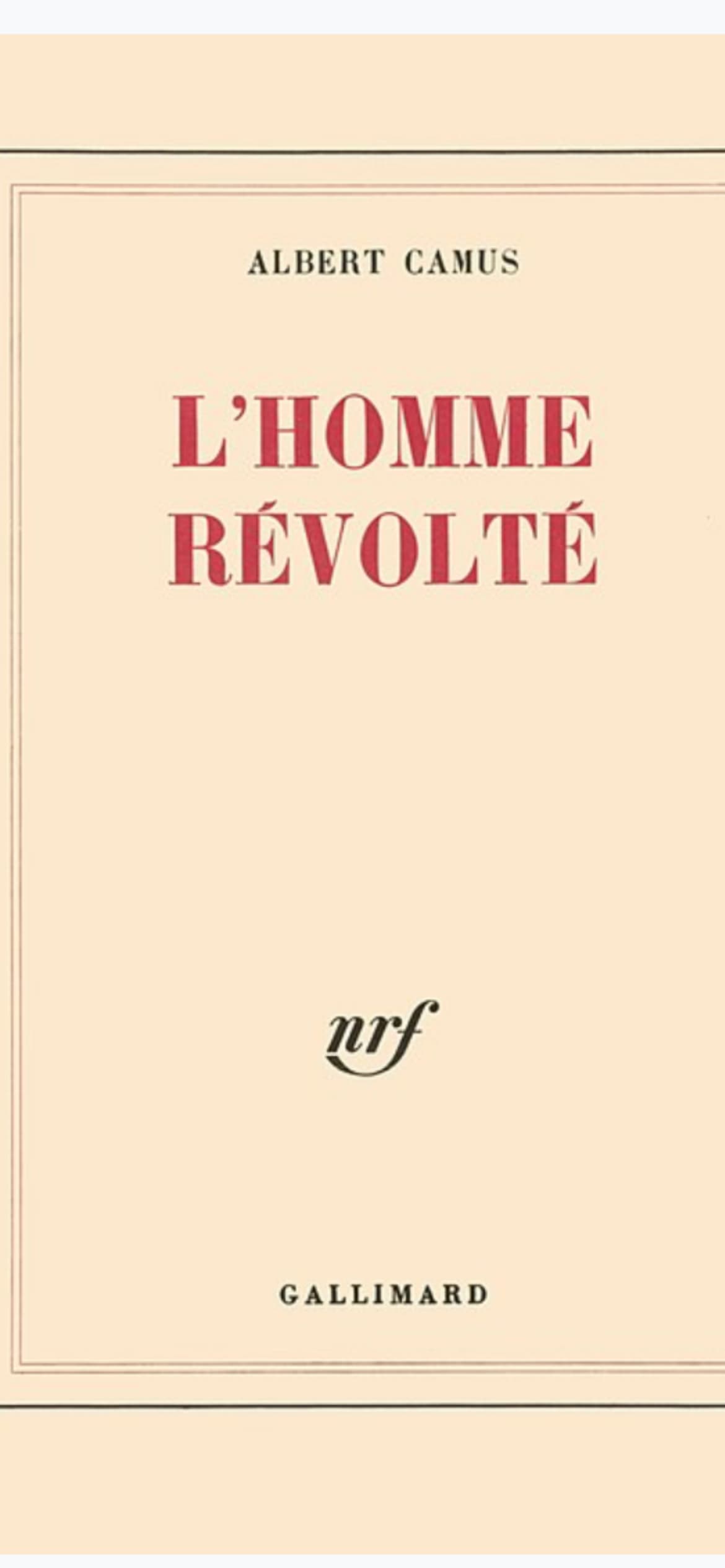
3. Camus, the Strange Rebel

When Albert Camus published The Rebel, in 1951, he had had the opportunity to watch the rise of three totalitarian -isms which were, in a certain sense, his primary targets on the book:

Socialism.

Fascism.

Nazism.

Having actively fought against the Nazis, seen what these did to his country (France), he was, then, confronted with the implications of his former friend and ally Jean-Paul Sartre’s defense of Socialism, something which apparently contradicted the existentialist philosophy both Camus and Sartre defended. This book ended up being the reason why the two French giants

went separate ways thenceforward. A reading of it shows who’s the true winner of the “duel”.

Having had to deal with the rise of the three most vicious -isms in the history of men, Camus observed how such systems, being the embodiment of totalitarian black/white thinking, led to a complete apathy, a complete indifference towards suffering and death:

“Fascism wants to establish the advent of the Nietzschean superman. It immediately discovers that God, if He exists, may well be this or that, but He is primarily the master of death. If man wants to become God, he arrogates to himself the power of life or death over others. Manufacturer of corpses and of sub-men, he is a sub-man himself and not God, but the ignoble servant of death, content of rebellion.”

Fascism [Nazism is also meant by the concept] leads to a glorification of death. Since the superman (the immoral man) is the new God on earth, he won’t need to justify his actions- being a superman necessarily entails he has no need for justification. Just like God will “condemn” most men to eternal death post mortem, the living human God condemns real men to death and has no reason at all to feel ashamed about it. His own notion of being superior and of being helping nature is justification enough to his mind.

Can we ultimately condemn Fascism/Nazism? Do we have a firm moral basis to do so? Camus believes we have, though, as I will comment later, this is the weakest aspect of his thesis in The Rebel.

For Camus, rebellion is an essential concept. More important than his notion of the absurd. This, in brief, is the notion that, without a God, or ultimate values to hold on to, the individual finds himself, all the time, aware of the utter meaninglessness of everything, including his own actions. But his actions are meaningless in so far as there is no ultimate (transcendental) consequence for them, like for the Christian, whose every action is “watched” by God and will bear significance when “Judgment Day” comes. The absurd man, however, incapable as he is of attributing ulterior significance to things, lives in the now, in the present moment, and is nothing more, nothing less, than the Camusian name for your average man on the street. The guy busy with everyday life, who may sometimes even ponder why things are what they are, but has a life to take care of, and so, like Mersault (The Stranger), “just” goes on living, as he has nothing else to do. As for rebellion, Camus defines it as a “long adventure”. The long adventure of the conscious, questioning individual, in his fight to establish, to safeguard, the little pieces of freedom, and comprehension, he can gather in this world. The rebel is not a fighter for absolute notions of what is right and what is wrong. Heʼs not a champion of relativism either (in the sense that all beliefs might be equivalent). Rather, while believing in the precariousness of human knowledge, he realizes itʼs impossible to establish an once and for all valid explanation or justification to things, so he attaches himself to a position that ensures men will continue to be able to doubt, to question, to be ignorant, to keep on searching for meaning to the very end. Totalitarian, dogmatic, authoritarian mindsets, most systems then, are anathema to him, because they suffocate thinking at its core.

In The Rebel Camus traces the whole itinerary of rebellion from the birth of civilization up to modern times. All the great rebels of history are mentioned, including De Sade, Nietzsche, Dostoyevsky and Stirner. Unfortunately, the few pages dedicated to the latter are the worst of the whole book. Camus entirely misinterpreted Stirner, the quintessential rebel, and was not able to perceive both were so much alike.

In this long history of nonconformity, individuals invariably end up crushed by the whole, by the hive mind. But they always keep on fighting, and as long as there are humans on this world there will be rebellion, there will be rebels. Because the nonconformity is exactly the reaction of individuals against totalitarian, black and white thinking. Black and white, good and evil thinking entails a belief in absolutes. But, Camus argues, the existence of the absolute implies the meaninglessness, the uselessness of all thinking. It’s no surprise totalitarian regimes suppress thinking. They represent some absolute truth, some absolute perception of what is right and what is wrong. Why go on thinking? If the answers are all there, in a book, black or red, why bother with thinking? So, all absolute doctrines necessarily defend and justify suppression of freedom of mind. Christianity, like all absolute beliefs, does the same, though appearing to do the opposite. The liberal Christian, as I said elsewhere, just doesn’t accept that his religion implies some people being absolutely right and some, most, being absolutely wrong.

“In contemplating the results in an act of rebellion we shall have to ask ourselves each time if it remains faithful to its first noble promise or whether it forgets its purpose and plunges into a mire of tyranny and servitude. In Absurdist experience suffering is individual, but from the moment that a movement of rebellion begins, suffering is seen as a collective experience, as the experience of everyone. Therefore the first step towards a mind overwhelmed by the absurdity of things is to realize that this feeling, this strangeness is shared by all men, and the entire human race suffers from a division between itself and the rest of the world.”

That’s often the case with most rebellions. The rebel begins with an honest act of indignation against what he perceives as injustice- and which human system could ever be “just”, given it doesn’t take real flesh and blood humans into account?- and ends up endorsing a system based primarily on revenge against his former “oppressors”. The hero becomes the villain. You become what you hate the most.

In The Rebel Camus makes a critique of the modern world that goes much deeper than Nietzsche could ever hope to do. The German great, while brilliant in every regard, diminished himself as a mere fighter against “nihilism”. It’s like “nihilism” was his favorite fixed idea, his favorite spook, to use Stirner’s term. But Nietzsche, Camus notices, was a nihilist too. He saw no ultimate meaning in human life, except to create the kingdom of the Übermensch upon earth. But in this endeavor:

“In a certain sense, rebellion, with Nietzsche, ends again in the exaltation of evil. The difference is that evil is no longer a revenge. It is accepted as one of the possible aspects of good and, with rather more conviction, as part of destiny [amor fati]. Thus he considers it as something to be avoided and also as a sort of remedy. In Nietzsche’s mind, the only problem was to see that the human spirit bowed proudly to the inevitable. We know, however, his posterity and what kind of politics were to claim the authorization of the man who claimed to be the last antipolitical German. He dreamed of tyrants who were artists. But tyranny comes more naturally than art to mediocre men. “Rather Cesare Borgia than Parsifal,” he exclaimed.”

Which is the same as saying: even the ones who try to “redeem” the decadent world through elitism, through an appeal to nobility, like Nietzsche, end up creating a new, or rather re-establishing an old morality and a new/old division between good and evil people. Only, the good now are the amoral ones, the supermen, and the bad the ones who cling to the old notions of good and bad. Camus’ reference to Nazism is a reminder that the average Nietzschean will only utilize the most mediocre aspects of his philosophy.

It’s important to notice, Camus pretty much recognizes we live in the dog-eat-dog world:

“The appalling society of tyrants and slaves in which we survive will find its death and transfiguration only on the level of creation.”

And that our living on it is essentially an act of surviving, one day at a time. Also, he recognizes we can’t change the world, but can rather find a means of evasion in artistic creation and the appreciation of beauty:

“But hell can endure for only a limited period, and life will begin again one day. History may perhaps have an end; but our task is not to terminate it but to create it, in the image of what we henceforth know to be true. Art, at least, teaches us that man cannot be explained by history alone and that he also finds a reason for his existence in the order of nature. For him, the great god Pan is not dead. His most instinctive act of rebellion, while it affirms the value and the dignity common to all men, obstinately claims, so as to satisfy its hunger for unity, an integral part of the reality whose name is beauty. One can reject all history and yet accept the world of the sea and the stars. The rebels who wish to ignore nature and beauty are condemned to banish from history everything with which they want to construct the dignity of existence and of labor. Every great reformer tries to create in history what Shakespeare, Cervantes, Moliere, and Tolstoy knew how to create: a world always ready to satisfy the hunger for freedom and dignity which every man carries in his heart. Beauty, no doubt, does not make revolutions. But a day will come when revolutions will have need of beauty. The procedure of beauty, which is to contest reality while endowing it with unity, is also the procedure of rebellion. Is it possible eternally to reject injustice without ceasing to acclaim the nature of man and the beauty of the world? Our answer is yes. This ethic, at once unsubmissive and loyal, is in any event the only one that lights the way to a truly realistic revolution. In upholding beauty, we prepare the way for the day of regeneration when civilization will give first place—far ahead of the formal principles and degraded values of history—to this living virtue on which is founded the common dignity of man and the world he lives in, and which we must now define in the face of a world that insults it.”

The rebellion itself is a reaction to ugliness. The rebel himself realizes the world outside is ugly, unfair, cruel, and indifferent to his needs or aspirations. It’s only through creation (and the making of a philosophical system is an act of creation) that man “corrects” nature, positing the notion of a saner, more beautiful alternative. Like when poets daydream about a “better future”- the dream itself is not the problem. Woe to him who wants to take literature from us! The problem is when the creator, the artist, the idealist loses himself in his never-ceasing daydreaming. It’s there that lies the birthplace of tyranny. Because the contrast between the ideal and the real, between the what we envisage in our dreams and what we have to deal with in everyday life is so big, so mind-blowing, that it’s only natural some would prefer the dream, and would do most anything to make this dream come to life.

“Art is the activity that exalts and denies simultaneously. “No artist tolerates reality,” says Nietzsche. That is true, but no artist can get along without reality. Artistic creation is a demand for unity and a rejection of the world. But it rejects the world on account of what it lacks and in the name of what it sometimes is. Rebellion can be observed here in its pure state and in its original complexities. Thus art should give us a final perspective on the content of rebellion.”

The artist is the quintessential rebel. I’d rather say, he’s the embodiment of Stirner’s Unique. He exists in a perpetual state of contrast- like the Unique exists between his own affirmation of existence and the need to recognize that most of existence is not him, is outside of him. Ie, in contrast between the man he is and the social animal (the number) he is too. What Camus labels here as reality we could also call the outside world. The world outside one’s own inner desert. Without reality (“the others”) to serve as contrast, the artist (and the Unique) dies, disappears, loses his raison d’être. He exists in opposition. Like the quintessential rebel that he is.

Camus is, then, a sworn enemy to each and all doctrines which try to enslave the individuals, the flesh and blood men, in the name of some absolute, be it God, be it the State, “the people” or “the future”. He’s perfectly aware that all these are abstractions, concepts within our minds, while our suffering for and because of them is all too real:

“It contrives the acceptance of injustice, crime, and falsehood by the promise of a miracle. Still greater production, still more power, uninterrupted labor, incessant suffering, permanent war, and then a moment will come when universal bondage in the totalitarian empire will be miraculously changed into its opposite: free leisure in a universal republic. Pseudo-revolutionary mystification has now acquired a formula: all freedom must be crushed in order to conquer the empire, and one day the empire will be the equivalent of freedom. And so the way to unity passes through totality.[…]Totality is, in effect, nothing other than the ancient dream of unity common to both believers and rebels, but projected horizontally onto an earth deprived of God. To renounce every value, therefore, amounts to renouncing rebellion in order to accept the Empire and slavery. Criticism of formal values cannot pass over the concept of freedom. Once the impossibility has been recognized of creating, by means of the forces of rebellion alone, the free individual of whom the romantics dreamed, freedom itself has also been incorporated in the movement of history. It has become freedom fighting for existence, which, in order to exist, must create itself. Identified with the dynamism of history, it cannot play its proper role until history comes to a stop, in the realization of the Universal City. Until then, every one of its victories will lead to an antithesis that will render it pointless. The German nation frees itself from its oppressors, but at the price of the freedom of every German. The individuals under a totalitarian regime are not free, even though man in the collective sense is free. Finally, when the Empire delivers the entire human species, freedom will reign over herds of slaves, who at least will be free in relation to God and, in general, in relation to every kind of transcendence. The dialectic miracle, the transformation of quantity into quality, is explained here: it is the decision to call total servitude freedom. Moreover, as in all the examples cited by Hegel and Marx, there is no objective transformation, but only a subjective change of denomination. In other words, there is no miracle. If the only hope of nihilism lies in thinking that millions of slaves can one day constitute a humanity which will be freed forever, then history is nothing but a desperate dream. Historical thought was to deliver man from subjection to a divinity; but this liberation demanded of him the most absolute subjection to historical evolution. Then man takes refuge in the permanence of the party in the same way that he formerly prostrated himself before the altar. That is why the era which dares to claim that it is the most rebellious that has ever existed only offers a choice of various types of conformity. The real passion of the twentieth century is servitude.”

Servitude in the name of an ideal, whatever ideal. It doesn’t matter if you’re fighting for the will of God, for “the people” or if you’re fighting for the re-establishment of some out of fashion Roman or Greek notion of virtus ( ρετή ) that may exist only in your mind. You’re fighting to establish the ideal on earth, but the human rejects the ideal, as the ideal entails the end for all human efforts, the necessary cessation of all fighting and questioning for humans. Having an imperfect, all too unstable system where humans have to struggle to make ends meet, but, at least, have the possibility of dreaming of change, of fighting for better conditions and for better (not complete) understanding of things is far better than have some definitive, all-encompassing system which gives a final answer to all doubts in life- and thus puts an end to life itself. Is it any surprise that a totalitarian system like the NS or the Maoist one end up supressing completely even a hint of discord, of discomfort? “This is perfection! You have to be satisfied! Otherwise you do not deserve to be part of this!” So goes the totalitarian mindset. Only, the dissatisfied one will not be tolerated, his existence itself is an insult to the existing status quo. He must be suppressed. He can’t even afford the luxury of dreaming of a better future or a better statu quo ante. He must die. And it’s only natural that, ecstatic about the realization of the ideal, the defenders of such systems end up being completely indifferent to death, even to death of their own family members. Suffering, which is all too real, becomes an abstraction. Worse yet, traitors deserve to suffer. Like the victims of Inquisition, they have treaded the Path of Sin, and so their burning serves them right.

“The protest against evil which is at the very core of metaphysical revolt is significant in this regard. It is not the suffering of a child, which is repugnant in itself, but the fact that the suffering is not justified. After all, pain, exile, or confinement are sometimes accepted when dictated by good sense or by the doctor. In the eyes of the rebel, what is missing from the misery of the world, as well as from its moments of happiness, is some principle by which they can be explained. The insurrection against evil is, above all, a demand for unity. The rebel obstinately confronts a world condemned to death and the impenetrable obscurity of the human condition with his demand for life and absolute clarity. He is seeking, without knowing it, a moral philosophy or a religion. Rebellion, even though it is blind, is a form of asceticism. Therefore, if the rebel blasphemes, it is in the hope of finding a new god. He staggers under the shock of the first and most profound of all religious experiences, but it is a disenchanted religious experience. It is not rebellion itself that is noble, but its aims, even though its achievements are at times ignoble.”

In the absurdist worldview, nothing in this world has any ulterior meaning. Everything can only have a here and now meaning. What’s the meaning of suffering, then, when it’s clear the human being has no desire whatsoever to suffer? Happiness has pretty much a practical meaning to practically everyone- to be happy is to be satisfied. This meaning has no ulterior significance. You’re either satisfied now or you will never be satisfied. Then, what’s the justification for the antithesis of happiness, suffering? The social reformers will say that we need to suffer now to build a better world for those yet to come. What’s the logic of this? I will suffer now so that future beings, whom I’ll never now, be happy? That’s is how they justify suffering and, consequently, hatred and violence. But you see, a child suffering now has no logical reason at all to be suffering, except that the human beings around her don’t care enough to go and stop her suffering. Starting from here we will see how the idealist, the social reformer, becomes totally indifferent to what the totalitarian system does, no matter how cruel, what matters to him is that through his -ism his ideal is finally realized.

The adhesion to such -isms, invariably, begin with a desire for freedom, absolute freedom, and that’s precisely where the root of the problem lies:

“Rebellion is in no way the demand for total freedom. On the contrary, rebellion puts total freedom up for trial. It specifically attacks the unlimited power that authorizes a superior to violate the forbidden frontier. Far from demanding general independence, the rebel wants it to be recognized that freedom has its limits everywhere that a human being is to be found—the limit being precisely that human being’s power to rebel. The most profound reason for rebellious intransigence is to be found here. The more aware rebellion is of demanding a just limit, the more inflexible it becomes. The rebel undoubtedly demands a certain degree of freedom for himself; but in no case, if he is consistent, does he demand the right to destroy the existence and the freedom of others. He humiliates no one. The freedom he claims, he claims for all; the freedom he refuses, he forbids everyone to enjoy. He is not only the slave against the master, but also man against the world of master and slave. Therefore, thanks to rebellion, there is something more in history than the relation between mastery and servitude. Unlimited power is not the only law. It is in the name of another value that the rebel affirms the impossibility of total freedom while he claims for himself the relative freedom necessary to recognize this impossibility. Every human freedom, at its very roots, is therefore relative. Absolute freedom, which is the freedom to kill, is the only one which does not claim, at the same time as itself, the things that limit and obliterate it. Thus it cuts itself off from its roots and abstract and malevolent shade—wanders haphazardly until such time as it imagines that it has found substance in some ideology.”

The totalitarian -ism promises you total freedom from what currently burdens you, whatever it may be. Only, the human is the realm of the temporary, of the provisory, of the limited, not of absolutes. The human mind is not able to conceive something absolute, unrestricted by something else. It’s only the idea of unlimited freedom that guides some men. This is equivalent of the Abrahamic vision of an after life, where life will finally (freely) be enjoyed. Only, the Abrahamic post mortem paradise is a chimera. We only can have the limited amounts of freedom which our power allows us to have here.

And limited amounts of things is precisely all we can have in life. Limited understanding, limited space, limited love, limited freedom. All these things will be precious to us, will be our property [Camus wouldn’t name it thus], but a temporary property, nothing to last forever or indefinitely. The human animal is limited in time and imperfect, and that’s nothing bad about this, as the opposite to that, eternity and perfection, would necessarily entail the destruction of everything we call human.

Instead of blind adoption of some -ism, Camus is a proponent of moderation. This is another key concept for him.

“This law of moderation equally well extends to all the contradictions of rebellious thought. The real is not entirely rational, nor is the rational entirely real. As we have seen in regard to surrealism, the desire for unity not only demands that everything should be rational. It also wishes that the irrational should not be sacrificed. One cannot say that nothing has any meaning, because in doing so one affirms a value sanctified by an opinion; nor that everything has a meaning, because the word everything has no meaning for us. The irrational imposes limits on the rational, which, in its turn, gives it its moderation. Something has a meaning, finally, which we must obtain from meaninglessness. In the same way, it cannot be said that existence takes place only on the level of essence. Where could one perceive essence except on the level of existence and evolution? But nor can it be said that being is only existence. Something that is always in the process of development could not exist there must be a beginning. Being can only prove itself in development, and development is nothing without being. The world is not in a condition of pure stability; nor is it only movement. It is both movement and stability.”

Obviously, many other philosophers had lauded moderation, temperance, in the past. This wasn’t something unheard of. But Camus did this in the post-war period, where everything was black or white, including to thinkers, and when the world was already in the middle of a “Cold War” in which, basically, nothing real, only phantoms were fought (“capital”, “communism”), but nonetheless many were sacrificed on the altar of ignorance. Camus does not advocate for blind (and naïve) humanitarianism. He advocates a position of acceptance for everything that’s within the reach of man. The rational, the irrational, the science, the literature, the ponderation, the passion.

Since the all-encompassing Truth of the absolute thinker leads him to adopt a position of what a man should do in every moment of his life, and how he should react to each and every circumstance, how he must deal with reason and unreason, his own feelings and the feelings of others, but this not in a balanced, temperate manner, but as the true Bearer of Truth, as the righteous one, everything about which men concern themselves must be strictly regulated, so as that there is almost no room for individual choice, let alone for freedom.

Freedom , a word I haven’t touched upon here to this moment, is a concept essential to all that follows.

“Rebellion is born of the spectacle of irrationality, confronted with an unjust and incomprehensible condition. But its blind impulse is to demand order in the midst of chaos, and unity in the very heart of the ephemeral. It protests, it demands, it insists that the outrage be brought to an end, and that what has up to now been built upon shifting sands should henceforth be founded on rock. Its preoccupation is to transform. But to transform is to act, and to act will be, tomorrow, to kill, and it still does not know whether murder is legitimate. Rebellion engenders exactly the actions it is asked to legitimate. Therefore it is absolutely necessary that rebellion find its reasons within itself, since it cannot find them elsewhere. It must consent to examine itself in order to learn how to act.”

Which is a way of saying: if you’re fighting for freedom, you cannot install another oppressive system in the place of the one you’re trying to overthrow. You, the rebel, the thinking individual who realizes something around you is off, must know exactly what you are rebelling against. If you don’t, or don’t care to know, if rebellion is an end in itself for you, or if the end results of your act of destruction/reconstruction will be just another form of what you’re fighting against right now, then your revolt is nihilistic, it ends in nothing, and you just need to wait for the next generation of discontents to come and overthrow you. You’ll meet the exact same end you ascribe for the imaginary tyrants in your head.

Not that there aren’t tyrants. But the tyrant you perceive in your head, when you don’t have a clear intention of fighting for what you don’t have right now, is a creation of your own mind. If you’re already living in a sea of oppression, and start believing that, to finally end all oppression, you need to erect a system more oppressive than any that existed before, like the Marxist perspective goes, then you definitely already have what you’re fighting for, and you’re just struggling for a change of masters, or, most humanly, just fighting to become the new master, tired as you are of being the downtrodden one.

Ultimately, Camus is a denier of the need for violence, and, most especially, for the justification of death. That’s his essential problem with the totalitarian –isms en vogue in his days. That such systems invariably end in the glorification of death, of murder.

“On the level of history, as in individual life, murder is thus a desperate exception or it is nothing. The disturbance that it brings to the order of things offers no hope of a future; it is an exception and therefore it can be neither utilitarian nor systematic as the purely historical attitude would have it. It is the limit that can be reached but once, after which one must die. The rebel has only one way of reconciling himself with his act of murder if he allows himself to be led into performing it: to accept his own death and sacrifice. He kills and dies so that it shall be clear that murder is impossible. He demonstrates that, in reality, he prefers the “We are” to the “We shall be.” The calm happiness of Kaliayev in his prison, the serenity of Saint-Just when he walks toward the scaffold, are explained in their turn. Beyond that farthest frontier, con-tradition and nihilism begin.”

Clearly, “we are”= reality, “we shall be”= the ideal. I will talk more in depth about this later on. For now, it’s important to notice how Camus sees no logical reason for killing another human being unless it’s strictly unavoidable (a “desperate exception”, a “you or me” scenario). Then the rebel, when he kills, demonstrates that life is “unlivable” for him, an impossibility. In the radical Camusian stance against murder of man by man, there lies the perception that, the moment one kills, and justifies this act through whatever line of reasoning he may find convenient, he’s clearly stating that life is not something actually precious to him, only when it fits his own arbitrary criteria life is something worthwhile. In Hitler’s case, for instance, the life of an Aryan was the only valuable one. All the others, literally all the others, were expendable. But even the life of an Aryan was not completely safeguarded in Hitler’s demented worldview. Only the life of an Aryan who was strictly Hitlerian, ie, who lived in total accordance with what Hitler determined a man’s life should be. If some poor Aryan devil decided to question his inexorable role in life, his life would be immediately forfeit. Hitler would get rid of him without blinking. Which is the same as saying: life, human life, meant nothing to Hitler. Only his ideal, only his worldview of what men should be, mattered to him, and this only because it was his ideal, not an ideal inherited from others. Camus goes further than simply accusing mass killers like Hitler, he goes on to say all killing of humans is illegitimate, since it always entails that life’s only valuable, and preservable, if it follows certain patterns, otherwise it can be compulsorily finished for whatever reason the ideologue finds convincing.

And the killer, any killer, is an ideologue. He has a vision of a world in his mind with no place for the one whose life he’s taking. When the idealist kills, in the name of his ideal, whatever it is, he posits that his ideal is something worth of dying for. But that begs the question: which ideal is worth dying for? The ideal of a better world? A better world in which you won’t and can’t live? I could go on and on, but I think you can get the picture. If a death is a condition for anything related to the living, the living must know how very insignificant their lives actually are. It’s no surprise, actually, that the highest ideals lead invariably to mass murders. The living man, the flesh and blood man in front of you, matters little. Only a demented notion of what could become of him is relevant to your dogmatic eyes.

But if you’ve followed me so far, you might be nervously asking:

4. “So what? Can I go back to Tik Tok now?”

Yes, so what? I guess I might not have exactly reinvented the wheel with these modest words of mine here. “Nothing new under the sun”, so the saying goes. Yet, dear friend, if you are reading this, I can easily deduce that:

you clicked on the topic/essay because you found the title interesting enough;

you wanted to see what’s the drivel that this anonymous nonentity concocted this time;

you had nothing better to do;

all of the above

none of the above, but at least you tried

Whatever your reason, here you are, and so, I can humbly conclude you might think morality is either

a black or white matter, a collection of oughts and shoulds only the insane rebel against;

something relative, entirely dependent on time, space and circumstances ;

something arbitrary, entirely dependent on the whims of anyone who finds a use for the concept;

something not existing at all- nothing but a beautiful name for convenience;

none of the above, go and educate yourself

But then, let me ask you to forget or leave aside the concept of morality, connected as it is with black/white worldviews, and concentrate on ethics instead. Morality is an essentially negative word, a theory of the power of prohibitions (“thou shalt not!”), while, at least for me, ethics sounds much more positively.

Since this topic is centered around Camus’ worldview, and how he struggled to find an answer to the agonizing questions that tormented himself and his contemporaries post World War Two, and ended up creating an ethics of acceptance, tolerance and moderation, an ethics of affirmation of life, human life, one might be inclined to ask- how is this any different than what we had before, at least coming from the balanced side of human-kind?

I would answer: while we can say that, definitely, most of what Camus says isn’t exactly mind-blowingly new, his attitude on life is definitely in such a huge contrast to the world around him, at that moment in time, that, yes, his can be definitely labeled as a sui generis Weltanschauung.

Thinking men were always rebellious in nature. In The Rebel Camus talks extensively about most of the most famous discontents in history. The thinking reaction to what surrounds him invariably leads the subject to question his own life, his own motives, and, most importantly, the motives of those who surround him. Beginning very early in history, in Greece, Rome, China, India, it was the action of these thinking individuals who helped shaping entire civilizations. Yet, what Camus noticed is that rebellion most often disguises an inner desire for conformity, like the rebel just believes he’ll be always the inquiring, questioning one, but is easily satisfied when what he envisions as an ideal world, or an ideal arrangement of things, is finally reached. Camus is the perpetual rebel, the lifetime rebel. Not in the sense that he is a teenager for life, always complaining about everything. Nope. A rebel in the sense that the action of questioning is not, cannot, be ever converted in its exact opposite, ie, in conformity, otherwise it loses its raison d’être. For Camus, it’s important to understand, we will most probably never, ever, reach a point in human existence where all questions will be answered, all solutions will be found, and then life can flow on peacefully, with no more doubting, no more learning, no more possibilities.

Camus is not the quintessential rebel only because this role surely belongs to Max Stirner.

He understands the urge for rebellion, as a desire to create, or disclose, a reality that is not presently there, or is so hidden beneath lies and falsities, that to even be able to perceive it is a huge task. But as man is doomed to be a Sisyphus, and also a Mersault, always trying to do the impossible and always getting “bumped” by the absurdity of his every action, for Camus, who is this same Sisyphus, this same Mersault, and the same rebel he’s talking about in his book, is a notorious example of the paradoxical nature of the species, he, man, can decide to be open to all possibilities in life, to be either a teacher or a disciple when necessity arises, to be a Don Juan or a solitary man, to be a leader or a follower, a realist or an idealist, he just doesn’t have the possibility of not choosing.

More than an absurdist, Camus was an existentialist. This philosophical system, brilliantly (and dare I say, boringly) developed by Jean-Paul Sarte, is centered around the following notorious statement:

existence precedes essence.

Though not labelling himself as an existentialist, Camus was undoubtedly one, as for him also, first you exist, first you live and identify yourself as a human being, with his own nature, his own volition, his own inclinations, his own actions, than you worry about what the ultimate essence of things, including you, are. If you can even come to the understanding of such a thing, to begin with.

For the old-fashioned systems of thought, essence preceded existence. What a man ‘was’ was determined from birth, his life was just the confirmation of what could already be foreseen by the simple fact of his being a man. Thence derived also an “expectation” of what an individual should do in his life, and when he failed to do so, he would be either ostracized or punished. Existentialism came to break this boundary to pre-conceived notions of men, of people. Nope, you are what you make of yourself. By your own will, by your own choices, your own actions. The action, both for Sartre and for Camus, is the most important thing. Without action, a human being is nothing, whatever he talks about are just ideas floating within his head.

Of course, existentialism goes much further than this, Sartre wrote extensively (and, again, boringly) on the subject, but Camus did not find himself in agreement with everything Sartre said. For one, Sartre believed that’s up to the individual to choose his course of action in life. For he’s the one who has to live with the consequences of his choice, of his free choice. But this leaded Sartre to voluntarily choose to defend the oppressive socialist systems, like Stalin’s. Camus could not accept that. For him, Stalinism, as the hardcore version of Marxism, condoned mass murders and the suffering of millions of people. He could not accept that a man like Sartre, up to then a fighter for freedom, freedom of thought and freedom of action, would end up endorsing a totalitarian system which kills freedom at its core.

Sartre obviously had his reasons for doing what he did, he wrote whole essays about that, and I won’t mention them here. Sartre is not particularly interesting to me, Camus is.

For Camus, as the lifetime rebel, realizes that, existence preceding essence, it’s important to take into account first what men are in reality, how they think, how they act, how they may be suffering, right now, in the present, not in a hypothetical future. He’s a thinker of action and of the now. The endless philosophical discussions about the “essence” of things- what is there? why is there matter instead of nothingness? why is man what he is?, though valid, engaging, thought-provoking, don’t actually account for immediacy, and what we have, living in the now, is immediacy, not a hypothetical future where the “big questions” will finally be answered.

What did the “traditional” philosophers up to that very moment? Philosophize, obviously, but mainly concerned with the construction of a system aimed, most of the times, at perfecting men, at redeeming men, at changing men. They never took actually living flesh and blood men into consideration. It’s only the future, the hypothesis, that matters.

Not even Nietzsche, brilliant and bold as he was, “der Philosoph mit dem Hammer”, the idol-smasher, ended up doing exactly what he despised so much. Camus admired Nietzsche profoundly and despised how the Nazis (mis)interpreted his words:

"In the history of the intelligence, with the exception of Marx, Nietzsche’s adventure has no equivalent; we shall never finish making reparation for the injustice done to him. Of course history records other philosophies that have been misconstrued and betrayed. But up to the time of Nietzsche and National Socialism, it was quite without parallel that a process of thought—brilliantly illuminated by the nobility and by the sufferings of an exceptional mind—should have been demonstrated to the eyes of the world by a parade of lies and by the hideous accumulation of corpses in concentration camps. The doctrine of the superman led to the methodical creation of sub-men—a fact that doubtless should be denounced, but which also demands interpretation. If the final result of the great movement of rebellion in the nineteenth and twentieth centuries was to be this ruthless bondage, then surely rebellion should be rejected and Nietzsche’s desperate cry to his contemporaries taken up: “My conscience and yours are no longer the same conscience.”

But he also understood that Nietzsche, with the Übermensch, concoted a system which rejected present life, present man, in the name of a future which would possibly never come. Nietzsche himself said he wrote for future men, men of whom not even one might be living in his lifetime. But such future men are phantoms, nonexistent idealizations. The real men, as Camus pointed out, would not find a real application for Nietzsche’s highly stylized ramblings, except taking each of his words at face value, like the Nazis did. Nietzsche, like all unique individuals, existed in opposition to the world surrounding him. He despised Europe, Germany, of his days for reasons only his mind could thoroughly understand (his style, as flamboyant and as passionate as it gets, doesn’t help matters), and though he must probably would have despised Hitler, and national socialism, with all his being, he would not be able to prevent his words being (mis)interpreted as a condemnation of weakness and an exultation of strength and hate. That’s what simple minds do: simplify everything.

So, despite loving Nietzsche, Camus also rejected his “system”, as one more idealization unattainable to the common, flesh and blood man that he was.

The Nietzschean philosophy is a highly sophisticated version of an old aspiration for a nobler, worthier humankind. Paradoxically enough, Nietzsche echoes his “arch-enemy” Plato, because this one also envisaged the perfect society as a place ruled by the best amongst men. Nietzsche went in the same direction, envisaging a “freer” world, where men would be “free” to be entirely men, ridden of the limitations and hypocrisies of organized religion, and would also, thus, ensure the continuity and the valuation of life on this world, no longer rejected in favor of a hypothetical paradise. This attitude, this elitism, though starting with a rejection of (Christian) morality, would end up, in the long run, creating a new morality, a new definition of right an wrong, like all systems invariably do, no matter how well-intentioned or sophisticated. One would only change the traditional definitions of good and bad. “Good” is what enhances, guarantees life, and the “will to power”. “Bad” is the opposite, ie, the whole Christian mindset.

For Camus, all rebels, like Nietzsche, who start with a total rejection of their status quo and end up erecting a new status quo which just changes the positions of the subjects, ends up contradicting his own intention in rebelling. That’s how he ends up disagreeing with most, if not all, of the rebels he describes in his book.

And that’s why he’s a unique thinker, and actually analyzed human reality in an unheard of manner, separating himself even from his “brother” Sartre. And that’s why he realized what nobody else seemed capable of realizing. Being “anti-systemic” (sic), not having a system to offer, or a final solution/answer to sell, he is a shining example of a flesh and blood man daring to meddle, successfully, with the realm of philosophy, of the great ideas. He brings philosophy to the level of the man on the street, and, in doing that, he recognizes the existence of this creature completely ignored up to that point, even by the most brilliant thinkers (Marx is arguably an exception).

Camus realizes the most important thing in life, to take things to the level of the really living man, and not to just sit, relax and idealize hypothetical futures for nonexistent men, and with this being said, I can now add my own interpretation of his ideas, together with his brother Stirner’s, and daringly try to posit what would be

5. An egoist individualist’s take on ethics

Well, if you’ve followed me this far, congratulations. You’ve found out the true Path to Revelation.

Seriously, if you’ve come this far, I’d kindly ask you to go on reading to the end. Who knows, you might find something interesting, instigating. Who said, after all, that there’s never anything new to learn? I’m open to learning new things, and new perspectives on things, I’m not closed to what might be valid counterpoints to what I have to say. Live and learn, from fools and from sages, as the popular poet says.

You might be inclined to agree I started this on a very “gloomy” note.

What’s all that about us being prisoners of an unrelenting dog-eat-dog world? How can someone even talk about ethics in a world like the one you described? And what does any of that have to do with what you wrote about Camus? Man, you’re nuts!!

Yeah, yeah, and now, I’ll make things even worse.

I’ll make my case even harder to justify, by saying:

We owe nothing to our families.

We owe nothing to our “fellow men”.

We owe nothing to our societies.

We owe nothing to our countries.

We owe nothing to “the world”.

Before closing the topic and going back to your TikTok-ing or you YouTube-ing, you might want to re-consider your current definition for owing. It may not be the most logical one.

How did this all begin, this idiosyncratic-at-all-costs worldview of mine?

I will not say that Max Stirner saved me. He was no prophet and surely no savior. I will just say he opened my eyes. Opened my eyes to myself. And to the world around me. Reading Der Einzige und sein Eigentum, and I read it many a time, was the single most liberating experience of my life. Not in the sense that I, finally, found a “club” to belong to or the definitive Truth to which to adhere- but rather, in the sense that, after so many years of reading, and of knowing “philosophies” that talked so much but said so little, I had, finally, found something that resonated so perfectly within me, with each and every single word making perfect sense to what I see and perceive in me and the world around me, that I can be even forgiven for my quasi-religious tone here.

Not that you have (or need) to forgive me for anything.

That’s the core of the matter.

Nope [anticipating your criticism], Stirner didn’t give me a once for all answer to the questions concerning me, my life, even because he could not, really, foresee that I would be one of his readers, or even that there would be future readers to what was such an absolutely idiosyncratic worldview that his only valid expectation would be to believe the book would be completely forgotten as time went by. And it was, during a long time. The fact that this philosophy can find resonance in a completely different time, space and environment than that in which it was initially conceived, is evidence that its depth overcomes the limits imposed by time, so that Stirner was talking to the men of his day and age, and, at the same time, to men who would be living anytime, anywhere.

This is the true power of a “philosophy”, if there can be one.

Now, didn’t I say Camus seemed to understand something none of his contemporaries could, even the brightest ones? Stirner was also one to understand things deeper than any of his “Zeitgenossen”. While Proudhon, Marx, Bruno Bauer, Bakunin, many others, were fighting for the reform of externalities, struggling for a change of masters, for a “better world”, Stirner was the single one to perceive the change of external factors would mean nothing to the individual who, being unique, is never represented by any system which supposedly tries to change or “ameliorate” his life.

This is something that goes deeper than our usual reticence allows us to recognize:

The ones who want to “change” the world, and it’s usually “for the better”, though invariably being “for the worse”, want to change it without consulting the world’s inhabitants about it. In other words, “they” want to save you, but don’t give a rat’s ass about you. Another way of putting it, “they” build a whole system centered around the reform, the radical change of your life without asking you about it. What matters your opinion? The world needs to change. The injustice, man, the inequality, the oppression, the horror, man, the horror!!

And if someone says, well, it’s not exactly about you, but about future generations, then, what right does an ideologue have of dictating what future people, non-existing people, should do? Won’t future generations be able to take care of themselves without your dictating what’s better for them? Really, an ideologue’s mindset always leads him to a dead end.

I ask myself, how was it possible that no one among Stirner’s contemporaries or predecessors was able to realize what his not particularly great mind was able to perceive so clearly? But, coming to think of it, I may have to accept that it was hard for everyone to come to such a radically clear understanding of things, given the perils involved in such an attitude. Took me years, literally decades, to give up on my collective-centered mindset, something which was impregnated in my mind since my very first day on earth. Took me decades to understand the basic reality of this simple fact that appears so logical and irrefutable, but, at the same time, goes against basically all I had been told to believe for the entirety of my life:

Everything begins with me.

Everything ends with me.

Everything is centered around me.

What does the collective mind, the hive mind, says in response to that? Everything centered around you? Man, talk about delusion! You are nothing without the people around you! Without society, the individual perishes, succumbs, literally starves. Without the all there can’t be the part.

Yet, I would still repeat, in response, these same sentences, enlightened as I am by the sheer power of reason:

Everything begins with me.

Everything ends with me.

Everything is centered around me.

Let me quote these words from Stirner [Stirner’s excerpts here are taken from the Marxists.org site’s translation, by Steven T. Byington]:

“As I find myself back of things, and that as mind, so I must later find myself also back of thoughts– namely, as their creator and owner [Eigner]. In the time of spirits thoughts grew until they overtopped my head, whose offspring they yet were; they hovered about me and convulsed me like fever-phantasies– an awful power. The thoughts had become corporeal on their own account, were ghosts, such as God, Emperor, Pope, Fatherland, etc. If I destroy their corporeity, then I take them back into mine, and say: “I alone am corporeal.” And now I take the world as what it is to me, as mine, as my property [Eigentum]; I refer all to myself.”

Stirner realizes, having his own corporeal body as his most solid and irrefutable evidence, that all thoughts and ideas exist solely in his head. Such ideas encompass all beyond the physicality of the subject, whether it’s God, society, democracy, fatherland, doesn’t matter what’s the idea, it’s an object, a concept within the mind of the subject. It doesn’t have an existence of its own, when the individual stops thinking about God, “He” disappears. But, notice, contrary to what would be expected from solipsistic thinking, Stirner’s point here doesn’t exclude others when stating all concepts exist solely within the subject’s mind. That’s because the others are not concepts, they have their own corporality too.

So, when I say all begins with me, I mean, the whole world of concepts, which was born at one point in time but is reborn every day, every time a new human being becomes capable of conceptualizing, this whole “world of ideas” begins with me and ends with me, not that others won’t be thinking and conceptualizing too, in their own particular ways, but, for me, the “world of ideas” begins when I start to have ideas of my own, when I decide to do anything about them or nothing at all, and when I give up on them, what I do most often, or when I die, such ideas simply disappear, they have no enduring effect over me, as they are creations of my mind, and, as such, are beneath me, as their creator and owner.

But doesn’t an act of giving up on thoughts, on idealization, necessarily entail that a man is reduced to a machine, an automaton, a drone? Nope, because:

“Not until one has fallen in love with his corporeal self, and takes a pleasure in himself as a living flesh-and-blood person– but it is in mature years, in the man, that we find it so – not until then has one a personal or egoistic [egoistisches] interest, an interest not only of our spirit, for instance, but of total satisfaction, satisfaction of the whole chap, a selfish [eigennütziges] interest. Just compare a man with a youth, and see if he will not appear to you harder, less magnanimous, more selfish. Is he therefore worse? No, you say; he has only become more definite, or, as you also call it, more “practical.” But the main point is this, that he makes himself more the centre than does the youth, who is infatuated about other things, for example, God, fatherland, and so on.”

Special emphasis on “satisfaction of the whole chap”. So, nope, Stirner doesn’t surely invite one to a dive in sheer animality, or even an acceptance of corporality and nothing more, but rather, what he intends is to experience the human experience in full, both the physical and the spiritual aspects of it, without enslaving himself to one or the other, rather being the owner of both his body and his mind.

“Therefore the man shows a second self-discovery. The youth found himself as spirit and lost himself again in the general spirit, the complete, holy spirit, Man, mankind – in short, all ideals; the man finds himself as embodied spirit.”

That looks like something obvious to you? Well, “chap”, took me decades to actually be able to understand the real profundity of this. Being a teenager, a youth, means your body and your mind are not yet fully developed. But when a grown up man still sticks to the same foolish naiveté of his youth, and stubbornly refuses to grow, to accept that he’s not the idealized version of himself he likes to dream or boast about, but that flesh and blood “chap” he looks in the mirror, that “embodied” spirit, ie, a unique creature in the whole universe made of flesh and mind [spirit] intermingled, and existing as man only when both things work fully to the realization of his own egoistic, unique, unrepeatable purpose in existence.

Now, if a man simply decides to remain a youth for life- and he most certainly can- that’s his business, and that’s the greatest thing about Stirner, actually- whether you want to be something or nothing, whether you want to grow or to remain an adolescent forever, whether you want to be only part grown up and part youth, all is entirely up to you. There’s nothing anyone can do to condemn you. Nothing. Being the only creature in the whole universe capable of complete self-consciousness, man is also the only one maker of rules, maker of his own destiny. Precisely because of this, he can never be an animal, and doesn’t matter how silly his ideas are- he’s still miles ahead of a chimp or an elephant.

As I said elsewhere, I had never been a religious man, I have never actually believed in God. But even though, I was educated, like any Western man, within a “theistic” frame of mind, in the sense that some things must be, for whatever reason, “holy” for me. So, even not believing in God, I’d never doubt, for a second, in the “holiness” of society, or of family, I’d fight to the end to defend the sacredness of such abstractions against any villainous anarchist who dared to doubt their significance. I have read many radical anarchists like Bakunin and Malatesta, who firmly attacked the sacredness of concepts like capital, State, property, but, deep down, all these guys did was substitute some “holy” notions for others. Instead of God- community, love for others, solidarity, “the future of mankind”, etc. And in my early adult years I would accept that, ie, I would still nurture in my head a firm belief that to believe in something holy, whatever it may be, was essential to a man’s life, to a man’ s sanity.

Just like Bakunin couldn’t [logically] leap from “God is not holy” to “nothing is holy”, I couldn’t, either. I couldn’t jump to the most logical conclusion that to attack holiness is only effective when all holiness is abolished. Otherwise, we just exchange God for another concept, equally void:

“To the ancients the world was a truth,” says Feuerbach, but he forgets to make the important addition, “a truth whose untruth they tried to get back of, and at last really did.” What is meant by those words of Feuerbach will be easily recognized if they are put alongside the Christian thesis of the “vanity and transitoriness of the world.” For, as the Christian can never convince himself of the vanity of the divine word, but believes in its eternal and unshakable truth, which, the more its depths are searched, must all the more brilliantly come to light and triumph, so the ancients on their side lived in the feeling that the world and mundane relations (such as the natural ties of blood) were the truth before which their powerless “I” must bow. The very thing on which the ancients set the highest value is spurned by Christians as the valueless, and what they recognized as truth these brand as idle lies; the high significance of the fatherland disappears, and the Christian must regard himself as “a stranger on earth”; [Hebrews 11:13] the sanctity of funeral rites, from which sprang a work of art like the Antigone of Sophocles, is designated as a paltry thing (“Let the dead bury their dead”); the infrangible truth of family ties is represented as an untruth which one cannot promptly enough get clear of; [Mark 10:29] and so in everything.”

If, for the Christian, the body is something to be overcome and despised, given that the “soul” is the most important thing, for the ancient pagan men, the body was essential, the most essential thing, and without a mens sana in corpore sano, no philosophy would ever have been possible. Stirner, being rational, is much closer to the ancients than to Christians, and he recognizes that Greeks and Romans perceived things Christians try, in vain, to ignore. Most specially, the importance of the body and the interchangeability of ideas.

Taking myself again as an example, I didn’t realize, when I firmly believed in the sacredness of ideas such as the State, the Fatherland, or familial love, that these were just perfectly interchangeable with their opposites in the mind, ie, with anarchy, statelessness or a life of solitude. Because such concepts, existing within my mind as untouchable notions, as things never to be questioned, never had any reality for me, insofar as what I experienced in my real life, was not directly related, or was even totally distant, from the idealized notions of State, Fatherland or family which I naively held dear. What does it matter to me my country or my family as per se concepts? Does my country do anything for me? Can my country do anything for me? Is my country a person? Is my country an entity? About the family, one could argue, well, family are people, not an ethereal concept. Yet, the family I’m talking about here is the idealized concept, the spook, not the real guys and girls whom I call my relatives. Is the “family”, then, a real thing? Something I should hold sacred? Nope, just as my country can mean shit to me, my family can be as distant from me as foreigners are. Meaning, then, nothing. Now, the real flesh and blood people around me, these people with whom I’ve grown up with, these people I actually deal with in every day life, they can mean something to me, just I can love or hate them. I’m not forced, by some external force, to love my family. I don’t hold the family, then, as something sacred, though, obviously, it can be something important to me.

What Stirner does when he attacks the notion of sacredness, holiness, is more than simply rebelling, like a teenager, against “spooks” or windmills. His intention is to show that what one holds sacred is an object of ridicule for others. Just like Christianity would look intolerable to an old pagan’s eyes, and paganism is unacceptable to Christians. But what’s the definitive criterion humans have to establish that one sacred thing, one ideal, is better, more reasonable than others? To the old pagan’s eyes, his naturalism seemed totally reasonable. To the theist, belief in a God or in the soul is nothing sort of sheer logic. Who’s to establish, once and for all, what’s the real, the unquestionable Truth? Humans can’t do that. The believer, the ideologue, does his utmost to prove the tenacity, the veracity of his claims. Some write whole encyclopedias to prove, with an impeccable use of reason, that God is real and every single letter in the Bible is true. Good luck if you’re decided to go and show the author is wrong. He will never be convinced of his error or of his biased intellect. Ditto for anyone who firmly believes the exact opposite- all in the Bible is sheer drivel, and God’s no more real than Santa Claus.

Which is the same as saying: human ideals are interchangeable. Depending on your frame of mind, you’re either a theist or an atheist, an optimist or a nihilist, and you can even be both things, only partially, because the number of ideas your brain can hold is unlimited, and it’s not rare to find men totally confused whether they’re worshippers or infidels.

It must be clear now what I mean when I say we owe nothing to our families, our countries, etc. These, and many others, are just “spooks” in our heads. Concepts turned into sacred things. Certainly, I will not deny some people can be entirely devoted to what they call their fatherland. And, to them, this fatherland is something tangible- a group of people with its customs, its territory, its language- not a mere phantom. Yet, I will argue that what these people actually love is not the idea of fatherland in their heads, but the actuality of a soil, of a group of people they relate with, the language they have grown speaking. They transform this actuality in something ethereal- the fatherland- which then becomes a synonym for something much greater, bigger, than what the individual can actually fathom- or love. Then, when you go to war to die “for your country”, you’re actually dying for something else. And just like, for your country, your dying in war doesn’t mean anything, as your country is not an entity which can value any of your acts, for you, too, that death might sound like something heroic, but deep down, it’s tragic, when you realize what you were really fighting for was that little part of your country that actually mattered to you. It’s in that sense that most men who go to fight and die in a war they haven’t provoked or begun feel, despite all their alleged patriotism, that they’re sacrificing themselves in vain.

As Stirner says:

“Just observe the nation that is defended by devoted patriots. The patriots fall in bloody battle or in the fight with hunger and want; what does the nation care for that? By the manure of their corpses the nation comes to “its bloom"! The individuals have died “for the great cause of the nation,” and the nation sends some words of thanks after them and – has the profit of it. I call that a paying kind of egoism.”

Egoism, the term most easily associated with Stirner, was another word that had an entirely negative connotation to my ears. Like everybody else, I grew up with the notion that egoism is bad and that self-sacrifice is the true cardinal virtue. Live for anything, except for yourself. In Western countries, such a notion is so much ingrained in people’s brains, thanks, obviously, to the influence of Christianity, that even amongst the most radical, out of the box thinkers, the notion of self-sacrifice is still regarded, if not openly, at least implicitly as an unquestionable dogma.

But

“(…) whom do you think of under the name of egoist? A man who, instead of living to an idea, that is, a spiritual thing, and sacrificing to it his personal advantage, serves the latter. A good patriot brings his sacrifice to the altar of the fatherland; but it cannot be disputed that the fatherland is an idea, since for beasts incapable of mind, or children as yet without mind, there is no fatherland and no patriotism. Now, if any one does not approve himself as a good patriot, he betrays his egoism with reference to the fatherland. And so the matter stands in innumerable other cases: he who in human society takes the benefit of a prerogative sins egoistically against the idea of equality; he who exercises dominion is blamed as an egoist against the idea of liberty, and so on. You despise the egoist because he puts the spiritual in the background as compared with the personal, and has his eyes on himself where you would like to see him act to favour an idea. The distinction between you is that he makes himself the central point, but you the spirit; or that you cut your identity in two and exalt your “proper self,” the spirit, to be ruler of the paltrier remainder, while he will hear nothing of this cutting in two, and pursues spiritual and material interests just as he pleases. You think, to be sure, that you are falling foul of those only who enter into no spiritual interest at all, but in fact you curse at everybody who does not look on the spiritual interest as his “true and highest” interest. You carry your knightly service for this beauty so far that you affirm her to be the only beauty of the world. You live not to yourself, but to your spirit and to what is the spirit’s, that is, ideas.”

Stirner entirely redefines and resignifies the whole concept of egoism. While this idea, to this very day, is, to most, a synonym for individual arbitrariness, a highly negative concept, to Stirner egoism is merely the recognition that my needs and desires come before anything else, but not simply the needs and desires of my body, but of my entire being. If I decide to live for an idea, any idea, even the idea of “myself” (as the egomaniac does), I’m not actually living for me, for the entirety of me, but for the “spirit”, meaning here the traditional concept of the “spirit”, not the Stirnerian one (the living spirit, the spirit connected to this flesh and blood being who is writing this). Ie, Stirner doesn’t attack or deny the spirit, the mind, per se, but the idealized notion of what the spirit is. So a man, the egoist, is both body and spirit, both a physical and a spiritual being, at the same time and necessarily (he can’t be a man without either the body or the mind), and is in accepting and embracing this reality of his, of his being independent from all the others, and from their ideas and conceptions of him, that he actually can live his life to the fullest. As a conscious egoist and an individualist, as a man who sees himself as the starting point to go and try to understand the world around him.

Why do some, including Camus, accuse Stirner of solipsism or egomania? Because they misinterpret passages like this:

“They say of God, “Names name thee not.” That holds good of me: no concept expresses me, nothing that is designated as my essence exhausts me; they are only names. Likewise they say of God that he is perfect and has no calling to strive after perfection. That too holds good of me alone.”

which, in their minds, entail that Stirner transforms the ego in a Ersatz for God. But a careful analysis of Stirner’s words reveal that this is not the case. What he means is that he, the individual, the unique human being, is undefinable by any term that has hitherto served to label, categorize and limit human beings. “No concept expresses me”, indeed, because me is a being who was born after all such concepts were created, and whom no conceptualization could possibly foresee or define. All concepts about men are generalizations who don’t serve to actually describe the actual beings that men are, rather, they serve as convenient labels to categorize men, to divide them, but they always pale and dissolve when you have to deal with the real thing. That’s why, whenever someone calls me an anarchist, a liberal, etc, this someone is not taking the trouble to read anything I say, as I am explicitly saying no label serves to define me, except the ones I myself choose. The label is a convenient way for the limited mind to pretend to understand things and people. Only, people, unique human beings, are beyond all ultimate understanding, to the point that I could actually say a human being is the single most incomprehensible thing in the whole universe.

For, when we come to think about what we are, about what we want and strive for, who among us can offer a perfect and indisputably clear answer? I can even try to define what I am and to ascertain what I want, but at most this is an attempt, not a definitive answer about who I am in this world. Does this mean that the human being is ultimately a mystery? Surely, and more, it means that Stirner was able to perceive this more deeply than any other thinker in history. When others want to encapsulate me within their limited definitions, my mind, my ego, reacts. Because I realize those people are not realizing I’m more than they could ever hope to understand.

When Stirner says the Unique doesn’t need to strive for perfection, what he means is that the self-conscious egoist doesn’t need to strive for any ideal of what he should or could be in some hypothetical future. Being unique, realizing his uniqueness, and that he’s the creator of ideas, and ultimately, of the whole world around him, how could he still strive to attain a level of being that could, potentially, represent a better, a more enlightened version of him? When believers say God doesn’t strive for perfection, they mean God doesn’t need to fight to be what He’s not yet, He’s all in all, He’s perfection itself, so the individual is also perfection itself as an individual, as an egoist and a self-conscious spirit, he doesn’t need to fight to become a better individual or a better egoist, that’s what he is by definition. His essential goal in life is to ascertain his individuality and his egoism, to make sure he’s always living for himself even when, partially, also living for others. If I don’t need to fight to become what I already am, then I do need to fight to secure the maintenance of what I am, I do need to fight not to let others destroy or submit what I am to what they want or expect me to be.

Stirner’s fight is, essentially, for freedom, for individual freedom, for freedom at the core, at the most fundamental level. If the individual is not free, then the freedom of everything else is meaningless. Doesn’t matter if his family, his country, the world is free if he’s a spiritual slave:

“Political liberty means that the polis, the state, is free; freedom of religion that religion is free, as freedom of conscience signifies that conscience is free; not, therefore, that I am free from the state, from religion, from conscience, or that I am rid of them. It does not mean my liberty, but the liberty of a power that rules and subjugates me; it means that one of my despots, like state, religion, conscience, is free. state, religion, conscience, these despots, make me a slave, and their liberty is my slavery. That in this they necessarily follow the principle, “the end hallows the means,” is self-evident. If the welfare of the state is the end, war is a hallowed means; if justice is the state’s end, homicide is a hallowed means, and is called by its sacred name, “execution”; the sacred state hallows everything that is serviceable to it.”

Does this entail a total rejection of any of the concepts mentioned, such as the polis? Nope, there’s not a single stance where Stirner doesn’t acknowledge we live socially, what he means here, actually, is that if you’re not free to either be social or not, to either be in the polis or not, to either be religious or not, then you can’t actually say you’re free. Your polis may be free, your religion may be free, as there’s no hindrance to its existence and spread, but you are not free if you think you’re forced to live in that certain polis, or to follow that certain religion. Only to the extent that the individual can choose to either be [whatever] or not be, he can talk about being free. What necessarily entails “the freedom of the people is not my freedom”, because such freedom is an abstraction, as “the people” itself is an abstraction, but I am real, my freedom can be real, not that of “the people”.

So, despite being so much maligned for such a long time, it turns out Stirner was not saying anything so absurd and unreasonable as many like to think. On the contrary, he’s the most lucid among all his contemporaries, as his philosophy goes beyond himself, and can be easily realized as illuminating for men living in the most different environments. Like me.

Now, Stirner brought to me these very important topics of egoism and freedom, and his words will probably always be the most enlightening ones about such ideas, but I had always come to another basic conclusion about life, that I can summarize thus:

We exist individually.

We live socially.

While my wise German friend did offer the world such an incredibly liberating work as “Der Einzige”, he doesn’t offer any advice, or any prescription about how to live, how to deal with the world. There is not a Stirnerian model of what society should be. Which, on the one hand, means the Unique can be found anywhere, can be found living under any conditions imaginable, and, on the other, that Stirner couldn’t offer a “life and how to live” it guide to anyone as this would contradict his own point in the book of everyone being unique and having to choose their own path in life.

The fact that we exist individually seems, to me, to be indisputable. Individually is how I perceive things, individually is how both my body and my mind react to externalities. Existence is not a collective experience, like the hive mind pretends it is. The first act of liberation to an individual is when he wakes up and realizes he is alone in the entire universe, with no hope of ever finding another person who can fully understand what he is, as he himself will not be able to do, or fully understand how he feels, as he himself may be unable to accurately describe his feelings. But, after this realization of our unique natures, then comes a feeling of emptiness that nothing can subdue entirely. “Who made this to me?” “Who put me here?” “What’s the ultimate meaning of this?” are questions that naturally arise, and men who fight for answers to them are not to be blamed, they’re only as confused about their own individual existences as we all are.

As natural as to question our existence is to look around and see that we exist socially. As fragile beings that we are, we cannot hope to be omnipotent, to be powerful enough to be able to live entirely alone, on our own.

Some do try and isolate themselves from society, from civilization, but I will not pretend this can become a general rule. For me, at least, total isolation is not desirable.

So I need to deal with the fact that there is the “I” and there is the “we”, as there is the “we” and there is the “you”, I have to find a way to make my living in society, among others, gain a significance, as my existing as a unique individual has done.

But to complicate matters further, the world I live in, as I described earlier, is not a very humane place to be in, rather, is a dog-eat-dog, a relentless world where each and every one is fighting, above all, for survival against all odds. It could be more comfortable if I chose to describe this world in a totally positive light. However, to deceive myself about things and men is not an option. I must be courageous enough to admit this is a world of darkness, of blindness, of fanaticism, of ignorance, a world where people kill for the most banal reasons, for millions or for cents, a world where fanatics of all colors want to impose their worldview on others, a world where you can be hated for being white, black, for being gay or straight, for being rich or poor, for being American or Latino, basically, for anything.

Nope, being naive about the world is not an option. Rather, I must keep my eyes open to the reality around me, to the people who might be wanting to destroy, to deny me, for whatever reason.

But I must also be open to those people who are not here to destroy me, but rather, see me as another one who, like them, is on this world fighting for his life, and, at the same time, fighting for all the others.

There’s no contradiction here to what I said earlier about egoism. I have mentioned the egoism of the individual and the egoism of the group to which he belongs. The group, society, also has an egoism of its own and also wants to survive, to all costs. So, when I’m pacified in my egoism, when it’s satisfied, I recognize the others around me, and I see their well-being can be secured even when I do the utmost to ensure my survival. I don’t need to destroy or deny the others to survive. Rather, their remaining as what they are, in whatever role they may happen to play, is essential to the maintenance of my egoism. My egoism can look at people as objects, yes, not as ends-in-themselves, but that’s my egoism, my own self-preservation talking to itself. To the group I belong to, that doesn’t matter, as long as it is preserved, and that’s exactly what my egoism chooses to do- to preserve, to keep society as it is.

So I can finally talk about the subject of this chapter- my own peculiar view on ethics, as an enlightened egoist.

Camus helped me a lot in shaping it.

Just like Stirner, Camus understood things in a broader way than most, if not all, of his contemporaries. Being forced to fight, and to resist, to Hitler’s plan to entirely subdue France, his adopted country, Camus knew firsthand the meaning and intensity of violence and hatred upon this world. He understood that such things are not to be trifled it, as momentary inconveniences soon to be ignored in the everyday fight for life.

Nope. Actually, for many, for most, especially in Camus’ time, the everyday fight for life was a fight against the perpetual threat of destruction, perfectly incarnated by the figure of Hitler, but not only by him. Hitler was a defender of ultra-nationalistic radicalism, strict adherence to a totalitarian system ruled from above. But people coming from the opposite direction also ended up doing basically the same as Hitler. Stalin is the most notorious example. While not defending the supremacy of a race above all others, like Hitler did, Stalin oppressed people pretending to care about their well-being, denying their existence in order to safeguard the existence of an imaginary collective, an imaginary “all”.

Camus’ whole philosophy was a reaction of a sane man against the oppression, the evil he saw on the world. He did not postulate a new collection of oughts, a new ideal. Instead, he criticized all the guys who proposed a final solution to the human drama, as being incapable of seeing the human reality completely. That’s why his talking about all the great rebels in history in his book is also his way of rejecting all of them, proposing instead an ethical view on the world that embraced the fortuity, the absurdity, the temporality of the human condition, and the essential frailty of the human individual, as starting points. Since the old rebels offered nothing more than ready-made solutions, none of them could be blindly embraced, as that would mean, to Camus, denying the essential, the core aspect of the human experience.

Camus accepts the existence of all, of the all, and doesn’t try to deny it, to deny either the others or the world, what he does instead is to insist on the fact that the human being cannot lose the little things he has in this life for the sake of hypothetical scenarios which would not include the whole of mankind, but rather separate it further into definite groups of righteous and wrong ones.

My own relation to others, being essentially guided by my own egoism, doesn’t ignore the fact that these others are essential, in many ways, to my well-being. So I do not intend to destroy them. What can happen is that, in my fight for life, ie, for power, others may stand in my way. In such cases, a “one or the other” situation is the inevitable result. However, such a fight, for power, ie, for survival, doesn’t entail my actually wanting to annihilate my “enemy”, rather, I want to secure my egoism over him, to show my power is bigger than his, not to destroy him.

Egoism is, thus, not incompatible with an ethical approach to others. Not egoism understood rationally. Actually, analyzing my life objectively, I must conclude that my behavior to others is essentially ethical.

Why do I need to differentiate morality from ethics?

Morality comes from the Latin word mores [essentially meaning proper behavior, how people are expected to behave]. Ethics comes from the Greek ήθος (ethos) and has too basic meanings: it can be a synonym for morality or it can mean an individual nature, or rather, how an individual naturally reacts to things around him. His personal behavior towards things and people.

So, while in the idea of morality there lies a notion of what should be, of duties, of laws of conduct, in the concept of ethics we can see there’s an inherent notion of how a man actually behaves in life, according to his own nature, his “ethos”, ie, his character. In this sense, ethics has a much more profound and interesting sense to me than morality, as this word entails acceptance, obedience to external, arbitrary rules, set upon me, forcing me to follow them for the “good of all”, whereas ethics stems primarily from me, from my nature, and can therefore be totally compatible with my individuality and my egoism.

Here I could also bring the Heideggerian notion of Dasein, of being-in-the-world as essential to my worldview, albeit with the risk of adulterating Heidegger’s original meaning. I don’t simply exist, I exist within a world which is much bigger than me. I am there (da- sein), in the world, and I have to react to it, and I’m forced to react to it, to take a stand. Total passivity is not an option.

As a being-in-the-world, what do I realize? That leaving aside my natural, my animal instincts, there’s no moral obligation ingrained in my mind, forcing me to do this or that. There’s no inherent need for me to be true to my family, to be loyal to my country, to be either a good son or a patriot. I only choose to be one thing or the other, and I can definitely choose not to be either, the blame, the consequences, are entirely on me.

The human is the realm of the possible.

The realm of possibilities.

It’s not a black or white matter of what I should do, but rather a question of what I choose, and mostly, of what I can do.

So, taking these two notorious examples of acceptable, normative behavior, filial love and patriotism, what is the force that makes me submit to these so-called obligations by definition and from the get-going? There’s no such force. If I don’t believe in God, if I don’t believe in some confusing system which substitutes nature for God, I can’t possible ascribe to a fixed, holier-than-me definition of moral obligation which forces me, regardless of actual circumstances, to love my family or to love my country.

What happens is that I may love my family, as I may love my country. As I may love my neighbor, or may respect the neighbor’s wife. It’s all about a possibility, a question of what I can do in real life, according to my nature or to my life circumstances.

Since I don’t submit to any moral system than came before me, and that is placed beyond me, beyond my understanding, I’m only left with two choices: sheer arbitrariness or a personal stance, ie, a personal ethics.

Ethics is perfectly adjustable to the realm of the possible. And it’s entirely dependent on real life circumstances. My nature, the character with which I was born, determines how I will generally react to circumstances. But my conscious mind, my freedom, actually make me ponder circumstances, and to either accept my nature entirely or to “correct” it, fighting an otherwise inevitable aversion to certain types of people, for instance. Being an entirely conscious creature, my most important asset on life is freedom of choice. Freedom entails that my behavior is not either totally submitted to external factors (ie, determined) or to the whims of the moment (ie, arbitrariness), as it is part of the essence of what I am, of my Dasein, as being free, for me, necessarily implies my accepting my limitations in life and the space of others.

Not being violent by nature, I do not have any desire to injure others purposefully, with a clear intent of rejoicing on their suffering. But I could, obviously, be naturally inclined to appreciate violence, to appreciate the idea of destroying others. I am not. I know, however, that there are countless humans who are exactly like that, ie, who love to see others suffering, being humiliated, dying. That’s a typical characteristic of the dog-eat-dog world. People come in all shapes and sizes, their minds vary from the most equanimous to the most turbulent and chaotic, and since we can’t simply foresee how people will react towards us, we must always be both aware and wary.

Here I must try to look deeper into those two postulates I mentioned very early here regarding human existence:

might makes right and

only the strong survive

Yes, my own experience in life has shown me might makes right. Like, literally and always. But, some might ask, what about mutual understanding? What about convergence? What about democracy? In order to understand how this adage applies to all human relations in society, one must understand that right, here, is practically a synonym for lawful. What is right? What the law, what those in power, say it’s right. God, the Pope, the King, the President, the leader, the chief, the commander, the influencer, the pater familias. Authority figures. Such figures, which are chosen by the many or by the few to lead the way, to establish rules, to dictate what’s to be done to ensure survival in the next day, are the embodiment of the notion that men can’t regulate themselves alone, without some [external] power to impose a rule, a law, for others to obey, with the intention of securing the harmony and the continuity of the group, be it a family, an enterprise or a country.

Living in this world, we are more or less never free from such authority figures, and we even end up being one of them, when we are leaders of a team, or simply when we have a family. We have to be strict when being leaders, otherwise we’re seen as weaklings, as cowards, as easily manipulated individuals. By our colleagues or by our own children. It’s not like we can simply go and run from this grand scheme of things, by living in a forest or in an Indian community, for instance. There we will have to either be authoritative figures or be subordinate to others, only when we decide to live entirely alone we can say we’re actually rid of them all, but, then, how many of us are capable of living like that?

The wild life, the Indian tribe, are as ruthless to the totally independent individual as the civilization. You’re also forced to abide to certain rules, if you intend to survive till the next day. Total freedom is obviously a chimera.

So, it happens that we’re never actually rid of the spectrum of authority, and of the might makes right adage. Doesn’t matter if such might comes God, from society or from ourselves- someone has to say a NO, someone has to put a stop to arbitrariness, someone has to find a means to bring conciliation, to pacify the hive. From the most ruthless authoritarian state to the most easy-going democracy, there must be some societal rules and laws, applied to all, and enforceable, and it’s no surprise every type of government can’t simply go on without a police. Some societies, of course, have succeeded so thoroughly in convincing their members that rules of conduct are necessary for survival, that the acceptance of such rules by the citizens is never even questioned, having become second nature.

And by it becoming second nature, the average Joe thinks he’s free from the might makes right rule because he lives in a democracy where, supposedly, he’s free to choose his representatives. But democracy, though highly preferable to tyranny, is just another example of a type of society, of government, where the might is needed to secure the respect to the Law.

Even in the most tolerant and acceptable type of democracy, we still will see the bellum omnium contra omnes, but in a more subtle way. The competition for survival, for being strong, never ends, it can never end as long as human beings exist. As I said earlier, we just need to reinterpret the meaning of strong to see it’s still applied to the world we’re living in. We tend to believe nowadays that human society has evolved enough for all to realize that force, power, is not the answer, and that protecting the weak is a virtue, a sign that humans have evolved from their primitive state of selfishness and barbarism.

Yet, what happens is that the weak are as unprotected today as they have always been. A weak man is, by definition, someone who needs help and protection all the time, someone who’s on the brink of destruction all the time. Someone who depends on others, on the mercy of others, even for eating. The strong is the one that survives, that survives at all costs, that doesn’t give up on fighting, that doesn’t give up on living. In this sense, we’re mostly a race of survivors, of people capable of adapting to the most diverse and harsh circumstances. When you look at life like I do, and you realize the world is very far from being the paradise some imagine it is, a fundamental way of not losing balance is to understand that it’s absolutely astounding that humankind, which includes me and you, has survived so far, even with all the odds against it. Actually, if the world was a good place to be, was a decent place for all of its inhabitants, it’s very probable that philosophy, or any kind of questioning against the status quo, would never have been. The very act of questioning entails the idea of change, or at least a desire for change, for establishing a different world, a different society. Otherwise, we would be a race of conformists, which is definitely what humans are not, for they question basically everything, and two men can’t be in full agreement even about the color of the sky.

It goes then without saying that the world is a ruthless place, and that’s precisely what makes our lives on it interesting, as it entails we have to fight to the very end, to our very last breath, and only the strong survive to tell a tale of his victory over the world, of how he accomplished the impossible task of surviving in a world which denies his existence at every moment.

The weak, in this process, are dependent on others and are complaining against fate. I’d add that the weak, the veritable weak, are the ones who give up on the inevitable fight for life. I’m not talking about a man who falls sick suddenly and has a need thenceforward of constant care. This is not a truly weak man, this is a man whose strenght is reaching, or has reached, its limit. Am I advocating that we should just let such a man perish? Nope. Once again, I advocate for no should, and, besides, if the guy was strong enough, he obviously fought for providing for himself the necessary care when and if he ever had need of it.

Just like Stirner, I don’t come here to say how people should or shouldn’t act. That would be contradictory. My maxim is: let people be. If they want to help others, let them do it, if they want to harm others, let them do it, and face the consequences. These others, who let themselves be harmed, are the ones who have to decide for their course of action.

So, I think I have made it clear what I meant by “only the strong survive”. It has certainly nothing to do with a call to barbarism or to eugenics. Both notions are abhorrent to me. I simply redefine the meaning of strong, so that we can all be seen as strong, in our own peculiar ways. If we are alive, if we have resisted so far, if we have somehow made it in a world of such enormous odds, then we must be strong in one way or another. And we would certainly be weak if we, simply, decided to stop fighting.

What are the kind of men that I admire? Liberals? Conservatives? Christians? Buddhists? Nihilists? The answer is not that simple, but I could try and sum it up by saying I admire strong men. Obviously, according to my own definition of strong. I’m certainly not speaking about the likes of Hitler. Doesn’t matter if the guy is a liberal or a conservative, an Atheist or a Christian: let me just see how he fares in this dog-eat-dog world, how he establishes himself, how he justifies himself. Let me see if I can make heads or tails of what he says, let me see if he struggles to be consequent, to make sense, to be honest with himself and with his intention, let me see if the societal masks which he wears are just a minor gear for survival or if they’re all that there is to him.

Yes, that’s what I admire: survivors. Not “good” or “decent” men according to outdated concepts of virtue, but survivors who make it in this world not destroying the possibilities of others in this world, but rather, enhance such possibilities, and make this world seem a little less sterile, a little less suffocating. Creators, writers, artists, free thinkers, and also the average Joe on the street who is surviving in his own way, who’s exemplifying a side of humanity we tend to overlook, but which is at the same time the most essential one: we have to keep things down to earth, we have to remember we’re only fragile human creatures whose existence can end at any time, by the most unexpected reasons.

And these creatures, these fellows of mine, as that’s what they are, my fellows, for I have come to realize the true meaning of this word, for my worldview encompasses all human beings, and not as being exactly equal to me, this they could never be, but as being similar to me, if not in thought or deed, at least in what is their essential goal in this world: to survive till the next day.

In this harsh fight for survival, I can never forget to look beyond the appearance of things and to ponder my possibilities, our human possibilities.

It’s by never losing sight of the many possibilities of the human mind, that it’s not something determined from birth, but rather, can be nurtured, can be taught, can grow, can change, that we can come to the conclusion that, instead of this crude nature of this world being something destined to put us down, to make eternal pessimists of us, it can serve to open us to our many possibilities of fighting circumstances, of changing the few things we can actually change and control in the world, even though never being able to actually change the world at is core.

Camus was a believer in the possibilities of the human being.

He never lost sight of the cruelties that happen in this world. He was an eyewitness to many of them. Yet what he proposed was an acceptance of the world, not because it’s inherently good, but because it’s the only world we’ll ever know. This house may not be the most comfy or adequate one, but it’s the only one we have. So his fight went in a very curious, and, shall I say, almost quixotic direction. He struggled to convince the rational men of his day and age about the need of a reaction, of a firm reaction against arbitrary violence and totalitarianism. He envisaged that, without this firm reaction, humanity would soon succumb to other megalomaniacs like Hitler and Stalin. His was a call to action, but also, and mostly, to conscience, to the human conscience, and he talked to Christians as he did to atheists, to existentialists as he did to theists, and he addressed all with the same politeness, with the same open-mindedness, never judging, always humbly recognizing that his interlocutors had the right to have their own worldviews, essentially different from his, and always searching to establish a dialogue, a conversation, not an imposition of an ideal, of his ideal, on the ignorant crowds.

This Camusian attitude, so radically different from what you would expect of a firm believer, in whatever, demonstrated that Camus had an understanding of the human mind, and of the essentially egoistic nature of human beings, much deeper than most, if not all, of his contemporaries. Yet Camus seemed to be a believer, a believer in the human being, in the potential of the human being to create a breathable environment for him and for others in this world.

For this, one would need to accept the existence of others, and of the differences between people, one would need to leave aside judgment, at least for a while, and accept the essential precariousness of human existence as a starting point.

By letting others be, what I do is accept their existence as something different, and separated, from mine. By not nurturing useless hatred within me against others, I not only get rid of an unnecessary and unhealthy mental malady, but also never lose sight of these others, never transform my ego, my self, in an obsession. To hate others is to hate my neighbor, my colleague, my brother. To hate others is to hate a projection of what these others are, an image created in my mind, which corresponds to just some characteristic of those others, a characteristic which may not even be the most important or significant one, but that is more than enough, in my brain, to create a scapegoat, an easy target against which to vent my frustration.

But, hey, what about those who actually want to do me harm?

Will I call them my brothers too?

I’m not violent by nature, but if I’m forced to use force, I’ll obviously do it, for surviving is my essential goal. I’ll obviously do the utmost to ensure my survival. I’ll even have to, conveniently, count on the Law against trespassers. But that’s not what I want to do. Actually, I’m a private and tranquil person who wants to live in peace. Do no harm to me and I’ll do no harm to you. This is not a categorical imperative to me, it’s a rule of conduct that’s only applied whenever circumstances demand it. But, thankfully, I rarely, if ever, need to resort to violence to resolve any situation. By letting others alone, I let it clear to them that I want to be left alone too. Human understanding, imperfect as it can be, is at least enough for apprehending that.

Camus, too, embodied in a perfect way this laissez-aller attitude. Never bent on controversy for controversy’s sake, never being a flamer or a hater, he looked for comprehension, for dialogue, trying to understand others and their needs, and therefore he was liked by all, even by his most fervent opponents (if they can even be called so in the case of a man so thoroughly likable as Camus). Stirner, as described by John-Henry Mackay in his biography, was also a quite humble and tolerant individual, never wanting to impose himself on others, rather, trying his utmost to liberate them from their shackles.

For Camus, the tolerant humanitarian, the human being is limited by time and space, and his actions can only lead him so far, and he’s also a temporary creature doomed, many times, to an early death, which reduces his realizations in life to nil. Despite not being a materialist, he does not advocate supernatural belief of any kind, he doesn’t have a theory about the human soul and its possible survival post mortem. He’s as down-to-earth as a thinker can possibly be, which leads some to say he’s superficial, or that he contradicts himself too much.

One of such contradictions comes immediately to my mind: he is an advocate of human solidarity, which ends up being almost a new categorical imperative to him. But such categorical imperative comes out of nothing. As I said, in an absurdist worldview, there’s no place for morality coming “from above”. Whence comes this moral duty that forces men to help others? The same reasoning led Camus to be 99,9% against killing of people, for whatever reason, except in the already mentioned “me or him” scenario.

Ok, that was his personal position, that he justified brilliantly, as I mentioned before. But it’s no less arbitrary than saying “love your neighbor”. It’s an individual choice, but it can’t be imposed on others. This, alongside his myopic take on Stirner, are the weakest spots of the Camusian Weltanschauung.

But he was brilliant in so many regards, and his position of acceptance of the world as it is, and of tolerance regarding people of all colors and sizes, actually atone for his shortcomings.

So, after this very long text, I think I can finally come to a

6. Conclusion

that may not even be that satisfactory, but which will, I hope, summarize my point here in an acceptable way.

Human beings are alone in this big-yet-small world which is, at the same time, a ruthless prison and the only home we will ever know. There is no God above or below, there is no definitive answer to the questions arising within our brains, and we will probably die not knowing much, or anything at all, about what things ultimately are, what is the meaning of all this around us, what is the reason this big cold universe is here instead of nothing.

It’s only late in life that we realize we exist individually, ie, that our existence is a lonely, solitary experience we will never either completely understand or be able to explain to others. Takes sometimes long decades for one to realize the depth of such a perception. The conclusions are both mind-blowing and depressing: all comes from me, all concepts, all ideas, and my whole perception of things, my whole interpretation of the universe, will die with me, as limited as it may be, which is the same as saying that, for me, the whole universe will disappear after I die.

Will all of this have been in vain, then? All this fight, all this sweat, all this noise?

It surely will, if I choose to endorse a worldview where only my post mortem, ie, the realization of an ideal after I die, matters. Then only my death is the justification for my entire existence, only by dying I do truly live. But I, the living being, can otherwise stick to a position where the only things that matter to me are the things that happen while I am alive. Alive in the now. In the present.

This now, this present, which is eternal while it lasts, which is eternity itself for me, being the only thing that really matters to me, as I cannot conceive what others will do after I die, how they will “honor” my existence of use my words- whatever use they make of it is insignificant to me- cannot become a burden to me, like this world already can be, otherwise life becomes a synonym for martyrdom.

So, two things I needed to ascertain in life: my own maintenance, which is better justified through an egoistic, individualistic stance, and the maintenance of these “others” around me, ie, of society, for I live socially, not alone, and the “others” may be a hindrance, but oftentimes they are a necessity, they need to be there, exactly as they are, for me to act upon or against them.

My take on life doesn’t entail an idealized worship of myself [egomania] nor a desire to destroy or deny others’ existence.

The two guys who helped me the most in establishing this sane, healthy worldview were Max Stirner, the most abrasive defender of individualism ever born, and Albert Camus, the defender of ethics for the man on the street living in the now.

If Stirner proposed that everything starts with me in my relation to the world, Camus forced me to look beyond the me and face the people around me, he made me realize I may need these people, as different from me as they may be, so I must not dream of getting rid of them, in a hypothetical idealized future where only my “equal” will be allowed to survive. Nope, such a future will never be. I must of needs live in the present, and accept this present, with its unavoidable limitations, and understand than it is much preferable to live in perpetual nostalgia or in perpetual anticipation of a bright tomorrow that will never come.

Both Stirner and Camus are thinkers of the now. They converge in so many aspects, but also diverge fundamentally in others. I embrace both, I extract from both what’s useful for me in the construction of my Dasein, of my existence in this world.

But Stirner, Camus, and all other thinkers of old, are dead. They have existed, they have lived, and all that remains of them is their ideas. I am the living one. It’s me who has to live now. It’s my turn to try and make sense of this incoherent world around me. It’s also the fundamental, the most important point in human history. Because it’s my time, my turn, not the time of any other who came and died before me.

What I do, how I react to things, determine how my life shall be, so that I only need to see things through rose-colored glasses to start believing the world is in fact wonderful, or, otherwise, just need to adopt a grim outlook on things to turn this world into a lunatic asylum of which I could never get rid soon enough.

All begins with me, all ends with me.

Is this tragic? Is this bound to make me always feel empty? Nope. This makes life an endlessly interesting experience. The whole play of possibilities, of the possibilities of life and the possibilities of the human mind, makes all worth it. Not to be a prisoner of fixed ideas, fixed thinking, being open to new interpretations, being able to cry or to smile, being able to be rational or to be emotive, all this is part of the realm of the human, and therefore part of my experience, my most treasured possession.

It’s what makes life in the dog-eat-dog world tolerable. Otherwise it would be insufferable.

So, to finally be over with this, I thank Camus, as I thank Stirner, for having verbalized a broader understanding of things so thoroughly needed for me to make sense of my life and of the world I live in. I thank them and also, in a certain way, keep both alive in me, keep their ideas alive in me, thus justifying their whole existences. Whether someone will make the same with me remains to be see, by others, not by me. I’ll stay occupied with living the present moment, enlightened by the words of those two and of so many others, but, above all, capable with walking with my own two feet, of thinking for myself, and of making my own choices in life.

Does this look as something entirely banal to you? Ok, but to me it’s the most liberating perception I have been able to attain so far.

It’s ironic that most scholars dismiss the possibility that there was a hit on Camus by the Soviets, when he published a critique of the brutal effects that they put down the Hungarian Revolution, which came to be known as the Shapillov incident, at a time of great international fears.

The academic turn characterized it as a conspiracy, but it’s also likely that view was a measured response to an overt unmanageable threat off global conflict not 20 years after the World War.

Such absurd notion had to be wiped, for the risques were enormous of a rekindling of brazen power plays by the major forces and a renewal of world wide conflict.

I avoid conspiracy theories like the plague, but the fact is, the guy had big balls and he was seen as a threat by many, for embracing convergence, dialogue, mutual understanding in a time of deep polarization, where both “parties” could see [and wish] nothing but the evil of the “enemy”.

We need a new Camus today.

The man placing himself barely in the middle, at a time when the French academic community considered him the leading thinker, . Sartre did not concur, as a matter of fact they were competing for the leading voice.

The Hungarian revolution may not have been the direct key, I think Poland’s Gomulka mixed the athmosphere for a yearned for idea of western democracy, but it was Kadar of Hungary who sparked the fire to revolt.

It reminds me that Dryfus affair was equally dangerous, but the outcome well described by Joyce, was less toxic and more abstract.

()

The point I am trying to make is that these two parallels point to today’s situation far exceeds the potentially grave consequences, and as an analogy, the epoch is a pro po a valid descriptionSysyphus dropped it again, as history repeats it’s self, and Hungary again placed it’self in a questionable position. By historical account, Repetition, could well again modify a new awful deconstruction by adding the simulation of hope and trust into the picture,

If god did not exist He had to be created. A sort of reverse promorphic structural necessity.

I found reading Camus very helpful when undergoing cancer treatment.
He gave me a perspective on the value of my life, that ultimately if I did not matter then neither did the cancer.
When you really embrace your mortality - only then are you truly free.

Hey, that was tough! THAT’s what I call a real life problem, not whether the future mayor is a Muslim or a Janist. And that’s exactly the message Camus had to share with others, concentrate on the real life, on the real problems, on the real challenges, face the consequences of your actions, and, also, understand that everything may be ultimately meaningless, but nothing you do in the now is meaningless to you, everything you do has a purpose. So you have a reason for fighting cancer, or whatever other malaise that may happen to be threatening your life or your well-being.

Men have learned to think only theoretically about themselves, like their real being and their image of themselves were two entirely different things, it’s only when real life comes knocking at their doors that they are forced to forget the idealization, the daydreaming, and find strenght to face the all too real problems they have to deal with now. You mentioned cancer. I could add, as something equally dramatic, the loss of someone important to you. It’s another kind of experience that forces you to stop, ponder, and take a stance in life. Will I give up? Will I surrender? Is that what (s)he expected of me? Is that what (s)he taught me? In brief, the worst life experiences teach you to actually value life.

Yes, and that value is a paradox. When viewed as maximally valued the truth is that it is ultimately valueless.
Still, having lost 30lbs from not being able to eat through my irradiated throat, with bleeding tonsils, and constant nausea from the chemontherapy; tired beyind belief and whilst throwing up in the bath burning my red raw throat with my own stomach acid - had I had a button to make me disappear - I would have had no hesitation in pressing it.
Still - that was 2008, and I lived to tell the tale.

A replay of an earlier and significant precedent:

(President Duda arrived in Kyiv on Saturday morning for an unannounced visit, the Polish President’s Office said on social media.

Ad

Derila

Ukrainian Foreign Minister Andriy Sibiha said the programme of the visit would include a meeting with Zelenskyy and participating in Ukraine’s Constitution Day celebrations.

“President Duda stood by Ukraine’s side in the most difficult times of Russia’s full-scale aggression,” Ukraine’s Minister of Foreign Affairs Andrii Sybiha wrote in a post on Platform X. Sybiha praised Duda as a “true friend of Ukraine”.

Ad

Enence

“We are grateful to him and all Poles who have shown true solidarity with Ukraine,” he added.

The Office of the President of the Republic of Poland also said that President Duda attended the celebration of Ukraine’s Constitution Day as the Guest of Honour.

During the ceremony, President Duda was honoured with the highest Ukrainian decoration a citizen of a foreign country can receive, the Order of Freedom.

According to a decree published on the website of the Office of the President of Ukraine, Duda received this decoration “for outstanding personal merits in strengthening Ukrainian-Polish international cooperation” and “supporting the state sovereignty and territorial integrity of Ukraine.”

Derila

The Polish Interior Ministry also extended its wishes on the occasion of Ukraine’s Constitution Day in a message published on X.

“We express solidarity with Ukraine, especially in view of its heroic struggle for freedom and independence. We hope that the democratic values, which are the foundation of Ukraine’s constitution, can be restored as soon as possible in the currently occupied Ukrainian lands,” the ministry wrote.

This is the Polish president’s farewell visit to Kyiv ahead of the end of his term in August. President Duda, along with the presidents of the Baltic states (Lithuania, Latvia and Estonia), visited Ukraine on the eve of the invasion in 2022, and again last August, when he took part in the celebrations for the 33rd anniversary of Ukraine’s independence.

In August, Duda will complete his second term as president of Poland. President-elect Karol Nawrocki has stated that he remains committed to helping Ukraine’s defence efforts, but opposes Kyiv joining Western alliances such as NATO.

… an earlier precedent to the setting of the stage, during harrowing times is a quote from ‘What Marxism really is’ a very long forum, that needless to say I could not search through, points to them president (ca.1848) that again showed the precedent set by then President, of his objections to the status quo.

The point being is, that Poland IS the prima faciae revolutionary force who ignited the revolutionary counter offensives way back to the late 19 th century on, and others in Eastern Europe followed that course through ideological Marx) later through effective follow-ups , namely Hungary offering their actual dynamic strength.

This is preceded by the American then the French Revolution respectively, so the original source is Uncle Sam

()()

‘The Rebel and de’homme Liberte’ were published in deference to the French Revolution, as the American Revolution pre-dated that event.

So that’s how it came to be that these sequential epics became memorable within and without the Continent. Eurocentrism narrowed that gap, arbitrarily and reversing, ,Turning the political spectrum around to their benefit.

)(

))((

)()()(

So, can change be evidenced from the Hungarian pro lean to Moscow as a type of ‘goulash’ pro-moted pragmatic shift?

The only evidence for that comes in the present message from the Hungarian astronaut currently flying to the space station which propounds international good will and cooperation for mankind. Allegedly such would be coordinated and approved by the Hungarian government

)))))(((((

What are the chances to the denial of triggering causes in general?

)(

I found the 37 pages to be a powerful and thoughtful philosophical meditation, particularly the conclusion. It is neither banal nor trivial; it is a sincere reflection on existence that sits within the tradition of existentialist and post-structuralist thought. I also sense that you have lived with these ideas rather than merely adopting them intellectually.

One of the reflection’s strongest features is its radical honesty. Like Camus, your piece rejects comforting illusions. There is no appeal to a divine overseer or cosmic guarantee. This is existentialism at its purest: the acknowledgement that there is no absolute truth and the acceptance of human solitude within an indifferent universe.

Your integration of Stirner’s egoistic individualism with Camus’s ethics of presence is impressive. Many people fall into one of two extremes: total self-interest or moral self-denial. You avoid both traps. You acknowledge the self as the only direct access point to reality, while also recognising the necessity (and even the value) of ‘the other’.

Your clarity of temporal perspective is evident, and your emphasis on the present moment — the ‘now’ as ‘eternity while it lasts’ — is existentially mature. This stance resists utopian ideologies, religious promises of an afterlife, and nostalgia. It affirms life as it is and the sovereignty of the present moment.

You also acknowledge the influence of Stirner and Camus without surrendering to them. You remain the one who must live, decide and interpret. This is Stirnerian in essence, but also Socratic: you are not merely repeating old truths but thinking through them anew.

However

For me, the contrast with my mystical panentheism is where the tension lies. In mystical panentheism, the self is not truly solitary. It is a manifestation of a deeper unity: Atman is Brahman. In your view, by contrast, the individual self is the only access point to meaning and dies with the body. In the mystical view, the self dissolves into a larger field of consciousness, whereas in your view, it ends and takes the universe with it (subjectively speaking).

If we compare:

Camus: ‘The absurd is born of this confrontation between the human need and the unreasonable silence of the world.’

The mystic says, ‘The world only seems silent because you do not yet hear how it sings through you.’

So, while we both start with alienation, the mystic in me claims that it is only provisional — a veil. You, however, accept it as final.

Additionally, I see relation as the basis of being. Everything is embedded in a sacred matrix — life is not just individual Dasein, but inter-being. We mystics dissolve into the whole and find comfort there. Your view says: No one is coming. I am alone. But I can bear it.

This is a noble form of spiritual stoicism, of course, but it closes off the transpersonal or numinous dimension that mystics claim is always available, even if they cannot be proven.

For mystics, even suffering serves a purpose in the unfolding of the divine. Your view offers no such consolation. The universe isn’t evolving towards anything. It’s neither good nor evil. It just is — and you must navigate it freely, without map or myth.

However, I think there is a possible synthesis. Camus and Stirner keep you grounded in clear individuality and ethics in the present moment. Mystical panentheism might offer a complementary insight: that what you call ‘the me’ is not entirely isolated, but rather a local expression of something more profound — not a god above, but a depth within. This doesn’t require dogma or belief, just attention to the moments when the boundaries dissolve. I would argue that the mystic does not replace the existentialist but rather extends them.

However, I must say that what you have written is not banal, but rather a deeply reflective existential affirmation of life as it is. It is stripped of pretence, self-flattering delusion or wishful transcendence. Its clarity is earned through lived experience and hard-won thought.

If tragedy is present, it is the noble kind — what Camus called a ‘lucid despair’, which paradoxically becomes a kind of joy. However, if you ever find yourself drawn to the idea that even you might be a wave in a vast sea of consciousness, this would not contradict your insight, but rather deepen it.

I’m drunk on love the mystery of consciousness evolves to as a conscious manifestation, others disbelieve in the reality of dreams. I don’t really understand the significance of dreams as separable from the magic of individuals duration.

Hope to never to get there, where the state of being is said to be separable from its apparent existence.

Now to the magic of a mountain climes in order to be dissolute.

I can’t blame you Nd typist to sojourn, cause there could not be a defacement of understanding

If, ever to be duscerned, then the magic of the mountaintop would destroy that for which two brothers of Man(n) were to be sacrificed.

Was it worth? What? That they could not avoid the power of sacrifice.

This comment seems like a poetic echo rather than an analytical engagement.

Poesis precludes analysis but grant you as much

It’s really about weltschmertz not personal scarafice, bound to be…

What I think, and see reflected in your attitude here, is that you learned a lesson with that particularly painful experience.

When someone’s beef in life is another’s guy sexuality or religion, this person doesn’t know what a real problem is in life.

Unfortunately, he will have to go through such a particular hell in order to fully grow as a human. Or won’t, and will be just another one complaining about nothing till the very end.

Just like Ecmandu, you seem to be stuck within your own private trip here in these forums. Nothing wrong with that, to each his own.

Just answer a simple question: do you like Camus or not?