the question is, will a monopole magnet ever lose it’s charge? if we shield it from outside forces, and keep it at room temperature, will the electric flow eventually degrade its magnetic harmony? The answer i think is no, but i would like to hear a second opinion.
the question about the japanese free energy machine using dualpole magnets is that magnets repelling each other will begin to lose their charge. if magnets are needing to be replaced like fuel rods then the energy isn’t really free. however, in the japanese device the magnets might have had enough time to recharge their orientation when they were no longer exposed to repulsive charges on the far side of their revolution, therefore the magnets might not ever need to be replaced.
however i foresee some problems with your free energy schematics, James. The water heating idea you had doesnt seem like it would work, it seems that eventually the rods would find a place of harmony and eventually maintain a balanced state of equilibrium, and come to rest in the middle where both forces are equally acting upon them, and therefore stop moving.
the other problem is that your particle demon door machine doesnt seem to produce any net energy. it would take energy for a demon to discern whether the door should be opened, and it doesnt seem like it would violate entropy because as one side grows hotter, the other side grows cooler - no energy is gained.
When magnets are first formed, they have small domains, usually about 1 mm in size, those domains can be changed, but when heated or left too long, the magnet gradually restores the same domains it originally had. So the process proposed of freezing the neo magnets would only be temporary. The magnets would have to be originally formed with the domains in the proper arrangement (whatever that might be) for it to remain stable.
?? Which was the “Japanese” one? In those that challenge the integrity of the magnets with pulses, the claim is that the energy received far, far exceeds the cost of new magnets. They have claimed over 200 years life expectancy (Howard Johnson’s).
Huh?
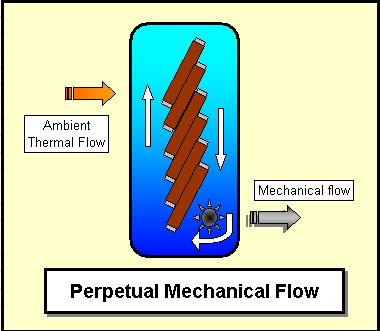
Oh… you mean the water towers. Those use outside thermal energy from the atmosphere soaking into the columns to merely create a convection flow of water. The water is not heated by anything other than normal outside thermal energy. The trick is that such water will separate into hotter and colder water all by itself, due to gravity. That is an anti-entropy effect which I take advantage of by placing the aluminum bars from the hot to the cold. The average temperature doesn’t change. It stays at the same temperature as the outside air. The mechanical energy is obtained by using a small turbine to siphon off a little of the natural convection flow (second pic). Even if the convection flow was temporarily stopped by the turbine, it would start up again all by itself as the water naturally separated again.
My KD device uses a fixed, non moving “door opener” scheme. There is no energy involved in opening any doors. And it was calculated that approximately 400 HP could be obtained from a 1 foot cube sized, expertly made KD engine. I don’t know to what level they ever actually got it. And that would literally freeze the air surrounding the engine, so the air or engine would have to be moving in order to not lose thermal conductivity. An automobile would consume the thermal energy from the place it started and through its motion, redistribute that same thermal energy to the road and atmosphere. If literally everyone in NY were to race to CA, they would cause NY to be a little colder and CA to be a little hotter (in more ways than one) for a day or so.
The half inch coil was wound from 32 gauge wire with 100 winds. None of the videos gave an indication of this being critical to the process. Friction isn’t a problem, balancing the coil so it would spin without inducing all kinds of wobble was the hard part. I simply scaled the size of the coil to the size of the magnet being used. Spun fine. The coil weighs next to nothing and divided by two with a 32 gauge wire isn’t going to induce all that much friction in the polished area of the eye of a needle. They have to polish that area very smooth to prevent thread from hanging up in the needle.
With regard to current in an open circuit. I was under the impression, and I will admit to never formally studying electricity nor do I hold any certification, that current in an electrical conductor is dependent on the electron shells of the molecules of the material in question. Current being equivalent to the bumping of one electron in the molecules lattice to the next molecule, it bumping into the next, creating a “chain” of electron transfer. By applying voltage to the conductor you are passing electrons into the system, the longer the length of the conductor the fewer of the charged electrons can pass along the conductor and instead simply energize the electron shell of an individual molecule causing heat, Which is a function of resistance. An open circuit will never pass a current as there is no where for the electron to go. Instead of current you get heat. I’d bet if I could spin that coil long enough and measure it’s temperature all it’s doing is heating up. Didn’t you also post a video of someone demonstrating heat generation by spinning a magnet array in proximity of a copper pipe? Could have followed one of the links you posted. The same effect would be produced spinning an open circuit copper coil near a stationary magnet. A wire that is charged and not connected to anything will generated a magnetic field in the wire but not a current. The current would only be evident if someone got between the charged open circuit and ground providing a path for current to flow through. Not a pleasant position to find yourself in. There is that old saying that electricity will always find the path of least resistance and an open circuit provides for pretty high resistance. You really have to step the juice up with a coil to get it to jump across a gap in a spark plug and the spark plug is plugged directly into the ground of the ignition system, if the circuit were open after the spark plug you’d never get a spark to jump at all.
From my understanding the “monopole” magnets advertised aren’t really monopole magnets but rather are commonly used in magnetic therapy and as only one pole is used in magnetic therapy they could be advertised as monopoles even though they aren’t. Notice that none of those adds mention which pole their monopoles represent. Any of the devices that are said to require one are hoaxes cause they don’t exist beyond the theoretical. At least I’ve seen no practical evidence someone has figured out how to make one.
From a sequential standpoint, the first example you provided when you stated “There are many other types available today:” is a fraud, but it was linked as “one of the many” types available today. When I implied it was a trick, your response was to post a second example of the same trick performed a little differently and then asking me if I thought the second guy was an illusionist. Apparently looks can be deceiving. Come on, did Doug Henning look like an illusionist? You know how many versions of the saw a lady in half gig there are? Doug was known for his version, called the ZigZag girl.
I don’t know where the making a debunk video came from. I’ve seen simple explanations why from a physics standpoint it is impossible. Then we have these video demonstrations of devices that appear to defy the reasoning as they appear to be functioning. Answering the question of how they might have performed the illusion then becomes the game or as in the article posted by Walter Noon, “where the trick” is hidden. Watching some of these is like watching a good magic trick, problem is if you go into them believing in the impossible you won’t even ask what’s the trick? If it were possible there wouldn’t be a trick.
Any of these videos have to prove they aren’t a trick before I’m going to get all worked up about the possibility of “free” energy. Like I said before, I wouldn’t buy a house based on how it was presented in a video. I’ve had all kinds of ideas how to solve problems related to gardening. I invented an automatic watering system that used the moisture in humid climates to water plants. Wasn’t really successful as it only operated when a sufficient temperature differential existed between the moist air I was drawing into the system and how much could be forced out by a relatively small drop in temperature 18 inches down. Some times it worked very well, but other times in just dried out the soil faster and in the long run I estimated it was achieving a zero net benefit.
Another example, also having to do with the relationship of where the water is and where it could be used involved a pool of water at a low elevation and a condensation pool at a higher elevation, essentially creating a micro model of the natural hydraulic system; water evaporating in one place and raining in another, moving the water with solar energy, then taking advantage of the water at the higher elevation to drive a turbine to provide electricity and move the water where I needed it without having to buy a pump to pump it there. Not very practical when you have to manufacture the elevation difference, but it might work very well if you had the right site with the needed elevation change already a part of the landscape. I did make a few models to see what sort of transfer I could get out of a given volume of ducting. The system did transfer water, just far below the amount you’d need to drive any sort of electrical generation.
I appreciate the continued interest in the greenhouse. I figured, if, on the cheap, I could extend the growing season I’d be ahead. Unless I’m willing to invest a lot of money on the heat loss side of the equation I’m willing to accept the greenhouse ain’t gonna be so green when it’s white out. Frozen solid 24/7/90 from December 1 through March 1. If I’m lucky I can keep the greenhouse above freezing until December naturally. I do have an emergency heater that will kick in if the temperature drops bellow 40 degrees. But if that’s the warmest I can keep it the plants aren’t really able to grow fast enough to make it worth while. Changing crops also could factor in; tomatoes tomatilo’s, peppers and green beans aren’t exactly cold hardy plants. I had a raise bed garden a few years ago and with just a hot house over it I was able to keep a parsley plant growing for three consecutive years. By the time the parsley got that old it wasn’t any good for eating so that experiment turned out and didn’t. Despite three hard freezes the brussels sprouts, beats, carrots and parsnips are still green and growing. If I change my growing habit’s that alone might allow me to grow plant through the winter. I’ve heard there are some quite cold hardy members of the spinach and kale families. I like spinach alright but kale doesn’t suit my fancy. Sometime between now and a couple months of snow cover I should get those plants out. A lot of gardeners only pick half of those sorts of root vegetables cause they can overwinter in the ground with few ill effects. Come spring a fresh crop would be waiting for you as soon as the ground thawed. That’s a lot more cold hardy then I am.
I use the greenhouse during those frozen months as light therapy for SADD. It really lifts my spirits during the dead of winter to be able to step outside into a seventy or eighty degree space and let the sun shine in. I’ve also explored composting as a means of developing heat but I have found that isn’t all that a unique an idea either. A compost pile releases a lot of heat during digestion and I do have plenty of material to compost as result of the garden. Now I gotta learn about microbiology.
From this post it doesn’t look like you were asking me to just test the monopole part. Sounds to me like you thought it would work with either.
Frankly, beyond the video that claims to be close… they all look like magic tricks. If the effect can be reproduced by a trick, then it is up to the device inventor to prove it isn’t. But remember, a good illusionist will always give a bystander the impression they are “checking over” the apparatus to insure it’s legit. That’s all part of a good illusion. Which of the videos that you’ve linked are you really buying is an example of the possibility of free energy? And what ratio of the ones you’ve linked do you think are hoaxes?
And if you suspected any were hoaxes why would you use them as examples of free energy devices? That sort of seems in line with all the liars you’ve mentioned.
The half inch coil has the issue of the top of the coil being too close to the bottom as it spins in and out of the field, possibly not being able to develop enough current to manage the effect. All movement has resistance and we don’t know precisely what is required to overcome the tiny bit that is there. When trying to verify someone else’s work that you suspect doesn’t work, you have to make sure that your example is as close to theirs as possible. You can’t use your own presumptions of what “should be good enough”.
You were right up to that point.
The electrons move even when they don’t have very far to go. The more they move, the more heat is developed. Imagine the wire being 1000 miles long. If you passed a magnet by one end of the wire, the electrons would not be able to know if the other end was grounded or looped back until they got down there. A shorter wire merely allows them to get down there sooner. If the magnet is spinning, you get alternating current going from one end of the wire back and forth to the other end. If the ends are connected, you get even more heat because very many more electrons flow much further around and around.
As I said, they might not be actual monopoles, but rather just something that is effectively [for the purpose at hand] a monopole and thus commonly called a “monopole”. I can’t judge them based merely on my suspicions and wording pedantics.
Yes, Doug Henning looked like an illusionist. Illusionists have to have a degree of dexterity and intelligence. You are not going to convince me to judge anyone based merely on the probability that they are lying. I leave that up to assholes and children.
I very well know the physics theories involved (except for the monopole bit). And I have found far too many fraudulent physics laws in my life. Physics professors are no different than religious priests. They believe and they insist that you believe. They are under the delusion that just because their equations have worked out and their professors insist on the theory, that they know what they are doing and everyone else is wrong. They jealously protect their reign. That is wrong of them for several reasons.
It shouldn’t be a question of getting “worked up” about it. The only question is whether the principle is true or not concerning each type being presented. They don’t have to prove anything. If you don’t want to believe them, you will find an excuse not to. If you do want to believe them, you will probably find an excuse to believe them. Finding the truth is YOUR burden (or mine), not theirs unless they are literally wanting to sell you something at a cost.
Yes, getting all of the details worked out isn’t usually very easy. And absorbing enough energy to do any significant work is even harder.
I would think that low light levels for the plants would be a serious problem during those months, as much as low temperatures. And I had forgotten about the compost idea. One problem with the compost is that it MUST be kept warm in order for it to get hot. The heap will die if the temperature gets too low. Usually a small compost heap can’t survive winter.
I doubt that I will come up with any macroscopic device that would provide enough energy for your use, but I am still going to think about it for a while. I know that I have a valid fundamental theory. It is the practicality that defies me at this point.
The first thought is to test the monopole properties. If that doesn’t work, the rest isn’t worth much. I was saying that I couldn’t see the difference between a monopole being used vs a regular bipole being used (still can’t). I don’t know what a monopole is supposed to do different than a regular magnet, but maybe there is something about it that I just don’t know. The point was to get the monopole first, without which the rest is merely a typical alternator and not really expected to work. But test it just to see for sure.
And I know that East Indian types tend to get into some pretty strange behaviors, but why would someone go to the trouble of hoaxing the fabrication of monopole magnets? Why not just leave that out like everyone else. The video showing the fabrication requires quite a few trick maneuvers just to make it appear to be working. Why bother to go to that much trouble when they can just leave that part out entirely?
In this video, starting about half way through, in order to hoax the scene, he has to go to a lot of trouble:
[youtube]http://www.youtube.com/watch?v=fn4A6VJodow[/youtube]
His explanation of “positive and negative magnetic particles” is bad. There are no such things as “magnetic particles” in that sense. Every atom is a magnet to a degree, but never merely one pole or the other. But the issue isn’t whether he actually understands what he is doing, but rather whether what he presents is fraudulent or not. It is a reasonably convincing video, but not impossible to rig. The remaining question is whether you could freeze the magnets to the degree he suggests is required. He didn’t give a number.
Either way, to me it isn’t a big deal to “get worked up about”. And the most convincing video is the one of Muammer Yildiz, merely because of the number of other inventors examining his project and then him winning the inventor’s international award.
At time stamp 05-06 there is a metal fitting laying close to what looks like a “u” shaped magnet painted red and blue. The fitting appears close enough to be attracted to a magnet that large if it were a magnet. Or the fitting could be made of aluminum, but the screw, washer and nut are very likely made from a ferrous metal so why isn’t he peeling them off the side of the magnet that large? We are simply left to assume it is a magnet but nothing other then it’s paint job and shape would lead us to that conclusion. So what could the spinning magnet be responding to? Perhaps another magnet spinning just under the table.
How strong a magnetic field do you think would be needed under the table to affect the magnets above the table? A plastic table could be as thin as 3/16 inch thick. the board maybe .75 inches and maybe another 4-5 inches between the top of the board and the hanging magnets. I’d say a strong enough magnet rotating around the same axis below the table would effect the magnets in the same manner.
A very common ploy used in illusions is taking advantage of what we think is present given what it looks like. Nothing in the video proves the “U” shaped thing is actually a magnet and may only be needed as a “trigger” that can be assumed is causing the rotation. For some that would be enough.
I have no way of knowing given the information provide in the video whether that is how the effect was achieved, but I argue it is plausible enough to demand additional information not provided in the video to ascertain whether the effect was achieved in that manner.
Notice the top magnets, if you can believe the color coding, are arranged so that the two magnets create a single larger magnet, with a single north and south pole. Think about the gig the Indian guy was saying about how coupled magnets behave. So the fact the magnets are two different lengths really doesn’t seem to matter, one half of the combined magnet would be a north pole and the other half would be the south pole and the length of the magnets isn’t an issue at all once they have been coupled together.
If the “U” shaped, red and blue painted chunk of material were a magnet, it’s north pole would simply attract the south pole of the suspended magnet and that is were the demonstration would end. There isn’t any indication in the video that the poles of the suspended magnet are attracted to the “U” shaped chuck of of what ever at all. I’ve been playing with magnets the last couple of days and you get two magnets that close to each other and they will just attract each other, end of story. That’s another indication why I don’t think, given the information available in that video, that the “U” shaped chuck of what ever is even magnetic. There is a really good possibility the “U” shaped object painted red and blue isn’t a magnet at all. If it wasn’t, what then could be causing the rotation?
I’d say this one could more easily be a trick then a motor, even though that’s what they called it.
I don’t know James, I didn’t find his video compelling. What compelled me to try was you baiting me with bullshit. Four magnets cost me $14.00 and a trip to the local hobby store. It also cost me a look or two from my wife wondering what the hell two metal disks were doing in the freezer, and you didn’t think it was worth your effort to perform the experiment yourself. Given our give and take over the past couple of days, I’m not so sure you understand sufficiently to access where what I am aware of begins and ends. I have a hard time even conceiving of an electron that could ‘know’ anything, much less that it’s behavior in a long conductor is the result of it not knowing the circuit is open at the end. It doesn’t have to know anything to perform it’s function in a circuit, and in an alternating current there isn’t an electron in the circuit that makes the transit from one end to the other. That apparent conviction on your side doesn’t render within me a whole lot of confidence you really have anything more then an inclination.
I have two 100 foot extension cords and an air compressor whose electric motor has a fairly high starting amp requirement. One of the extension cords is 18 gauge and the other is 12 gauge. Using the 18 gauge cord the compressor won’t start as result of insufficient current and it generates a lot of heat as result of induced resistance. The other extension cord is 12 gauge and using it the compressor starts without any problems and during it’s operation the extension cord does heat up but never reaches the point where I would consider it hot.
Energy is for all practical purposes ‘free’ already.
The sun.
Those who want to create a machine which produces free energy want to create their very own sun.
But then it’s also because it’s never enough.
It’s essentially trying to cheat death, to escape death.
I don’t know what this has to do with anything, but…
The smaller wire has naturally higher resistance. Resistance is not “induced”. The resistance prevents the voltage at the compressor from getting high enough to start it up. The larger wire has less resistance, thus provides enough voltage and current to the compressor. It doesn’t heat up very much because it doesn’t have much resistance. If you kept the smaller wire connected and attempting to start the compressor without a breaker tripping, the smaller wire would probably melt and catch fire. If the wire is small enough with a high enough resistance, the voltage would not be enough to send enough current through to generate much heat. The greatest wattage consumed point (wire getting hottest) is neither highest conductance, nor highest resistance.
Oh, I’m learning very quickly the limits of your understanding of begins and ends. What kind of idiot cannot figure out the English language enough to NOT be able to know that when someone says, “the electron had no way to know….”, he was NOT referring to cognitive, human like knowledge, but merely the lack of any means to sense the situation. It is a very, very common manner of speaking. Again, like with your insistence on a particular strawman usage of the word “free”, you pedantically attempt to presume a word usage with the apparent intent of merely nonsensically proclaiming the other person to be dumb. The contrary seems to be the case in that you are certainly old enough to understand more of the English language than you put on. You are obviously merely trying to take any skimpy opportunity to argue and defame the other person regardless of any reality - typical atheist strawman tactics making him seem more stupid than the person he is attempting to attack. In short, just more “Bullshit”.
Don’t you think that a breeze blowing across the table would be a bit simpler? In either case, one must match the motor speed to the actions of the perpetrator. The motor must start, slow down, and stop on queue. Another option is that the larger “horseshoe magnet” is in fact merely a dressed up battery operated oscillating electromagnet. If he was a stage professional magician, he would certainly be willing to go to such troubles, but who gets paid for such videos?
A larger horseshoe magnet does not necessarily have any stronger flux than a small bar magnet. And the flux on a horseshoe magnet is strongest between the two poles, not stretching out at a distance. So no, i am not at all surprised that the screw and nut were not reacting to that magnet. It is pretty obvious that none of those magnets are very strong.
The setup is that there is a smaller and larger bar magnet. It is not clear that the two magnets are actually touching once coupled together (thus not a single larger magnet). And when mounted, are not centered on the hanging mount. Thus the larger magnet can override what the smaller (not adjoined) magnet might be inspired to do. They are initially setup to repel from the horseshoe. The larger magnet does so, forcing the smaller magnet into the horseshoe field and apparently passed it where it would begin being attracted to the other horseshoe pole. But by that time, the larger magnet is beginning to get attracted to the other side of the horseshoe, propelling it further. By that time, it isn’t inconceivable that the moment is too great for it to stop right there and thus the cycle begins again.
In theory, if such a motoring could start up by itself and complete a full rotation, it could continue. If it had to be initially pushed, the rotation speed would slowly degenerate. I don’t trust any of the demonstrations that require an initial push unless they show the device running for a great deal more time or the device speeds up.
If you wish to believe in the ridiculous I can’t stop you. Knock yourself out, and hopefully you have some fun in the process. I clearly haven’t a clue why you continue to so willingly participate in the perpetuation of a myth.
You clearly keep throwing up links to hoaxes and claim they are examples of free energy machines and apparently don’t have a shred of skepticism at all. Your judgment has clearly been affected by your wishful thinking. Must be true if you see it on YouTube. See, free energy and perpetual motion machines exist and this potentially hoaxed video is my proof.
Pretty lame.
But I should have learned by now not to ridicule a man’s religion.
You just described yourself. You are the one judging. I am merely presenting and not allowing poor and non-evidence to persuade. I don’t buy anything nor turn anything away without sufficient need to do so. You obviously feel free to presume. I don’t.
Where does the convection flow come from? If the heat comes from the top of the jug, and hot water rises to the top…there is no reason for the water to move.
that is a neat idea however cars have to stop at redlights, and airplanes fly at cold altitudes so it would not be too practical.
As explained before, water in a tall column will naturally separate into hotter water on top and colder water on bottom. If the column is not insulated at all, a very small amount of heat from the surrounding air will flow into the bottom and out of the top. If insulated, the water will simply remain hotter on top and colder on bottom with no flow.
What the rods achieve for you is to cause a convection flow within the column by transporting the heat from the top down closer to the bottom and only on one side of the column while also transporting the cold from the bottom closer to the top. The convection flow occurs for the same reason it occurred originally, “heat rises” and if able, brings water with it.
Perhaps it would have been more clear if the orange arrow was on bottom.
The original intent for that device was for air conditioning; cooling and heating. Heat exchangers and fans were to be provided for top and bottom. And the bottom was to be 20 feet below ground level.
Who said that the cars could not start and stop normally???
And another feature of KD is that it provides a means to create those floating hover boards you see in the film Back to the Future. Flying isn’t a problem unless you want to get extremely high, then you’re back to more conventional means to boost you higher or faster. Rockets are still hard to beat for speed.
why would heat go to the bottom if it was not insulated? Heat does not go downward in dirt.
The arrows dont make it clear, they are pointing to the side, off into blank space, it doesnt seem to coincide with the cyclical flow you describe.
also the function of the rods are unclear in this picture, do the rods bobble up and down, rotate, or just transfer heat from one rod to the other without moving?
Aluminum is a very good conductor of heat, thus the top of the bar is roughly the same temperature as the bottom. Water is not a very good heat conductor, but it holds onto the heat very well. Thus the little bit of water that touches the bar at the bottom gets warmer than the water around it, and rises. The little bit of water that touches the bar on top gets a little colder than the water around it, thus sinks. By ensuring that the rising and the sinking are not along the same path, a flow begins and continues.
If thermal energy is taken out of the system, new energy simply flows back in from the surrounding air. The device merely converts ambient thermal energy into mechanical torque: chaos to harmony.
It has been known sense the days of Ampere that any time a metal passes through a magnetic field, a current is generated in the metal. It doesn’t matter how long the metal is, or if there is a noticeable circuit. And unlike modern physicists, I can tell you exactly why. I have begun that explanation in the thread on RM:AO: Affectance Compression - “Magnetism”.