This is the second claim that he has made that the paradox has been resolved. Each time these claims get made they add to the google count.
Despite the fact that numerous claims (737,000) to the contrary have been made, the statement is false. If he or any other person wishes to debate the point I will oblige.
Well, did you want to discuss the Twins Paradox or your Triplets Paradox?
Your analysis involved three parties;
Your analysis involved the time dilation between each of the three parties K1-S, K2-S, and K1-K2.
In that analysis, you found that the math didn’t work out. Congrats. But that wasn’t the Twins Paradox.
The Twins Paradox involved only your Kirk1 and Kirk2. There is no Spock. Or alternatively, Spock and Kirk1. And that is the one that I believe is logically resolvable because it is only concerned with K1-K2 or S-K1.
This is really just a question of simultaneous equations and having to have more frames of reference than variables (parties). That is something one would think that any mathematician 100 years ago would know instinctively.
What they didn’t seem to realize is that where ever the clocks were synchronized constitutes a frame or reference. They could hang a buoy out in space to mark that spot if necessary.
I had the Twin A “drift a little” so that;
So Twin A is “effectively still”, moving extremely slowly, merely to reveal that there is an otherwise hidden frame of reference to the paradox. With the required three frames, the math becomes trivial for a mathematician.
But none of this has to do with any absolute universal frame of reference (RM:AO deals with that notion).
Well, in logic terms it is obviously resolved but if you want the math, your the mathematician.
Do you have some question about it? Did you want it in German too?
And the same is true concerning RM:AO. The logic is resolved, but the math gets really strange and needs someone like yourself to put it in standard math terms.
We begin with 3 frames of reference; Spock’s, Kirk’s, and the “Frame of Origin”.
The frame of origin, “fO”, is where it all begins. Spock’s clock and Kirk’s clock are synchronized. As long as they stay at that location with respect to each other, the clocks stay synchronized. I think that part everyone can agree to.
The question is usually asked, “who ages more if one begins to move, since neither party can be used for an inertial frame?”
If either party accelerates from f0, his clock will decelerate and thus display less time passage. If Kirk zips away at near the speed of light, he will not age nearly as much as Spock. Their clocks will be out of sync. The Lorentz equations will foretell exactly how much. His variations in acceleration might make the math more difficult to track, but the results should be consistent with relativity concerns.
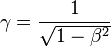
The process of acceleration is a process of varying speed. At each differential speed, there is a Lorentz transformation for the time dilation (from Ed’s thread);
Or from Wiki; ,
If that is integrated over the duration of the acceleration, a total time dilation should be evident. If no deceleration occurs, the dilation caused by the acceleration will remain constant. The clock that is still moving relative to f0 will still be turning slower than before the acceleration.
There are other formulae for the concern of Lorentzian acceleration, but they must resolve to the integral of the speed variation, else relativity has yet another issue.
Since there is no end to it, I suspect they will never experimentally know the answer to that.
But it wouldn’t surprise me to find that they have spent $10 billion of government money trying to find out. They did something equally as insane with the Higgs boson search and even rewarded themselves with a Nobel prize for fooling the population (which seems to be the whole point in Nobel prizes. Even Obama got one for the same reason).
So wait, your understanding of Time, Direction, and Relativity presumes no limit to the universe. Your presumption of gravity, for example, rests on the premise of a infinite universe, as so for the weak and strong forces?
Like, are they operating at a equal tangent towards the center of a galaxy? Who is closer to the intersteller winds, and galactic winds, on any given trajectory? Someone is always going to be a winner and loser in those variables.


 ,
, 