James and the Twin Paradox

Hi to all,

I have been analyzing the resolution to the Twin Paradox provided by James.

Basically I have three problems with it.

First the analysis is not done consistently with either Newtonian mechanics or Special Relativity.
Second the author appears to not use any type of definition of a frame of reference with which I am familiar.
Third the author appears to completely dismiss Twin B’s reality.

In the second paragraph the author writes:
“It is called “the inertial frame” because it is the one frame declared “inertial; not movable”. But the issue comes to mind as to how either frame can be considered the one that isn’t moving. SR declares that such a notion is irrelevant. But if it is ignored, an apparent paradox arises.”

From the point of view of Special Relativity there is no such thing as a fixed (immovable) reference frame. Initially I thought that the author just meant that all the observers could identify the origin from which they began. But, in my opinion, after puzzling over, the seventh paragraph it became clear to me that the author wants a fixed absolute reference frame.

In the seventh paragraph the author writes:
“If we apply the time dilation to the one doing all of the serious moving, Twin B’s clock will run slower and he will age less. We cannot simply reverse the reasoning and say that it is all relative because Twin A is not moving away from the Frame of Origin.”

Due to the setup Twin A is clearly moving away from the origin at the “Frame of Origin”, albeit in a relatively slow manner. The only sense that I can make of this is that the author means to imply that somehow Twin A is in the “Frame of Origin” and Twin B is not. If that is the case, then this author is not only relying on a physical system that does not comply with Special Relativity, but it is not complying with Newtonian physics. In fact I do not know of any system like this.

Finally, if we cannot reverse the reasoning, then, in this mystery model, we cannot allow Twin B to have his own Reality. This is because the Twin B view would be different from an observer at the origin of the “Frame of Origin”; and would not match the “Correct view” of an observer in the “Frame of Origin”.
I think that it would be helpful to remember that our experiences have all approximated Twin B’s experience in the sense that we ridden in cars, trains, buses, or some other moving vehicles, and we don’t dismiss our own reality.

Ed

Hi James,

There is too much to think about for now. We can talk later

Ed
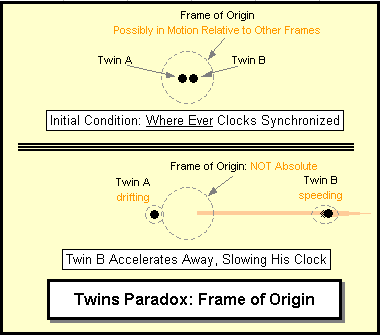
Not true. It exactly fits SR and more importantly even GR.

That is why people have been arguing over it. I pointed out that there is a “Frame of Origin” inherent in any situation that begins as one scene and changes to another. You weren’t familiar with it, because they apparently weren’t bright enough to see that.

Not at all. As I explained to phyllo, everything that Twin B experiences can be used by Twin B in order for him to know who is going to age more. If Twin A uses those same things of his own experience, he will end up agreeing with Twin B.

What I said exactly was;

I wasn’t referring to my solution, but the earlier confusions.

Again, what I specifically said was;

The Frame of Origin is going to be different for every beginning scenario. If the twins left from Earth vs Mars, they would have a different Frame of Origin. If there were triplets, wherein two left together and then later left each other, there would be two Frames of Origin to consider; the initial frame where all were synchronized and a second where the two Trips were still synchronized with each other and moving with respect to the first frame.

How could that make any sense? You just said that Twin A is moving out of the Frame of Origin, yet is still in it.

The acceleration of Twin A is made to be minuscule to allow for precipitating the age difference noted later, while allowing the understanding that he is NOT the Frame of Origin.

It clearly was not the case.

The reasoning that we cannot simply reverse is the reasoning that “I see movement of the other guy and I am going to ignore my own acceleration.” If both parties do that, they end up with a paradox. All of the proposed solutions deal with acceleration issues. I didn’t invent that concern.

For reference, this was the post;

Followed by;

It might help, if you would ask more questions BEFORE you post a presumptuous complete analysis.

Let’s start again.

In the traditional paradox, Twin B returns to the origin in what you have called the “Frame of Origin” where Twin A is waiting. In your resolution does Twin A also return to the origin?

Ed

I don’t believe that such changes the issue at all, but yes, have them return by reversing the process;
Twin A “drifts” back and Twin B “speeds” back.

Twin A didn’t have to leave the Frame of Origin. I just put that in so as to make it clear that there is a frame that is independent of the observer’s later motion. As I said, they could have dropped a buoy out in space before any acceleration began.

Hi James,

The following is my understanding of the setup.

Each observer has their own reference system and establishes their own coordinate system (required to to speak of velocities), arbitrarily but traditionally Cartesian:

The implied observer (I will designate the observer by O because I think it likely that we will refer to him again) in the “Frame of Origin” has a coordinate system with the origin at (0o, 0o, 0o, 0o).
Twin A has a “Reference Frame A” with a coordinate system with an origin at (0a, 0a, 0a, 0a).
And Twin B has a “Reference Frame B” with a coordinate system with an origin at (0b, 0b, 0b, 0b).
Here we assign the first, second, third, and fourth coordinates to x, y, z, and t dimensions respectively.

I am also assuming that Twin A is following in the same direction as Twin B.

The only distinctions that can be made, due to the setup and strictly from Special Relativity, are in the motions of the observers relative to a given observer’s coordinate system. For example:

Twin A is moving slowly relative to the origin of the “Frame of Origin”
Twin B is moving rapidly relative to the origin of the “Frame of Origin”
O is moving slowly (in a negative direction) relative to the origin in “Frame of A”
Twin B is moving rapidly (though not as rapidly as in the “Frame of Origin”) relative to the origin in “Frame of A”
O is moving rapidly (in a negative direction) relative to the origin in “Frame of B”
Twin A is moving rapidly (in a negative direction, though not as rapidly as O,) relative to the origin in “Frame of B”.

Initially, each of the subscripted 0’s will equal 0. However after some time we would see:

“Frame of Origin” has a clock at its origin reading (0o, 0o, 0o, to)
Twin A has a “Frame of A” clock at its origin reading (0a, 0a, 0a, ta)
And Twin B has a “Frame of B” clock at its origin reading (0b, 0b, 0b, tb)

Do you agree with my assessment of the setup to this point?

Ed

Emm… no. You can’t do that for two reasons.

A) You have added an observer (“Oo”) which means that it is no longer the “Twins Paradox”, but a “Triplets Paradox” so any argument is rendered irrelevant. I am not defending Special Relativity as a whole, because I already know that it doesn’t entirely work. I am defending SRT only in the one case of the Twins Paradox wherein you have two observers trying to decide who ages more.

B) The Frame of Origin is like a sunrise. A sunrise is a particular location and moment in time, but only relative to its observers at that time and from their locations. The sunrise itself has no observer of its own. The sunrise itself can’t have a clock with which to compare time dilation relative to its observers, because the sunrise isn’t an object. The sunrise is the moment when the Sun and the Man observed each other for the first time that day. The observers involved have to keep track of events from that moment onward in order to agree with each others time-of-day.

The same is true of a Frame of Origin. It is merely a location and moment in time when both observers observed each other as being in sync… It is not an object nor the presence of an object, but a past moment from which to measure events. For the observers to later agree, they have to track the proceeding events from that time and location.

The SRT proposal is that both observers are stupid, having only one eye that watches their speed between each other. And in that case, they cannot know much because they have one variable and two equations (as Einstein proposed). But the observers don’t have to be stupidly using only one eye. They can also watch their own acceleration (a second eye). And if they do that, they have two variables with two equations, and can resolve the variables.

Paradox resolved by “opening both eyes”.

Hi to All,

If you go to the Wiki article and look under History you will get a good fundamental understanding of the paradox. You can use the following link to get there:

en.wikipedia.org/wiki/Twin_paradox

It also does a very thorough job at looking at the paradox from many different points of view.

Ed

Hi James,

It is fine by me if you want to speak of the traditional two person paradox. (The two person paradox makes the problem simpler). Just a reminder – You cannot introduce any “special” reference frames. In order to debunk the paradox you must be constrained to using the rules of Special Relativity and General Relativity.

Do you wish to proceed?

Ed

The only thing “special” about it is that it doesn’t necessarily have an observer in it, but if it makes you feel any better we can just call it the “Point of Origin” or perhaps even better, “Point of Synchronization”.

So the Twin B accelerates away from the Point of Synchronization, PoS. He knows how much he is accelerating because he can measure it on board his own ship. He doesn’t need to reference any other frame. He can then calculate his speed away from that PoS. By then applying the Lorentz transformations, he can calculate how much different his clock is running from Twin A.

And since he had to know how much acceleration to apply in order to achieve the speed he wanted, he already knew the amount of acceleration before he even started. So he wouldn’t really even have to measure acceleration. To be honest, it’s a pretty dumb question and just shows how easy it is to get intellectuals in a frenzy for centuries (as with the rest of philosophy). They will probably still be arguing over it 100 years from now.

The whole point in Relativity was to come up with a set of physics laws that could be used regardless of any proposed “inertial-frame” motion, especially of the Earth itself. They were seeking a set of rules that would be consistent whether on Earth or on a ship speeding through space. And what it amounts to is that if they are going to use SRT, and be able to know the time differences between two frames of motion, they have to keep track of their acceleration through time. The whole point of time is to measure changes. One cannot leave out acceleration as one of the changes to be measuring. And acceleration can be detected without worrying about any proposed absolute frame. But one must know at what point in any changing of acceleration, the clocks were in sync (or at least know to what degree they were out of sync at the time).

So yeah, proceed.

Hi James,

For our readers, inertial reference frames are ones that are not acted on by any forces.

In this setup of a traditional Twin Paradox, Twin A and Twin B are at rest and initially have a common origin (This is technically not possible but the small differences can be ignored in a problem with large scale). We will assume that this origin is located so remotely that the effects of external massive bodies are not to be considered part of the problem.

Twin A has his own coordinate system with an origin at (0a, 0a, 0a, 0a); and Twin B has his own coordinate system with an origin at (0b, 0b, 0b, 0b). At the beginning of the experiment the origins are equal for each Twin.

We assume that Twin B accelerates away from Twin A. We can detect who is doing the accelerating with an accelerometer.

There are two points of view to consider. First we will consider the point of view of Twin A.

There are six intervals to consider. They are:

  1. The interval of initial acceleration.
  2. The interval of constant velocity away from Twin A.
  3. The interval of deceleration.
  4. The interval of acceleration back towards Twin A.
  5. The interval of constant velocity back towards Twin A
  6. The interval of deceleration ending with the meeting of the twins.

James, are you OK to this point?

Thanks Ed

Sure, go for it Ed.

Hi James,

There is a couple of additional setup assumptions that I need to make.

First for purposes of simplicity, I need to assume that, from Twin A’s perspective, Twin B is experiencing a constant acceleration away from Twin A.

Second the method of propulsion does not diminish the mass of the ships involved.

The first interval from the perspective of Twin A is more interesting, I think, than most people realize.

From Twin A’s perspective, he can analyze the motion of Twin B as a sequence of small changes which can be addressed via Special Relativity. Recalling t’ is the time as measured in Twin B’s coordinate system and t is the time as measured by Twin A in his inertial frame:

We know that dt’ = ( (1 – (v/c)^2)^1/2)dt. Since v = gt, where g is the assumed constant acceleration and t is the elapsed time from twin A’s perspective, we can substitute for v to get:

dt’ = ((1 – (gt/c)^2)^1/2)dt

Upon integrating both sides we get t’ = Integral (((1 – (gt/c)^2)^1/2)dt. But since ((1 – (gt/c)^2)^1/2)dt) is always less than 1 (Remember that gt/c < 1) we must have Integral (((1 – (gt/c)^2)^1/2)dt < Integral (1)dt. And < Integral (1)dt = t.

Therefore t’ < t during this interval.

There is another important component to the contraction of time which needs to be considered. We must also consider the component induced by General Relativity. Clocks in gravitational fields run slow. This is true even in “fake” gravitational fields such as those that experience a uniform acceleration.

Most people simply assume that t’ < t in this interval, but I think it is important to ask why and hopefully challenge the comment some of my comments.

Are you OK at this point?

Ed

Okay.

Agreed.

Okay.

Well now you might be running into trouble.

There are two issues A) We are talking strictly about Special Relativity, not General Relativity and B) General Relativity can be included as long as you don’t both integrate the concerns of Special Relativity and also add General Relativity concerns on top of that, because that would double the acceleration effects.

Because you have already setup the equations for integrating the speeds into an acceleration, you have already included the concerns that General Relativity proposes.

And also, remember that Twin A knows that he is NOT the one accelerating and thus can apply such equations only to Twin B, not himself, whereas Twin B knows that he IS the one accelerating and thus applies the equations to himself. That is the key to the whole issue.

Hi James,

I am enjoying this conversation. It is one of the most intelligent I have had in some time. I should also note that I do have some second thoughts on this subject matter.

Now to your comments.

If we had to be constrained to Special Relativity we could never analyze this story from the point of view of Twin B. We need to allow for a narrative in both General and Special Relativity in order to describe the realities of both twins.

On the pretty sure I am right side:

Reliable descriptions of gravitational effects are generally given from the perspective of the inertial observer (It is why I am skeptical about the Mercury results) in this case Twin A. Solutions of the field equations require observation from an inertial reference frame. Specifically t’ must be viewed from the point of view of an observer measuring t in an inertial reference frame.

As far as not double dipping on both the Special Relativity account and on the General Relativity account:

I had to think quite a bit about this and I am not sure why I am right about this but –

There are a couple of empirical results to consider.

First the Hafele – Keating experiments. The results, which are consistent with the theory of relativity require that adjustments for both Special Relativity and General Relativity
Secondly if you consider Muon decay from the position of an observer on Earth, and apply the weak field transform, the clock should beat faster, rather than slower. In fact the opposite is true because the effects of Special Relativity are orders of magnitude larger.

I have speculated as to why one would need to consider both effects and the best that I can come up with is that the amount of energy required to move even relatively small objects to speeds near light is very massive. I think that this energy is why we need to consider General Relativity, whereas shear speed alone is enough to create a variation in Special Relativity.

Since my comments about adjusting for both Special Relativity and General Relativity are not conventional, I assume that I will get feedback before proceeding to a much more boring interval.

Ed

Interestingly, I was thinking that same thing just yesterday. And the reasons why. :sunglasses:

And if you think that this is interesting, you seriously should consider RM:AO because it answers ALL of the questions involving physics, including Young’s famed Double-Slit experiment. It merely needs the mathematical language so as to convince certain people. There is an opening for notoriety waiting for you (Einstein, move over). It could also use a better (younger) programmer than me as well for sake of computer emulations, making it much more obviously true and relevant. I programmed it up to the point that it could display things such that I could personally see what was happening, but it needs much better visual representation for strangers to the concepts.

All I meant was that this one Twins Paradox only needs SRT, as long as you include the integral of the speed as the one twin accelerates.

As I understand it, the purpose of GRT was to increase the scope of SRT to include all concerns, not just speed. GRT had to focus on gravitational effects and thus a formula was produced in order to handle gravitation. During that process, it was declared that there is no difference between forced acceleration and gravitation. That was not actually true. There is a slight difference in effect. But the concern of gravitation (GRT) is not a part of this one paradox.

But if you want to include GRT in your analysis, you can do that. It will make it more complicated, but won’t change the logical result, merely the precision of the measure.

All we need to know to resolve the paradox is who it is that is accelerating and we already know that, as do the Twins. To what degree their clocks will vary is an issue of the precise mathematics. But we already know who’s will be slower and that was the whole issue.

So go ahead and get into which ever math model you prefer.
Time is relevant, if not relative. :laughing:

Hi James,

Sorry that I have taken so long to respond. I am on vacation and only occasionally have access to a computer.

In the second interval Twin B, as viewed from Twin A’s perspective, enters a period of inertial flight. Here each party is in an inertial frame and there is no component of General Relativity to consider.

One of the easiest relative velocities to deal with is .8c. This is because the Lorentz contraction is .6. And since the speed of twin B is arbitrary I will assume that his relative speed is in fact .8c.

Assuming that the interval of inertial flight is 20 years, from the perspective of Twin A, then Twin B will only age 12 years.

This is all pretty straight forward, and assuming that you have no questions or comments, I will move on to the more complex third interval on my next post.

Thanks Ed

Hi James,

Sorry it has taken so long to respond. (When I got back to work, a lot of things were piled up).

The third interval is when Twin B, as viewed by Twin A starts to turn around.

Here we have:
dt’ = (1 –((.8c – gt)/c))^2))^1/2)dt

As in the first interval, (1 – ((.8c – gt)/c))^2))^1/2) is always less than 1 and after taking the integrals we get t’ < t throughout this interval.

In fact if you plot the graph of the first interval and compared it with the second interval you would find that they are mirror images and the integrals are equal.

The only other consideration is the effect of General Relativity. Since Twin B will be considered by Twin A to be in a gravity field there will be an additional contraction.

In all cases t’ is strictly less than t throughout this interval.

The remaining intervals all have symmetric relationships with the previous intervals.

Interval 4 has mirror symmetry with interval 3. Interval 5 is equal to Interval 2 except that –v is exchanged for v, and since (v/c) is squared equals (-v/c) squared) the time relationships are equal. And finally interval 6 is a mirror interval with interval 1.

I have spent some time on actually evaluating the intervals and interval 1 has t’ severely depressed compared to t. I come up with the Special Relativity Component showing t’ <= (kg/c)t where 0 <k <1 and the General Relativity component showing t’ ~ .997t. Intervals 1, 3, 4 and 6 all have the same severe contraction.

This basically concludes the analysis of the travels of Twin B as viewed by Twin A.

There have been experimental models that reach similar results.

By far the hardest analysis is from the perspective of Twin B, and it starts immediately during the first interval where Twin A appears to accelerate away from Twin B.

Do you have any questions or comments at this time?

Thanks Ed

Well as I said before, I don’t think that the GRT component is actually valid in this case, but if you/they want to throw it in there, go ahead. But I don’t see a final number…?

You have properly concluded that t’ will be substantially lower than t for Twin A calculating Twin B’s time. But you still seem to be missing the entire point when you say that Twin B calculating Twin A’s time is “hardest”.

Twin A already knows, before any calculation that Twin A is NOT accelerating. And Twin B already knows that Twin B IS accelerating. Thus Twin A applies all speed concerns to Twin B, not any to himself. And Twin B, although he already knows that he is accelerating, he doesn’t know for certain that Twin A isn’t also accelerating.

By “viewing” Twin A, Twin B can calculate how much his own acceleration might be. But perhaps a part of that view is Twin A accelerating also. Thus for Twin B to know how much of the acceleration he sees belongs only to himself, he must have something with which to compare it. He requires an accelerometer. And that doesn’t invalidate the use of SRT. Using an accelerometer is a hell of a lot easier and more accurate than trying to observe a velocity that is headed directly away from you.

So by now, Twin B has already calculated each leg of the journey and has had an accelerometer to tell him how much of the visually observed acceleration was his own, he already knows that ALL of the acceleration was his own.

Thus Twin B merely does exactly the same as Twin A does in calculating, but swaps t’ for t, making his own t less than the t’ for Twin A. All done.

So the calculating is actually already over, showing that Twin B’s time is substantially lower than Twin A’s time, and observationally noted by both parties.

Hi James,

To come up with a number, based solely on SR, I will assume that Twin B, as viewed by Twin A, will accelerate to .8c and further I will assume that g = 10, we need to evaluate the integral, from t = 0 to t = .8c/g of:
(1 – (gt/c)^2)^1/2 dt.

To do this we need to substitute variables. Here I let u = gt/c. Now integral, from t = 0 to t = .8c/g, of
(1 – (gt/c)^2) dt becomes the integral, from u = 0 to u = .8, of ((1 – u^2)^1/2)(g/c)du. However we can evaluate the integral, from u =0 to u =.8, of ((1 – u^2)^1/2)(g/c)du to be (g/c)(1/2)[(u(1 – u^2)^1/2) + arcsin(u)]. If u = 0 then the last expression is 0. When u = .8 the last expression is (g/c)(1/2)[(.8)(.6) + ~.9272952]. (You can look at en.wikipedia.org/wiki/Integratio … bstitution to see how integration by substitution works).

Thus t’ in the first interval is (5/c)[.48 + .9272952]t plus or minus .0000001. Or t’ = (1.6667 x 10^-8)t
Since t is the time in Twin A’s reference frame at t = .761 years plus or minus .001. t’ will be 2.34549 X 10^-8.

Now we have t = .761 years and t’ = 1.7849 x 10⁻⁸. Basically, t’ = 0 plus or minus .001years.
Since there are 4 intervals of equal time we have 3.044 years have elapsed for Twin A and no time has elapsed for Twin B.

In the two intervals where both Twin A and Twin B are in inertial frames Twin A has 40 years elapse and B has 24 years pass.

In total Twin A has aged 43.044 years, plus or minus .001 year and Twin B has aged 24 plus or minus .001 years. (I believe that I can get this much more precise but I simply wanted to show that Twin B will appear to have aged significantly less than Twin A.).

I believe that everything that you have said about who is accelerating and who is not is correct. However, we still have to find out how Twin B sees things, and we have to do that exclusively by means of the tools provided by General and Special Relativity.

I probably will not respond as quickly as I wish in order to familiarize myself with the classic arguments concerning the debunking of the twin paradox. (I would like to see this problem through their eyes).

Thanks Ed

Realize that all discussions of relativity are directly related to the religious concern that “God cannot be seen/known, an eternal unknown”. The attempt in Relativity is one of trying to resolve all unknowns without having need of that one, “Leave God out of it”. And by declaring that all equations have been resolved (even though they haven’t), they declare that there is no “God” (no “absolute”) and even if there was, God (the absolute) is irrelevant. It is science attempting to rise above religion or “Human displacing God” = “Human Secularism”.

The problem is that when you leave out the absolute (aka “the God perspective”), you always have more equations than unknown variables and thus can never actually resolve “Truth”. So the proposal was that because the speed of light is seemingly absolute (although not exactly constant), we can just fill in the “absolute variable” as “the speed of light” and then we can know all things with absolute certainty, all equations and unknowns resolved, “We can be gods”. Of course after many discovering that such wasn’t working, they simply declared that “Truth is relative”, “there is no such thing as Truth”. It is a political war to gain the worship of Man.

Thus what they always do throughout all Relativity is leave out one of the available perspectives (variables), in this case they leave out the accelerometer reading, that “second eye”. Having left that out, the issue cannot actually be resolved, again because they end up with more unknowns than equations. But because this whole thing is a religious confrontation, they belligerently insist that the paradox is solved anyway. And they use a hand-waving confusion of mathematics and the banning of alternate discussion to promote their stance. If you peek behind their curtain, they run you out of the theater and label you as some kind of deranged malcontent, else you will expose their “magic”.

Relativity and Quantum Physics are both merely engineering tools that are being used as truth models (“it seems to work sort of like this, thus this is the absolute truth”), when they are actually merely approximations which when presumed and extrapolated to an extreme, become incoherent.

Void of the accelerometer readings, I don’t think they have any mathematical solution to this paradox. And even with accelerometer readings, they still can’t resolve the Stopped Clock Paradox. The SCP demands the absolute frame. A constant speed of light doesn’t work. Thus they won’t even allow the SCP to be openly discussed at all. They don’t even attempt it.