Limits of philosophy?

as humans, we can only ever experience and understand the world through our own lens and the way we perceive things. while it is possible we don’t see the same red or taste the same sour or feel the warm, it’s pretty likely we experience and understand reality at least somewhat similarly. however, this perception means that we may never truly understand anything outside of our own limited perspective. there are so many questions we’ll never be able to ask, so many things we’ll never detect and so many things we will never understand because we might not perceive reality as it truly is, assuming there even is a reality that exists outside of one’s mind.

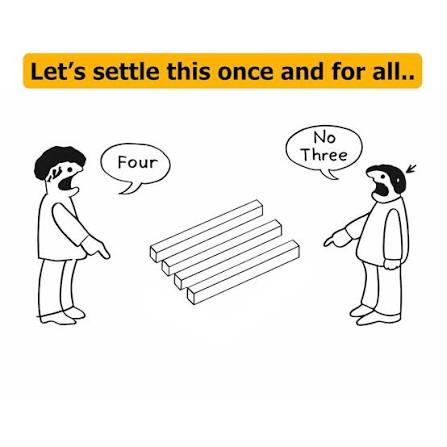
but does this mean we will never be able to access reality outside of any mind? the objective reality, that we can’t currently perceive? yes… probably. but who is to say our view of reality is false? it may simply be from a different perspective. take the image above for instance (while highly simplified it gets my point across), depending on how you look at it, both answers may be right. or to put it more precisely, in each person’s reality and view of the world, there is a different “correct” answer because of the way they each see the world.

so… i suppose that the way we perceive reality, is reality. our own reality of course. which is why i encourage you to be more positive. (genuinely though, when it comes to small annoyances, try not to be so caught up with them. don’t suppress your emotions, but don’t waste your energy on things that don’t matter(though what “matters” is a topic for another day(parenthesis in a parenthesis??(parenthesis in a parenthesis in a parenthesis???(parenthesis in a parenthesis in a- okay i’ll stop now :frowning: )))))

but again, if the way we perceive reality is our reality, does that not mean social constructs can be inherent to one’s reality? take someone who has never questioned social constructs and laws and norms. to them, the value of money is as fundamental as gravity. in their own reality, social constructs aren’t human made; they are a core part of reality.

it gets more difficult to defend when it comes to claims such as the existence of a god. but for someone who truly believes in god, it can still be argued that in their reality and in the way they experience the world, there is a god. and for many believers, it is probably safe to say that in their perspectives, life has a purpose. for people who are religious in general, there is meaning in their lives. whether that be worship a god that doesn’t exist… etc. but to them, meaning isn’t a human construct, it is a part of their reality.

and i don’t think we can even say the mind independent reality (if it exists) has no meaning. we might just not know and it may even be completely inaccessible to us because, like i mentioned before, there may be somethings we are just unable to ever know or experience due to the limits in human perception and understanding. but even if the universe was inherently meaningless, why should some cosmic purpose assigned to you by the universe matter any more than that which you assign yourself? (wait i’m highkey cooking… i’m copyrighting that)

however, changing your beliefs on things you truly take to be fact is difficult. if you are an atheist, it’s incredibly difficult to convert to christianity (i’ve tried :(( ) because idk go figure… it just is. because, imagine trying to convince yourself 2+2=5. no like actually try.

however, i believe that there is a difference between doing that, and giving yourself some sort of purpose. you don’t need to follow any religious doctrine to assign some reason to keep going. for some it’s money, for others love and for you it might be touching grass. in fact, i personally believe hedonism is actually a viable framework that is over hated in my opinion. but that’s a conversation for another day.

to conclude, we as humans are limited to our perspectives and experiences and our senses overall, so it may be impossible for us to ever fully access the universe outside of our minds (if there is one). but, our beliefs shape our reality and the way we experience the world around us so social constructs may genuinely be a fundamental part of reality for some people. and furthermore, due to our reality being shaped by the way we see things, we can assign ourselves a purpose that is actually meaningful in our perspectives whether is meaningful in the grand scheme of things.

:slight_smile: thank you for reading and i hope you found something interesting or even disagreed with something so we can talk about it xx

also:

“why should some cosmic purpose assigned to you by the universe matter any more than that which you assign yourself?”™
2 Likes

Yes, we can only experience and process reality in a subjective manner.

Your subjective view of reality is not false, its just partial.
Humanity is like a shattered mirror. Each sliver reflecting the world around it from a specific point. Is one shard’s reflected image any more true or wrong than the other’s?

As for not being to be able to perceive objective reality: No, it would go against the nature of what you are. Human beings are literally, physically incapable of doing so.

Surely. Delusions come in every shape and color.
You are king of your own world. If you have convinced yourself that something is real, even your body will react to it in that manner. Thats the basis of the placebo effect too.
You are king of your own castle.

Now this one is a bit incorrect if you take into account that you have to build your mind first.
Tabula rasa.
When you are born, the only information you hold is the information your body holds. The instinct of your flesh. A screaming bundle of meat without any form of selfawareness, identity, or agency.

And if you do not interact with reality. Thats all you will ever remain.
For your mind to develop, it needs to interact. Lock a newborn in a box, and even if you solve the problem of sustaining it’s body, it’s mind will eventually fall apart, shut down and die.

You cannot exist without external stimulus. That is the only problem here, and one of the main arguments for noumenon.
For without noumenon, you’d not be able to exist.

Its not the spoon that bends Neo.

Of course. The meaning of life has always ever been what you are willing to die for.
Not more, and not less.
Asking for the purpose of life, is simply stating that you have nothing in it you’d be willing to sacrifice it for without a second thought.

It was a nice read.
It reflects much of my own understanding and conclusions. I usually refer to what you wrote with simply that one proverb:

2 Likes

Although ‘we’ can obviously only experience ‘the world’ through ‘the body’ ‘we’ are in, ‘we’ can understand ‘the world’ through not just our own individual so-called ‘lens’ but also through ‘the lenses of others’.

We just do not know, for sure, if we do or do not see the same red or taste the same sour or feel the same warm. At the moment, there is just no physical way of testing and verifying this. So, it is possible we may or we may not. For example, for all we do know, for sure, is that ‘my red’ could be ‘your green’. But as long as ‘we’ are in agreement and acceptance, then that is all that really matters. After all, it is through agreement and acceptance that the actual Truth of things, and what is Right, in Life, is discovered, understood, and known.

So, what you say here,

suffices.

‘We’ could also replace ‘our limited individual thinking’ of what the ‘our’ word here means and replace ‘that perception’ of one only individual human being, to be and mean human beings collectively. Which would provide a much larger picture and perception of things, while also maintaining the True fact that ‘we’, collectively, may never truly understand outside of ‘our’, collective, limited perspective.

However, if ‘we’ keep moving up and towards the much larger perspective and view of things, ‘we’, collectively, can understand far more than the limited understanding that comes from just one individual human being or even from just the limited understanding of just human beings only have.

Perceiving and understanding Reality, Itself, and how It really is, is possible. But just not in the ‘current way’ older human beings ‘look at’ and ‘see’ things.

The ‘information’ of Reality, and how It really is, is fed into ‘us’ exactly how It is. ‘We’, however, and unfortunately, can all to simply and easily distort, prevent, or block that actual Truth from entering fully.

To me, there are no limits to ‘philosophy’, itself, because to me that word just refers to having the love of wisdom, where ‘wisdom’ is obtained through learning, experiencing, and observing.

How do ‘you’ personally and individually separate “the three”, exactly?

No, what is probably the case is that we do perceive objective reality to a small degree. We can infer some of the features of objective reality, to some degree, from the contents of our minds. That’s why we don’t walk into walls, and just about everything else in life is also based on the above, probably. (Also, technically our minds are also parts of objective reality.)

Interesting reading, I agree with most of it.

Trying to identify some reality independent of your mind is an impossible task, since you experience the world only through it. Even the senses are related to electrical signals that are processed through our brain.

Is there an objective reality? Given that are many things which all people see/feel/understand them in a similar way, we tend to believe that it exists. Yet, there is no way to escape the subjective filter of our minds when it comes to interpretating this reality.

Philosophy asks questions and investigates how the world functions. It attempts to give objective answers using our subjective perspectives. Thus, it becomes practically impossible to come up with agreed “truths”. In my opinion, this is the main limitation of the philosophy: the inability of humans to identify “reality” in a universal way.

what are your thoughts on solipsism? i know to many it’s a detestable (concept? framework? idea? i dont know anymore) lol but i was just wondering because you said things like we and our. like the immediate assumption is that you are not the only mind that exists when it could be the case that… you are

Philosophy for me works axiomatically: I postulate something as basic truth, and based on that I build my understanding on how the world functions.

Using the “we” and claiming that there are other minds apart from mine is an axiomatic statement, a belief if you prefer. I cannot prove it, since I cannot access the world outside my own mind, but I take it as given.

Same thing with the world that surrounds me. I accept what humanity currently claims to know about the universe, its size and its content. Based on that “belief”, I consider that there are things which are independent of my own experience and existence (once again, without being able to provide hard proof).

With regard to your original question: I am a scientist and I am studying natural phenomena. I cannot do that by doubting every time if any of them is true or not. Thus, solipsism is not a philosophical approach that I would choose.

1 Like

I think this fits a pattern where the outer/external is to be taken as given and the internal/inner is to be corrected. But both are part of reality. Those are real reactions/feelings. The inner is real. The outer is real. We could accept both and see what this leads to. Instead of ‘yes, your job isn’t great for you, but try to have a positive attitude about it,’ one could accept the job and the reactions you have to the job. This is the job I have and it has these qualities. These are my reactions/feelings about/to that. Why should we not allow the inner to be as it is? (I did notice you saying ‘don’t suppress the emotions’ but why suggest we be more positive?) [there is something missing from my response: one can potentially change/improve facets of jobs to some degree or change jobs, but then, then being more positive might undermine the motivation to improve the job or find another]

if you are an atheist, it’s incredibly difficult to convert to christianity (i’ve tried :(( )

How did you try? (I’m not a Christian to take away one possible context here)

Just remember that ‘our minds’ are not in your mind - at least not in the worldview it would seem you have. We are part of your external reality in that model. Maybe we’re not all the same and the same as you? If you don’t know about external reality then you don’t know about us.

I’d just like to broaden that: why should some cosmic purpose assigned to you

by

society

your parents

morals

messages in films, songs, tv, videos, advertising

social media

your peer group

your political group

‘them’

the zeitgeist

your culture

matter any more than that which you assign yourself?

Which raises the question: how do you know what purpose you assign yourself? how can you be sure it wasn’t assigned by some of the above?

1 Like

i get what you mean, but ruminating on negative thoughts just isn’t a pleasurable experience. we can allow the inner to be as it is, but it’s in your control, while the external world isn’t. you can choose to have a more optimistic outlook on life and you can choose to be more pessimistic as well. i’m saying you should try to have a positive view as it makes the experience of life much more tolerable.

i was raised as a christian actually and around the age of 12 i just fully rejected but it wasn’t good at all. i often regret falling out with religion. so there was a period where i would pray even though i knew there was nothing listening to me, i would follow to christian accounts and listen to arguments for the religion, i stopped engaging with secular individuals and ideas. i even started reading the bible and identifying as a christian.

didn’t work, but i’m not really an atheist as i can no longer confidently say that there is no god. and if there is, i am 98.3% sure it just isn’t the christian one.

yes i mean not in my mind and not even in my perception of reality. because i can never experience another mind.

by “my external reality” do you mean my experience/perception of external reality? because physically i can see other people but i don’t have access to their minds. and i don’t really think one’s mind is connected to their body in any way. so, i can never experience another person’s mind.

but there is one’s mind and there is one’s perception of reality. the perception of reality is dependent upon the mind, yes, but is it not separate from the mind? the mind exists and one’s reality also exists but do they exist as one or are those two different things?

i think in a way, all of these influence the purpose (or lack thereof) you give to yourself. that and your natural personality. even though you are influenced by these things, i think the purpose that you assign yourself will be meaningful to you and if it was forced upon you by someone else, i think there will be some dissonance there.

i like to think of a mind that has no personality or preferences or prior experiences picking between the colours red and green. they can’t pick however because they have nothing that “draws” them to either colour.

haha it’s funny how everyone knows who “they” are and simultaneously no idea who “they” are.

anyways bye bye have a lovely day :))

Well, ‘ruminating’ is adding something new. Be positive is different from don’t ruminate. And yes, it’s unpleasant to feel certain things, but I think ‘be positive’ just adds a layer where you try view something other than the way you actually feel about it. The unpleasance is there, but you try not to notice the feelings you have.
Accept the external and view it positively.

Don’t accept some of the internal and…doesn’t one end up viewing it negatively?

Ah, I should react to my job more positively. Doesn’t that send a message that something is wrong - or less good - about the internal reactions you have?

If the job is not that pleasant, we could try to have a positive reaction to that and to our so called negative emotions. IOW I think the ‘have a positive outlook’ is a way of saying accept the outside, but I see no reason not to try to accept the inside even if it is less than pleasant. Otherwise you are sort of not accepting yourself in the attempt to feel positive about something you actually don’t feel positive about. I am not suggesting one ruminate. We often react and move on. Young children can move from incredible upsetness to curiosity and joy in seconds. This is not a suggestion to go around and around about the hatred of the job. I guess we wouldn’t generally say this about physical pain, but emotional pain we see the emotions as problematic.

And given that emotions are the great motivators, in many situations this might allow a problem to stay a problem.

Yes, I mean, if we can’t know external reality, it would be odd to say ‘we’. Because one is saying first and formost ‘I can’t know external reality’. Well, if you can’t know external reality than the use of ‘we’ - in ‘we can’t know external reality’ - is problematic. It’s like ‘I know all of you are the same as me, so I can generalize.’ But if you can’t know external reality, then the use of ‘we’ doesn’t really work. It’s like you can’t know the reality of chairs, but you can of other people, even though both are part of external reality.

I tend to think perception is part of the mind. I do think we can know external reality, but I can’t justify it particularly.

I forgot to add one thing to my list. why should some cosmic purpose assigned to you by one part of yourself be correct?

I think we’ve all seen people who get an idea and try to fit themselves and their lives into that idea. Like the neocortex or the left brain decides that it is great to be or do X. But then the person has this huge struggle internally, because actually only one part of the person wants to do that. And that part may even want to do that without much respect for their own desires. I think often what is really going on with a person who ‘has discipline’ is they have an internal tyrant. (none of this is easy, by the way).

Though most kids are going to have a preference, even preverbal - after they actually start getting color vision that is.

you too.

1 Like