A belated conditional of an passant for being out of order.
For the record, I was being sarcastic. 
That shit is second nature to a programmer… As you and phon would know.
Nothing is logically impossible until one knows better.
In this case, “we” know better. It actually is impossible for two separate regions of space, occupied or not, to be absolutely identical or even merely first-order infinitely identical for any more than an infinitesimal of time. But having said that, every finite region of space has an infinity of first-order infinitely identical copies, including your body. But they are only identical for one infinitesimal of a second. And as soon as one is no longer infinitely identical, another becomes infinitely identical (on average). So at any one moment, there is always an infinity of you throughout the universe who are becoming different than you at the same time that another infinity of not-quite-you are becoming identical to you (chew on that one for a while).
There is actually no “smallest thing” or space (Plank length is a superstitious myth). And the “edge” of an object is only an edge by the definition of an observer. When the observer says that less than 5% of the object’s substance being represented defines the edge of the object, then that is the edge of the object.
The entirety of the universe and everything within it is nothing but varied concentrations of affectance noise (ultra-miniscule EMF pulses). There are no discontinuities at all, everything is “smoothly joined” by slopes of affectance density. On a small enough scale, there are no edges. Man uses the concept of an edge, just like he uses digits, so as to permit his cognitive mind to function via “objectizing”. An edge is merely an observer’s perception of a strong contrast slope in density.
Every sub-atomic particle has a density similar to what is shown in this anime. The “edge” is merely a convention concerning where one chooses to say that it is (often around the 5% of maximum density line).
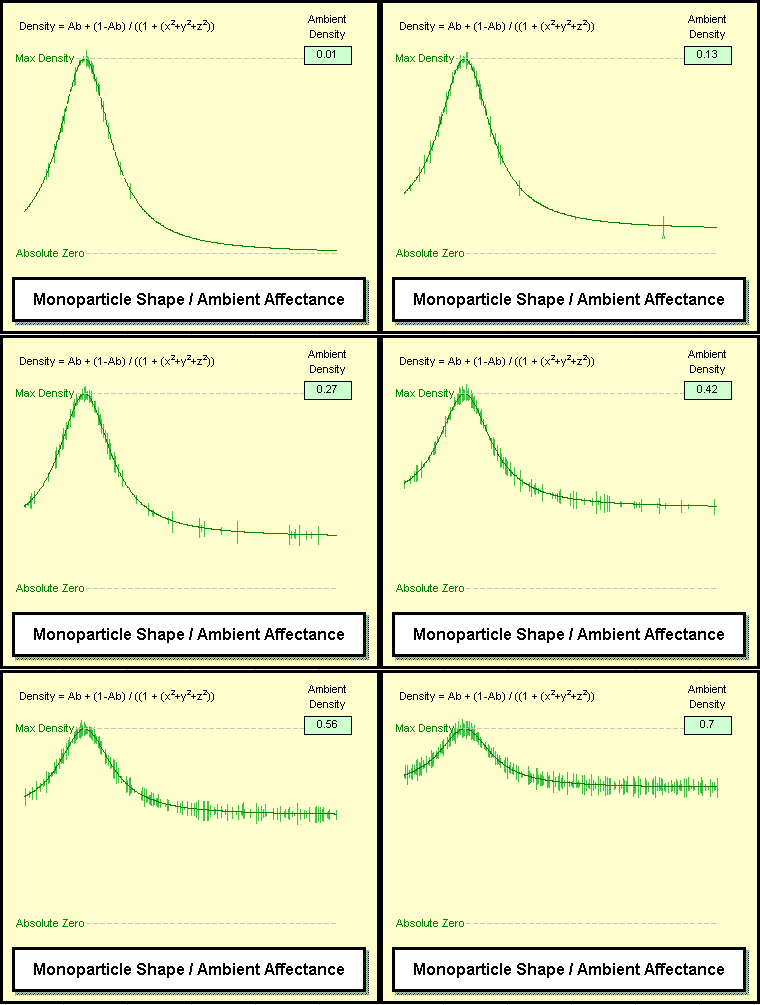
… and the Schwarzschild effect merely creates optical illusions due to energy absorption rules.
I exist because I exist…
Things are what they actually are…
A equals A…
Totally different phrases James.
As for your discourse on infinity, where things are infinitesimally the same for an infinitesimal amount of time before they change… infinitesimal as a completion means exactly ZERO, which means they cannot be the same because they don’t exist. If something is infinitely small, it equals EXACTLY zero.
If something is exactly zero, then it is not infinitely small, but rather doesn’t exist.
1 / infA =/= absolute zero.
1 / InfA ≡ 1 infinitesimal.
1 / AbsInfA ≡ absolute zero (non-existence).
Well, you shouldn’t have been sarcastic. Just because something is utilitarian, doesn’t mean it’s good. I could shoot a bunch of people to get pussy… that’s utilitarian, but not good.
Just because programming language has evolved around A=A, does not mean it’s good programming language… ever notice how paradoxes and exceptions emerge in programming, this is because it’s not as fluid as the human brain.
Let me put a = a to you this way, this of the equal sign as “as”, not “is” and you’ll be closer to the truth here.
Let me put it to you this way…
“Is” exists as “exists as” … we are pointing to it and saying it exists as something different than itself… we are making an agreement in a relative sense.
1 can equal infinity because it cannot exist by itself… but we make an agreement that 1 is not a multiplicity for purely utilitarian reasons. So we say, 1 exists as 1.
Ec, stop.
Yes, GM develops his “anti-metaphysical” view where man is a “chance” (not “accidental”) development of historical conditions and otherwise blind forces (blind to themselves). No absolutes just means that small factors can irrevocably alter the future in ways beyond predetermine knowing.
I actually think Nietzsche really didn’t mean to go so far as he did here, or is taken to have done, certainly he would be the first to laugh whole-heartedly at all “postmodernism” that has grown up as a consequence of his ideas seeding into the human earth (Foucault comes easily to mind, also Derrida), but really he did as much merely to identify and enunciate these changes as he did to “create” them. Too often these others take from Nietzsche only the one side, the “playful affirmation and breaking-apart” without taking from his other side (absolute hardness), and the latter is of course the condition for the former (heightened value-standard!). Also, it is easy enough to read Nietzsche’s stances here however best uplifts our own self-valuing (a neat trick of every good writer).
Nietzsche didn’t abandon absolute truth (objectivity). He simply asked us (we philosophers) to take a closer look—and implored everyone else to stop looking, not because there is nothing to see there but because there are higher values to be gained (for those others). What is good for the philosopher is decidedly bad for most others, and the reverse is often true as well.
Very well said. Unfortunately for them, those who are implored not to seek truth still come to Nietzsche and interpret his ideas and models in ways they would interpret more innocent, simple and straightfoward ideas, with damaging consequences to their minds, which are neither able to withstand nor to justify what they encounter in there.
Virtually the whole class of ‘intellectuals’ - neither simple, nor deep enough to partake in life fully - is trapped in the less than stimulating choice of abandoning the concept of truth or embracing a truth that they would prefer to avoid knowing. Suspension of the human spirit. It seems to me that evolution is closing certain doors here, before the new paths can be accessed en masse
Strange times. Art is necessary.
I’m pretty sure that he did. He was a pragmatic, no?
Fixed,
I’m waiting for you to address my latest response to you…
Erik wrote:
N. wrote:
" [T]he whole teleology is so planned that man during the last four thousand years shall be spoken of as a being existing [22]from all eternity, and with reference to whom everything in the cosmos from its very inception is naturally ordered. Yet everything evolved: there are no eternal facts as there are no absolute truths. Accordingly, historical philosophising is henceforth indispensable, and with it honesty of judgment
Praxis is always subservient to telos. The only telos that N acknowledged was power. All praxis is thus a function of the will to power. This is as objective as philosophical statements get, granted that it is still a human interpretation - in as far as objective truths are possible, N posited the one with which bargaining or contending is impossible, as both would be direct proof of that will to power.
Epistemically, N’s truth is objective - indisputable, valid in terms of all rationally responsive perslectives. But that this truth is objective means at once that there is only a very select class of objective truths; that all practical truths are subjective, because all praxis is a function of will to power and will to power is a logical function of difference.
Please read and think with more patience Primal. Your points have been exhaustively addressed.
Even from this quote, you can derive absolutes, such as the fact that all things change.
Let’s break this down a bit, shall we?
What does absolute truth mean?
Are we meaning to say that it’s ‘something’ that always is what it is, regardless of our perspectives, or any other possible factor? A thing-in-itself?
Was not N. ferociously against this sort of thinking?
This sort of ‘truth’ seems like another emanation of Judeo-Christian nihilism, like the soul, or the atom; the eternal, indestructible one - god.

Cheers!
Why? I did make a mistake though… I should have said when we point we are saying it is that, when we say equality, what it really is, is “being as” or “exists as” which is a form of pointing and saying one is different than the other. The thread is weaving between two topics, I have a right to discuss logical equality theory here. Everytime you see the word “is”, think “being as” or “exists as”
The laws/principles (the “absolutes”) do not.
To answer the Ops direct question about logic, though I’m not necessarily sure how it relates to Nitsze… I’ll leave that to the experts, whether he even discusses this…
All logic follows the same rules as definition, equalities, all of it, which is pointing and memorizing, it is fundamentally a pointing process to say something equals itself…
A=A is nonsense.
This A <------ is that A is not nonsense. They are not the same A’s, and the idea of equality is flawed as it sits. Even the word equals translates directly as is, which translates directly as “exists as”, which is a metaphor or a pointing procedure.
Yes, this is an important point. There is an abyssal difference between talking about truth and talking about how we talk about truth; that difference can get reduced away by the adoption of an epistemically-closed sphere of ideas, such as the one espoused by (a cursory reading of) Nietzsche.
It is useful to find these positions from which counter-positions are de facto rendered unthreatening by virtue of structural imposition within the semiotic substances, however that usefulness is a utilitarianism which explains why those who adopt it qua method get quite good at refining their self-valuing around a particular nexus. But are we more concerned with honing this or that actualizable self-valuing or are we more concerned with truth? The circle of thinkers gets narrower very quickly as we climb higher. And it is possible to situate Nietzsche with respect to this climb, he is not the apex but only a apex.
Will to power is also a function of sign-mechanics by which the inward ordering of the nature of differentials furthers or impeds certain actualizations. What we see as the logic of selection behind the natural world, for example, is more precisely understood by applying a Peircean (credit Parodites) schema (augmentation with Kitaro’s vector analysis of spatio-temporal locales of dimensionally-entangled consciousness) of triadism than by simply referring to the will to power; selection, bias and accumulative growth arises as it does because of the limits inherent to any ontically-coherent expression, by which certain irreducibles given to those expressions delimit possible structures. The will to power is a very broad brushstroke.
The objectivity of N’s truth here, as you say, is a selective class from which practical actions can follow (world actions or self actions). Its truth-value cannot be questioned in the antecedent of actual praxis (reality-disclosures), but it nonetheless remains a “closed idea” that necessarily blinds future exploration to itself, blinds it with its own image of itself much like a philosophical Narcissus. (Hence the linearity of psychological configurations and “personality distortions” so common among Nietzsche admirers.)