@greenfuse
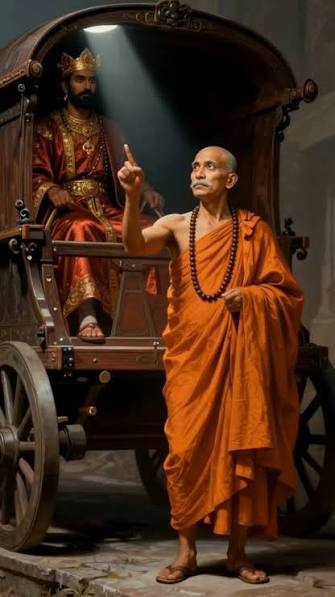
Originating in the ancient text Milindapanha(The Questions of King Milinda), the analogy features a dialogue between the Greek King Milinda and the Buddhist monk Nagasena.
The Question: King Milinda asks Nagasena what his name is, and Nagasena replies that while his name is conventionally used to identify him, it does not point to any real, independent “person”.
The Inquiry: Nagasena counters by asking the King to identify the chariot. Is the axle the chariot? The wheels? The pole? The King answers “no” to all.
The Conclusion: Nagasena points out that a chariot is nothing more than a functional label used when a collection of parts comes together.
Just as a chariot does not exist independently of its wheels, axles, and frame, a “self” does not exist independently of the ever-changing physical and mental components that make up a human being.
In Buddhism, these components are called the Five Aggregates (Skandhas)
1). Form (physical body)
2). Sensation (feelings)
3). Perception (recognition)
4). Mental Formations (thoughts, habits, and will)
5). Consciousness (awareness)
When these aggregates are assembled, we conventionally call it a “being” or a “person,” much like how a pile of parts is called a “chariot”. The teaching of anattā reminds us that we are an impermanent, interdependent process rather than a fixed, rigid entity.

2 Likes
And since each of those parts has parts, they also have no identities. So, there’s just shifting stuff. No persons or things.
2 Likes
@greenfuse
The existence is real, the identity of the self or ego is not. The self is like a mental optical mirage.
Self and ego are very different things.
Well, if you’re fine with that idea and somehow know it’s true, then Buddhism, related to that issue, matches your beliefs. I don’t know what existence you are calling real. There is no you that persists through time.
1 Like
@greenfuse
Is the self and ego so different from each other?
The physical body does not persist through death.
The ego is a part of the self. Often focused on boundaries from other parts of the self and from others. It is not the unconscious mind for example. It’s not procedural memory and habitual patterns. It’s not the knowledge of how to ride a bike or read someone’s emotions.
The physical body does not persist through life. All the atoms are being replaced all the time. - for the physicalists or materialists in the audience (most communists, that is). If the body is matter, you don’t even survive more than 7-10 years, but let’s be clear, in those years most of you has already been replaced.
In Buddhism there is no non-physical thing that persists. There is no persistent self, period. You don’t die at death, it’s not even the same you. Even the parts are not the same parts that they were days before that.
1 Like
@greenfuse
Well, everything is constantly changing in perpetual flux where all of that does make sense.
I am certainly not the same man I was twenty years ago, although a few remnants remain consistently unchanged.
@greenfuse
You are correct in asserting that there are glaring contradictions within Buddhism.
I am aware of that as well. No organized religion, spirituality, or philosophy is entirely perfect just as human beings are not perfect either.
By acknowledging such I think transforms me into being a better Buddhist if you want my honest opinion on the matter.