Multiple personality

People living with multiple personalities sometimes are unaware of their condition. They seem to be oblivious to it,many get confused when people deal with them differently at different times, in different places. They say to the person, ‘hey is that You’ masking their confusion, The personality displayed require an appropriate response, conforming to the expectations of that person, and they sometimes display an eagerness to get below the display of alternate persona,regarding that as something of a quirk, or maybe even a humorous attempt to mask something which can not be shared.

People will make allowences for lapses of consistency, and they will pass on some slight display of inauthenticity. However, a regular pattern of obviously non intended changes in thought, mood and behavior, can be quite a challenge to people having to deal with multiples personalities.

Sometimes this condition is mistaken for other similar personality trait dysfunctions such as disassociation, and there is also a so called normal form of this, in people with low ego strength and self esteem, which characterized by introjective identification, where the person literally becomes another person, consciously,and intentionally displaying the character traits of an admired friend or aquaintence. These types of people may present quite a challenge to friends and relatives,often they are rejected, and tend to become loners, or shut ins. Does anyone have an example of this type of experience in their lives, and how did you deal with them? does the fine line of an intentional and benign attempt at role play sometimes gets to go overboard and become a personality problem?

For example they tell actors that after concluding a role, they should forget about the role, and not carry it with them home afterwards, because it may become part of their ‘real’ repertoire of down home behavior. Some actors have actually lost it, because the professional role became much more attractive and useful to them in real life.

Any comments?

I have multiple personalities.

On the surface and with other people I’m just a casual guy trying to find his happiness in the world and contribute to the society. Nobody that stands out much O:)

Beneath it I sometimes want to utterly annihilate all life on earth, beginning with the human race and laugh in the face of all the idiots, liars and evil people as it all crumbles down :evilfun:

Luckily, I’m keeping the evul me under check… for now.

I adopt a different personalities with my wife, my sister, my clients, my friends, my family, etc. This is perfectly healthy and normal and should be encouraged.

Each relationship I form has specific boundaries and one of the most critical elements of human relationships is how to navigate in this world (bumping into people) while allowing these boundaries to be flexible but not breached. Those that allow boundaries to be breached cannot differentiate their own personality from other peoples personalities (their own feelings from the feelings of others).

If our boundaries are rigid and non-flexible then chances are we will come into a lot of conflict with a lot of people (ironically we will tend to view others as idiots and stubborn).

We want our boundaries to be like a balloon. Impermeable but flexible.

Ultimately, we are none of these personalities.

How does a person deal with people on either extreme. That is up to you and your own personal boundaries. Ensure they remain intact and flexible.

Are You implying that boundary situations are the cause of multiple personalities? Or are they the effect?

Because if we allow identification to occur at one end
as you put it, by not setting up bonderies, it seems there may be a volatility in whether an intensional losening took place to effect a kind of mysterious conjunction , as Levi Strauss points out. But the kind of mltiple i am talking about, may not have any intentional quality about it, it happens because there has never been a differentiation to begin with. It is a primal state, where role playing is an automatic, introjective effect. It does not raise to the level of consciousness.

Maybe you are referring to Borderline Personality Disorder rather than Dissociative Identity Disorder (DID) type of personalities.

yes i did, but i wanted to show differentiation on ground other then mere role play, and where simple dissociation may not rise to a pathalogical fragmentation. The difference between borderline, where multiple personality may be co present or co morbid with pathological dissociation, replacing multiple personality in newer nomenclature.

The reason for he new nomenclature is that
more benign forms of dissociation may be less dissociated, with presence of more awareness.

But the basic question remains, of the legitimacy of
calling simple role play, even when it’s caused by an
automatic or semi automatically conditioned response toward adapting to different roles, relational with it’s more pathetic counterpart.

This is what Wikapedia says of this issue:

Psychotherapist Nicholas Spanos and othrs have suggested that DID may be the result of role playing rather then alternative incentive, pointing to a lack of incentive tom manufacture or maitain separat identities. The point rather, to histories of abuse, as primarily causative’

I would think that a conclusive answer depends on both of these views, and it is possible that incentives can be actually found in ceetain cases.

I do not think incentives can be found. It is not a deliberate process (either BPD or DID).

I worked with someone (a psychologist) who had DID with something like 12 personas.

DID and BPD (and other MI’s) are protective responses that function to help maintain a sense of self that is currently under threat.
In any particular instance it is an adaptive response, but in the long term a maladaptive response.

Like someone who self medicates with alcohol to cure depression (short term adaptive but long term maladaptive).

Maladaptive in the long term as it harms the individual rather than benefits them.

I think the word disorder and pathology do a disservice to the benefits of all psychological states. Even with depression, if a person is feeling depressed and fragile then a lack of motivation potentially protect the self from harm (in the short term). High risk behaviours (for that individual, at that time and to their capacity) may result in harming the sense of self. The same goes with DID and BPD (short term protective strategies that preserve the sense of self). Generally, these protective strategies follow in the footsteps of trauma (relative to the individuals capacity rather than an absolute value of trauma).

Humans can be multifaceted… that does not mean we have multiple personalities, but tools to cope in a challenging social setting - not everything is a problem, you know.

When you meet a genuine person diagnosed with DID you will understand what multiple personalities means (a term not used any more). Generally speaking, within the persons mind there are different isolated identities that come on in different circumstances. Sometimes these identities do not communicate with each other and switch. So a person may be talking like a 6 year old girl in one instance and switch to a 30 year old male in another instance. It is not a multifaceted concept but two distinct concepts of self that function independently. The only real way to understand this is to see it and when one does it is then understood.

I do not think this is a problem. As I said, I knew a psychologist who had this condition and functioned normally within most situations. At work, her professional identity functioned. At home, various identities functioned. It made life with her partner difficult as sometime she was a child. The point being, she was a 6 year old in her mind not acting like a 6 year old. The partner would then switch to parent mode. This was not a problem for them and she was a pleasure to work with.

When I was young (in my twenties) I had continous hallucinations. I was not aware that these were hallucinations. I went to see my doctor as I was sad, cried a lot and had suicidal thoughts. I was refered to a psychiatrist. I found out that much of what I experience was hallucinations (auditory, visual and tactile). When I found this out I fell apart and my world fell apart for many years. I stumbled upon a MI forum and someone shared with me that they learnt to enjoy their hallucinations. Over the years I then trained my self to enjoy the sounds, visuals and touches. I could even listen to my favourite songs as if a radio were on. Often I had violent hallucinations which I will not go into. With these I learnt to stay calm and detached even when experiencing physical pain (hallucinations) from these. Over time these violent hallucinations disappeared. Eventually the hallucinations I enjoyed also began to vanish. In a strange way, I miss them like I miss an old friend. The point of all this is that they were only a problem when I did not want them. Ironically, when I wanted them they eventually disappeared. I still do not view them as problematic as they allowed me to process traumatic childhood events. Now, there is nothing that life throws at me that is problematic. I have the resilience to work through any difficulty that life throws at me. It was not a problem, it was a subconscious psychological strategy that was useful.

The deficits model of mental illness doesn’t work for people. As you say, not everything is a problem. When a person who experiences mental health issues learns that their condition is functional not dysfunctional, they then begin to experience life fully.

Multiple personalities or DID or borderline personality disorders or any other condition are functional. Often, it is others that find it dysfunctional and it is they who, unknowingly, perpetuate and propagate dysfunction.

I guess anything that goes off the scale of being useful is classified as a disorder.

Do you think all such disorders (this one and yours) are caused by trauma?

All things are useful and so there are no disorders.

I no longer have a diagnosis and haven’t for decades.

I think most is triggered by trauma with some genetic and environmental factors thrown in. One must remember that trauma is relative to the persons capacity. It is like muscular strength; each person has different capacities and becomes injured at different loads. There is no single event that can be classified as traumatic (although many obvious ones can be generally considered as traumatic).

It is helpful to see such conditions as an injury rather than as a disorder. Our physical body produces pain to warn us against injury or further injury. When injured our physical pain is guiding us on our recovery. Similarly, through subjective trauma we become injured and experience psychological pain. This pain is guiding us on our recovery. It is functional and useful - not useless. It becomes useless to us as we fail to see its function. Like a piece of junk cluttering our room.

The leveling of personality types as one philosopher called it, ‘One dimensionality’, may be behind the idea, suggested by many current theorists, that we live in a ‘borderline age’ , where literally, the borders have been re aligned, where the object, or the person, becomes more objective, less meaningfully insightful. In this process, the security of standard personality functions, including behavior tend to be expressed mor in fluid states, in line with the behaviorall matrix of consumerism having the focus of effect on the personality. Most aspects of life the emphasising trade offs, the give and take of inter relation, and inter action, and the assumptions of given perceived situations, shift the focus of interpretation toward the measurable and quantified forms of behaviorism.

The personality is reduced to specified and formal designations of measurable quantities, shifting bounderies away from previously understood reified positions. The muliple personality will be seen inn more accomidating and up to date modern terms, as having the chameleon ability to ‘reinvent ones’s self.’
Maybe the designation of multiple personality has been also eliminated, for the political shifts which have developed over the older nomenclature.
This is perhaps why, the inclusive/exclusiveness of members belonging to sets of designations, formerly fairly predictively extended the bounderies, to include largr sets of more and more generalized category of cases. It is not uncommon to characterize loosely designe memberships in terms of
a developmentl disorder, where the seemingly mutually exclusive roles, have yet to be internalized. This is most basic, and probably the result of anti-psychiatry’s effect on the broad spectrum bird’s eye view of gross social change’s effect on individual psychology. Social psychology has up ended the individual psychology of yesteryear. Behaviorism in terms of social change, shifted the focus to one of behavior as the result of the degree of success in social adaptation. This trend is accelerating at an ever increasing rate, especially within the context of the newly emerging one world concept. Multi culturlism will too, with the disintegration of rel borders, be flattened out, while the formal andsynthetic elements of cultural diversity will separate to an extent where the grey area will create moreand more ‘objective’ qualifications.

Hi Orb, I am sorry but I am finding it difficult to understand your post. I work long hours and work with people who experience many issues in life. I am often mentally fatigued and so find it difficult to take in what people write. Could you re-explain in a way that does not place so much cognitive load on me. Thank You.

Hi, Wells.

Early in my analysis, (Jungian) I was fortunate to become the analusand of a very gifted woman, who was working for her PHD, and used me as one of her test subjects, in her thesis. I cncurred with her assessment, that, there is a relationship between borderline situations, (in the existential use of the word), and borderline personalities. This restates the idea, that the hypothetical holding as to causation may have to do with an extended, unwarrated, or introjected role play. Now, if in this dimension, there is some level of equivity, between the situtinal and the personal, then the seemingly differing sense of that term, may be seen as overlapping. The shift, both in meaning and in practice, appears to go towards more and not less. The effet of this is more generalization in the usage, whereby that usage, is a function of the differential quotient. Borderline and bounderies will have mutually effect , in those terms and effects.

Herbert Marcuse, in his 'One Dimensional Man, made the comment, that we have lost value in certain aspects of life, we have been flattened out progressively as a result, objectified. This is an ongoing process, as we define ourselves, and seek our ails, more and more because of the objecified shift toward behaviorism, vis, our success or failure to play the games people play. These games are more objective, philosophically (Wittgenstein’s language games) , as they set the very rules by which we play them.

As a result, de humanization, objectivism, are the matrix from which the content of analysis derives their tools. Add to this the antipsychiatry, which was derived from the diminished base of value laden , analysis of the unconscious, the result, is situational analysis, or, deriving content from the way cases present them selves. (The presentation of the personality, Goffman)

The point is, and i think it is well taken, with these thoughts in mind, that, multiple personality is not always exclusively has an onset due to a dramatic life incident, but a sustained and ingtrojected number of role play effects. The shallowness of interpretation as the object and the objective way it is analyzed, is a function of the matrix of these effects.

What are the perimeters here? That there is a dynamic here, where if present trends continue, borderline situations and boundaries effecting reciprocally the game strategies by which roles are defined, alter the way certain pathological designations are changed ovee the course of time.

That is what happened to the designation of ‘multiple personality’, in fact the whole concept of mental illness. Szasz saw to that. So the next step was the inavoidable, the question was permitted to be asked, who is crazy, the individual, or the situation through and within which, a crazy society drove him there?
Roles, boundaries, borders, are changing the defining
characteristics of the very approaches we tale toward each other in an ever dynamic world. The dynamic is primarily defined through economic tools, (both in the Freudian sense, and in the sense of commercial exchanges of objetive value criteria)

When all of us become borderline, none of us will be, because that will be the new norm.

Thiis snippet is fromA MEETING OF THE PSYCHIATRIC CLINICN OF NORTH AMERICA. 1994 Dec, Review; may be a point of interest of the changing of nomenclature, and dynamics, somewhat aligned to this discussion

'Number of points that assert what is today a
minority position within the fields ofMPD/DID and
BPD. 1. BPD and MPD/DID have similar appearing symbols such as identity problems, unstable affect modulation, self destructive behavior, chaotic impulse
control, and troubled intrerpersonal relationships,

but, they have decisive differences in underlying dynamic process and structure.

  1. DSM tends to blur these two disrders by it’s
    emphasis on phenomenology over inner structure ,
    thus,fostering misleading confusion, when DSM criteria are used to test for co-morbidity or overlap between BPD and MPD/DID.

  2. BPD and MPD/DID are both described dynamically
    as using the defense of splitting, but the splitting
    each disorder is fundamentally different from the splitting in the other. BPD uses a polarization form of splitting,whereas MPD/DID uses ego splitting or
    identity division.

  3. Both disorders parttake in the process of dissociation,

but, the quality of dissociation in BPD is of ‘lower tech’-spaced, at a lower type,whereas that of
MPG/DID is a higher type-waking dream.

  1. BPD structure is also ‘low tech’ with polarization of
    self,objects and relationships; MPD/DID structure is
    'high tech, with heavy symbolic , nuanced variations of self,object, and relationships. Both conditions have etiological elements of trauma, BPD has larger
    degree of developmental deficiency, with failure to
    complete the task of enterkng a repression hierarchy of defenses.
    MPD/DID by use of primary process linked symbolic
    dissociation is able to continue development to the
    repression hierarchy although at a profound cost of simultaneous suspension of reality testing.
    BPD patients suffer from the rigid use of too few
    defenses, MPD/DID patients suffer from the the use of too many defenses. (obsolete use)

  2. BPD patients grow up in homes in which overt aggression is more tolerated, and openly expressed,
    in DID patients, agression is kept a secret.

The psychological desription herewith,parallels the
philosophical/phenomenological parallel, and
although i do conceed itis a minority opinion, this has been my own belief all along, but it does not sway the fact that minority opinions at times, become the
majority later on, and at the very least, they do tend
to be incoporated into the majority.

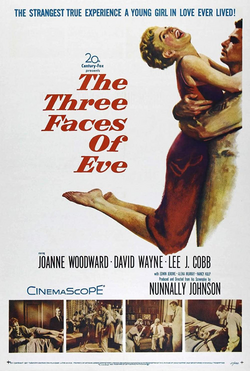
There is nothing that has more confused and directed people’s conceptions of the “multiple personality syndrome” than this film.

en.wikipedia.org/wiki/The_Three_Faces_of_Eve

Sadly, this film has been taken at face value, but I a COMPLETE FICTION.

It won’t matter how much you try to convince people that this is a fiction. People prefer to 'believe" and they are not interested in inconvenient facts or evidence.

Eve gets topped as the worst, by Sybill, who later on, was found to be a hysterical fraud, who capitalized on multiple personality.