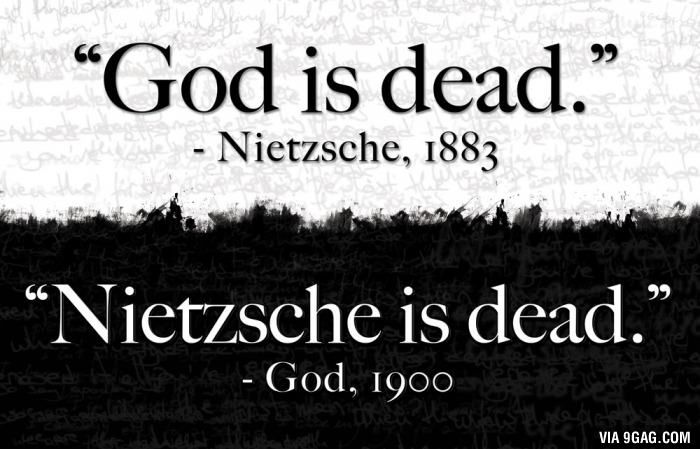
i still dont know anything about Nietzsche really and am not convinced i should read about him.the last time i asked about him on ILP over 10 years ago ,the other members refused to educate me.
u all know i could just read wikipedia but that is not the purpose of me posting about this.
at this point the most i got out of Nietzsche was clark discussing the Übermensch(superman?) on the 1st episode of smallvill.
You shouldn’t read Wikipedia on Nietzsche. I recommend trying any work by Laurence Lampert on him, though I must say they’re all flawed gems. His Leo Strauss and Nietzsche, for example—which will also educate you on Strauss—, has received two amendments from yours truly:
You could also try Heinrich Meier’s What Is Nietzsche’s Zarathustra? (‘prequel’) and Nietzsche’s Legacy (sequel), but those are really quite difficult.
Which philosophers do you know (or think you know) something about? And how would you summarize your philosophical position?
…
i dont think i’ve studied any famous philosophers . i’m totally into Einstein but nobody talks about wether he had a philosophy or not. on the net’ they only talk of his science in physics mostly.i’d be interested to know if he had one.
personally morality is my philosophy and a logic based approach to the universe.
“His Leo Strauss and Nietzsche, for example—which will also educate you on Strauss—, has received two amendments from yours truly”
R u sayin Lampert let u change his book?
This is serious big league shit, Saully. U got real academic philosophers and intellectuals including your stuff in their books and articles.
You’re not just posting anymore, Saully. You’re a real writer now who’s words will be set in the stones of history. Are u prepared to accept this task, this responsibility?
Imagine thinking “muh I’ll just check wiki” is a meaningful or real substitute for actually reading the real author himself. Like what the actual. If I thought this was a forum for actual philosophers I would be shocked.
My amendments are just forum posts so far. Still, in a private exchange I had with him in 2011, Lampert did in effect agree that his first book, Nietzsche’s Teaching, would require some sort of amendment:
“[Y]ou are right; I have changed my view because it seems to me now that the great philosophers throughout the tradition have acted on behalf of philosophy out of philanthropic motives. The blanket condemnation found in my first book is inappropriate.”
“I was wrong about the great Socratics with respect to revenge. Now it seems to me that they were all philanthropic and that they knew the misanthropy of certain kinds of religion. I even think that Socrates (in ‘Phaedo’) showed that he recognized the roots of otherworldly religion in the passion of revenge.
That view was a long time coming, but I already appreciated much of it in ‘Nietzsche and Modern Times.’ [His second book.] […]
Personally, again, my need to change in that particular way seems to have come from my having discovered the nature of philosophy from ‘Thus Spoke Zarathustra’ --that vehicle for Nietzsche’s discoveries dictated a kind of exclusivist rhetoric for a Zarathustra who first founded the otherworldly teachings of revenge and then had to be himself the one who alone came to see through them and then to found the contrary view. So maybe what I’ve been doing is recovering from the exclusivist rhetoric of ‘Thus Spoke Zarathustra’ and discovering the Nietzschean core of all the great thinkers.”
Read the Walter Kaufmann translation of Thus Spoke Zarathustra, it’s good. You will get a nice exposure to Nietzsche in that book, although it’s written as some type of religious work complete with parables and poetic language. For his aphorisms I would recommend Twilight of the Idols, although even a lot of that are his personal issues and edginess. Still you can find kernels of truth and his writing style is good when it comes to aphoristic form.
For something a bit more like proper philosophy and prose you’ll need to check out something like Beyond Good and Evil. Definitely worth reading although his focus is pretty limited and he doesn’t bother trying to build much with his ideas, mostly just complaining about various errors he notices.
Oh my… Do you have any inkling at all about the plan of each of Nietzsche’s books—Beyond Good and Evil, for example?
The Preface, which has no subsections, is thereby the center of itself. Chapter 2 is the center of the first three chapters. Chapter 7 is the center of the last five chapters. This very basic structure was brought home to me by Meier only recently, even after I’d studied Strauss’s “Note on the Plan of Nietzsche’s Beyond Good and Evil” and Lampert’s Nietzsche’s Task: An Interpretation of Beyond Good and Evil (not to mention BGE itself, of course). And now, thanks to you I’ve found the following:
Chapter 4, “Maxims and Interludes”, begins where the 62 aphorisms of the first three chapters end; and it has 123 different numbers and two doubles (65 and 73), both of which occur before the halfway point of the chapter. This halfway point, therefore, occurs after 62 maxims/interludes… It’s aphorism # 125:
“When we have to change our opinion about someone we hold the inconvenience he has therewith caused us greatly to his discredit.” (Helen Zimmern’s translation.)
“[F]or a variety of reasons, we live in an age of extreme hermeneutical pessimism. We despair of the possibility of reaching the ‘true interpretation’ of even the simplest of texts. In such an environment, the idea that earlier thinkers wrote esoterically is a most unwelcome suggestion, threatening to burden the practice of scholarship with all kinds of new and intractable demands. Exactly how is one to read ‘between the lines,’ and how is one ever to know that one has reached the author’s true, esoteric teaching? Every such difficulty, real as it may be, grows in our eyes into a sheer impossibility. In our hermeneutical malaise, this theory feels to us altogether unmanageable, unbearable, unacceptable.” (Arthur Melzer, Philosophy Between the Lines: The Lost History of Esoteric Writing, pages 106-07.)
There are true edible fungii (which has a brown oval or pointed fruiting body with an irregular honeycombed surface bearing the spores) and false ones?
The exact same thing happened to me here. I didn’t know anything about Plato and I still don’t. He’s a dead Greek guy, so far, to my knowledge. Should I read him or about him? That’s a question.
Did people help me? No.
It’s the same with my parents. You’d think after 35 years of living with me they’d know my needs and desires about as clearly as their own. Can’t they just come down to my room with the snack?
The most I thought I was learning about Plato was when I watched a Friends episode “The One with the Monkey,”, but after about fifteen minutes, I realized they were talking about Play-Doh.
And of course, I already knew that the basic structure was Preface—first three chapters (two plus one!)—fourth chapter (interlude)—last five chapters (three plus two!)—Epode. But what Meier points out is that the Preface, chapter 2 and chapter 7 are the only places where Nietzsche uses the phrase “free, very free spirits”.
Of course, this apparent pattern of 1 (Preface)—62 (first three chapters)—62 (first half of the fourth chapter)—1 (center of the fourth chapter)—62 (second half of the fourth chapter) could be random, but there are certainly many patterns in the book that aren’t. And if, from aphorism # 125, we skip yet another 62, we get to # 187 (not the 187th aphorism, which is of course # 185, the end of the fourth chapter). Now add another 1, and…
“In his seminars on BGE Strauss gave special emphasis to aph. 188: ‘You must always consider 188 as a very important section for understanding Nietzsche’s whole position’ (transcript of 1967 seminar, lecture 12, p. 4).” (Lampert, Leo Strauss and Nietzsche, page 67.)
Aph. 188 is basically about the need for “nature” (first or second natures) to arise from nature (zeroth nature)…
“Throughout this aphorism (188) Nietzsche speaks of nature only in quotation marks except in one case, the final mention of nature; nature, and not only nature as the anarchists understand it, has become a problem for Nietzsche and yet he cannot do without nature.” (Strauss, “Note on the Plan of Nietzsche’s Beyond Good and Evil”.)
“I came to see that the central event occurs in ‘The Dance Song.’ Studying that chapter, I saw that one word after another in that piece fit exactly right. And that exactitude occurred in a song. And that song was on the deepest possible question, the question pursued by the wisest, the nature of nature. And the point of the song was that Life offered herself to Zarathustra to be fathomed. That and that alone made it possible for Zarathustra to address the wisest as he does [i.e., as their superior]. And I thought, if that exactitude, that precision of language is there, then it has got to be elsewhere, and I moved outward to the whole book.” (Lampert, on his Nietzsche’s Teaching: An Interpretation of Thus Spoke Zarathustra.)
“[The skeptic Socrates] experiences the whole [Gk. tò hólon, “the universe”] as neither perfectly transparent nor perfectly opaque, but elusive and alluring. And this experience derives not simply from the limitations of human reason but from the character of the world: hiddenness is a property of being itself. Nature is esoteric. Now, if this is the case, then the puzzle-quality of an esoteric text would not be artificial and obstructive of philosophy but rather natural and necessary, being an accurate imitation of reality.” (Melzer, Philosophy Between the Lines, page 234.)
“The third stage of Socrates’ philosophic education initiates him into an ontology based on understanding the nature of the human as eros; it is an account of beings as a whole based on acquaintance with the being most intimately knowable. As an ontology it occurs within an understanding of the limitations on human knowing, the dreaming and shadow-painting that inevitably construct the forms and particulars of human experience blocking all direct access to beings.” (Lampert, How Socrates Became Socrates, page 191.)
“[Charles Sanders] Peirce’s objective idealism is the paradoxical doctrine that what is most intimate and private, not observable but only introspectable [namely, feeling], in fact exists objectively: it composes the universe and all the things in it that we objectively observe. The ‘law of mind’ must be known by introspection but applies objectively, so that, by looking within our own minds, we grasp the fundamental law of the universe.” (Thomas L. Short, “What was Peirce’s Objective Idealism?”)
Well, not literally secret codes and faeces, but yeah. For example:
“Nietzsche played with numbers in composing Zarathustra, contriving each of the first three parts to have twenty-two chapters, part 3 having twenty-two in an oblique way [fifty-nine plus its last chapter, “The Seven Seals”] that suggests that the total of sixty-six chapters is a meaningful repetition of the Bible.” (Lampert, Nietzsche’s Task, chapter 4, footnote 6.)