On further thought, this is not right. For iNtuition means having the results of one’s sensing process logicized by having them impressed on by one’s inner or outer world.
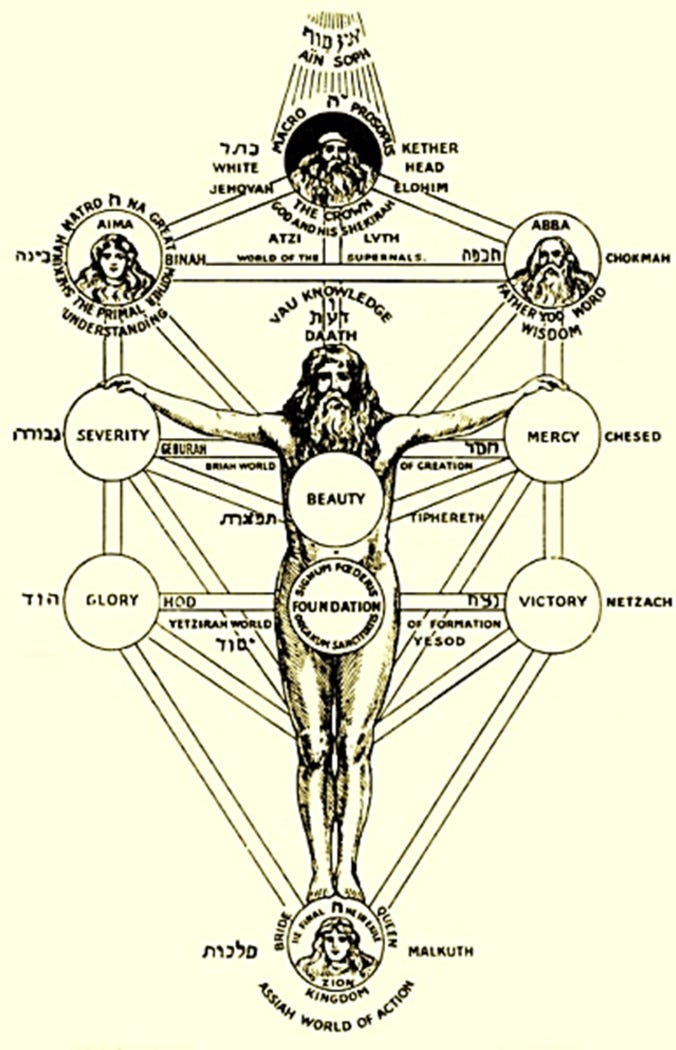
I was already inclined to think, and now I’ve become more certain, that this “zeroth” Sephira be none other than Daäth. Together with my new correction on iNtuition, above, this also makes me more certain of what I was also already inclined to think:
Note that Daäth as N represents the head of Adam Kadmon “by itself” (one of the four heads), whereas Daäth as Se represents his head as part of his body:
'At that point I “lost” my HGA for a while, until I found myself in [my HGA’s] place, meaning I no longer saw [my HGA] beyond myself, but now identified myself with [my HGA]. So yes, [my HGA]‘s my higher self or, as Jung puts it, my whole self (including the sense of “wholeness”).’
It occurred to me by the way that a quite obvious way to relate our models is to view VO as pertaining to Binah, and SL to Chokmah. Interesting there that the virtue of Chokmah is Devotion, which is a form of valuing, yet not self-valuing. The virtue of Binah is Silence, which may relate to why Ive never been able to make myself truly clear on what I mean with 'self-valuing", and instead caused a lot of grief (Trance of Sorrow) for myself by my increasingly violent attempts.
You might say that SL also relates to Kether, but I think Kether must also include VO/Form (Binah and Chokmah as two sides of that coin) as it is not just discharge, but emanation.
This does make some sense from my perspective on your perspective and on Qabalah/Kabbalah. Take, for example, this passage from a couple of posts earlier in this thread:
You have said that my model is mystical whereas yours is a logic—indeed, the Logick. There’s also the fact that I ‘received’ the concept of self-discharging from Lampert (the contents) and from you (the form)—although I’m still not sure that’s quite what he meant (and he’s dead now). In general, I tend to be accused of taking my thoughts from others instead of coming up with them myself. This is not my own perspective, though.
Note that Kabbalah literally means “something received”. Perfect devotion, which is the Jewish ideal, would indeed mean discharging oneself completely.
“The race of Cain ends with the song of Lamach, who ‘boasted’ to his wives of the slaying of men and of being superior to God as an avenger. In contrast, the race of Seth (the replacement of Abel) cannot ‘boast’ a single inventor. Its distinguished members are Noah and Enoch who were righteous and ‘walked with God’. The contrast between the race of Cain, the founder of a city, and the race of Seth, leads Strauss to conclude that ‘civilization and piety are two very different things’. But he does not elaborate. It seems that those who walk with God cannot aspire to greatness. Those who aspire to greatness must renounce God. Strauss repeats Nietzsche’s claim that for the Greeks the individual is marked by the pursuit of excellence, supremacy and distinction, but for the Jews the individual is marked by honoring mother and father, or living a life of obedience to the ancestral. Not only are the Jews not lovers of philosophy as Spinoza observed, they have failed to found a great civilization. The latter requires not only philosophy, but craftsmanship and the arts, which are an extension of man’s love of knowledge; they are part of his revolt against God and his aspiration to compete with God by remaking the world to his own liking. By their great words and great deeds (not good words and good deeds), men aspire to the immortality of the gods. The Jews failed to found a great civilization because they ‘walked with God’." (Shadia Drury, The Political Ideas of Leo Strauss, “Philosophy’s Hidden Revolt against God”.)
Now for some of my own revolt against God:
Binah, or the High Priestess, is already Kether or the Ain…
The brothers of blackness, a.k.a. the Black Brothers, are those who think they’re already in Binah/Kether when really they’re still only in Daäth. So “Chokmah” is set beyond their “Binah”—Daäth!—so that they don’t make unto themselves a crown: “No, you’re not in Kether yet; you still have to get to Chokmah first”…
It’s true that they’re not in Kether yet, but this is only because they don’t understand(!) that Binah and Chokmah constitute a two-in-one, not a two-beyond-the-one. And since two plus one equals three, the two-in-one is also a three-in-one, namely the one—Kether—plus the two in the one—Chokmah and Binah.
(Note: in my ‘Jungian’ Tree of Life, Chokmah and Binah together constitute the Judging function, whereas Daäth constitutes the Perceiving function—together with Kether: the “two crowns” (really another two-in-one; and I suppose Judging and Perceiving together may also be understood as constituting a two-in-one, namely the one function of Cognition…).)
I don’t think it speaks against the Jews, though. I mean, why slay men, why be an avenger, why invent, why found a city or a civilization, why aspire to greatness? Perhaps out of the striving for distinction, i.e. out of cruelty, but that can only give a temporary relief from nihilism, like having a lovely, very young woman’s asshole relax for you.
According to Crowley, Chokmah is not just Wisdom, but also the Will of the All-One. Well, the will, too, is something received…
Jesus Christ Superstar (1973) HD - Trial before Pilate
Of course, “the All-One” (Kether) is really the Ain, “no-thingness”, which is the same as nothingness…
This now reminds me of something I wrote on April 9, 2010:
The experiments or attempts (both Versuche in German) of the great man—that is, the man of strong will—become temptations (also Versuche) when they flow into the public sphere, for the distance created by them between themselves and ‘the rest’ arouses in some among this ‘rest’ the pathos, the feeling, of distance, and this in turn arouses in some erôs, that is, the will to narrow the distance between themselves and the one who aroused it. These others see reflected in that great man their own ‘next’ selves, which they then seek to attain.
You obviously see your ‘next’ self reflected in Nietzsche. And in seeking to attain that, you inadvertently become someone in whom others see their own ‘next’ selves reflected. But what about Nietzsche himself? More generally, what about the genuine philosopher himself? If he is the highest human being (and I agree with Laurence Lampert that he is), in whom can he himself see his ‘next’ self reflected? It can only be in a god (compare Gay Science 143. Also, Nietzsche says somewhere that the Greek nobility related themselves to their gods as lower nobility to higher nobility). Zarathustra was Nietzsche’s Dionysus, Nietzsche himself was Zarathustra’s soul, his Ariadne. Nietzsche imagined a Dionysus who gave everything to him (see TSZ Of the Great Longing, which is the mature counterpart to the Night-Song). Because Zarathustra gave everything to him, he himself became overfull, he himself became a Dionysus. The climax of the Night-Song is when Zarathustra cries that he longs for speech. One time when I was ‘living through’ that song, I ran into a wall at that point, because I did not understand what he meant by that. I think I do now. He, a Dionysus, longed for speech by his Ariadne. He longed to be a receiver for a change. And this happens after he gives his Ariadne his “last thing to give” in Of the Great Longing. (The only thing that still confuses me a bit is the use of the word “soul” in the Night-Song. In the Night-Song, Zarathustra does not address his soul as a different person, but in Of the Great Longing, he does. I don’t think these two ‘souls’ should be identified. I think that in the Night-Song, “my soul” is just a poetic way of saying “I”, whereas in Of the Great Longing, it designates his anima, his Ariadne—the Psyche to his Eros).