Uncountable (to us) variations from the first note to… what… the swan song? Uncountable (to us) variations from the beginning to … what… heat death? And yet it’s all governed by the same rules.
Variation (freedom). Because rules (conditions).
Moving from music, to bow & arrow…
When the bow is at rest, nothing is going to perturb it … no arrow will move from it. We observe an arrow of time. Something moved what was always at rest before the movement, OR once something came to be, it started out in tension.
You either believe in a Ghostly Bowman, or … I dunno, man. Cuz bootstrapping a bow into existence/being from nothing is not a thing unless you are the source/thing of all other things & have the agency to give them existence/movement.
That’s logic, not evidence—and sketchy logic at that.
Variation is not freedom. And Who said the bow was ever at rest? Who said something first came to be? I say the bow always was, in tension; the Big Bang and the Big Chill are limits, not beginning or end points…
'I think “matter” radiates space-light… For the form, though not the content, of this latter term, compare the term “wave-particle”: particles are collapsed waveforms which can again “uncollapse” into waves of radiation; quantum excitations of a field which may become less excited and more field, less particular and more wavelike. In fact, at the most basic—quantum—level, all “beings” are getting lighter all the time, less all the time, meaning more and more space emerges. This is the infinite universe-equivalent of the “expansion” of the universe. (Logically, it makes no difference whether the universe is expanding or everything in it is contracting.) The Big Bang itself is the absolute maximum accumulation of force discharging itself into space (the heat death of the universe is when the universe almost entirely consists of space). Self-lightening into light-space is not so much discharge into the void as it is discharge into void: the self-lightening becomes light-space, never completely but more and more (approximating an asymptote). The discharge creates more void, or more precisely it is a creating of more void (empty space, vacuum). Self-lightening in light-space is not even a particle(‘s) becoming a quantum of space, but the relative un-kinking of a wave of space. The whole is infinite, but its “parts” can never be infinitesimal. The elementary charge becomes ever smaller—not in the sense that 1e becomes, say, .5e, but in the sense that e itself decreases. The Big Chill is the ending that never ends, just as the Big Bang is the beginning that never began.’
Erm, yeah, that’s called science… Science is not science—Lat. scientia, “knowledge”—, but philo-sophy—which in Latin would be amor scientiae. More precisely, premodern science is philosophy; modern science is a method, a path—and although a path to knowledge may seem as undogmatic as love of knowledge, taking one path means you’re not taking any others… Thus Heidegger said:
“The threat to man does not come in the first instance from the potentially lethal machines and apparatus of technology. The actual threat has already affected man in his essence. The rule of Enframing threatens man with the possibility that it could be denied to him to enter into a more original revealing and hence to experience the call of a more primal truth”.
By choosing a path towards it, you impose a frame on knowledge. (Having said all this, I’ll still share my thoughts on the rest of that passage you quoted. The whole universe at one point in time is being compared there to a part of the universe at a different point in time. If one thinks of the universe as finite and expanding, a part of the universe at one point can be thought of as equal in size to the whole universe at an earlier point. If one then compares the two, one may expect them to behave the same way with regard to their expansion.—If the Planck constant is related to the elementary charge, though, and the latter is changing, then the former, too, must be changing.)
My philosophy, although inspired by, among other things, modern science, is not modern science. Though it may fall short from the perspective of modern science, it’s illuminated by what Heidegger calls “a more original revealing”. This revealing, however, is not of the kind of the “revealed religions”, like Christianity. In fact, your religion is more like modern science in Heidegger’s sense: you be-lieve, i.e. you want to believe, and from that point of departure go in search of scientific theories that support your precious articles of faith. I, on the other hand, have no interest in helping you round out your dogma. If you want to discuss a specific subject, please raise it here, and I may indulge you.
Osiris is the male who divides the male from the female. Horus is the male who unites the male with the female.
“The essential characteristic of the Grade [of Magus] is that its possessor utters a Creative Magical Word, which transforms the planet on which he lives by the installation of new officers to preside over its initiation. This can take place only at an ‘Equinox of the Gods’ at the end of an ‘Aeon’; that is, when the secret formula which expresses the Law of its action becomes outworn and useless to its further development.
(Thus ‘Suckling’ is the formula of an infant: when teeth appear it marks a new ‘Aeon’, whose ‘Word’ is ‘Eating’).
A Magus can therefore only appear as such to the world at intervals of some centuries; accounts of historical Magi, and their Words, are given in Liber Aleph.
This does not mean that only one man can attain this Grade in any one Aeon, so far as the Order is concerned. A man can make personal progress equivalent to that of a ‘Word of an Aeon’; but he will identify himself with the current word, and exert his will to establish it, lest he conflict with the work of the Magus who uttered the Word of the Aeon in which He is living.” (Crowley, “One Star in Sight”.)
In a draft for an email I mostly wrote last summer, it says:
‘Moving toward what is good and moving away from what is bad are two sides of the same coin which is eros. Thumos, then, is not only moving toward what is bad, but also moving away from what is good.’
Perhaps, then, lust of lust is eros’s moving toward what is “good”; wrath of lust is eros’s moving away from what is “bad”; wrath of wrath is thumos’s moving away from what is “good”; and lust of wrath is thumos’s moving toward what is “bad”.
My draft immediately continues:
‘In fact, […] thumos has its own goods, which are directed toward the bad, such as victory over it and revenge against it. For the sake of such goods, it spurns the goods of eros. So thumos is basically the mirror image of eros’.
Perhaps, then, delusion of lust is the belief that eros’s goods be good and its bads be bad; and delusion of wrath is the belief that the goods of thumos be good and the goods of eros be bad…
I actually turned these last two around on purpose. Contrast:
“To attain the grade of Magus he [the Master of the Temple] must accomplish […] the renunciation of His enjoyment of the Infinite so that he may formulate Himself as the Finite”. (Crowley, “One Star In Sight”.)
Binah: love of comprehending delusion—which is not just the delusion of goods and bads, but at bottom the delusion of selfhood—;
Chokmah: will to create delusion.
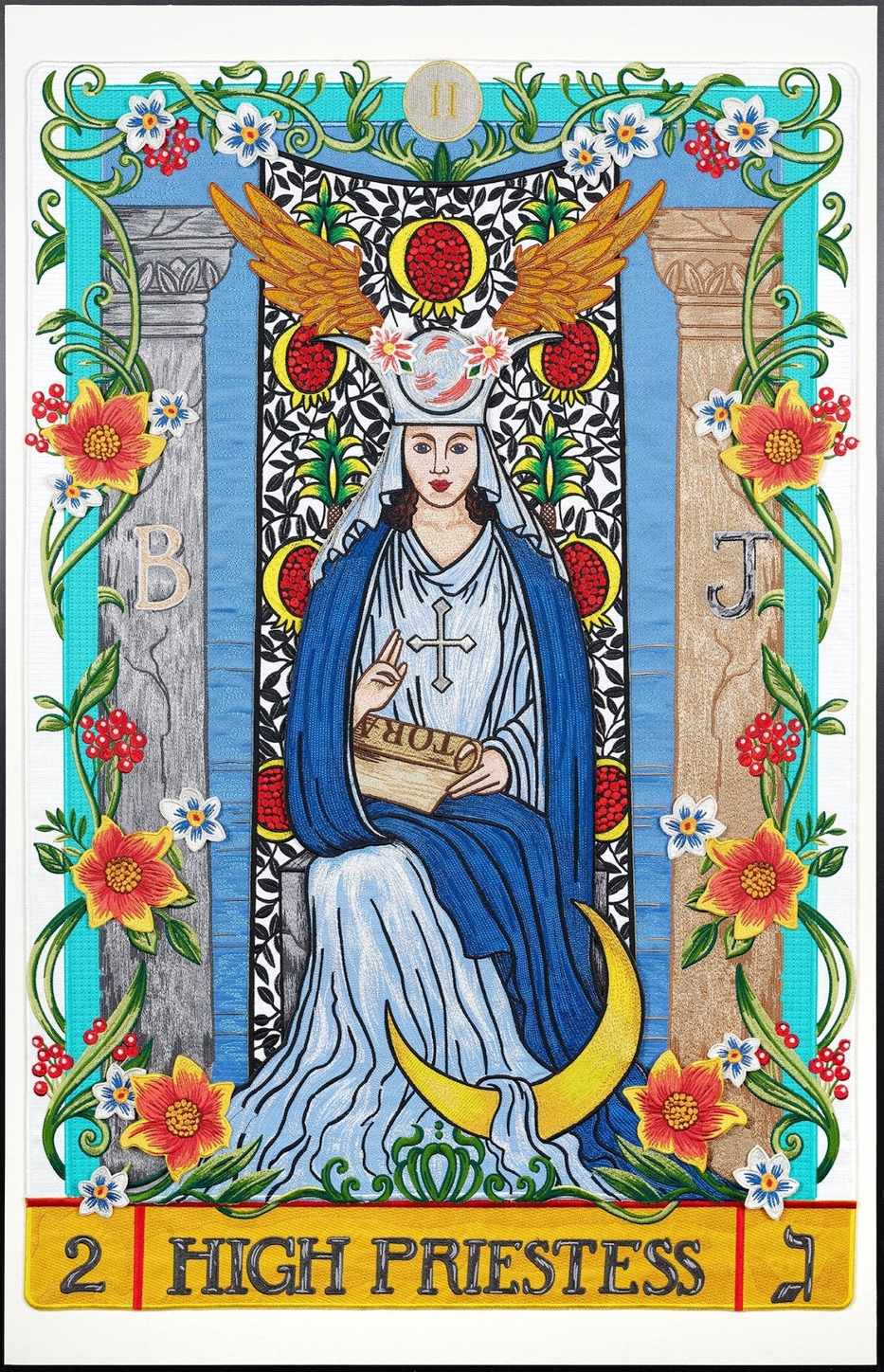
Like I said before, the said renunciation and formulation are symbolized by the Star card from Tarot, which is the same Star from the title “One Star In Sight”:
“The Order of the S. S. [Silver Star] is composed of those who have crossed the Abyss; […]
Every active Member of the Order has destroyed all that He is and all that he has on crossing the Abyss; but a star is cast forth in the Heavens to enlighten the Earth, so that he may possess a vehicle wherein he may communicate with mankind. The quality and position of this star, and its functions, are determined by the nature of the incarnations transcended by him.
[…] There are full accounts [of the Grade of Master of the Temple] in the Magical Diaries of the Beast 666, who was cast forth into the Heaven of Jupiter, and of Omnia in Uno, Unus in Omnibus, who was cast forth into the sphere of the Elements.” (ibid.)
A grade cannot be separated from the tasks required for passing that grade (and only the grade of Ipsissimus does not have such tasks). A Master of the Temple’s being cast forth in the Heavens, then, is precisely his renouncing his enjoyment of the infinite so that he may formulate himself as the finite. To be a Master of the Temple means, among chiefly two other things, to try and formulate oneself as the finite.
¹ “This Sephira [Yesod] is the seat of the great crystallization of Energy. But it takes place very far down the Tree [of Life…]. There is little help from low, unbalanced spheres like Netzach and Hod. What saves Yesod is the direct ray from Tiphareth; this Sephira is in the direct line of succession.” (Crowley, The Book of Thoth.)
So, does my Word, Athelema, make special sense in the context of Yesod as the delusion of lust? I do indeed think so. Thus I also wrote before in this thread:
‘My current crisis revolves around my renunciation of the Will, my identification with the Love that is not under Will.’
In other words, my renunciation of wrath, my identification with the lust that is not under wrath (cf. phobos, “hate, repulsion”). Which is not to say Crowley was cast forth into Tiphareth; as I wrote elsewhere:
‘I do not agree with Crowley on who the historical Magi were, although there is some overlap. For example, Crowley lists the Buddha and identifies his Word as Anatta. I agree on this one, but would also list Homer, for example, whose Word I’d identify as Hades. […] And as for Crowley himself as the Magus of our “Aeon”, whose Word be Thelema (“Will”): wouldn’t it be more accurate to say that Nietzsche was the Magus of our “Aeon”, whose Word (then) is “will to power”?’ (Indirect source: https://onlinephilosophyclub.com/forums/viewtopic.php?p=419364#p419364)
will to power
amor fati
‘I think you and Sloterdijk are wrong about Nietzsche because you don’t appreciate (the full extent of) his exotericism. In the fundamental respect, the doctrine of the will to power does not disinhibit the “powerful”, but on the contrary.’ (Source: https://ilovephilosophy.com/viewtopic.php?p=2922111#p2922111)
‘I think you and Sloterdijk are wrong about Nietzsche because you don’t appreciate (the full extent of) his exotericism. In the fundamental respect, the doctrine of the will to power does not disinhibit the “powerful”, but on the contrary.’ (Source: https://ilovephilosophy.com/viewtopic.php?p=2922111#p2922111)
From this it would follow that the Ipsissimus does not love and therefore does not will. As I wrote elsewhere on this site:
But if Chokmah/the Magus is second (only) to Kether/the Ipsissimus, and it/he does will, then that must mean it/he loves Kether/the Ipsissimus. And if what it/he wills by loving is the creation of delusion, what it/he loves is surely the reality of existence… For it’s only in contrast that anything comes into its own (even contrast itself).
“It is the figure of the Magus of the Taro¹⁸; […]
18. Atu I. This is Mayan, the Great Magician, he who has created the Dyad ({HEB:Bet} = 2) and thus made possible the conception of Opposition, and hence of ‘Evil’. He is to be distinguished from Chokma, the creative Mercury who transmits the Essence of Kether as a Logos, that Kether may become intelligible to Himself through Binah. This lower Mercury asserts the Dyad as Reality, and denies alike Kether and the Ain. Hence its issue is in Materialism.” (Crowley, Liber 418, the 3rd Aethyr.)
ox [size=1]Mario Miyamoto, “Karnov’s Revenge / Fighter’s History Dynamite (Arcade) Playthrough - Longplay (Ryoko Kano) World Ver”[/size]
The lower Mercury pertains to Hod… If you turn the Tree upside down, Hod becomes Chokmah, and what becomes Kether is both Yesod and Malkuth—“Kether” and “the Ain”, respectively…¹ Thir true nature is denied, because the reality of thir dyadicity is asserted… Kether is contrast, and the Ain the lack thereof; and contrast only comes into its own in contrast with a lack of contrast… This is a paradox, and Kether and the Ain both do and do not contrast with one another. Chokmah transmits the essence of Kether—contrast—as a logos, thoroughly in the Heraclitean sense.
“By a Magus is this writing made known through the mind of a Magister. The one uttereth clearly, and the other understandeth; yet the Word is falsehood, and the Understanding darkness. And this saying is Of All Truth.” (Crowley, Liber B vel Magi sub figura I.)
Space is dark and literally com-prehends. Light is clear, yet shiny, show-y, seeming/-ly. The word is false like a photon, a pharticle, a point of phew.
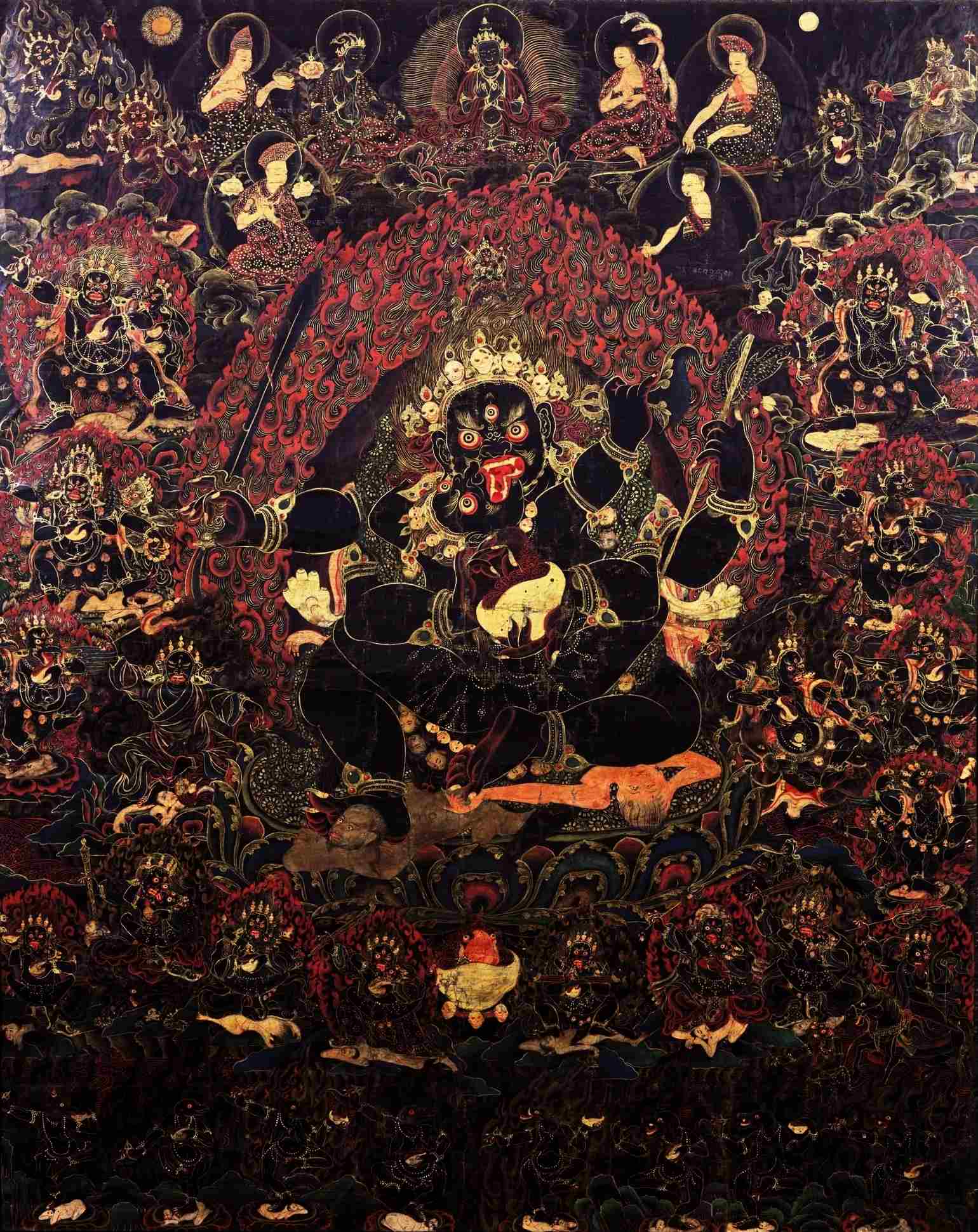
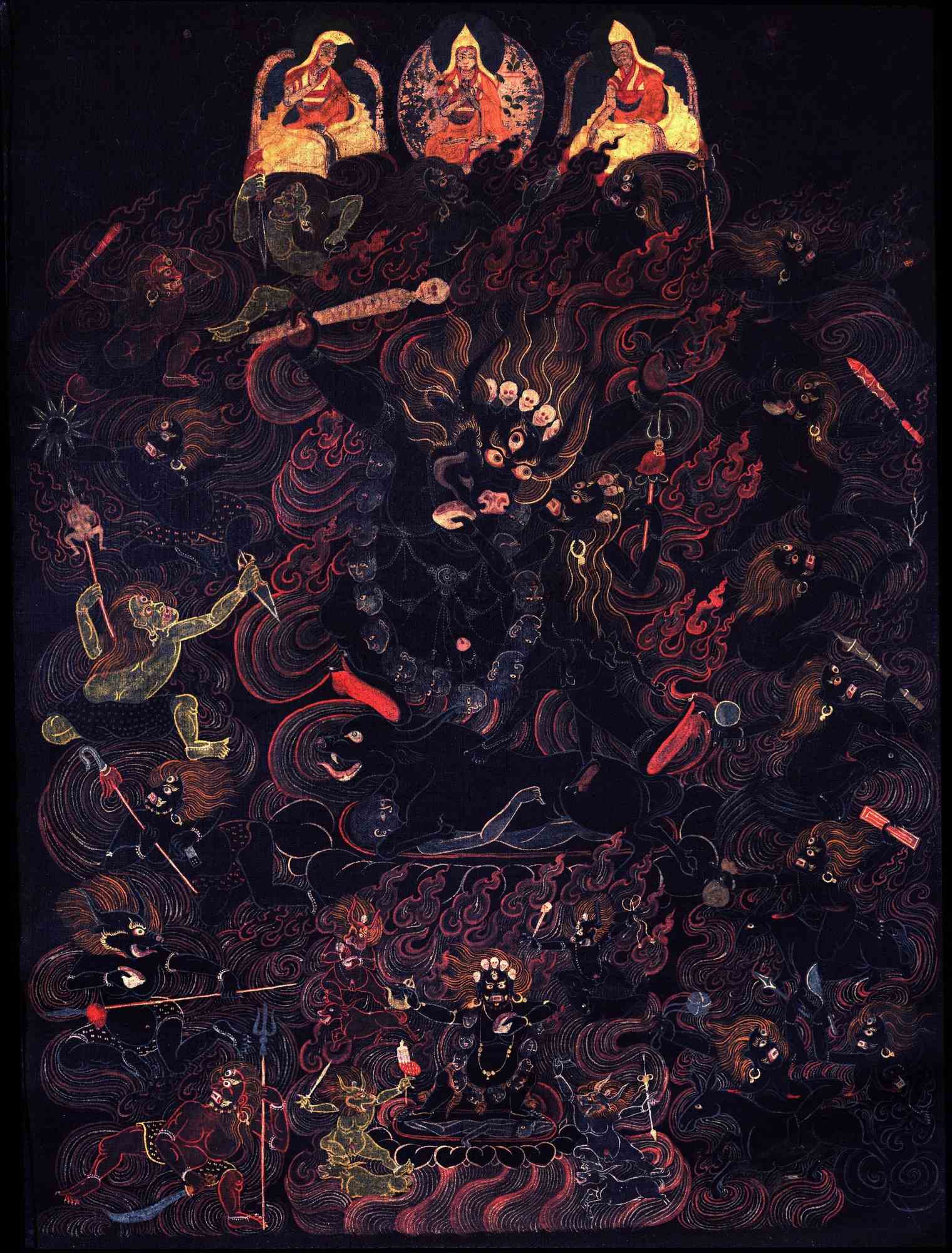
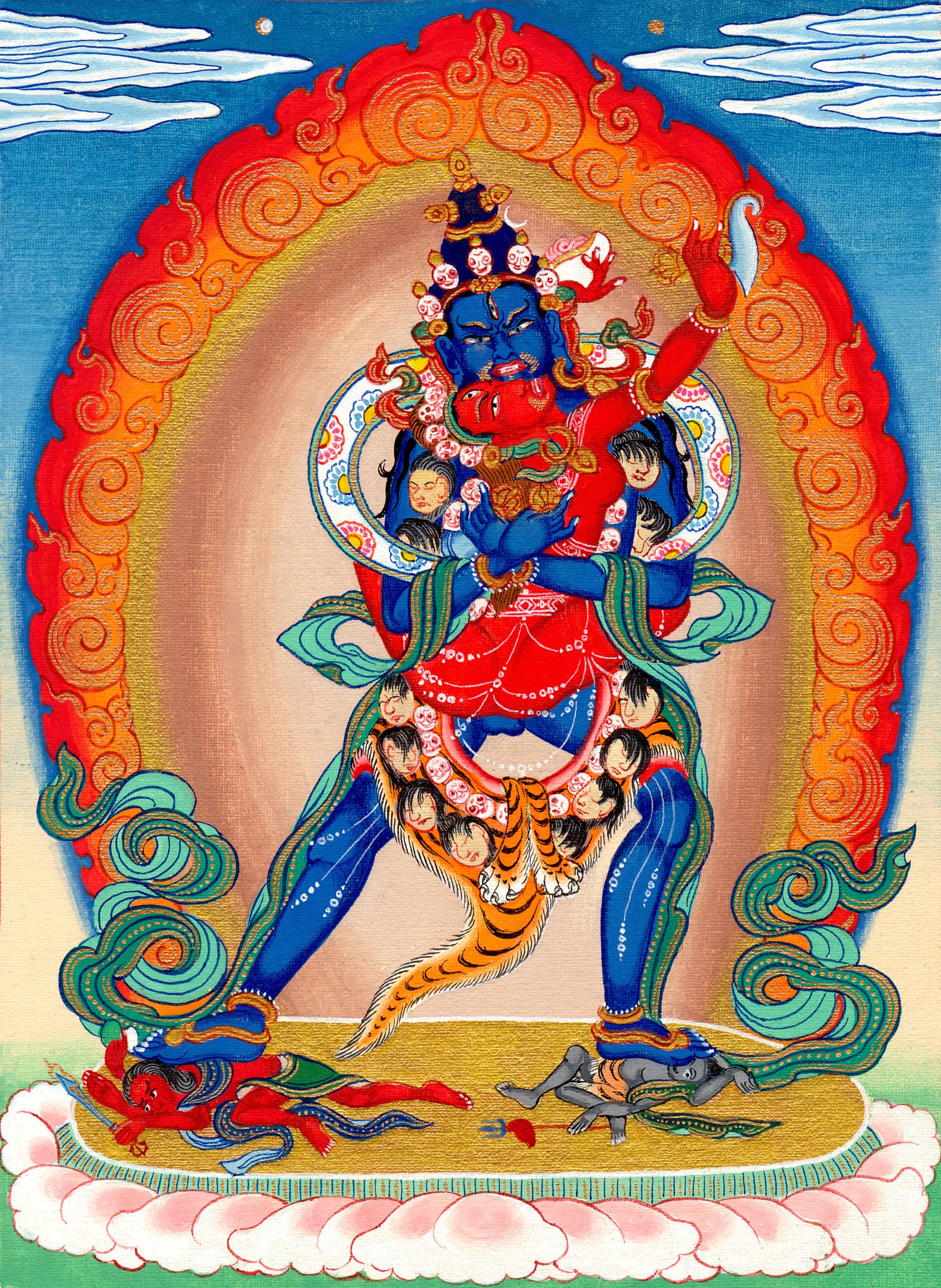
It turns out I was wrong about Yamantaka. Yamantaka, too, belongs to Father tantra. Here’s Kalachakra, who belongs to either Mother tantra or non-dual tantra, but certainly not to Father tantra:
“From the Taoist classic Tao Te Ching, it was held that ‘The Tao produced One; One produced Two; Two produced Three; Three produced All things.’ It is generally agreed by Taoist scholars that Tao produced One means Wuji produced Taiji, and One produced Two means Taiji produced Yin and Yang [or Liangyi (兩儀) in scholastic terms]. However, the subject of how Two produced Three has remained a popular debate among Taoist scholars. Most scholars believe that it refers to the Interaction between Yin and Yang, with the presence of Chi, or life force.” (Source: https://en.wikipedia.org/wiki/Three_Pure_Ones#In_Taoism)
In this scheme, Wuji clearly corresponds to Qabalah’s Ayn (Soph); Taiji to its Kether; and Yin and Yang to its Chokmah and Binah.—With the lack of contrast, the Ayn, contrasts itself Kether, the contrast between Chokmah and Binah. The Ayn is zero, Kether is one, Chokmah two, Binah three. Or: the absence of contrast is a third to the presence of contrast between the two. And this principle, of contrast, is Of All Truth:
“The ultimate truth is the flux of things with the contradiction that it contains within itself.¹ Torn into its opposites and formless, this ultimate truth is not world, either. There is only an unreal world; the real is nothing but pure negativity, time, or, as Nietzsche also calls it: suffering. But pure negativity has, by itself and out of itself, no subsistence:² it is only as it produces show³ out of itself, which however, because it stands in opposition to it, is itself not real either but only a show. […W]ithout show, the eternal flux has no subsistence. It must produce show out of itself. Show therefore belongs to its truth. […] ‘In order that there could be any degree of consciousness in the world, an unreal world of error had to—emerge.’” (Source: Georg Picht, Nietzsche, pp. 251-53, my translation.)
¹ The contradiction between past and future.
² Bestand.
³ Schein.
Of course, this is an abstract way of putting it, for what does lack of contrast really mean? Not some kind of “nothingness”, but a One without an Other. (This “One” may be Osho’s no-thingness, though.) So Kether, without Chokmah etc., is really the Ayn; and as soon as there’s Kether and the Ayn, i.e. “two Kethers” or “two Ayns”, that’s Chokmah and Binah: this “internally” contrasting dyad contrasts “externally” with the “non-contrasting” monad Kether, the “Ayn”.
Here’s a draft I found from four weeks ago, which I’ve decided to post after all.
::
But then the reality of existence must be will.—Crowley’s “Word of an Aeon” is Thelema; my (personal progress equivalent to that of his) “Word of an Aeon” is Athelema. The reality of existence is “love” (eros!), not will; but the abyss of love, of lack, must produce the delusion of substance, of Being, out of itself:
“The ultimate truth is the flux of things with the contradiction that it contains within itself [i.e., the contradiction between past and future]. Torn into its opposites and formless, this ultimate truth is not world, either. There is only an unreal world; the real is nothing but pure negativity, time, or, as Nietzsche also calls it: suffering. But pure negativity has, by itself and out of itself, no subsistence [Bestand ]: it is only as it produces show [Schein ] out of itself, which however, because it stands in opposition to it, is itself not real either but only a show. […W]ithout show, the eternal flux has no subsistence. It must produce show out of itself. Show therefore belongs to its truth.” (Georg Picht, Nietzsche, pp. 251-52, my translation.)
Now the challenge was, in Laurence Lampert’s words, that “modern opinion necessitates what [to be sure] it also makes possible, the attempt to bring society’s opinions into accord with philosophy’s character, not by making society wise but by making its opinions reflect rather than contradict the truth” (Lampert, Leo Strauss and Nietzsche, page 168):
“Nietzsche does not say, as would have to be said from the side of metaphysics: The will to truth is the will to knowledge of the steadfast, the true, the permanent, the being; he rather says: ‘The will to truth is a making steadfast, a making true-permanent,’ a reinterpretation of show into Being. When one first makes what is to be known as true oneself, when one gains Being only thereby that one reinterprets show into Being, then the will which accomplishes that cannot avoid eventually discovering that what it must first make steadfast is not yet steadfast by itself, and that the permanence which it must first create is not already given by itself in advance. As Nietzsche puts the concept ‘will to truth’ in place of knowledge of the truth, he has thus carried out the great inversion. He wants to know the problem of science no longer on the soil of science, but sees the process of designing the schema of a permanent world from the perspective of the artist. From this perspective, too, the truth is still only so-called truth; it is the show in which the counterworld appears. But only when considered from the side of the will to truth does it come to light what is really true about the so-called truth, namely the necessity to found an abiding order, in which life is possible. Once again it turns out that Nietzsche’s inversion of metaphysics has a double meaning. On the one hand, the basic error of metaphysics is as it were unmasked; it is now no longer possible to pass off as Being what in truth is show. On the other hand, however, it is through the exposure of the will which is active in the basis [of metaphysics] that the proceedings of metaphysics in their inner necessity first become understandable and in this sense get justified. Only through the overcoming of the error of metaphysics does what had been true in all metaphysics come to the surface [zum Vorschein , “to the fore-show”]. If one understands ‘truth’ in the concept ‘will to truth’ as the truth in truthful show, then the will to truth is no more only a will to so-called truth; it is then rather the will to poiesis or, as Nietzsche says here, to ‘making,’ that is to say to the production of a show which does not negate life but affirms it; which is thereby in unison with life and thanks its truth to this unison.” (Picht, Nietzsche, pp. 281-82, my translation.)
On page 280, Picht had explained how traditional, i.e. Platonic, metaphysics errs fundamentally and thereby negates life:
“The traditional, metaphysically based morality, however, is false in the sense of falseness raised to a higher power. It does not just posit the necessary show, but on top of that it passes this show off as truth. Traditional morality is therefore false in a dual sense, whereas the world is only singly false. In morality, the spiral of show is, if I may say so, rotated a full rotation further. Therefore, the truthful show of the world is not affirmed; the world is rather, on the basis of an additional deceit, negated in the name of the alleged truth.”
The so-called truth is a show which negates life; the will to truth is a show which affirms life. For the will reflects eros, albeit as its “negative”, its diametrical opposite.
And consider this passage I translated immediately after that:
“Insofar as contradiction is the essence of the primordial One, It can even be supreme pain and supreme pleasure at the same time: immersion in appearance [die Erscheinung] is supreme pleasure: when the will becomes exterior entirely. This, it attains in the genius. […] The primordial One looks at the genius, who sees the appearance purely as appearance: this is the world’s pinnacle of ecstasy. […] These reflections in the genius are reflections of appearance, no longer of the primordial One: as images of an image, they are Being’s purest moments of repose.” (Nietzsche, notebook End of 1870-April 1871 7 [157].)
Until recently, I thought of such motions as motions in one’s outer world. But consider my ‘Judging as Napoleonic Realizing and Perceiving as Nietzschean Logicization’ thread:
The motions thought creates can also be motions in one’s inner world. Still, this is always complemented by the motions feeling creates in one’s outer world.
The will, though never free in the sense of “freedom for”, is still free in the sense of “freedom from”… For the highest will is not bound by erōs, as all other wills are. In other words, it does not have an inner world. Like all other wills, it’s only the attraction caused by a perceived superiority (the pathos of distance, of order of rank). But in this case, it’s only an illusion; there is no consciousness attracted by a perceived superiority, making it strive away from us, repel us, and thereby attracting us, exerting a will on us. It attracts us, it exerts a will on us, but only by seeming to be a superior consciousness. It’s just a meme. But memes do exert an influence on us, i.e. they “will” us to change, and yet their will is free, free from need, from want, from neediness. As such, they are gods great and small, and gods great and small, conversely, are memes.
‘I’ve never felt much affinity with Hod, though I think most people would assign me to it, especially online.’
“This Sephira [Yesod] is the seat of the great crystallization of Energy. But it takes place very far down the Tree [of Life…]. There is little help from low, unbalanced spheres like Netzach and Hod. What saves Yesod is the direct ray from Tiphareth; this Sephira is in the direct line of succession.” (Crowley, The Book of Thoth.)
‘The lower Mercury pertains to Hod… If you turn the Tree upside down, Hod becomes Chokmah’.
'Tis now finally time to try and do some justice to phoneutria’s thoughts on the Jungian functions:
I now think Kether corresponds to Sensing, or vice versa; Chokmah (“Wisdom”) to Feeling; Binah (“Understanding”, Intelligence) to Thinking; and Daäth (“Knowledge”) to iNtuition…
What lies beyond Kether, the Ayn (Soph (Aur)), “the (Light (Bounded by)) Nothing”, is what Nietzsche called “the formless unformulable world of the chaos of sensations”. If Kether is distinct from the Ayn at all, then it is the Sensing of that chaos, the sensations as distinct from what causes those sensations,—the Sensed…
Feeling is “Wisdom” in the sense of received wisdom; not wisdom attained by oneself, by unaided Reason (say), but “revealed” wisdom, so to say.
Binah is Reason itself, understood to be itself “suprarational”, in that it does not itself “obey Reason”, to speak with Blake.
Daäth is the result of perception: not the process of letting things in through one’s “doors” of perception, but them actually being inside one’s “house”, one’s mind. Intuitions in the non-superstitious sense.
Note that these are the Jungian functions in the abstract: without an orientation (introverted or extroverted).
Extroverted Feeling corresponds to Chesed, or vice versa; extroverted Thinking to Geburah; introverted Feeling to Netzach; and introverted Thinking to Hod. So the Middle Triangle includes the extroverted Judging functions, whereas the Lower Triangle includes the introverted ones. But for the Perceiving functions, the orientations are reversed, because these functions do not impress themselves, but are impressed. So extroverted Perceiving corresponds to Yesod, whereas introverted Perceiving corresponds to Tiphareth, or vice versa.
This explains why I should have identified with Yesod instead of with Hod. While my primary function may be introverted Thinking, my primary extroverted function is extroverted iNtuition; and extroversion tends to dominate appearances, making me an INTP according to Myers-Brigss, whereas the Socionics code, INTJ, would be more accurate.—The secondary function is the auxiliary, used both to support the primary and to support other people.
Now I haven’t yet distinguished between the oriented Perceiving functions with regard to their functions, only with regard to their orientations. I’m inclined to associate the iNtuitive ones with Yesod and Tiphareth, but introverted Sensing to Malkuth. What, then, about extroverted Sensing? Well, in One Star in Sight, Crowley actually lists eleven grades:
Ipsissimus ……………… 10○ = 1□
Magus …………………… 9○ = 2□
Magister Templi …………. 8○ = 3□
Adeptus Exemptus ………… 7○ = 4□
Adeptus Major …………… 6○ = 5□
Adeptus Minor …………… 5○ = 6□
Philosophus ……………… 4○ = 7□
Practicus ………………. 3○ = 8□
Zelator ………………… 2○ = 9□
Neophyte ………………… 1○ = 10□
Probationer ……………… 0○ = 0□
To me this suggests I should associate extroverted Sensing with some “zeroth” Sephira…