Defining God
I believe in God (or a God of sorts) not because I was raised religiously but because it is a consequence of my theory of consciousness. My aim was to explain consciousness, and I ended up believing in God. If you have read everything up to this point, it should be clear what the connection is between consciousness, the universe, and God. Because consciousness (or subjective experience) is everywhere in nature, corresponding to every physical action whatsoever, then one can say the universe is conscious. And if anything should count as a God, it would be a conscious universe.
However, this isn’t the Christian God, or any personal God, it is the universe itself–the physics of the universe counting as its body, the subjective qualities of experience accompanying every action counting as it’s spirit. It’s difficult, however, to attribute to this God the usual characteristics, like counting as a person, or hearing prayers, or intervening in the physics of the universe to suspend the laws of nature. It is questionable whether it even knows about us, and to the extent it knows, it’s questionable whether it cares. This God follows the laws of nature–even if that means allowing for great and catastrophic natural disasters, disease, war, and other horrors of our reality. Expecting it to answer your prayers, or to show mercy to the suffering, or to demonstrate its supernatural powers by performing miracles, is naive at best–about naive as expecting the same out of the material universe that atheists believe in. Our God is nothing more than the atheist’s universe except with a soul. The only catch with my theory is that the events that happen in the universe represent different qualities of experience and the way they flow. ← These experiences are what God is experiencing, but they are in all likelihood incomprehensible. This God does not experience love or hate, or concern or disdain for His human children, or thoughts and emotions, or memory, or dreams, or sensations like touch, taste, or smell. These are human experiences that must correspond to some kind of neuro-chemical events in the brain. That’s not to say, however, that other physical phenomena can’t come along with similar experiences. Maybe certain chemical processes elsewhere in the universe feel like thought. Maybe weather patterns on Jupitar feel like emotions. But even if that’s the case, I would suspect that these would be very different kinds of thoughts and emotions than human beings are familiar with or could even imagine. It’s possible, in principle, to be sure, that an exact replica of some experience humans are capable of having is possible with some other physical apparatus–computers, for example, may in fact experience the processing of signals through their circuitry as thought almost indistinguishable from human thought. But for the most part, this God experiences a colossal diversity of experiences the vast majority of which are unknown and incomprehensible to us.
So this is more like the gods of old–unpredictably brutal and not that concerned with human affairs–and possibly quite unaware of human beings–but it might serve as some degree of consolation to think that because we care for ourselves and those around us, and truly hope to make the world a better place–a part of God cares and wants to make the world a better place. But that part is us. If God cares for humanity, it is because we care for ourselves.
This is the picture of God rendered by the logic of my theory, but there is more. Considering the reductive hierarchy of the universe we so frequently spoke of–whereby galaxies are reduced to stars, planets, rock, ice, dust, gas, etc., and those in turn are reduced to atoms and molecules, and those in turn to sub-atomic particles, and so on–we know that on the mental side of the hierarchy, each level is related by equivalence. But what does this say about God? If God is the entire universe–all past, future, and present states–then which equivalent level is He? Is He at the top-most level that can be described no other way than “the whole universe”? Is He at the human level? Present in all things human-size like trees, cars, animals, computers, refrigerators? Is He at the level of sub-atomic particles and quantum waves? Relentlessly orchestrating all such particles and waves such as to make the rest of the universe possible?
I like to think we can call all layers–all levels of scale, all levels related by equivalence–God, as each such layer is simply a different expression of the same meaning. Insofar as we are talking about the universe as a whole–in all its states past, present, and future, and across all reaches of space–it is rightfully entitled to the status of God. The universe at the top-most level of scale is the same universe as that at the level of sub-atomic particles and quantum waves. It should thus be the same for God. But according to the principles of equivalence, we cannot exactly say that each level is identical to each other level above and below it. Physical reduction deals with identities (as explained in previous posts) but experiential reduction (or more precisely, the reduction of meaning) deals with equivalence, which says that each equivalent level is not identical to any of the others but can be interchanged with it, and as far as their existence goes, no one level can claim sole entitlement to existence over any other. So they all qualify as God, but each “God” must be regarded as different to the others. The God at the top-most level is, I would maintain, characterized by a single quality of experience–uniform and homogenous–but when we come down to the level of (say) human beings, God is characterized by an almost infinite diversity of qualities of experience–variegated and heterogenous.
It’s odd to think, therefore, of some of the paradoxical affairs that can fall out of this. If, for example, we were to say that God has a thought at one of the levels lower in scale (say at the level of human beings because the thought belonged to a human being), we would not be able to say the same of God at the top-most level where a single, uniform and homogenous experiences resides. Unless that experience IS the thought just mentioned (which I highly doubt), no such thought exists therein (the logic of this point, the reader might recall, is the same logic we laid out in a previous post, a post in which we talked about how the red, green, and blue of the pixels on a screen are not there in the orange as seen by a person a few feet away). So is God thinking the thought or not? Well, what we can say is that with respect to the universe as a whole (at the top-most level), there is no thought per say, but an equivalent universe may have such a thought (so long as whatever else exists in that equivalent universe, coupled with that thought, makes it qualify as equivalent). In other words, a God whose sole singular uniform and homogenous experience can only be represented by the universe as a whole is at least equivalent to a God whose variegated and heterogenous experiences may include the thought. And since equivalence is a form of entailment, one could say the singular, uniform, and homogenous God entails the thought however much it wouldn’t strictly “have” the thought.
But there is something to thinking of the God at the top-most level as the “true” God and all other levels below it (where diversity and heterogeneity of qualities manifest) are simply expanded expressions of this one God at the top, more variegated and heterogenous the further it gets expressed along this axis–God expressing Himself in more and more detail as we go further down in scale. And since equivalence is a form of entailment, there is no reason to think God can’t express himself thus. Each such expression is, of course, spoken with the material of consciousness itself, and so upon being expressed, it projects and becomes all the things at the level of scale being expressed. And since the material of consciousness with which it is being spoken makes that which is being expressed more experience (via flow and entailment), one can think of these levels as extensions of God from the top-most level. Thus, even if we cannot say each level is identical, they are all connected by entailment and God’s effort to express Himself, which implies that what God is expressing is that all layers are Himself but put in more details and diversified terms. (And even if we consider just one level, it still encompasses the entire universe (past, present, and future), and so still qualifies as a God.)
Getting back to the point about the top-most God being the “true” God, the previous paragraph describes each level as originating from this top God. This top God might be considered the source of all then. This is another version of holism. This version says that if you want to find what’s fundamental to the universe, what’s the ultimate basis, you have to look up, not down. Reductionists, in contrast, look down. They look at smaller things, parts and components, to explain bigger things, the whole the parts and components make up. To look up, however, is to aim one’s sights on the universe as a whole–as if it were one singular thing–and from that, from the essential nature of what the universe as a whole is, you get all the details, parts, components, and diversity which are a logical or necessary consequence of the universe’s singular identity and unique character at the top-most level. Let’s consider God from a holistic point of view. God, as the universe as a whole singular thing, is, on the side of experience, a singular uniform and homogenous experience. This experience is the core being of God, what God really is when put in the most succinct and simple terms.
So what is this experience like?
Well, if you recall from my OP (part 2), I argued that experience is the ideal candidate for the ultimate strata in the reductive hierarchy of the universe. I argued this along two lines: 1) That there is nothing hidden in an experience, that it’s all exposed. If an experience could have hidden parts (like the atoms hidden in the rock), those parts wouldn’t be felt (the very definition of “hidden”). But if they’re not felt, how could they be part of the experience. The experience is defined as just whatever’s felt therein. This implies that there are no hidden layers to experience, nothing further down in the reductive hierarchy that, like the atoms in the rock, awaits discovery. So when we introspect and experience, or feel it, we are peering straight down to the fundamental level of what the experience is. It is meant to reside at the bottom of any reductive hierarchy. 2) That experience manifests necessity (as opposed to contingency). We see this in the way experiences flow. Each experience which flows to the next is, as we said, “entailing” it. We borrowed this term from formal logic to denote the way logic flows by necessity, and that “entailment” is a term that describes how logic does this (premises entail the conclusion); of course, we broadened this term to encompass things like the flow of emotions, fantasies, irrational thinking, and musical scores come to represent themes like adventure or tragedy–all things we are hard pressed to recognize as thoroughly logical, but it was noted that we can fall back on “justified” if “necessity” seems a little too strong (that and the argument that sometimes the necessity with which experiences flow is hidden in the overwhelming complexity of the experiences involved, some not necessarily even epistemically conscious). In any case, the necessity with which experience flows is felt in the experience–as made clear by the Jetson example (see earlier post)–we are able to draw the conclusion that George is a cartoon because we see how George being a Jetson and all Jetsons being cartoons must (by necessity) lead to the conclusion that George is a cartoon. As we said, it stops all “why” questions. We are not fumbling for explanations as to why the premises lead to the conclusion. We have it in the very midst of thinking it, and is in fact what drives our thinking it. This means that even if this fundamental layer to the reductive hierarchy is constantly in flux, it contains its own justifications for how this flux works. Each experience contains the justification for the next, its necessity. Nothing more fundamental is needed. Nothing on which experience must rest in order to be explained.
We argued in the OP (part 2) that if anything is to serve as the ultimate strata upon which everything else rests and is explained, with no deeper strata to explain its existence, we need something that not only explains everything above it in the hierarchy, but itself as well. It must be a self-explaining, self-justifying, self-sufficient, self-affirming kind of thing. Not something that doesn’t have a basis, but is its own basis (or just is basis). What we have just argued in the previous paragraph is that 1) due to experience’s completely transparent nature, it cannot fit anywhere except at the bottom of any reductive hierarchy, and 2) that it perpetually justifies and entails itself, thereby requiring nothing other than itself in order to (continue to) be.
Now before the reader objects with the point that we’ve talked numerous times of breaking down experiences into more fundamental parts (recall the park that was broken down into a playground, groves of trees, kids playing, a park bench), the point there was simply that experience can be so broken down. But not that it needs to, at least not if you’re looking for the ultimate basis on which all else stands. Experiences will always be divisible in the same sense that numbers will always been divisible, or how the meanings of words can be deconstructed into a lengthy dictionary definition (which in turn can be further deconstructed on account of its words). But you can treat numbers as fundamental too. You can treat 1 as the basic unit of all numbers and mathematics. That doesn’t mean it cannot be divided. It just means dividing it (or, for that matter, building it up to larger numbers) doesn’t get you anywhere closer to the fundamental unit, the final strata. If 1 is the fundamental numeric/mathematic unit, then dividing it (or building it up) takes us away from this ultimate basis. While this is not quite the case with experience (each experience being equally fundamental in its own right), the fact remains that as far as you get when dividing an experience into its component parts, you are getting no closer to a self-sustaining, independent strata in the reductive hierarchy. One cannot even say the component experiences are a “part” of the whole experience–as if when brought together, they constitute the whole–as equivalence reminds us that the component experience, even collectively, are not identical to the whole. So the whole can be said to be its own fundamental self-sufficient thing (nothing below it in the hierarchy on which it rests) while the components can also be said to be their own fundamental self-sufficient thing. Remember, equivalence is merely a way of relating different expressions of the same meaning. So if a whole experience is broken down into several component experiences, equivalence tells us that these are simply two different ways of expressing a shared meaning, and not a decomposition into the building blocks on which the original (whole) experience depends for its existence.
The same applies, of course, to the physical side of the reductive hierarchy. No matter how much you break a thing down into its parts–a rock into its atoms and molecules, for example–you are getting no closer to a fundamental basis for that thing. In the case of the mental side of the hierarchy, however, it is because you are already at the fundamental level no matter your position in the hierarchy. In the case of matter, it is because you never are at the fundamental level, and going down in scale is the wrong direction to go. The reader might recall that the real reductive hierarchy in the universe is neither along physical lines nor mental lines–it starts, at the top, with physics and material reality, which then reduces to experience (idealism 101), and that in turn is fundamental. You can imagine it as the following diagram:
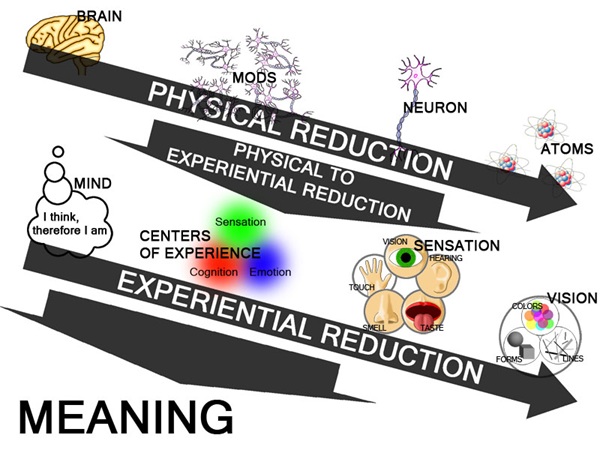
So while we may be used to the direction of the reductive hierarchy in terms of physical scale–big things reducing to small things–and while this logic might seem to carry over to the mental side of things–these parallel reductive hierarchies must be turned 90 degrees–each hierarchy now sitting horizontally with physics on top and consciousness on the bottom, and nothing beneath. As you can see, one can still break down larger things to smaller things, thereby traversing the (now horizontal) hierarchies down in scale, but one is going in the wrong direction if one’s ambition is to find that final, self-sufficient, independent layer. One must first recognize that physics and material reality are really reducible to mind and experience, and then recognize that experience is self-sufficient, independent, and final.
All that being said, none of the foregoing answers our question: what is the experience of the universe at the top-most level like? Well, I went through the above to remind the reader 1) how the universal experience at the top-level, uniform and homogenous, can be consider fundamental in its own right, and though it obviously gets decomposed into galaxies, dust clouds, radiation of all kinds, etc., this decomposition gets it no closer or farther away from being fundamental. It just makes its components equally fundamental. But it is nevertheless unique in the sense that it’s singular quality (uniform an homogenous) makes it that from which everything is decomposed. Its fundamentality, in other words, is fundamental even to the fundamentals. 2) What it means to be fundamental is to require nothing more fundamental to be explained or upheld. It must be self-sufficient, self-explaining, self-justifying, and self-affirming. With these two concepts in mind, what we must say of the experience of the universe at the top-most level is that it is something that, once apprehended, explains itself (no “why” questions) and in such an obvious, self-evident, and immediate way, that one sees that there could never have been anything other at the core of the universe, and that this experience is truly necessary, that it could not have turned out differently. All this must be embedded in the experience itself, it must uphold and justify itself from within. It must be all the answers to everything succinctly wrapped up in one simple experience.
And yet, there is more to it. We will argue later that this top-level experience must exist in a timeless state, but for those who prefer to think of the universe, even what it is as a singular top-level thing, as passing through time, you may think of this ultimate top-level universal experience as self-entailing. It only entails itself (at least if we are to stick to this top-level in scale). It must be characterized in such a way that whatever its meaning, that meaning entails that same meaning. So unlike any other experience, this experience undergoes no change (this is why it is better to think of it as timeless, but if the reader must, he/she can think of it as perpetually entailing and re-entailing itself).
Yet we do see change at every lower level. We see how the components of the universe transform and effect each other to cause change. What this means is that every state the universe passes through as it advances in time must be equivalent to the whole, to the singular experience at the top-most level. This implies that for every instance of change we see in the universe, the rest of the universe must simultaneously change in a compensating way–compensating, that is, in order to preserve the equivalence between the parts and the whole. We can understand this using both our color analogies and our mathematics analogies. For example, if we represent the top-most experience of the universe as orange, then we can represent its parts as, say, red and yellow. As the red diverges more towards the extreme red end of the color spectrum, the yellow must diverge in the opposite direction by the same amount. Only in that compensatory way can both colors maintain their equivalence to the orange representing the whole. Turning to mathematics, it’s as if the universe as a whole is represented by 1 and the parts by .5 and .5. If one part diverges to .6, the other part must diverge to .4. Only then can they both continue to represent 1 collectively and maintain their equivalence to the whole.
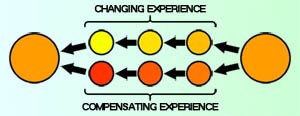
This explains the laws of nature. The laws of nature represent the change that must happen in response to specific events in order to maintain the universe’s equivalence to the whole. Water boils when you heat it passed 100 degrees Celsius. The heating of the water is the event that must be compensated by the water boiling in order for the universe as a whole to maintain its identity. Glass breaks when you throw a rock at it. The rock hitting the glass is the event that must be compensated by the glass breaking in order for the universe as a whole to maintain its identity.
This also explains what time represents. Time, as we experience it, represents the ordering of the many states the universe can exist in such that for any two consecutive states, every experience in the antecedent state entails every experience in the consequent state. This can’t be said for just any two arbitrary states. To spell this out in more detail, suppose we represent each state of the universe as a set of pairs of numbers such that each pair, when summed, amounts to 1. So the set would include pairs like .1 and .9, .4 and .6, .5 and .5, and so on (for the sake of simplicity, we will limit this set to decimals of one digit only). If we order each pair according to the rule that for pair n, the numbers of pair n+1 differs by those of pair n by exactly .1. So if pair n is .3 and .7 then pair n+1 is .4 and .6 (or .2 and .8, depending on which direction you want to represent time). In other words, whereas each component experience may entail an experience which is neither identical nor equivalent to it, all entailed experiences must collectively be equivalent to all entailing experience collectively, and both thereby maintain equivalence to the whole.
Each such state is, as we said, a different way of expressing the whole, the one singular experience of the universe at the top-most level. So then what is being expressed? How do we sum up this one singular (uniform and homogenous) experience which, for all intents and purposes, is God. Well, summing up this experience in words or in human concepts will understandably prove difficult. It’s quality is well beyond our ability to comprehend. But if we can use human cognition as a closest approximation, I would say it is an understanding of how itself, as this very understanding, can be this understanding. ← That might sound convoluted, but it harkens back to what we said earlier about the experience containing within itself that which explains and justifies itself. Recall it must be self-sustaining. As a (metaphorical) understanding, what is understood is just itself. It is a self-referencing understanding. An understanding of itself as this understanding. And that is my definition of God: A metaphorical understanding of how itself as this very understanding can be this understanding. Or this slightly altered rendition: A metaphorical understanding of how itself as this very understanding, sustains its own existence (or just is). And a third, more simplified, rendition: an experience of what experience is in essence–experience as experience itself.
These versions of the definition are put in mental term, or in terms of experience. But as we know, experiences project and become real things. So what does an understanding become when projected? In this case, I would say a principle (still metaphorical). God is the principle on which existence is possible and rests. It is an understanding of this principle. And in being projected, the principle is real, and therefore does sustain existence. The understanding projects the principle, and the principle justifies the understanding.
If we think of this in the context of the limitlessness of qualities (explained in part 1 of the OP), we can understand it as follows. The limitlessness of qualities ensures that out of all possible qualities of experience, there is bound to be one experience that matches this description precisely. There is bound to be an experience that can be described precisely according to my definition of God, an understand of how itself exists, or a principle on which itself rests for its truth. If this quality of experience must exist, then it does exist, and thus all of existence must necessarily be.
Unfortunately, we must limit our understanding of this point only to metaphor. Understandings and principles are only analogies of this top-most godly experience, and what the experience truly feels like will forever remain beyond our comprehension. But I maintain that the self-referential nature of this experience and the manner by which this permits its own self-justification and self-reification is accurate, and explains how it serves necessarily as the foundation of all existence.