My Theory of Consciousness

You’re absolutely right about Plato’s cave. That’s an excellent analogy for my theory. Just as the shadows are representations of object behind the cave dwellers, material objects are representations of experiences being had by the universe. The light is the flow of consciousness. Light flows into the cave and casts the shadows on the wall. Consciousness flows from these experiences the universe is having through our senses to create our perception of material objects.

I also agree with your assessment of human beings being not much more enlightened than intelligent apes (though our hubris tends to convince us we know a lot more than we actually do). But let me ask you about science. You’re right that 100% certainty will never be ascertained, but do you believe that science gets us closer?

2 Likes

Having curiosity is fine and with that curiosity of our universe we have progressed technologically overtime.

I think one of the main problems with science today is the ethical situation of just because we could create something into existence nobody asks the question if we should at all. Of course this is more problematic with our modern society where ethical questions are ignored completely in the name of for profit science that only cares about money or constant investments rolling in.

But yes, I don’t believe we’ll have all the answers of the cosmos or a completely logical explanation of everything regarding the unlocking of the universe’s deepest secrets, there will always be unknowns beyond the primitive mental grasp of us humans where maybe that is not such a terrible thing as it gives us the constant mystery enigma of life.

A big difference between man and ape is that ape, given sign language, doesn’t ask questions. I wonder how the power to ask questions came into being.

1 Like

My answer to that would be religion.

Please go on…

1 Like

It was religion that first postulated the question “why?” where before religion human beings were just content living day by day on instinctual impulses like any other animal. The introduction of religion with the introduction of the question “why?” changed human consciousness forever from there on especially with the much later introduction of other concepts like ‘God’ for instance.

…which leads to the question What is religion?

1 Like

The first psychological works and externalization of psyche and what man is in mind and its relations to the surrounding physical and non physical world. To understand one’s own mind, it must be externalized first.

Religion was and is a tool for this. Though the proper usage of said tool is lost on many.

MrAuthoritarian wrote

It was religion that first postulated the question “why?"

Are you sure of that?

In my opinion, there are many things that lead to the emergence of religion. The ability to imagine is one thing, the ability to speak is another, the ability for abstraction is a third.

I’m almost certain the imagination came first because I swear many animals show a rudimentary ability to imagine. I think language came later, and on top of that came the ability to ask questions (to ask “why?”) but its first utility was to query for information. The human tendency to utter statements to communicate facts or events (or whatever) meant that there had to be a need to extract facts, events, or whatever from others when the need arose. Thus the advent of questions, the purpose being merely to extract information from others.

For sure, the ability to ask “Why?” was an important stepping stone towards religion, but I think religion also requires the ability to think abstractly. Judging by what anthropologists often dig up at prehistoric burial sites, it seems religion began as a sort of ritual ceremony surrounding death, as if they were conscious of some after life or world beyond where the soul goes after the body dies. Naturally, then, I would think the first “why?” question that was asked was “What happens after we die?” (technically a “what?” question, not a “why?” questions, but let’s not split hairs). ← That certainly requires abstraction.

1 Like

The question “why” is pre-religion. Children ask why. If you go back far enough in human history, you come to archaic societies in which the whole set of distinctions we make between religious, political, economic, social aspects of society ceases to make sense. Religion was everywhere interwoven with everything else. It was undifferentiated, and a no sense constituted, a separate sphere of its own. Religion only became a thing when secularity emerged as a thing. The sacred was differentiated from the secular. It seems to be a western phenomenon. The question why is philosophical. It implies that there’s a reason for the way things are and seeks to find out what it is.

1 Like

What does everyone think: the great “Why?” question must be none other than “Why are we here?”… right? Or it’s “what” rendition: “What is my purpose?” Both questions, and all other variants, are pointing to one thing: how can I fulfill my purpose in this life so that I can secure for myself the best afterlife? ← It all leads back to the afterlife, how to control our destine therein. Mankind, and most animals before him, have always been afraid of death–it’s an instinct as old as animal life itself, one that has kept us alive until now–and with the ability to imagine an afterlife (and to believe in it) one starts conjuring up strategies for how to navigate ones life towards it and within it, effectively conquering death.

Consciousness is the individuals experience of being unable to control their vibratory movement within matter.Consciousness comes in two forms in the waking state.The in and out of the moment consciousness states or the in synch and out of synch consciousness states.

The only way to be still is to be separated from matter because all matter vibrates and emits varying frequency electromagnetic energy waves which the individual interprets.

The Universe as God–Intro

When a theory like mine says that experience is everywhere, that there is no physical action without some kind of subjective qualitative experience to justify that action, you know we’re talking about panpsychism. And if the universe being conscious counts as a sort of ultimate God (and how could it not?), we’re also talking about pantheism. Yet this isn’t necessarily the Christian God (or the Jewish God, or the Muslim God, or any God from any other religion). In fact, it isn’t even my intention to introduce another “God” to the philosophical pantheon. It’s just a consequence of my theory, a side effect if you will. The way I explain consciousness just so happens to introduce a picture of the cosmos that makes it look very much like a God (and an ultimate one at that, for how could there be anything higher than the universe?). So in this post, and the following series of posts, I would like to express my thoughts on the universe as God when rendered in terms of my theory.

I wish to split this into the following parts:

  • This intro.
  • How to define God.
  • How to explain the Big Bang.
  • Addressing some Objections.

Each part will be presented in a separate post.

Defining God

I believe in God (or a God of sorts) not because I was raised religiously but because it is a consequence of my theory of consciousness. My aim was to explain consciousness, and I ended up believing in God. If you have read everything up to this point, it should be clear what the connection is between consciousness, the universe, and God. Because consciousness (or subjective experience) is everywhere in nature, corresponding to every physical action whatsoever, then one can say the universe is conscious. And if anything should count as a God, it would be a conscious universe.

However, this isn’t the Christian God, or any personal God, it is the universe itself–the physics of the universe counting as its body, the subjective qualities of experience accompanying every action counting as it’s spirit. It’s difficult, however, to attribute to this God the usual characteristics, like counting as a person, or hearing prayers, or intervening in the physics of the universe to suspend the laws of nature. It is questionable whether it even knows about us, and to the extent it knows, it’s questionable whether it cares. This God follows the laws of nature–even if that means allowing for great and catastrophic natural disasters, disease, war, and other horrors of our reality. Expecting it to answer your prayers, or to show mercy to the suffering, or to demonstrate its supernatural powers by performing miracles, is naive at best–about naive as expecting the same out of the material universe that atheists believe in. Our God is nothing more than the atheist’s universe except with a soul. The only catch with my theory is that the events that happen in the universe represent different qualities of experience and the way they flow. ← These experiences are what God is experiencing, but they are in all likelihood incomprehensible. This God does not experience love or hate, or concern or disdain for His human children, or thoughts and emotions, or memory, or dreams, or sensations like touch, taste, or smell. These are human experiences that must correspond to some kind of neuro-chemical events in the brain. That’s not to say, however, that other physical phenomena can’t come along with similar experiences. Maybe certain chemical processes elsewhere in the universe feel like thought. Maybe weather patterns on Jupitar feel like emotions. But even if that’s the case, I would suspect that these would be very different kinds of thoughts and emotions than human beings are familiar with or could even imagine. It’s possible, in principle, to be sure, that an exact replica of some experience humans are capable of having is possible with some other physical apparatus–computers, for example, may in fact experience the processing of signals through their circuitry as thought almost indistinguishable from human thought. But for the most part, this God experiences a colossal diversity of experiences the vast majority of which are unknown and incomprehensible to us.

So this is more like the gods of old–unpredictably brutal and not that concerned with human affairs–and possibly quite unaware of human beings–but it might serve as some degree of consolation to think that because we care for ourselves and those around us, and truly hope to make the world a better place–a part of God cares and wants to make the world a better place. But that part is us. If God cares for humanity, it is because we care for ourselves.

This is the picture of God rendered by the logic of my theory, but there is more. Considering the reductive hierarchy of the universe we so frequently spoke of–whereby galaxies are reduced to stars, planets, rock, ice, dust, gas, etc., and those in turn are reduced to atoms and molecules, and those in turn to sub-atomic particles, and so on–we know that on the mental side of the hierarchy, each level is related by equivalence. But what does this say about God? If God is the entire universe–all past, future, and present states–then which equivalent level is He? Is He at the top-most level that can be described no other way than “the whole universe”? Is He at the human level? Present in all things human-size like trees, cars, animals, computers, refrigerators? Is He at the level of sub-atomic particles and quantum waves? Relentlessly orchestrating all such particles and waves such as to make the rest of the universe possible?

I like to think we can call all layers–all levels of scale, all levels related by equivalence–God, as each such layer is simply a different expression of the same meaning. Insofar as we are talking about the universe as a whole–in all its states past, present, and future, and across all reaches of space–it is rightfully entitled to the status of God. The universe at the top-most level of scale is the same universe as that at the level of sub-atomic particles and quantum waves. It should thus be the same for God. But according to the principles of equivalence, we cannot exactly say that each level is identical to each other level above and below it. Physical reduction deals with identities (as explained in previous posts) but experiential reduction (or more precisely, the reduction of meaning) deals with equivalence, which says that each equivalent level is not identical to any of the others but can be interchanged with it, and as far as their existence goes, no one level can claim sole entitlement to existence over any other. So they all qualify as God, but each “God” must be regarded as different to the others. The God at the top-most level is, I would maintain, characterized by a single quality of experience–uniform and homogenous–but when we come down to the level of (say) human beings, God is characterized by an almost infinite diversity of qualities of experience–variegated and heterogenous.

It’s odd to think, therefore, of some of the paradoxical affairs that can fall out of this. If, for example, we were to say that God has a thought at one of the levels lower in scale (say at the level of human beings because the thought belonged to a human being), we would not be able to say the same of God at the top-most level where a single, uniform and homogenous experiences resides. Unless that experience IS the thought just mentioned (which I highly doubt), no such thought exists therein (the logic of this point, the reader might recall, is the same logic we laid out in a previous post, a post in which we talked about how the red, green, and blue of the pixels on a screen are not there in the orange as seen by a person a few feet away). So is God thinking the thought or not? Well, what we can say is that with respect to the universe as a whole (at the top-most level), there is no thought per say, but an equivalent universe may have such a thought (so long as whatever else exists in that equivalent universe, coupled with that thought, makes it qualify as equivalent). In other words, a God whose sole singular uniform and homogenous experience can only be represented by the universe as a whole is at least equivalent to a God whose variegated and heterogenous experiences may include the thought. And since equivalence is a form of entailment, one could say the singular, uniform, and homogenous God entails the thought however much it wouldn’t strictly “have” the thought.

But there is something to thinking of the God at the top-most level as the “true” God and all other levels below it (where diversity and heterogeneity of qualities manifest) are simply expanded expressions of this one God at the top, more variegated and heterogenous the further it gets expressed along this axis–God expressing Himself in more and more detail as we go further down in scale. And since equivalence is a form of entailment, there is no reason to think God can’t express himself thus. Each such expression is, of course, spoken with the material of consciousness itself, and so upon being expressed, it projects and becomes all the things at the level of scale being expressed. And since the material of consciousness with which it is being spoken makes that which is being expressed more experience (via flow and entailment), one can think of these levels as extensions of God from the top-most level. Thus, even if we cannot say each level is identical, they are all connected by entailment and God’s effort to express Himself, which implies that what God is expressing is that all layers are Himself but put in more details and diversified terms. (And even if we consider just one level, it still encompasses the entire universe (past, present, and future), and so still qualifies as a God.)

Getting back to the point about the top-most God being the “true” God, the previous paragraph describes each level as originating from this top God. This top God might be considered the source of all then. This is another version of holism. This version says that if you want to find what’s fundamental to the universe, what’s the ultimate basis, you have to look up, not down. Reductionists, in contrast, look down. They look at smaller things, parts and components, to explain bigger things, the whole the parts and components make up. To look up, however, is to aim one’s sights on the universe as a whole–as if it were one singular thing–and from that, from the essential nature of what the universe as a whole is, you get all the details, parts, components, and diversity which are a logical or necessary consequence of the universe’s singular identity and unique character at the top-most level. Let’s consider God from a holistic point of view. God, as the universe as a whole singular thing, is, on the side of experience, a singular uniform and homogenous experience. This experience is the core being of God, what God really is when put in the most succinct and simple terms.

So what is this experience like?

Well, if you recall from my OP (part 2), I argued that experience is the ideal candidate for the ultimate strata in the reductive hierarchy of the universe. I argued this along two lines: 1) That there is nothing hidden in an experience, that it’s all exposed. If an experience could have hidden parts (like the atoms hidden in the rock), those parts wouldn’t be felt (the very definition of “hidden”). But if they’re not felt, how could they be part of the experience. The experience is defined as just whatever’s felt therein. This implies that there are no hidden layers to experience, nothing further down in the reductive hierarchy that, like the atoms in the rock, awaits discovery. So when we introspect and experience, or feel it, we are peering straight down to the fundamental level of what the experience is. It is meant to reside at the bottom of any reductive hierarchy. 2) That experience manifests necessity (as opposed to contingency). We see this in the way experiences flow. Each experience which flows to the next is, as we said, “entailing” it. We borrowed this term from formal logic to denote the way logic flows by necessity, and that “entailment” is a term that describes how logic does this (premises entail the conclusion); of course, we broadened this term to encompass things like the flow of emotions, fantasies, irrational thinking, and musical scores come to represent themes like adventure or tragedy–all things we are hard pressed to recognize as thoroughly logical, but it was noted that we can fall back on “justified” if “necessity” seems a little too strong (that and the argument that sometimes the necessity with which experiences flow is hidden in the overwhelming complexity of the experiences involved, some not necessarily even epistemically conscious). In any case, the necessity with which experience flows is felt in the experience–as made clear by the Jetson example (see earlier post)–we are able to draw the conclusion that George is a cartoon because we see how George being a Jetson and all Jetsons being cartoons must (by necessity) lead to the conclusion that George is a cartoon. As we said, it stops all “why” questions. We are not fumbling for explanations as to why the premises lead to the conclusion. We have it in the very midst of thinking it, and is in fact what drives our thinking it. This means that even if this fundamental layer to the reductive hierarchy is constantly in flux, it contains its own justifications for how this flux works. Each experience contains the justification for the next, its necessity. Nothing more fundamental is needed. Nothing on which experience must rest in order to be explained.

We argued in the OP (part 2) that if anything is to serve as the ultimate strata upon which everything else rests and is explained, with no deeper strata to explain its existence, we need something that not only explains everything above it in the hierarchy, but itself as well. It must be a self-explaining, self-justifying, self-sufficient, self-affirming kind of thing. Not something that doesn’t have a basis, but is its own basis (or just is basis). What we have just argued in the previous paragraph is that 1) due to experience’s completely transparent nature, it cannot fit anywhere except at the bottom of any reductive hierarchy, and 2) that it perpetually justifies and entails itself, thereby requiring nothing other than itself in order to (continue to) be.

Now before the reader objects with the point that we’ve talked numerous times of breaking down experiences into more fundamental parts (recall the park that was broken down into a playground, groves of trees, kids playing, a park bench), the point there was simply that experience can be so broken down. But not that it needs to, at least not if you’re looking for the ultimate basis on which all else stands. Experiences will always be divisible in the same sense that numbers will always been divisible, or how the meanings of words can be deconstructed into a lengthy dictionary definition (which in turn can be further deconstructed on account of its words). But you can treat numbers as fundamental too. You can treat 1 as the basic unit of all numbers and mathematics. That doesn’t mean it cannot be divided. It just means dividing it (or, for that matter, building it up to larger numbers) doesn’t get you anywhere closer to the fundamental unit, the final strata. If 1 is the fundamental numeric/mathematic unit, then dividing it (or building it up) takes us away from this ultimate basis. While this is not quite the case with experience (each experience being equally fundamental in its own right), the fact remains that as far as you get when dividing an experience into its component parts, you are getting no closer to a self-sustaining, independent strata in the reductive hierarchy. One cannot even say the component experiences are a “part” of the whole experience–as if when brought together, they constitute the whole–as equivalence reminds us that the component experience, even collectively, are not identical to the whole. So the whole can be said to be its own fundamental self-sufficient thing (nothing below it in the hierarchy on which it rests) while the components can also be said to be their own fundamental self-sufficient thing. Remember, equivalence is merely a way of relating different expressions of the same meaning. So if a whole experience is broken down into several component experiences, equivalence tells us that these are simply two different ways of expressing a shared meaning, and not a decomposition into the building blocks on which the original (whole) experience depends for its existence.

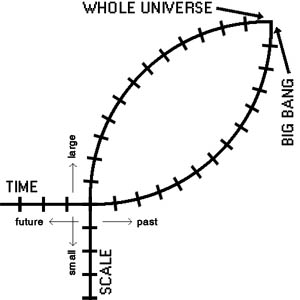
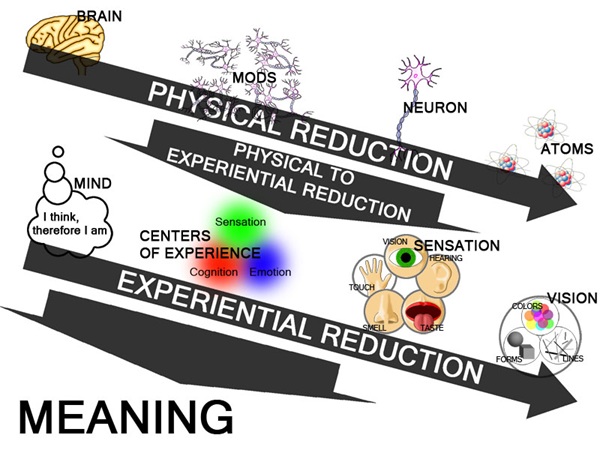
The same applies, of course, to the physical side of the reductive hierarchy. No matter how much you break a thing down into its parts–a rock into its atoms and molecules, for example–you are getting no closer to a fundamental basis for that thing. In the case of the mental side of the hierarchy, however, it is because you are already at the fundamental level no matter your position in the hierarchy. In the case of matter, it is because you never are at the fundamental level, and going down in scale is the wrong direction to go. The reader might recall that the real reductive hierarchy in the universe is neither along physical lines nor mental lines–it starts, at the top, with physics and material reality, which then reduces to experience (idealism 101), and that in turn is fundamental. You can imagine it as the following diagram:

So while we may be used to the direction of the reductive hierarchy in terms of physical scale–big things reducing to small things–and while this logic might seem to carry over to the mental side of things–these parallel reductive hierarchies must be turned 90 degrees–each hierarchy now sitting horizontally with physics on top and consciousness on the bottom, and nothing beneath. As you can see, one can still break down larger things to smaller things, thereby traversing the (now horizontal) hierarchies down in scale, but one is going in the wrong direction if one’s ambition is to find that final, self-sufficient, independent layer. One must first recognize that physics and material reality are really reducible to mind and experience, and then recognize that experience is self-sufficient, independent, and final.

All that being said, none of the foregoing answers our question: what is the experience of the universe at the top-most level like? Well, I went through the above to remind the reader 1) how the universal experience at the top-level, uniform and homogenous, can be consider fundamental in its own right, and though it obviously gets decomposed into galaxies, dust clouds, radiation of all kinds, etc., this decomposition gets it no closer or farther away from being fundamental. It just makes its components equally fundamental. But it is nevertheless unique in the sense that it’s singular quality (uniform an homogenous) makes it that from which everything is decomposed. Its fundamentality, in other words, is fundamental even to the fundamentals. 2) What it means to be fundamental is to require nothing more fundamental to be explained or upheld. It must be self-sufficient, self-explaining, self-justifying, and self-affirming. With these two concepts in mind, what we must say of the experience of the universe at the top-most level is that it is something that, once apprehended, explains itself (no “why” questions) and in such an obvious, self-evident, and immediate way, that one sees that there could never have been anything other at the core of the universe, and that this experience is truly necessary, that it could not have turned out differently. All this must be embedded in the experience itself, it must uphold and justify itself from within. It must be all the answers to everything succinctly wrapped up in one simple experience.

And yet, there is more to it. We will argue later that this top-level experience must exist in a timeless state, but for those who prefer to think of the universe, even what it is as a singular top-level thing, as passing through time, you may think of this ultimate top-level universal experience as self-entailing. It only entails itself (at least if we are to stick to this top-level in scale). It must be characterized in such a way that whatever its meaning, that meaning entails that same meaning. So unlike any other experience, this experience undergoes no change (this is why it is better to think of it as timeless, but if the reader must, he/she can think of it as perpetually entailing and re-entailing itself).

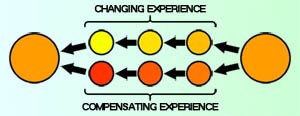
Yet we do see change at every lower level. We see how the components of the universe transform and effect each other to cause change. What this means is that every state the universe passes through as it advances in time must be equivalent to the whole, to the singular experience at the top-most level. This implies that for every instance of change we see in the universe, the rest of the universe must simultaneously change in a compensating way–compensating, that is, in order to preserve the equivalence between the parts and the whole. We can understand this using both our color analogies and our mathematics analogies. For example, if we represent the top-most experience of the universe as orange, then we can represent its parts as, say, red and yellow. As the red diverges more towards the extreme red end of the color spectrum, the yellow must diverge in the opposite direction by the same amount. Only in that compensatory way can both colors maintain their equivalence to the orange representing the whole. Turning to mathematics, it’s as if the universe as a whole is represented by 1 and the parts by .5 and .5. If one part diverges to .6, the other part must diverge to .4. Only then can they both continue to represent 1 collectively and maintain their equivalence to the whole.

This explains the laws of nature. The laws of nature represent the change that must happen in response to specific events in order to maintain the universe’s equivalence to the whole. Water boils when you heat it passed 100 degrees Celsius. The heating of the water is the event that must be compensated by the water boiling in order for the universe as a whole to maintain its identity. Glass breaks when you throw a rock at it. The rock hitting the glass is the event that must be compensated by the glass breaking in order for the universe as a whole to maintain its identity.

This also explains what time represents. Time, as we experience it, represents the ordering of the many states the universe can exist in such that for any two consecutive states, every experience in the antecedent state entails every experience in the consequent state. This can’t be said for just any two arbitrary states. To spell this out in more detail, suppose we represent each state of the universe as a set of pairs of numbers such that each pair, when summed, amounts to 1. So the set would include pairs like .1 and .9, .4 and .6, .5 and .5, and so on (for the sake of simplicity, we will limit this set to decimals of one digit only). If we order each pair according to the rule that for pair n, the numbers of pair n+1 differs by those of pair n by exactly .1. So if pair n is .3 and .7 then pair n+1 is .4 and .6 (or .2 and .8, depending on which direction you want to represent time). In other words, whereas each component experience may entail an experience which is neither identical nor equivalent to it, all entailed experiences must collectively be equivalent to all entailing experience collectively, and both thereby maintain equivalence to the whole.

Each such state is, as we said, a different way of expressing the whole, the one singular experience of the universe at the top-most level. So then what is being expressed? How do we sum up this one singular (uniform and homogenous) experience which, for all intents and purposes, is God. Well, summing up this experience in words or in human concepts will understandably prove difficult. It’s quality is well beyond our ability to comprehend. But if we can use human cognition as a closest approximation, I would say it is an understanding of how itself, as this very understanding, can be this understanding. ← That might sound convoluted, but it harkens back to what we said earlier about the experience containing within itself that which explains and justifies itself. Recall it must be self-sustaining. As a (metaphorical) understanding, what is understood is just itself. It is a self-referencing understanding. An understanding of itself as this understanding. And that is my definition of God: A metaphorical understanding of how itself as this very understanding can be this understanding. Or this slightly altered rendition: A metaphorical understanding of how itself as this very understanding, sustains its own existence (or just is). And a third, more simplified, rendition: an experience of what experience is in essence–experience as experience itself.

These versions of the definition are put in mental term, or in terms of experience. But as we know, experiences project and become real things. So what does an understanding become when projected? In this case, I would say a principle (still metaphorical). God is the principle on which existence is possible and rests. It is an understanding of this principle. And in being projected, the principle is real, and therefore does sustain existence. The understanding projects the principle, and the principle justifies the understanding.

If we think of this in the context of the limitlessness of qualities (explained in part 1 of the OP), we can understand it as follows. The limitlessness of qualities ensures that out of all possible qualities of experience, there is bound to be one experience that matches this description precisely. There is bound to be an experience that can be described precisely according to my definition of God, an understand of how itself exists, or a principle on which itself rests for its truth. If this quality of experience must exist, then it does exist, and thus all of existence must necessarily be.

Unfortunately, we must limit our understanding of this point only to metaphor. Understandings and principles are only analogies of this top-most godly experience, and what the experience truly feels like will forever remain beyond our comprehension. But I maintain that the self-referential nature of this experience and the manner by which this permits its own self-justification and self-reification is accurate, and explains how it serves necessarily as the foundation of all existence.
Scale, Time, and Curvy Dimensions–Explaining the Big Bang

Now all the foregoing can be said of a universe with no beginning and no end–assuming there are infinite states the universe can exist in when broken down into its components (or these states are allowed to repeat). But what about a universe with a beginning? If we are to trust in science, we must account for the universe as having a beginning in the Big Bang. Of course, there are those who will argue that the Big Bang doesn’t really represent the beginning–that there was time and existence before–but this gets us back to a universe with no beginning and no end. So in this post, I would like to keep fixed the assumption that the Big Bang really does represent the beginning. If this is wrong, the previous post accounts for all we need to account for. So it behooves us to take on the challenge of accounting for a universe with a beginning in the Big Bang. That way, both scenarios are accounted for and we have our bases covered.

The Big Bang represents not only an ultimately significant event in the history of the universe–corresponding to a “mind blowing” experience–but stands out as a sort of anomaly in my theory. Experience, my theory says, is always entailed by prior experience. Yet here we have an event in the history of the universe which seems to count as the “first experience”. How can there be a first experience? How does experience all of a sudden emerge out of nothing? How does an experience exist if it isn’t entailed by anything?

We hinted at an answer to this question in the previous post when we talked about the ultimate top-level experience of the universe as “timeless”–that it is the same experience throughout time and therefore doesn’t change–but I’m sure this must still prove somewhat problematic to the reader. I offered a sort of “patch” solution to this problem by suggesting that the reader think of this experience as perpetually entailing itself, thereby giving the impression of change or motion, but entailment is more or less seamless–no gaps between experiences where the antecedent experience is in the middle of “entailing” before it becomes the consequent experience–and so we’re back at an unchanging experience. What we must do is account for how such an experience can be “timeless” and explain what this means. I will attempt to do that in this post.

I will do this in two steps: 1) I will propose a definition of scale (big vs. small) that renders it as a dimension akin to space and time. Then 2) I will borrow from Einstein and propose that scale, as a dimension, can be bent and warped in such a way that it merges with time at the moment of the Big Bang. From these two steps, I will conclude that time, at the moment of the Big Bang, wasn’t really time as we know it, and can be thought of more as scale. Scale will receive a complementary treatment, being rendered more like time at the moment of the Big Bang, but in such a way that it allows for change immediately, thereby averting the issue of imagining the experience of existence as unchanging.

So let’s begin with redefining scale. To be more precise, this is not so much a redefinition but an analysis of scale such that its meaning can be interpreted in two ways: 1) as changes in size, and 2) as changes in resolution. In regards to the former, when we go from small things like insects to large things like planets, we are going up in size. This can’t count as a proper dimension since dimensions ought to be traversable without forcing changes in position along other dimensions. Take the 3 dimensions of space, for example. One ought to be able to move left and right without moving up or down, or forward or back. Likewise, one ought to be able to move up and down without moving left or right, or forward or back. Similarly with forward and back. The same can be said of time. One ought to be able to move through time without moving through space, and visa-versa. But how does one go up in scale without moving through space? Moving from small things to large things necessarily requires taking up larger volumes of space. Blowing up a balloon, for example, necessarily moves the surface of the balloon through all dimensions of space. So scale as changes in size does not qualify as a dimension.

Now in regards to the latter, if we define scale in terms of resolution, it can qualify as a dimension. What do I mean by resolution? I mean the degree to which we drill down into the details of a thing. For example, a human being can be considered as one singular thing. Or it can be considered as a collection of organs and body parts. Or it can be considered as a collection of cells. Or it can be considered as a collection of atoms and molecules. And the details can be even more fine grained than that. Note that this fits well within the meaning of scale because we are still talking about large things compared to small things, yet we are not changing the amount of space we take up. A human being as one singular thing takes up just as much space as that same human being as a collection of cells. The key to this definition is not the movement from bigger to smaller (or visa-versa) but simply the level of scale itself–that is, the level of scale at which we consider the same object. The balloon we considered earlier, if considered at an instant in time, is at once both one object and a collection of atoms and molecules–it just depends on which level of scale we consider it at. And if we want to go beyond the balloon as a whole? Beyond a singular human being? Well, we can do this by considering the balloon and human being as a component in a larger environment. From there, it’s just a matter of how large this environment is–the current room, the whole world, the entire universe–there are no limits. And no matter how large an environment we consider, it’s still the same balloon, the same human being, taking up no more and no less space as it did at any other level of scale. Because this version of scale can be traversed without forcing changes in position along any other dimension (space or time), and because there are no limits in either direction, it qualifies as a dimension–a fifth dimension if you will, intertwined with those of space and time.

Now comes the second step. Einstein tells us that so long as it’s a dimension, it can be warped, bent, rippled, fused, fissioned, and made anything but straight. Einstein tells us that this is precisely what gravity is. Gravity is just the bending of space and time towards massive objects. Things passing by the Earth will be trapped by its gravitational pull because the space these things travel through bends towards the Earth. And because of Newton’s first law–that unless disturbed by an extraneous force, things will continue to travel along their original trajectories–these things will follow the curvature of space and thus “fall” towards the Earth. Things will even fall towards the Earth if they’re not moving. This is because things are always moving forward in time (at the speed of light, in fact). And since time also curves towards the Earth, their forward motion in time causes them to follow a bent path towards the Earth, which we recognize as falling.

So if scale, as resolution, is a dimension, then it too can curve and warp and bend. So what I propose is that as one goes up in scale, scale bends backwards in time. And likewise for time. As one goes further back in time, time bends upwards in scale. In effect, scale and time meet at the top-most level and at the Big Bang. The universe at the top-most level–what it is as a whole–is the same thing–identical, not just equivalent–as what it was at the moment of the Big Bang. The singularity that the universe was at the moment of the Big Bang (or just before, however you want to think about it) is the singular thing the universe is at the top-most level of scale. At the top-most level, it has never changed.

Now this concept obviously has to be unpacked. There is undoubtedly much confusion that arises in the reader’s mind in response to the above. I can imagine the reader trying to imagine the universe as a whole being stuck in time, the singularity of the Big Bang frozen in that state throughout eternity, and yet when broken down into its components goes through so much flux and change as it barrels forward in time. And if the universe at the top-most level is frozen in time, doesn’t this negate the principle of dimensions about being free to traverse other dimensions independently of the dimension in question? It certainly doesn’t seem free to traverse the dimension of time. And is this really a solution to the problem of imagining the universe at the top-most level as unchanging, or have we simply swapped the problem from the dimension of time to the dimension of scale? After all, if scale bends such that it merges with time, are we not saying it effectively takes on the role of time? Thereby preserving the issue of the universe traveling through time, at least at the beginning, unchanged? Let’s delve into these questions and answer them.

The most challenging part of this idea, in my opinion, is how our mental models of the physical universe must be altered in order to better represent the true structure (if it is indeed the true structure) of the universe as pure consciousness and experience. How must we think of the physical structure of the universe if scale merges with time the further up one goes in the former and the further back in the latter, ultimately meeting at the same point at the end? To be honest, it’s easier to explain this structure in terms of experience than it is physics. Experience has no physical structure (at least if we’re not talking about the sensory world). There is nothing terribly paradoxical about the idea that an experience had by one physical system is exactly the same experience had by a different physical system. It’s not like trying to imagine how the physical universe, at the top-most level, is exactly the same as the singularity it was at the moment of the Big Bang, that it actually hasn’t changed at all since then. So let’s work on a model of experience that fits this description in a simple and parsimonious way, and then see how it carries over to the physical universe.

The best way to explain it in terms of experience is to, once again, bring in our mathematical analogies. Above, we explained how time can be represented by pairs of numbers ordered in a particular sequence–that sequence being that each pair must always sum to 1 and that for any two consecutive pairs, each member of one pair must differ from the members of the other pair by .1. Therefore, let’s consider the following series of pairs to represent a certain interval of time in the universe’s history: .3 + .7 → .4 + .6 → .5 + .5. Since these are all equal to 1, we can represent them thus: 1 = .3 + .7 = .4 + .6 = .5 + .5, the equality representing their equivalence. This represents the flow of time, 1 representing the initial state of the universe, the singularity of the Big Bang, and each pair representing the manner by which the universe has changed in its history at a particular level of scale.

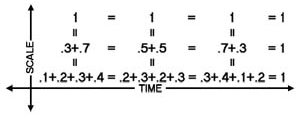
Now consider how each pair can be further broken down into quadruples–that is, a group of 4 numbers. This would represent the state of the universe at a lower level of scale. We would then represent time thus: 1 = .1 + .2 + .3 + .4 = .2 + .3 + .2 + .3 = .3 + .4 + .1 + .2. Now notice that no matter the point in time, and no matter the level of scale, each expression is equal to 1. Thus, we can represent the equivalence of each level of scale in a two-dimensional grid where we append 1 with an equal sign not only to the left of each row but at the top of each column:

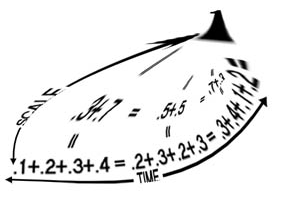
Now, the key to this diagram is to recognize that each 1 represents the same value. Every 1 you see in the diagram is the same 1, not separate instances of 1, just one single 1 (this harkens back to our discussion from a previous post about the multiplicity of metaphysical things–if a thing has no other way of being distinguished from some other identical thing except by its position in space and time, then metaphysical things don’t have that luxury–they are spaceless and timeless, and so if a metaphysical thing is identical to some other metaphysical thing, they are one thing, not two). Thus, a more accurate portrayal of the equalities in the above diagram might be rendered by the diagram below:

If the reader is confused about what he/she is looking at, this is my attempt at curving the dimension representing scale and curving the dimension representing time towards each other in order to meet at a single 1, all equal signs converging at that point (hey, I never said I was a Photoshop expert). As you can see, this is a much more succinct way of capturing the idea that they all equal the same quantity, that there is no difference between each 1. It may be unconventional–mathematicians don’t typically like to write out their equations in curved fashion, but as it is just notation, it makes no difference to that which it represents. The idea it represents–that the 1 which they all equal is the same, a singular entity–is not only nicely captured by this strange looking graphical representation, but is not that hard to conceptualize at all. What’s so difficult about conceptualizing the 1 they all equal as the same 1? And I don’t see it as any harder to conceptualize the same idea with respect to experience; Most experiences are metaphysical anyway–an abstract idea shared by two people is said to be the same idea, not two ideas in different heads that happen to be identical–because we think of metaphysical things as one and the same when they are identical, no spatial or temporal positions to separate them. And if the ultimate experience of existence at the top-most level and that at the beginning of time are likewise metaphysical, the same would apply to them (or it). So this idea, I maintain, is not that problematic when it comes to experiences.

The hard part comes when thinking about the material representation of this experience–that of physical existence at the top-most level and that at the beginning of time–and how to imagine scale bending toward time and time towards scale in such a way that the universe at the top-most level is just the singularity at the beginning of time, unchanged and timeless. There are a couple keys to keep in mind when contemplating this idea in terms of the physics of the universe: 1) we have to be extra careful to understand scale as resolution in the proper way, and 2) it helps to understand that the expanding universe we’re used to hearing about from scientists can equally be thought of as a universe of constant size with all its parts shrinking.

Let’s delve into 1) a little deeper. If the reader will recall, scale as resolution means that as we move up or down in scale, we increase or decrease (respectively) the level of detail we recognize in the objects of interest. The reader will recall that a human being is a single thing, a collection of cells, or even a tiny component in a larger environment. The key to understanding this is that when we stick to a particular level of scale, we must not imagine details below that level or larger wholes that the details at the current level make up. If we consider a human being, for example, at the level of cells, it is only a collection of cells–not organs, not a whole human being, not a collection of atoms and molecules–just a collection of cells. It will inevitably be tempting to imagine the molecules, for example, that make up the cells–primarily because we are used to thinking of the cells and the molecules as identical, as coming together, as both present within the whole. And why not? This is the proper way to think about them in a physical context–but if the reader will recall our definition of equivalence–that an experience, or a set of experiences, which is equivalent to another set, is not identical, is not present in, the latter set–this is also the way we must think of the different levels of scale of the physical representations when considered in terms of resolution. The cells are not a collection of atoms and molecules, and neither is it visa-versa. After all, if the physics of these structures is supposed to represent experiences, then perhaps it is a better way to think of the former. This doesn’t mean the atoms and molecules don’t exist with respect to the cells, just that they don’t make up the cells–the cells are their own thing–but rather exist on a different level of scale from the cells. We have to move to that level in order to consider them. One can therefore see why scale as resolution works so well here–it is a better way of understanding physical scale when physics is supposed to represent experience and the manner by which the latter relate to each other by equivalence.

Having said that, what does this imply about the universe as a whole–a universe as a singular thing, uniform and homogenous, no parts? It says that such a universe does not change. Change requires parts. It requires different components moving in relation to each other, or altering their relations in some way–otherwise, what would it mean for the whole to change? One might object. One might say that the billions of galaxies that constitute the universe are always changing, always in flux, moving apart, colliding, morphing and mutating their form–but this is to slip from the top-most level down to the level of galaxies, a level where we are considering the parts of the universe, not the whole–which is in violation of our rule of imagining only that which exists at our chosen level of scale. In this case, that is the level of the universe as a whole–just one singular thing, no galaxies, not planets, no medium sized objects, no molecules, atoms, or sub-atomic particles–all details gone, no internal structure.

And it can’t even change from one singular quality, uniform and homogenous, to a different singular quality, also uniform and homogenous–metaphorically, like red changing to orange and then yellow–for the universe at the top-most level represents the sum of all experiences–every experience imaginable (and unimaginable) being subsumed therein–and so if it could transform from one quality to another, that other quality must lack something with which it would still be the whole. It would have to give something up, in order to be something different from the whole (like white transforming to red). The sum total of all experiences can only ever be one thing, and it must be held constant, frozen in time so to speak, unchanging and fixed. If we are to imagine scale bending towards time and meeting at the singularity at the moment of the Big Bang, we can easily picture this as the top-most level of scale being fixed there, at that particular point in time, the beginning, always anchored there forever. No need to imagine it persisting through time. No need to question how it can avoid the flux of change. It’s simply pinned to the instant when the universe began.

Now let’s delve into 2)–the idea that an expanding universe might in fact be equivalent to a universe whose size is constant but whose parts are shrinking. Let’s start with a simpler thought experiment. Imagine a balloon inflating. By all accounts, we’d say the balloon is growing in size. But as a principle of relativity, couldn’t we also say the balloon stays the same size and the rest of the universe around it shrinks? How or why the universe shrinks is unimportant. It is the same thought experiment that we often bring up to introduce Einstein’s theory of relativity to novices. We say that as we drive a car down the road, it could also be said that the car remains fixed and the road, with the rest of the universe, moves backwards. How or why the universe would do this is unimportant. It’s enough to get the point across. For the same reason, how or why the universe would shrink is also unimportant. Einstein’s insight into the relativity of motion is not that something must cause the motion in order for it to be so, but that whether it is the car moving forward or the world moving back, whether it is the balloon growing or the universe shrinking, either frame of reference is equivalent to the other, and there is no fact of the matter which it really is. So if one were to switch from thinking of the universe as expanding ever since the Big Bang to thinking it remained the same size and its contents began shrinking, this would be an equivalent universe–no real fact of the matter which one it really is.

In this way, one could think of the universe as a whole–its incomprehensible size, its incredible vastness, its colossal expanse–as just what the singularity–the same as that at the moment of the Big Bang–looks like if we were to shrink down orders of magnitude below the level of the singularity. To be sure, we would witness the same historical events in the universe in this scenario of shrinking content as we would in the scenario of an expanding universe. At first, everything would be crammed into a compacted nugget. But as things began to shrink, more space became available between things. Eventually, enough space became available that particles were able to form, and as these particles continued to shrink, even more space became available. After a certain point, atoms were able to form–hydrogen atoms at first–and then gravity began to take over, pulling masses of hydrogen together to form stars. And after enough stars formed, their gravitational pull on each other caused galaxies to form. To this day, these galaxies and all matter between them continue to shrink, increasing the space between them and giving off the impression to us foolish humans observing the universe that the universe is expanding. This impression isn’t wrong per se, it’s just that there is an alternative that we haven’t considered–a shrinking universe (or rather, shrinking parts). Either way, of course, is equivalent to the other. So an expanding universe might justifiably be considered a universe of constant size with shrinking parts, and this allows us to understand how the universe at the top-most level is still a singularity, an object that has not changed since the beginning of time.

But one might object: how can things shrink below the level of a singularity? Isn’t a singularity a geometric point? No dimensions of width, length, or height? How can a thing become smaller than that? Well, I once watched a science documentary in which the lecturer said that most scientists don’t really believe the singularity was literality the size of a geometric point. He said it was probably the size of an apple. But even if the singularity was literally the size of a geometric point, one can bring in the concept of hyperreal numbers–that is, numbers that go beyond infinity or below infinitesimals. I won’t go into the details of hyperreals, but I will say that the concept thereof suggests that there can be whole universes below the level of infinitesimals (or things the size of geometric points), that the limits of our imagination (infinity on the cosmic end, infinitesimals on the microscopic end) are not the limits of reality. Infinity and infinitesimals may not be reachable, but for things already at those limits, there are orders of magnitude more beyond them.

Addressing some Objections

Now to address some objections (that no one’s raised). One may ask: doesn’t forcing scale to go back in time violate the rules of dimensions? Particularly the one that you (Gib) laid down as a requirement for making scale into a dimension? Namely, that a dimension must not force changes in position along other orthogonal dimensions? Well, to be precise, the rule states that no matter the position along one dimension, no position along any orthogonal dimension is off limits. For example, no matter what one’s position in time, every position in space should still be available for occupation. And likewise, no matter one’s position in space, every position in time should still be available for occupation. Nevertheless, when I propose that as one moves up in scale, one also moves back in time, it does sound like I am proposing that the present moment is only available for occupation at our level of scale (or the level of scale one starts from), and that as one moves up in scale, one must watch the present moment recede into the future.

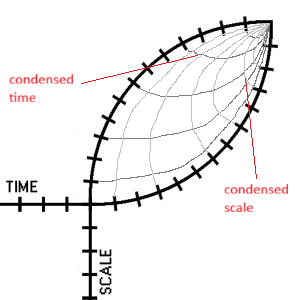
While I did say that scale bends towards the past as one goes up, I did not mean to suggest that one time travels to the past. There is always a “present” moment as one goes up in scale. And as one imagines going up in scale at the present moment, one remains at the present moment. The proper way to visualize this is to imagine that nothing is moving through time per se, but that as scale bends in the direction of the past, time condenses. And if one imagines time anchored to the moment of the Big Bang, then the whole of time must move back in time as it condenses. For example, if one were to imagine two points in time t0 and t1 with the present moment midway between them, then two things happen to t0 and t1 as one goes up in scale: 1) they come closer together in time. So if t0 and t1 were initially 1 hour apart, then half way up in scale, they would become 1/2 an hour apart (with the present moment still midway between them). And 2) they would both move closer to the past. This does not mean, however, that they time travel to the past. It means, rather, that time is being condensed as one goes up in scale, with the moment of the Big Bang being fixed, thereby “pulling” time pastward. Effectively, every event that occurs between t0 and t1 (inclusive), and the present moment, continues to occur at higher levels of scale (though seen at that higher level of scale, as occurring to larger things). It’s just that those events, and everything between them, occur at an accelerated rate (because time is condensed). All those events unfold at a faster rate. So whatever is happening at the present moment, it happens sooner at higher levels of scale since all of time at that level is condensed in the direction of the past, with the Big Bang marking the anchor to which all the condensing is approaching. But make no mistake, it does happen, and as one goes up in scale, one remains with the present at every point. The image below illustrates this point graphically.

An interesting point to corroborates this is that, relatively speaking, the higher one goes up in scale, the slower things move. I have to say “relatively speaking” because, for example, the speed at which the Earth orbits the sun is 67,000 miles per hour. Now that’s fast. But relative to the solar system itself, it takes a whole year to do just one revolution. If you were to watch the solar system from a bird’s eye view, you would barely see any movement at all. And if you were to go higher up to watch the galaxy rotate, it would take 225 to 250 million years to do a full revolution. That’s enough time for the human race to evolve, make their mark in history, and go extinct. Millions, if not billions, of events will have unfolded at the human level within that time. What this means is that as one goes up in scale, one can expect, as a general rule, for time to slow down for the objects one encounters at each higher level. In the previous paragraph, when I stated that events unfold at a faster rate, that was with respect to the events we observe to occur at lower levels of scale–the events of human history for example–but for the events that objects at the higher levels of scale undergo, they unfold at a (comparably) slower rate. Or, as one could say, a “normal” rate, but with less time overall to live out their lives. And at the top-most level, the condensing of time is so extreme that no time is available (or rather a single point in time is available) for events to unfold. Thus, the “timelessness” of the universe as a whole.

Getting back to the question, it isn’t that one is forced back in time, but that time itself is condensed towards the past. As condensed as it becomes, however, all of it is still available for occupation no matter what level of scale we are at. Thus, the rule about dimensions that changes in position along one dimension ought not limit positions along any other dimension is not violated. It’s just that if one expects one’s path upward in scale to be straight, one will find that he/she is mistaken, that one will find themself bending towards the past (with time becoming more and more condensed). If one really wanted to go straight, one would have to correct their trajectory such that one moved a little futureward in order to compensate.

It would be like driving a car with a bad wheel alignment. It tends to veer slightly to the right or the left. If one expects to go straight, one will find he/she is mistaken and will have to correct their course. But that doesn’t mean other parts of the road are off limits. It just means the driver has to make a small adjustment to the steering in order to move to those parts.

In fact, this problem appears even for linear graphs. Going straight up in scale doesn’t make the future or the past off limits, even though going straight up forces one to stay in the present and not occupy any position in the past or the future. But if one wanted to occupy the past or the future, one would simply have to bend their path.

Now these arguments don’t work so well right at the top-most level of scale, for at that level, it seems the whole of the universe is pinned to a single point in time, stuck at the singularity at the beginning of the universe. Are things not then prohibited from occupying positions in the future? Well, if you followed my reasoning above (and observed the accompanying graph), you will understand that it isn’t so much that the universe as a whole, at the top-most level, is “stuck” at the beginning of time, but that all time is maximally condensed at that level of scale. Therefore, in this case too, all of time is available for occupation. It’s just that it’s all condensed to a single point, all future and past events coinciding with the present. It’s not just that all points in time are available for occupation but that all points in time are being occupied (by everything simultaneously).

Now this must be understood only in the context of scale. Only in the context of scale does time condense as one goes up. In the context of time, the singularity is obviously the beginning, and time streams forth from it. You can see this in the illustration above. As you trace any of geodesics (lines) along the dimension of scale, you see that the geodesics of time always pass through them at a right angle, but also that because it bends towards the moment of the Big Bang, these temporal geodesics get more and more condensed. This is the idea I tried to get across in the previous paragraphs. But the illustration also shows clearly that the same relation also works in reverse–that is, as one moves further back in time, the geodesics of scale become more and more condensed, until at the point of the Big Bang, they are maximally condensed in the singularity. All levels of scale coincide therein, blurring any distinction between big and small. And at the same time, time marches forward from the moment of the Big Bang, as modern science would tell us, implying that only the beginning of time resides at that first moment.

This is a consequence of how orthogonal dimensions work. Since scale and time are orthogonal, they both contain all of the other. Just as all time penetrates the dimensions of space, all time also penetrates all levels of scale. No matter when you are in time, you can go up or down anywhere in scale–the same dimension of scale as at any other point in time. And no matter where you are in scale, you can consider any point in time. So as it concerns scale, even at the top-most level, it is interleaved with all time. And as it concerns time, even at the singularity at the beginning of time, it is interleaved with all levels of scale. It is the totality of time which is interleaved with scale that gets condensed at the top-most level. But the totality of time is not condensed at its own beginning; instead it condenses all levels of scale, the totality thereof, which is interleaved with it. The proper way to think about this is to imagine, not that all of time is contained in the singularity, but that with respect to scale, the singularity which is just the universe at the top-most level, persists unchanged through all time. But with respect to time, the singularity marks the beginning, and all levels of scale coincide, persisting at every level (the equivalent of persisting through time) at that very instant.

If this settles the matter over the free occupation of all points along all dimensions involved in the scenarios above, then I would like to start wrapping this up. This idea that scale bends backwards in time and that time bends upwards in scale, and that the two meet at the top-most level and at the moment of the Big Bang, was introduced to resolve the problem of a first experience. How does an experience spontaneously pop into existence without a prior experience to entail it, we asked? It’s the same problem that religious people often raise with respect to the Big Bang itself. How does something spontaneously come from nothing, they ask. It’s the age old problem of an uncaused cause (or in the context of my theory, an unentailed entailer). How can an experience come to be if it is not necessitated or justified? Without necessity or a justification, what grounds it? By linking the universe at the top-most level with the singularity at the moment of the Big Bang, we show that the experience of existence itself (that corresponding to the universe at the top-most level) is the same experience as that had by the singularity at the beginning of time. This allows us to answer the aforementioned questions by falling back on the experience of existence. That is to say, since the first experience is the experience of existence, it inherits all its justifications and necessity. Since the experience of existence is, like we explained above, a self-justifying, self-necessitating experience (an understanding of how itself, as this understanding, can be true), so too is the first experience. It doesn’t need a prior experience to necessitate or justify it because it necessitates or justifies itself.

In fact, one need not think of the first experience as “popping into existence” at all. If time bends upward to meet scale, and scale bends pastward to meet time, what this tells us is that, as dimensions, we can always think of the entire matrix (time and scale together) in a static abstract context (timeless, so to speak). In that sense, the first experience doesn’t “pop into existence”, it just is. It “is” in the same way that the experience of existence (that at the top-most level) is. The idea that it must pop into existence is an artifact of how we conventionally think of time. But if time and scale represent a more abstract and static state of the universe (as experience), then we can think of time in the same way we think of scale, and we are especially justified in thinking of it this way given the bending of time upward to meet scale.

One ought to keep in mind, however, that the bending of time to become parallel with scale doesn’t mean it becomes scale, or takes on the role of scale. It simply means it becomes parallel with it (and only at our level of scale). You can think of it the same way time bends towards the Earth. As explained above, Einstein’s theory of gravity says that space and time bend towards objects of high mass, like the Earth. So if you let go of an object, like a watch, it will fall to the Earth because it moves forward in time, and since time bends towards the Earth, it will follow the path of time which moves it towards the Earth. But the watch keeps ticking. It still measures time even though time becomes parallel with space. In other words, time is still time, and it still functions as such. The fact that it becomes parallel with space means only that–it becomes parallel with space. But that doesn’t mean it becomes a spatial dimension. It is still time. In the same way, time bending to become parallel with scale doesn’t mean it becomes scale, or takes on the role thereof. And the same is true of scale bending to become parallel with time. Time remains time and scale remains scale. We know this is true because even though time bends to become parallel with scale, every event in the history of the universe still unfolds the way time tells us it does. Likewise with scale. Even though scale bends to become parallel with time, it is still structured such that large things are composed of all the smaller things that make it up. The contents along each path, in other words, are still characterized as they would be for scale and for time (respectively). Their natures remain the same.

Now, before closing this post, I’d like to make an interesting observation of this structure (that of scale bending backward in time, and time bending upward in scale). It seems that along both dimensions, each consecutive state of the universe (each instant in time, or each level of scale) is not only equivalent to its neighbors (the state that came before and the state that comes after) but entails the state that comes after. In the case of scale, in fact, the entailment works in both directions. A rock entails a collection of atoms, and the atoms entail the rock. (To be sure, entailment can be bidirectional; if logical thought can be brought up as an example of how experiences entail, then we know bidirectional entailment exists as biconditionals (if and only if, condition and consequence mutually entailing each other) are a real thing in any Intro to Logic textbook.) We defined time earlier in this post as a sequence of universal states characterized such that for any such state, there is another state whose component experience are all entailed by the component experiences of the first state. This defines the order of events in time. But obviously, this is just one way to order the states of the universe. Scale represents another. Whatever the experience at the top-most level, it entails all other levels of scale going down (and not just as a whole, but each component experience entails the component experiences in each successive level–like a rock entailing its atoms). What this means is that there is more than one way of ordering the events of the universe such that each state is not only equivalent to all other states but the components of each state entail the components of some other state. Scale and time represent two such ways. It raises the question: how many other ways are there? And can each way be represented as a dimension to the physical universe?

In fact, it can also be noted that each state of the universe along each path must be shared by the other path. The dimensions of time and scale intersect not only at the moment of the Big Bang, but now. Right now, they cross paths again. Right now, one can look up in scale and contemplate the whole. One is a part of the whole. One comes from the whole, one of its components. But at the same time, one can look back to the past, and recognize that one also comes from the Big Bang. Time from the moment of the Big Bang, and scale, meet at his level of scale (the human level) and at this moment in time. This is true of every state of the universe. Each state in either scale or time, maps to the same state in the other. Both paths completely overlap, and thus both share each other’s states.

In effect, I believe the universe that we see at the human level–with its myriad diversity of phenomena and events, from chemistry to biology to cosmology–is just one way that God expresses himself. God ultimately is the experience of existence, that at the top-most level, the understanding of itself as that very understanding being justified, but this experience can be expressed in (perhaps) an infinity of ways, some simple (uniform and homogenous), some mind blowingly complex. Whether we follow the path of scale or that of time starting at the point where they both meet, we observe a singularity expanding, becoming more complex, being broken down into parts, becoming less homogenous and more heterogenous. With scale, we observe the universe as a whole, as a singular thing, being broken down into its parts. With time, we observe the universe as a singularity, exploding into parts and evolving into a variety of new and unique phenomena that didn’t exist before. Both paths show a singular thing being expressed in more complex terms but in different ways, along different paths. It seems there are numerous ways that God can express himself, explain himself, put together a logical story that reveals what He is in essence, and we humans seem to be fitted out to perceive at least two of these ways.

There was no single big bang….that is a myth dream’t up by the religious cult of atheism.

All matter enters and exits the holes at the centre of all the galaxies in varying timescales so if all matter were to disappear into all these holes then there wouldn’t be any matter left for a single Big Bang and single Big Crunch.

Also,if all matter were to disappear into all the these multiple holes then the electromagnetic fields which saturate the cosmos would remain because these fields aren’t tied to matter.

The JWT is confirming that there is a fire works display going on out there.It doesn’t matter how far out into space you look the galaxies are as mature as our own.

The problem with science is its cognitively biased starting atheistic philosophy (+=- and -=+).We know its cognitively biased because there is also the +=+ and -=- theistic starting philosophy.

The philosophy for everything is neither of these.

The philosophy for science is +/-=+/-.We know this because it’s impossible to cancel out the 4 off electromagnetic force interactions NN,NS,SN,SS that exist right now between all the spinning objects and particles with N and S poles which make up all matter at both the macro and micro levels.

All you can do is balance these forces hence N/S=N/S.

Mainstream atheistic science is wasting its time with its mythical forces which explain nothing at all.

All of the physical is binary.Balanced attractive and repulsive electromagnetic forces hold all matter together.The spin speed of particles regulate the frequency of the balanced electromagnetic force interactions NN,NS,SN,SS (N/S=N/S) and thus the amount of heat emitted in the form of electromagnetic energy waves.These waves contain binary data which are received by our physical body senses.The physical body machine which is the interface between the physical and the metaphysical then converts these waves into binary digital signals 0/1=0/1 which form part of the software which operates the machine body.

The concepts for science are simple.

The consciousness experience is VIBRATORY!!!

You are not the in or out of the moment consciousness states.You merely experience these two waking consciousness states which need to be balanced out to understand the psychological.

In/out=in/out

You exist because you need to exist to claim that you don’t exist.If you claim that you don’t exist then you are a liar who exists.Its ridiculous therefore to claim that you exist and are a misrepresentation of reality but many individuals do claim this.Rather you exist and are a representation of reality.

Jupiter wrote:

There was no single big bang….that is a myth dream’t up by the religious cult of atheism.

← I don’t think my theory suggests otherwise. →

All matter enters and exits the holes at the centre of all the galaxies in varying timescales ← You mean some galaxies suck shit up, while other galaxies blow shit out? Or that each galaxy is a mix–sucking a bit of shit and blows a bit of shit? → so if all matter were to disappear into all these holes then there wouldn’t be any matter left for a single Big Bang and single Big Crunch.

← No… No, there certainly wouldn’t… but why are you supposing all matter disappears into all these holes? I thought some holes were sucking, and other holes were blowing. Is there not a balance? →

Also,if all matter were to disappear into all the these multiple holes then the electromagnetic fields which saturate the cosmos would remain because these fields aren’t tied to matter.

← Really??? This is the first I’ve heard this. But you know what? Upon reflection this makes sense. I wouldn’t say the electromagnetic fields aren’t tied to matter–the former depend on the latter to be emitted after all–but once matter emits a series of electromagnetic waves, those waves take on an independent existence from their source. So all matter could disappear and the existence of electromagnetic waves (really just photos) would continue on. →
← But I’m afraid the actual science speaks against this. If you’re saying that black holes suck up all the matter in the universe, then science tells us that not even photons can escape black holes once caught in their grip. So I’m afraid that as matter gets caught in a black hole, any light it might give off is also caught by the black hole. →

The JWT is confirming that there is a fire works display going on out there. ← I thought I saw fireworks as I was driving home! → It doesn’t matter how far out into space you look the galaxies are as mature as our own.

← So no quasars? →

The problem with science is its cognitively biased starting atheistic philosophy (+=- and -=+). Aaaand you lost me. → We know its cognitively biased because there is also the +=+ and -=- theistic starting philosophy.

← Ok, are you talking about batteries? Because +=+ and -=- means nothing to me. I’ll agree that science is cognitively biased. How could it not be? It believes that empirical evidence = reality. But how do you prove that philosophically? I don’t think that’s ever really been established in intellectual circles. We just go with science because of how powerful it proves to be. But what is +=+ and -=-? I feel we need to take a detour into your symbolism here before we go further. →

The philosophy for everything is neither of these.

The philosophy for science is +/-=+/-. Well, yes, the left side definitely equals the right side. We know this because it’s impossible to cancel out the 4 off electromagnetic force interactions NN,NS,SN,SS ← Why do you call these the “off” interactions? Is there an “on” interaction? → that exist right now between all the spinning objects and particles with N and S poles which make up all matter at both the macro and micro levels.

← This reminds me of a conversation we had before. Maybe we had it in this thread, maybe another thread, but you explained these concepts to me before. All I can gather is that S and N stand for opposite polarities (North and South) that every spinning particle must have. But beyond that, I don’t have much knowledge of the subject matter. You might have to explain it to me. :open_mouth:

All you can do is balance these forces hence N/S=N/S. ← Yep, left side equals right side. →

Mainstream atheistic science is wasting its time with its mythical forces which explain nothing at all.

← Great segue! :smiley:

All of the physical is binary.Balanced attractive and repulsive electromagnetic forces hold all matter together. ← I’d be careful here. Yes, there is a binary here–attractive and repulsive forces, positive and negative–but that doesn’t make reality binary. At the very least, there’s also the analog pattern of how much force is applied from one to the other–I mean, you could have a weak electromagnetic negative charge being totally overpower by a strong electromagnetic positive charge. How much the one overpowers the other isn’t binary, but analog. → The spin speed of particles regulate the frequency of the balanced electromagnetic force interactions NN,NS,SN,SS (N/S=N/S) ← If you say so. → and thus the amount of heat emitted in the form of electromagnetic energy waves. ← Sometimes you just gotta throw some ice on it, eh? → These waves contain binary data which are received by our physical body senses. ← Does it have to be binary? → The physical body machine which is the interface between the physical and the metaphysical then converts these waves into binary digital signals 0/1=0/1 ← You mean like neurons firing or not firing? I will tell you that neurons are 100 x more complex than simple computer circuitry. → which form part of the software which operates the machine body.

The concepts for science are simple.

← Let’s hear it! :+1:

The consciousness experience is VIBRATORY!!!

← Once again, you speak of a conversation we once had before. The “vibratory” nature of matter, as I recall, is the manner by which all particles exist as waves, and thus have a “frequency”. So all matter is “vibratory”. I remember questioning whether this made the conscious experience “vibratory” (whatever that would mean), but I also remember settling on the idea that if matter is vibratory, and if mind has any relation to matter at all, it too, in some way, must be vibratory (like the universe is one big vibrator :sweat_droplets: ). →

You are not the in or out ← Man, this is really getting sexual! → of the moment consciousness states.You merely experience these two waking consciousness states which need to be balanced out to understand the psychological.

← What two conscious states? The in and out? The sucking and blowing? The positive and negative? And understanding these states is key to understanding the psychological? →

In/out=in/out

← Well, almost… you forgot to capitalize the i on the right side (or lower case the i on the left). →

You exist because you need to exist to claim that you don’t exist. ← Don’t confuse logical necessities with causes. → If you claim that you don’t exist ← I don’t. → then you are a liar who exists. ← Unless I really believe I don’t exist–like the Buddhists. → Its ridiculous therefore to claim that you exist and are a misrepresentation of reality ← A misrepresentation meaning something that presents itself as something other than a “part of reality”? As something that doesn’t really exist? → but many individuals do claim this.Rather you exist and are a representation of reality.

I completely and totally and 100% agree with you hear, Jupiter, but there are so many out there who honestly do believe they don’t exist. Buddhists don’t believe in the self. Atheists don’t believe in the soul. Nihilists don’t believe in the self. Materialists don’t believe the self really exist. Anti-realists believe… well, who knows what anti-realists believe… but they certainly don’t believe in the self, the ‘I’.

All of the physical is binary.Every aspect of it.Its a machine that does not possess life.

At the very least you are controlled by a binary processing machine.The automated side of your nature has to work somehow after all.

The philosophy for everything is balanced and unbiased.It is not unbalanced and biased.

The philosophy for everything is +/-=+/-

As all particles which make up all matter are spinning electromagnets with N and S poles, all of which interact in the following combinations NN,NS,SN,SS and it’s impossible to cancel out these interactions then the reason all matter vibrates is because these interactions are balanced N/S=N/S thus all matter is held together and electromagnetic energy waves containing binary data are emitted from it.The amount of energy waves emitted is dependent upon the spin speed of the particles which in turn regulates the frequency of the electromagnetic force interactions and thus the amount of heat emitted.

Science is very simple gib…we don’t need the religious cult of atheisms cognitively biased fake philosophy,science or psychology which results in many psychotic individuals,who exist, (because they need to exist to claim that they don’t exist) claiming that they are a misrepresentation of reality (an illusion).

We don’t have to believe in fake philosophy,science and psychology anymore because +/-=+/- philosophy,science and psychology is sound.

The electromagnetic fields which saturate the cosmos are NOT tied to matter.So if all matter were to disappear into the holes at the centre of all the galaxies from which it all came then spinning holes would remain within the electromagnetic fields….yet again proving that the atheistic religious cult of mainstream +=- and -=+ philosophy science is fake.

This religious cult is blatantly open that it is anti God and yet it has a statue of its god shiva displayed outside its religious HQ at CERN near Geneva…..How hypocritical is that.

The religious cult of atheistic science claims that it’s science was initiated by magic because if it wasn’t then it’s +=- and -=+ starting philosophy is incorrect.Either way its clams are nonsense and not scientific at all.

If you do away with the real deal then there will always be a false religion,philosophy and fake science that will take its place.