Nah, that sounds like some kind of dualism. No primacy.
Well, I’m frankly curious. How would you delimit it?
Without primacy. You are “in” the world, and the representation of the world is “in” you. But it’s all on the same “level”.
But if we can only imagine a small degree of it, what do we base the case for a wider object on?
Not sure what you mean. All philosophical worldviews are ultimately circular philosophies with no absolute basis.
While you two have your discussion, I’ll just quickly reply to Atla. I’ll read the rest tomorrow.
Atla
I haven’t started down the infinite regress, maybe it seems to you that way because you’re projecting the Kantian circular philosophy on what I say, where you assume from the start that the outside is completely unknowable, so we can only ever be trapped within concepts that have no actual outside referents. You also assume that experiences aren’t physical, they have no spatial dimensions. ← Well, I said most experiences aren’t physical/spatial. Sensory experiences obviously project as physical objects emersed in a 3D spatial continuum. → I was just wondering why you thought that such idealist assumptions were better.
And that’s totally fair. My direct answer is: I don’t think it’s better. (Better than what?) It’s a tool I’ve contrived over the years to solve the mind/brain (or mind/body, or mind/matter) problem. That’s its strength (I believe). But it turns out to be a form of idealism, which, as I explained above, suffers the infinite regress problem. So my recent two posts were to explain how I solve this. I don’t feel like I’m in competition with other theories; I just want to express mine.
But you say that your view doesn’t suffer the infinite regress. The only way that’s possible, as far as I’m concerned, is to either adopt something like my solution above, or to conceptually model conscious according to what I call the window-to-reality model of consciousness.
Let me explain. In general, I split theories on conscious into two categories: 1) window-to-reality models, and 2) system-of-experiences models.
The first sees consciousness as like a featureless window through which we just see reality as it is. Every property of every object we experience in the world really is a property of those objects, not artifacts of perception or experience. All consciousness does is it enables our awareness of it–like the window simply enabling you to see the world outside. The windows itself has no features–it is perfectly transparent glass–the outside world would look the same if it were removed and a square shaped hole was all that it left behind. But the window must be there to represent the function of consciousness–namely, to enable our awareness of the outer world (as opposed to a wall).
The second sees consciousness as a generator of experiences. The visual sight of a tree outside the window isn’t really there in the outer world, but is being generated by our consciousness–that is, from within our minds. In this model, the window isn’t really transparent or featureless, it’s more like a projector that creates the image of an outside world, and it uses the qualities of subjective experience to do so. In other words, it builds a system of experiences that work together to generate the image of an outer world, a reality. I believe any system-of-experiences model of consciousness worth its salt must address the aspect of reality, or being, that seems to be present in every experience. How can our experiences project as an outer world if they don’t feel real in the first place? So somehow, one’s system-of-experiences thoery of consciousness needs to grapple with the fact that experiences also feel like reality, and somehow reconcile and incorporate this.
As you can see, system-of-experiences models of consciousness are basically idealism, which, as I said, inherit the infinite regress problem. But window models don’t. Window models purport that we are in direct contact with outer reality, that there is nothing “mediating” our relation to reality. Experiences, on this view, are not seen as (sort of) hallucinations or dreams, they are seen as the state of being aware of some aspect or property of real things.
So then my question to you is: is your view of consciousness and its relation to the outer world closer to a window model of consciousness or a system model of consciousness? Or is it neither? Or both?
I think my view (representationalism / indirect realism) is distinct enough from both of the above, to be considered the third category. I guess how the representationalism actually functions is closer to how the system models function, and how representationalists live their everyday lives is closer to how people with window models live their everyday lives.
Fair enough. I was just curious because I try to collect all philosophical systems (of consciousness, or some aspects of consciousness) and then rank them.
Atla wrote:
I think my view (representationalism / indirect realism) is distinct enough from both of the above, to be considered the third category. I guess how the representationalism actually functions is closer to how the system models function, and how representationalists live their everyday lives is closer to how people with window models live their everyday lives.
I see. So by “representation”, I assume you mean that our perceptions and experiences represent the reality of the world beyond them, but strictly speaking they are not the reality of the world beyond them. This reminds me of Descartes’ representationalism. Descartes definitely believed there was a separation between perception and reality, enough so that he had to question how we could know that our perceptions were ever a reliable representation of reality. He concluded that God, being the benevolent deity he is, would never deceive us, and so ensures that our perceptions are accurate reflections of reality. It’s like we were staring at a scene, but between the scene and our eyes was a photograph of that exact scene taken from exactly the point of view we’re stand at such that the view looks indistinguishable from the real thing. Remove the photograph, and we might not even be able to tell the difference.
I think you have it right that this is closer to the system model of consciousness (what we’re actually experiencing is the photograph, not the scenary itself), but if you believe that consciousness is producing something like a perfectly accurate photograph, then you might as well say you know reality as it actually is. But technically, you can’t verify that because you can’t get around the photograph to see for sure.
The Kantian dilemma (or the problem of infinite regress) comes in a few flavors. It might revolve around knowability, it might revolve around conceivability, or it might revolve around referentiality. Your model (if the photograph analogy captures it) doesn’t have huge issues with knowability or conceivability, but I can see an infinite regress coming from referentiality. Because you can’t reference the real world beyond the photographs, any attempt to refer to “the real world beyond the photograph” results in referencing a thought instead (you bring to mind the thought of the real world rather than seeing the real world directly).
And you’re right to distinguish between how people think about consciousness and how they live their everyday lives. But a system model of consciousness need not reject the reality of the world as experienced. In my view, the experiences our minds generate come with reality embedded in them, so the world they end up create is still a real world. In that sense, one is aware, via one’s experiences, of the real world as it actually is, and one can live one’s life as if they believed in the window model of consciousness. But strictly speaking, it is still a system model because it’s the experience (mental things) that acts as the basis for the reality (i.e. it is a real world couched in a mental framework). True window models have it the other way around: the real world is the basis for consciousness. Consciousness is a phenomena that exists (couched) within a physical (real) framework.
Atla wrote:
Fair enough. I was just curious because I try to collect all philosophical systems (of consciousness, or some aspects of consciousness) and then rank them.
Ah, so where does mine rank in your system? Hopefully not last place 
In my version of it, it can’t be a perfectly accurate representation. The representation is manufactured using external input coming from the sense organs, plus using internal input coming from within the brain/mind. The representation seems to be “good enough” for most people most of the time, we usually don’t walk into walls and so on. But sometimes the representation has major defects, for example when people actively hallucinate and see objects and hear sounds that aren’t actually there in the external world.
And technically the representation itself is also part of reality, similarly to how a computer simulation is part of the computer.
This is where we disagree, I think it’s possible for thoughts to refer outside of themselves. I know it’s quite a mind-bender. The reference just points outside of itself and that’s that.
But it’s indeed impossible to do this under Kant, because under Kant the noumena can’t be referenced by definition. Thoughts can’t refer outside of themselves, spatiality is only a priori.
It’s decent say 6/10, though I admit I haven’t yet read all your comments so maybe it’s better than that, your comments are kinda long.  The 10/10 scorer in my system is representationalism (indirect realism) within the “Eastern” nondual framework, made 100% compatible with science, though we have to go outside the entire Western school of thinking for that kind of nonduality. We could maybe call it scientific Advaita or scientific Zen.
Atla wrote:
And technically the representation itself is also part of reality, similarly to how a computer simulation is part of the computer.
Yes, although the representation has a tendency to convince the experiencer it’s the represented, not the representation.
Atla wrote:
This is where we disagree, I think it’s possible for thoughts to refer outside of themselves. I know it’s quite a mind-bender. The reference just points outside of itself and that’s that. But it’s indeed impossible to do this under Kant, because under Kant the noumena can’t be referenced by definition. Thoughts can’t refer outside of themselves, spatiality is only a priori.
There is a very narrow interpretation of this that can make sense to me. You agree that a theory of consciousness can be a mix of window model and system model, so this might work for you. What you’re saying sounds like consciousness is representational (system model) at the perceptual level but direct (window model) at the cognitive level. So when we refer (with our thoughts) to something outside our minds, it succeeds because such a reference is directly accessing the referent. We can still call it a thought but in the same way we would call seeing what’s outside the window as “sight”. Sight, in this sense, wouldn’t mean an image produced by our visual system but just being viually exposed to things in the outer world. But for your brand of representational consciousness, this would be limited to thought. We would say that thought is just awareness focused on a particular object or aspect of reality.
As I explained earlier, the strength of my theory is that it explains the connection between mind and matter, but it only does this for system models of consciousness. If consciousness can sometimes be like the window model (or is always like the window model), my theory can’t explain that. So I don’t have the luxury you have.
So I have another question for you: first of all, is my above interpretation fair? Is it fair to say that thought, in your theory, is more window-like than system-like (at least when it gets it right)? Or are even thoughts representational (system-like)? Secondly, if this is right, how do you account for mistaken thoughts? You mentioned that sometimes our sensory systems get it wrong (hallucinations, dreams, optical illusions, etc.) but it wouldn’t be like switching between a system model and a window model. Since sensory perception is already representational, it’s always system-like whether it gets it right or wrong. But if thought is window-like when it gets things right, then it has to switch to system model when it gets things wrong. How does it do that?
Atla wrote:
It’s decent say 6/10 ← Woot! Woot!
→ , though I admit I haven’t yet read all your comments so maybe it’s better than that, your comments are kinda long.
→ The 10/10 scorer in my system is representationalism (indirect realism) within the “Eastern” nondual framework, made 100% compatible with science, though we have to go outside the entire Western school of thinking for that kind of nonduality. We could maybe call it scientific Advaita or scientific Zen.
That’s something I’d like to dig into later. So far, I’ve been talking about perception and perceived as a duality (although this is not theory; my theory fuse perception and perceived into a monism, but I preserve the divide between “inside” my mind and “outside” my mind). And my theory is also 100% compatible with science–well, maybe 99%. My theory says that whatever science discovers, I will be able to say my experiences are representations of those discoveries. The 1% that struggles with scientific compatibility is how it accounts for quantum indeterminism, but I have a simple tweak I can apply to my theory to fix that.
About reading all my comments, if you start with part 1 and 2 of the OP, you’ll have the basics. All other comments are just me working out the logic of the core theory when applied to particular scenarios or questions.
No, thoughts are also part of the representation, they are also part of the human consciousness. Our thoughts can refer outside of themselves, refer to the external world, because here there are two kinds of space, the “Kantian a priori” space which is a way how the representation is constructed, and the “Newtonian/Einsteinian” space of all known reality. In the latter sense thoughts can refer outside themselves. Kant argued that there is only a priori space but imo he was shown wrong.
But when people are healthy, and the representation works “good enough”, even though we are forever experiencing the representations inside our heads, in everyday life we can act like naive realists, act like we were directly experiencing the external world. It’s not actually true, we are just pretending, but it works well enough, and we evolved to function this way. It’s unhealthy to not do this, it causes mental problems. This is what I meant by: how representationalists live their everyday lives is closer to how people with window models live their everyday lives (imo).
I read part 1 and 2 of the OP, well from my perspective, no matter what we do within Kant’s perfectly sealed system, we can’t escape its quasi-solipsistic nature. It’s not true solipsism in principle, in principle there could be completely unknowable other minds, but because they are completely unknowable, the system remains solipsistic in practice. Guess I’m just not a fan of that, I couldn’t live like that.
And then we have to immediately add that there is no knowable universe outside our minds, and the relation is just a part of the structure of our minds. The more we deny the reality of the external world and even the reality of our brains, the more structure we have to add to the mind to compensate.
By the way the best resolution of the mind/matter problem is drastically different, and was missed by every Western philosopher for centuries: we have to go back all the way before Descartes and realize that mind and matter were always one and the same thing (without the need for any “substance”). In other words, the entire universe is experience, experience and matter are the same thing. The universe comes in first-person-view (existence is inherently in first-person-view, how else could it be?). Experiences aren’t “meaningful”, many human experiences are meaningful (meaning is also an experience) but it doesn’t follow that all human experiences are, nor that the rest of the universe is meaningful.
So it’s neither matter-over-mind, nor mind-over-matter. Those are two sides of the same coin, same hallucination. Descartes made it official that Western civilization be seeing double (it could be argued that he had one of the most destructive influences in history). Imo that’s why you still haven’t truly rejected dualism, deep down your philosophy is still based on it.
Going backwards in philosophy seems dumb and lazy, almost certainly wrong. And yet here we have to go backwards to the state before Descartes and others pretended that reality is split between mental and material. (I mean we don’t “have to”, it’s just the Occam’s razor choice.)
Atla wrote:
No, thoughts are also part of the representation, they are also part of the human consciousness. Our thoughts can refer outside of themselves, refer to the external world, because here there are two kinds of space, the “Kantian a priori” space which is a way how the representation is constructed, and the “Newtonian/Einsteinian” space of all known reality. In the latter sense thoughts can refer outside themselves. Kant argued that there is only a priori space but imo he was shown wrong.
You’re not making this easy for me, Atla  This is the impasse you mentioned earlier. I find it hard to wrap my head around how we can reference something that we’re not even conscious of. I think a basic requirement for referencing is that one at least “beholds” the referent somehow. A reference is basically a statement saying, “Look at that!” It’s a finger pointing to “that”. What is “that” if not something we’re somehow experiencing?
Atla wrote:
I read part 1 and 2 of the OP, well from my perspective, no matter what we do within Kant’s perfectly sealed system, we can’t escape its quasi-solipsistic nature. It’s not true solipsism in principle, in principle there could be completely unknowable other minds, but because they are completely unknowable, the system remains solipsistic in practice. Guess I’m just not a fan of that, I couldn’t live like that.
All it takes to avoid solipsism is to believe in other minds. I have no idea whether Kant did or didn’t believe in other minds. And I hope you don’t believe I’m a Kantian. There’s some overlap between my theory and his, but there’s significant differences too.
Atla wrote:
And then we have to immediately add that there is no knowable universe outside our minds ← Who said that? → , and the relation is just a part of the structure of our minds. The more we deny the reality of the external world and even the reality of our brains, the more structure we have to add to the mind to compensate.
I think you’re projecting a ton of material that I didn’t actually say.
Atla wrote:
By the way the best resolution of the mind/matter problem is drastically different, and was missed by every Western philosopher for centuries: we have to go back all the way before Descartes and realize that mind and matter were always one and the same thing ← That’s exactly what my theory says! → (without the need for any “substance” ← Oh, there’s a need all right. → ). In other words, the entire universe is experience, experience and matter are the same thing. ← Yes! → The universe comes in first-person-view (existence is inherently in first-person-view, how else could it be?). ← Exactly! → Experiences aren’t “meaningful”, many human experiences are meaningful (meaning is also an experience) but it doesn’t follow that all human experiences are, nor that the rest of the universe is meaningful.
That’s not true, my friend. Experience is information. It carries meaning. When we look at something like a book, we don’t just see the book, we’re told about the book. It’s the universe telling us, “There is a book on the table”. And if you look at this from a neuro-chemical perspective, it’s all chemical and electric signals traveling down neuronal axons and dendrites. These signals are information. It is one part of the brain communicating with another.
Atla wrote:
So it’s neither matter-over-mind, nor mind-over-matter. Those are two sides of the same coin, same hallucination. Descartes made it official that Western civilization be seeing double (it could be argued that he had one of the most destructive influences in history). Imo that’s why you still haven’t truly rejected dualism, deep down your philosophy is still based on it.
Oh boy, keep reading Atla, keep reading.
I don’t think one can really wrap one’s head around it. The reference just points into the mostly unknown, we only have some vague skeleton of a concept of the external world because we can only imagine it to a small degree. Imo this inherent uncertainty is what frightened Kant.
Ok then I guess I don’t understand your position. You seem to bring up the same issues as Kant did.
And why would it be enough to believe in other minds when we also believe that they’re unknowable? Again that was Kant’s defense.
What is the “universe” then, that’s telling you things? Information is just an abstract concept btw, it doesn’t refer to anything concrete. Meaning is probably assigned internally within the brain/mind, that’s why when you see an unknown object you don’t really know how to make sense of it first. Meanings can also change.
Why? Like I said, you haven’t fully rejected dualism yet. That’s completely normal, just about every Western philosopher did the same for 300-400 years.
What about Alta’s mind, his being a subjective experiencer? You seem to be assuming that and implicitly referring to it when you say ‘we’.
(my bold)
Other people’s minds and consciousness are noumena to you, or?
Not sure I understand this. If matter reduces to mind as you say, then how/why are the mind and the material head (of someone else we can’t know anything about?) in different universes?
On the other hand if they are in the same universe, and it looks like science can correlate our subjective experiences better and better with the material structure of our heads, then the language of matter does also describe our subjective experiences that we do know.
But according to Kant you can’t do anything with the noumenal.
Why do you think that there really exists a necessity?
Atla wrote:
I don’t think one can really wrap one’s head around it.
Well then asking one to believe it is an incredibly tall order. “Hey you, trust me, X, which makes no sense, is true.” ← Yeah, good luck with that.
Atla wrote:
And why would it be enough to believe in other minds when we also believe that they’re unknowable? Again that was Kant’s defense.
Because belief doesn’t require knowing. It requires faith.
Atla wrote:
What is the “universe” then, that’s telling you things? Information is just an abstract concept btw, it doesn’t refer to anything concrete. ← Does it have to? → Meaning is probably assigned internally within the brain/mind, that’s why when you see an unknown object you don’t really know how to make sense of it first. Meanings can also change.
Seeing an unknown object would come with a different meaning, but as long as you can put into words what you’re seeing, you’re putting into words its meaning. “There’s some unknown object there,” would be the meaning. I can’t exactly prove that all experiences have meaning–that’s why I call my theory a proposal, not a proof–I’m proposing a theory of consciousness–but unless one can disprove that all experiences have meaning, my proposal is fair game.
Atla wrote:
Oh boy, keep reading Atla, keep reading.
Why? ← Why keep reading? Seriously? → Like I said, you haven’t fully rejected dualism yet. That’s completely normal, just about every Western philosopher did the same for 300-400 years.
You’ll have to explain why you think I haven’t fully rejected dualism. Is it because I’m keeping the mind part of the mind/matter equation (which I’m not)? Is it because I still preserve a distinction between inner and outer (which I am)? Is it the way I phrased window models as “minds inside universes” and system models as “universes inside minds”? Help me out here.
greenfuse wrote:
What about Alta’s mind, his being a subjective experiencer? You seem to be assuming that and implicitly referring to it when you say ‘we’.
Well, a couple things: 1) to believe in another person’s mind doesn’t require knowing/verifying it, so I believe Atla (and yourself) have minds. 2) That belief takes the form of a concept in my mind, and that is the extent to which I experience other minds. When I refer to them, I’m referring to my concept thereof. And my solution to the Kantian dilemma (above) takes care of the correspondence between my concept of other minds and actual other minds.
greenfuse wrote:
Other people’s minds and consciousness are noumena to you, or?
One could say that, yes. But here’s where I differ from Kant. One way of putting my theory is to saying that noumena are just more phenomena, only that they are unimaginable phenomena. And in the case of other minds, they are phenomena that we can imagine. Here’s another way of putting it: the mind is the brain-in-itself.
Atla wrote:
Not sure I understand this. If matter reduces to mind as you say, then how/why are the mind and the material head (of someone else we can’t know anything about?) in different universes?
This requires a diagram. Just a sec… here we go:
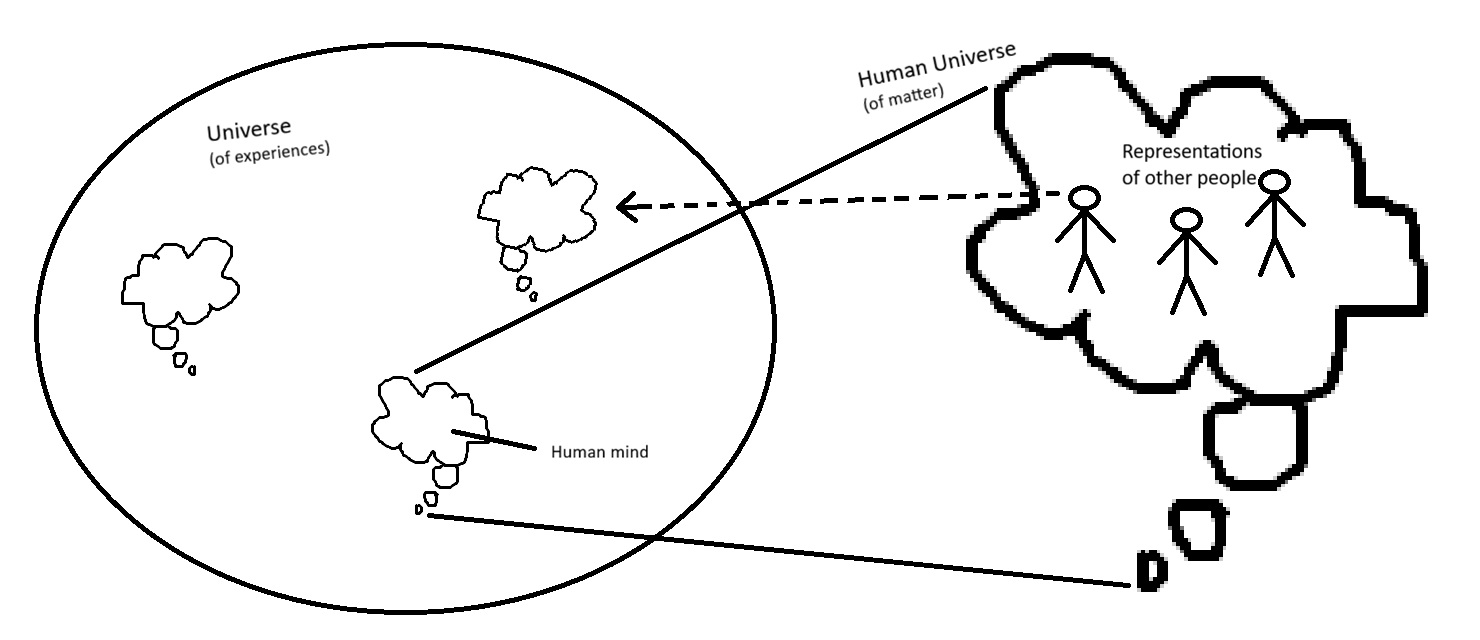
So the material representation of other people (their bodies and brains) exist in the physical universe projected by your mind. That physical universe, including other people (and their bodies and brains) reduces to your sensory perceptions of them and your conceptual apprehensions of them. But nowhere in this physical representation do we find their minds–their brains, sure, but not their minds and experiences–so where are they? Well, since one’s mind projects and becomes an entire universe, their minds are doing the same, but they are projecting and becoming their own universe. So where are those universes? Well, they’re not in your universe, obviously, they’re somewhere else in the greater universe of experience in general. This greater universe is what the physics in our human universes represent. If in the physical human universe, we see other people (and their brains) by way of light reflecting off them and entering our eyes, then this physical process is a representation of a greater mental process that connects their minds to ours and results in representations of them being communicated to our minds.
Clear as mud?
Atla wrote:
On the other hand if they are in the same universe, and it looks like science can correlate our subjective experiences better and better with the material structure of our heads, then the language of matter does also describe our subjective experiences that we do know.
Yes, and that’s still true. Nothing wrong with speaking in terms of the representation rather than the represented. That’s what the representation is for.
Atla wrote:
But according to Kant you can’t do anything with the noumenal.
I get the impression you think I’m simply expanding on Kant. Like I said, there’s some overlap but also significant differences. This is one place where we differ.
(See my responses to greenfuse.)
Atla wrote:
Why do you think that there really exists a necessity?
The laws of nature seem pretty necessary, don’t you think? The only area in science where necessity is challenged is the indeterminism of quantum mechanics, and as I said above, this is indeed a challenge to this very point. But also like I said, I have a relatively simple tweak that I can apply to my theory to make it work (see here).
The system totally makes sense. But you seem to be demanding Kantian absolute certainty, everything must be perfectly imaginable. But Kant’s own theory fails completely at that expectation too, his noumenon being perfectly unimaginable, so we completely can’t wrap our heads around that either then.
Imo a (Kantian) quasi-solipsist with faith in non-solipsism is still a quasi-solipsist. Maybe you’re not really Kantian though.
Well you referenced him 11 times in the 2 OPs, but okay you’re saying something seriously different than him, if you treat noumena like that. Kinda the whole point of Kant’s philosophy is that we can’t do anything with noumena.
Imo the bigger problem is that we can only talk about the insides of our minds, where every thought is related to other thoughts, so we’re trapped within a closed system where there’s a lot of meaning, any direction we go. But it doesn’t follow that experiences outside minds have meaning, or that every mind assigns meaning.
Not really, but the known laws are consistent with the emergence and sustainment of human life, human civilization.
Though the indeterminism of QM isn’t really a fact, it’s more like an interpretation, a philosophy. Maybe if we could monitor the entire universe, we could tell whether it’s deterministic or indeterministic overall. QM also has deterministic interpretations. Maybe it’s a challenge to your philosophy, maybe not.
I think I got it.. so does that mean that everyone is actually experiencing the same projected physical universe, because they are all representations of the same greater universe of experience, even though we can never locate other people’s projections?
Atla wrote:
The system totally makes sense. ← Then don’t tell me one can’t wrap their head around it; explain how a reference can point beyond the representation. → But you seem to be demanding Kantian absolute certainty, everything must be perfectly imaginable. But Kant’s own theory fails completely at that expectation too, his noumenon being perfectly unimaginable, so we completely can’t wrap our heads around that either then.
Absolute certainty? Not at all. I’m trying to fix an infinite regress that arises in my theory and Kant’s. And I think I did so successfully.
Atla wrote:
Imo a (Kantian) quasi-solipsist with faith in non-solipsism is still a quasi-solipsist. Maybe you’re not really Kantian though.
Faith in non-solipsism makes you a solipsist? What, like unconsciously? You’re right I’m not a Kantian… like I said I wasn’t.
Atla wrote:
Well you referenced him 11 times in the 2 OPs, but okay you’re saying something seriously different than him, if you treat noumena like that. Kinda the whole point of Kant’s philosophy is that we can’t do anything with noumena.
I’m trying not to re-invent the wheel. There are useful parallels between my philosophy and Kant’s, so I reference Kant for better understanding rather than starting from scratch. Did you read some of my responses to greenfuse? Try this:
gib wrote:
But here’s where I differ from Kant. One way of putting my theory is to saying that noumena are just more phenomena, only that they are unimaginable phenomena. And in the case of other minds, they are phenomena that we can imagine. Here’s another way of putting it: the mind is the brain-in-itself.
Atla wrote:
Imo the bigger problem is that we can only talk about the insides of our minds, where every thought is related to other thoughts, so we’re trapped within a closed system where there’s a lot of meaning, any direction we go. ← Exactly! → But it doesn’t follow that experiences outside minds have meaning, or that every mind assigns meaning.
Did I mention my theory is a proposal, not a proof?
Atla wrote:
Not really ← Reeeally! So when was the last time you saw an object fall up? → , but the known laws are consistent with the emergence and sustainment of human life, human civilization.
Yes, the laws of nature are consistent with human civilization and human life.
Atla wrote:
Though the indeterminism of QM isn’t really a fact, it’s more like an interpretation, a philosophy. Maybe if we could monitor the entire universe, we could tell whether it’s deterministic or indeterministic overall. QM also has deterministic interpretations. Maybe it’s a challenge to your philosophy, maybe not.
So the one area where I admit there is a lack of necessity, you want to deny. Bravo! 
Something tells me you’re a contrarian.
But anyway, I’ve got my bases covered. If quantum indeterminism turns out to be right, I’ve got my tweak. If not, I have my original theory.
Atlas wrote:
I think I got it.. so does that mean that everyone is actually experiencing the same projected physical universe, because they are all representations of the same greater universe of experience, even though we can never locate other people’s projections?
I’m not quite sure what you mean by this, but I tend to think of each person’s personal subjective universe as separate, though with almost identical physical content. It depends on what you mean by “representations of the same greater universe”. There was a time when I thought I had worked out my theory such that I didn’t have to say everyone lives in separate subjective worlds, but that fell apart after it took me down a rabbit hole that was too deep to follow. Perhaps you can have a shot at it. It starts with this: Physical things, which are identical in all their properties except for their positions in time and space, must be said to be distinct. But take away their positions in time and space, and they are one object. Now ask yourself this: do each of our subjective universes exist in time and space? I don’t think they do. I think time and space exist within them. What exists outside our subjective worlds? For lack of a better word, a “metaphysical” realm, a place that transcends time and space. But what does that say about the identities of our subjective worlds? They have no position in time and space, so they are one. We all live in the same physical (but still subjective) world.
^ See if you can flesh that out and make all the details work.
Again, I didn’t say one can’t wrap their head around it, I said one can’t really do it. Just a little. Again, this is because the partially knowable external world with its a posteriori spacetime isn’t quite how we imagine it, we can only imagine the external world to a small degree. So it’s largely unknown. No one can perfectly imagine referencing an unknown part of something.
But in this picture there IS an external world, outside the representation. The representation has an outside within a posteriori spacetime.
Frankly I’m confused, you say you don’t understand how a reference can point beyond the representation, which is totally Kant’s position, if we understand noumena the way Kant does. But if we understand noumena the way you do, then you should have no problem with this, then the representation has an outside, actually you may be doing the same thing when you reference your wider universe of experience / metaphysical “realm”. Look, I’m not a contrarian, from my pov you keep contradicting yourself.
Anyway where we do differ as far as I can tell is that my “non-Kantian noumenon” does have its own a posteriori space and time, yours doesn’t. In my case it’s much easier for a referent existing within the representation to point outside the representation. I mean it doesn’t literally go outside the representation (references are abstract), it points outside of it. It references the a posteriori outside, or an object in it.
No, I said a (Kantian) quasi-solipsist with faith in non-solipsism is still a quasi-solipsist. Imo. Continental philosophy went the other way though and brushed aside this objection.
That didn’t tell me what kind of necessity you have in mind.
Well imo saying that they are one, could still be an idea based on space and time. Imo if we really take away all space and time from the metaphysical realm, then we can neither say that “identical” objects or subjective worlds are one, nor that they aren’t one. It’s all undefined. Maybe they coincide maybe they don’t, maybe there’s one maybe more, impossible to tell without space and time.