Let’s see if this explanation for why there can be no discontinuity is sufficient without getting into complex mathematics cardinality issues.
Every potential-to-affect, “PtA”, has a finite amount of potential. How much change it can make upon surrounding potentials defines the amount of potential it had.
The property of a PtA is that of reducing the difference in potential between adjacent points. As a higher potential affects a lower potential, it uses up its potential and becomes lower while the lower potential gains potential and thus rises. Once they have equal potential, neither can affect the other or it can be taken as both affect each other equally and thus no change takes place.
For there to be a distinction between PtA point A and point X, time must be spent for A to affect X merely due to the definition of “distinction”. If there were no time spent, if the affect was instantaneous, there would be no distinction between points A and X. Thus every distinguishable point of potential is separated by time.
Between any two points A and X, there are necessarily an infinite number of points. If A is to affect X within only a finite amount of time, the first point next to A, “B”, leading toward X must be affected in an infinitesimal amount of time, “0+”.
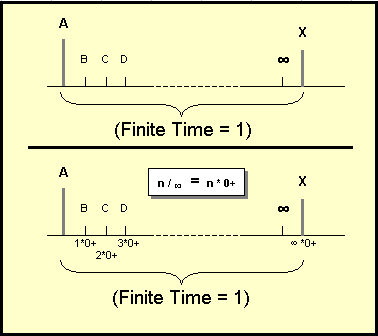
What this means is that no matter how different A was from B, within an infinitesimal time, they would become the same. And if it were not for the many directions of affects coming and going, thus making it impossible for both A and B to be affected equally, the entire universe would become homogeneous almost instantly and thus there would be no universe. But on the other hand, due to the nearness of A and B, the affects upon A very quickly also affect B, thus keeping them close to being the same.
From this we can conclude that PtA A and B, although must be slightly different, cannot be very different. There can be no discontinuity between points of potential to affect.